


Israel Conditionally Releases Palestinians Detained over Deadly Israeli Settler Raid

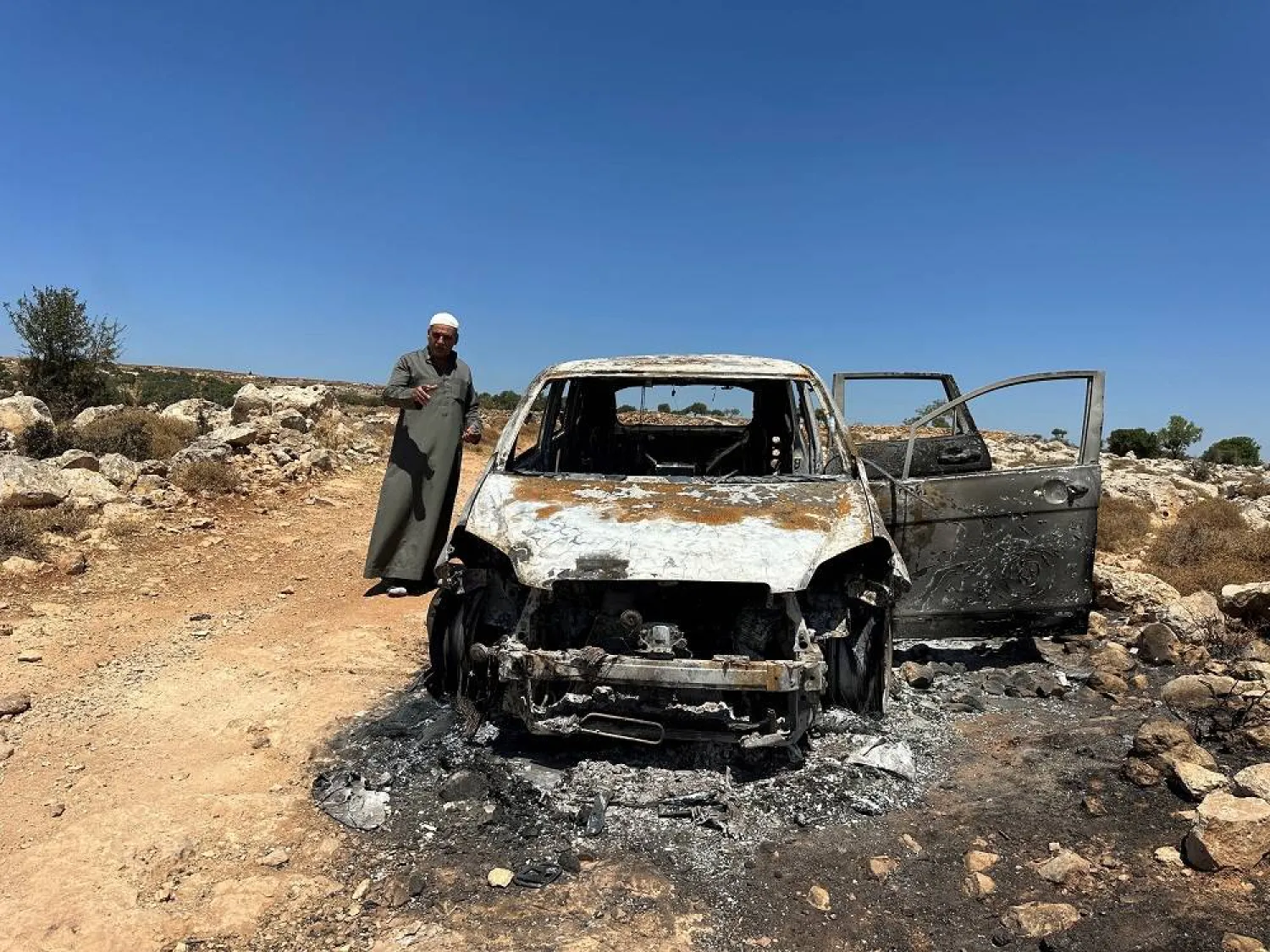
 Palestinian Saber Asaliyyeh reacts near a burned car after a confrontation with a group of Israeli settlers in Burqa near Ramallah in the Israeli-occupied West Bank, August 9, 2023. (Reuters)
Palestinian Saber Asaliyyeh reacts near a burned car after a confrontation with a group of Israeli settlers in Burqa near Ramallah in the Israeli-occupied West Bank, August 9, 2023. (Reuters)
TT

Israel Conditionally Releases Palestinians Detained over Deadly Israeli Settler Raid

 Palestinian Saber Asaliyyeh reacts near a burned car after a confrontation with a group of Israeli settlers in Burqa near Ramallah in the Israeli-occupied West Bank, August 9, 2023. (Reuters)
Palestinian Saber Asaliyyeh reacts near a burned car after a confrontation with a group of Israeli settlers in Burqa near Ramallah in the Israeli-occupied West Bank, August 9, 2023. (Reuters)

Israeli authorities conditionally released on Thursday a Palestinian man and three of his sons who had been detained over clashes with Jewish settlers accused of a deadly attack near a Palestinian village in the occupied West Bank last week.

Following the incident on Friday near Burqa village in the northern West Bank, two Jewish settlers face possible homicide charges after a 19-year-old Palestinian man was shot dead and another wounded in the leg.

The incident, the latest in a series of raids by Israeli settlers on Palestinians in the West Bank over recent months, drew rare sharp condemnation from the United States, which described it as a "terror attack by Israeli extremist settlers".

"What happened today was amazing," said Ismail Taweel, a lawyer for the 54-year-old Ammar Asaliyyeh and his three sons, who were released on bail of 2,000 shekels ($539) each after the court dismissed police accusations they hurled rocks and fireworks at a crowd of Jewish settlers.

"The police could not convince the court to keep them detained. The court reviewed the evidence and found that it was false," Taweel said.

The four, who were handed the court's decision in Hebrew as a soldier translated it to Arabic, were ordered to remain in Burqa until Aug. 17.

Residents of Burqa, a village in the northern West Bank which has seen repeated raids by settlers living in six surrounding Jewish settlements, said the incident began when a group of settlers began harassing Palestinian shepherds.

According to the residents, an argument broke out and stones were thrown before more settlers arrived, bringing their number to around 150-200. The settlers vandalized homes and torched cars and as the confrontation escalated, a settler opened fire, killing 19-year-old Qusai Maatan.

Rising settler violence

As Israel continues to expand settlements that most countries deem illegal, settler violence has risen. The United Nations recorded 591 settler-related incidents that led to Palestinian casualties, property damage or both in the first six months of 2023, the highest daily average since 2006.

Thursday's arraignment hearing in a military court followed proceedings this week in which two settlers were accused of "deliberate or depraved-indifference homicide" with a racist motivation.

According to their lawyers, the accused, one of whom is in hospital with a head injury he says was caused by a rock thrown at him, said gunfire was their last resort in self-defense against what he said was hundreds of rock-throwers confronting them.

"Their act was to save life, their lives, and other's lives," lawyer Nati Rom said.

Israeli military and security officials have warned that the series of attacks on Palestinian villages by Jewish settlers in the West Bank over recent months has placed troops under growing strain and risks undermining national security.

Palestinians say such attacks are intended to drive them from their land and accuse authorities of regularly failing to take action to prevent them.

"What self-defense?" said Akram Shaawar, a resident of Burqa who said he witnessed Friday's incident.

"We are the ones defending our land. They are the ones who mounted an attack on us, who attacked the shepherds," he said.

West Bank Palestinians are subject to Israeli military courts where, civil liberties groups say, they are often denied due process of law. As Israeli citizens, the two settlers held in the case have been subject to criminal courts in Jerusalem.

The Palestinians and rights groups have pointed to the dual legal systems as an example of Israel practicing apartheid against Palestinians, a claim Israel rejects.



Khamenei Message to Hezbollah Chief Reaffirms Ties, Sends Political Signals

A woman reacts as mourners gather on March 29, 2026, in the Choueifat area on the outskirts of Beirut during the funeral of journalists killed the previous day in an Israeli strike in south Lebanon. (Photo by ibrahim AMRO / AFP)
TT

Khamenei Message to Hezbollah Chief Reaffirms Ties, Sends Political Signals

A woman reacts as mourners gather on March 29, 2026, in the Choueifat area on the outskirts of Beirut during the funeral of journalists killed the previous day in an Israeli strike in south Lebanon. (Photo by ibrahim AMRO / AFP)

A message from Iran’s Supreme Leader, Mojtaba Khamenei, to Hezbollah Secretary General Naim Qassem, thanking him for condolences over the death of his father, “leader of the Islamic Revolution,” came at a pivotal moment of regional escalation, giving it clear political weight and signaling messages to both domestic and foreign audiences.

The message reaffirms the depth of ties between Iran and Hezbollah, reinforces the group’s place within Tehran’s strategy, and signals a push to sustain open confrontation.

It made no reference to the Lebanese state, even as officials in Lebanon seek to “disassociate” from Iran after Hezbollah opened the southern front in support of Tehran. Authorities have taken steps in that direction, including expelling the Iranian ambassador and banning the group’s military wing.

“Reaffirming the obvious”

Lebanese ministerial sources described the message as “a reaffirmation of the obvious,” saying it “offers nothing new, but reinforces an established reality.”

“The relationship between Iran and Hezbollah has never been severed,” the sources told Asharq Al-Awsat, pointing to continued coordination and joint operations in the current war.

They said the message aligns fully with both sides’ declared positions, making it “a restatement of existing policy.” The core of the relationship, they added, is now explicit and entrenched, forming part of a fixed political landscape that goes beyond the traditional concept of the state.

One battle, with the US named as an enemy

Political analyst Ali al-Amine said the message underscores that Iran and Hezbollah see themselves as fighting a single battle against a common enemy, reflected in references to “steadfastness” against the United States and Israel.

He said the narrative, invoking Hezbollah and Iranian figures killed by Israel, reinforces a shared path and common fate in the war.

Al-Amine noted one sharper shift, the explicit placement of the United States alongside Israel as an equal enemy, highlighted in the closing reference to the “American-Zionist enemy.”

Khamenei told Qassem he is leading the movement at a defining moment in the resistance’s history, voicing confidence in his ability to defeat Israeli plans and restore pride to the Lebanese people.

He reaffirmed that Iran’s policy remains aligned with the path of the late imam and the “martyred leader,” pledging continued support for the resistance against Israel and the US.

Ignoring the Lebanese state, overlooking the cost

Al-Amine said the message pointedly omits any reference to the Lebanese state, addressing only the Lebanese people and speaking directly to Hezbollah.

“All the focus is on confrontation and the role of the party,” he said, with no acknowledgment of state authority or decision-making power.

He added that the message also overlooks the scale of destruction and displacement in Lebanon. More than one million people have been displaced, most from the Shiite community, including many Hezbollah supporters forced from their homes and scattered across the country.


‘Iran Data’ Guides Israel to Hezbollah Leaders in Lebanon

Firefighters extinguish blazes in cars hit by an Israeli strike in Beirut’s Jnah area at dawn Wednesday, killing Hezbollah commander Youssef Hashem (AP)
TT

‘Iran Data’ Guides Israel to Hezbollah Leaders in Lebanon

Firefighters extinguish blazes in cars hit by an Israeli strike in Beirut’s Jnah area at dawn Wednesday, killing Hezbollah commander Youssef Hashem (AP)

The assassination of senior Hezbollah commander Youssef Hashem at dawn on Wednesday has laid bare signs of security breaches the group had previously said it had resolved before the latest war.

It has also exposed a mix of advanced techniques and what sources describe as Israeli data originating from Iran, alongside the persistent role of human intelligence in tracking targets, security sources and experts told Asharq Al-Awsat.

Since the war began on March 2, Israel has carried out a string of assassinations targeting Hezbollah and Revolutionary Guards commanders on Lebanese soil, most notably Hashem, who was killed in a missile strike on a parking garage in the Jnah area on the outskirts of Beirut.

Emerging security factors

Security sources tracking the killings and the pursuit of Hezbollah members said the major breach that existed before the previous war, which erupted in September 2024 and ended in November that year, appeared largely absent at the outset of the current conflict.

They attributed this to a set of changes. Hezbollah tightened security measures, shifted communication methods, evacuated headquarters and apartments, and abandoned communication devices altogether.

Newly appointed figures replacing assassinated leaders were largely unknown. Israel, meanwhile, was unable to rebuild the intelligence database it had compiled over the years in the short window between the two wars. It also diverted attention to gathering intelligence from Iran, reflecting a shift in priorities.

As a result, assassinations declined in Lebanon in the early phase of the war, despite limited breaches that still enabled targeted strikes on senior figures, including Hashem, whom Israel identified as Hezbollah’s southern region commander.

People stand near a damaged van beside scattered debris following an Israeli strike in Beirut, Lebanon, Wednesday, April 1, 2026. (AP Photo/Hassan Ammar)

Non-Lebanese data sources

The sources said the most decisive factor in identifying targets lay in non-Lebanese data, pointing to an intelligence bank compiled from Iranian and Palestinian networks.

That pattern is reflected in the profiles and locations of those targeted.

Israel said on Monday it killed Hezbollah commander Ibrahim Rakin in a strike on an apartment in Beirut’s southern suburbs, describing him as the deputy commander of Unit 1800, responsible for supporting Palestinian militants and managing Hezbollah operations in countries neighboring Israel.

Israel also said it killed several Iranian figures in Lebanon, including two central commanders in the Lebanon Corps affiliated with the Quds Force of Iran’s Revolutionary Guards who were operating in Beirut, one of them in the Ramada Hotel in the Raouche area.

On March 11, the Israeli military said it had targeted Hisham Abdel Karim Yassin, describing him as a senior commander in Hezbollah’s communications unit and in the Palestine Corps affiliated with the Quds Force, the external arm of the Revolutionary Guards.

The sources said Israel’s Iran-based intelligence pool helped it track individuals inside Lebanon. Most targets maintained contact with Iranians, making them easier to trace through Iranian movements.

They added that Iranian figures killed early in the war were widely believed to have been carrying mobile phones, making them easier to locate and track, as were individuals linked to those handling the Palestinian file.

The pattern is not new. In the previous war, Hezbollah leaders were killed alongside Iranian figures, including a Revolutionary Guards official killed when Hezbollah Secretary General Hassan Nasrallah was assassinated, and another killed with Radwan force commanders on September 20, 2024, reinforcing indications that Israeli intelligence sources extend into Iran.

Another hypothesis suggests that Iranian, Palestinian, and Lebanese figures coordinating with them are compelled to use communication devices, exposing them to surveillance.

Foreign operatives also tend to move through populated areas with surveillance cameras, making them easier to track through camera infiltration.

The sources did not rule out human intelligence breaches, pointing to operatives working for Israel’s Mossad in Lebanon, Iran, or the Palestinian territories.

Separately, Israel said on Wednesday it killed the head of the engineering branch in the Lebanon Corps of the Quds Force in a strike in the Mahallat area in central Iran.

The Israeli military said its air force targeted engineer Mehdi Vafaei, who had led infrastructure projects in Lebanon and Syria for two decades.


Huge Fire after Drone Attack Hits Engine Oil Warehouse in Iraqi Kurdistan

Smoke billows from an oil warehouse in the Kani Qirzhala area on the outskirts of Erbil, the capital of Iraq's autonomous Kurdistan region, following a suspected drone strike, on April 1, 2026. (Photo by AFP)
TT

Huge Fire after Drone Attack Hits Engine Oil Warehouse in Iraqi Kurdistan

Smoke billows from an oil warehouse in the Kani Qirzhala area on the outskirts of Erbil, the capital of Iraq's autonomous Kurdistan region, following a suspected drone strike, on April 1, 2026. (Photo by AFP)

A drone strike caused a massive fire at the storage facilities of an engine oil firm in Iraq's autonomous Kurdistan on Wednesday, the regional government and the company said.

Iraq has been increasingly and unwillingly drawn into the war started by Israel and the US on February 28, with strikes targeting both US interests and pro-Iran groups in the country.

The country's northern autonomous Kurdistan has not been spared.

The regional capital Erbil hosts a major US consulate complex, while its airport houses military advisors attached to a US-led international anti-jihadist coalition. Both have been regularly targeted since the outbreak of war.

Erbil's governor Omed Khoshnaw said the attack had started at around 0700 am local (0400 GMT) and that four drones had targeted the facility, AFP reported.

He said a double-tap attack had occurred "while the teams were still working, the same site was attacked by another drone".

A fourth drone was "destroyed mid-air before reaching its target," he said, adding that the blaze was ongoing.

Iraqi firm Sardar Group confirmed in a statement that the facility, a warehouse located around five kilometres (three miles) from Erbil, was attacked.

It said there were no casualties.

The company said it was not involved in any way in the Middle East war and that its operations were limited to services and investment, including "the storage of lubricants for automobiles, agricultural equipment, and construction".

The strike followed a heavy night of attacks near the regional capital, with Khoshnaw saying some 20 drones had been shot down over the city.