


Iconic New York Figure Was Likely ‘Major Player’ in Murderous Pirate's 1695 Heist

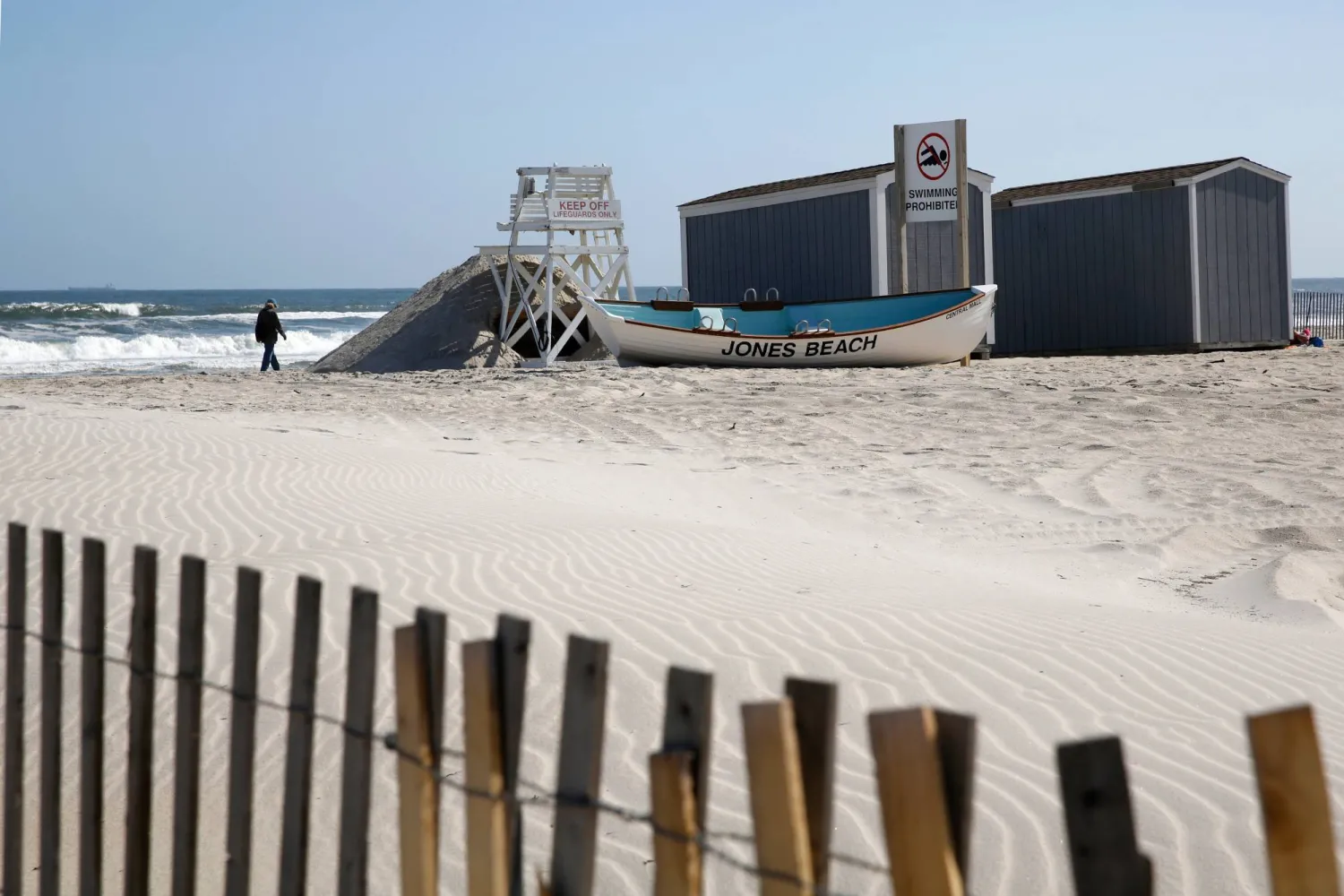
A person walks by the water at Jones Beach in Wantagh, N.Y., May 21, 2020. (AP)
TT

Iconic New York Figure Was Likely ‘Major Player’ in Murderous Pirate's 1695 Heist

A person walks by the water at Jones Beach in Wantagh, N.Y., May 21, 2020. (AP)

An amateur historian has stumbled upon a provocative clue to the enduring mystery of what became of a notorious pirate who raided a royal Indian treasure ship centuries ago, implicating a co-conspirator whose name is familiar to many New Yorkers.

James Bailey, who five years ago made headlines after unearthing ancient coins believed to be linked to English pirate Captain Henry Every, now says that colonial-era documents suggest the “King of the Pirates” and his violent crew got an assist from Thomas Jones, the namesake of Jones Beach, New York’s most visited state park after Niagara Falls.

“You have millions of visitors and generations of New Yorkers going to this beach,” Bailey said. “Nobody knew that he was actually a major player in arguably the biggest heist in the history of piracy.”

Since his big find, Bailey has pored through documents to dig even deeper into the bloody 1695 raid of the Ganj-i-Sawai on the Red Sea and the mystery of what happened to Every.

The pirate crew is said to have tortured, killed and raped those aboard the royal ship, sparking global outrage and what is considered the first worldwide manhunt, according to AP.

Some were caught and executed, but many others, including Every, were never heard from again and are believed to have scattered to Europe and the American colonies.

Documents, including depositions from Every’s associates, suggest Jones was recruited to serve as a “wheelman,” helping the pirates evade authorities after they made off with tens of millions of dollars' worth of gold and silver, according to Bailey.

Other documents show that New York’s governor, charged by the British crown to crack down on piracy, investigated Jones years later after he’d remade himself as the wealthy proprietor of a whaling operation on the barrier beach on Long Island that now bears his name.

Bailey’s research, which he hopes to have published, sheds light on a part of Jones’ checkered past long alluded to but never quite fleshed out in local history books, says John Hanc, author of “Jones Beach: An Illustrated History,” which includes a chapter on Jones.

Jones was a major in the English military before moving to the American colonies, initially settling in Rhode Island before eventually becoming a prominent businessman and landowner in New York. Jones owned thousands of acres of land on early Long Island, then just a rural expanse well east of the rapidly growing New York City.

But rumors of how he’d initially made his fortune persisted long after his death in 1713. Before it was demolished in the early 1800s, his crumbling mansion was said to be haunted by ghosts and strange occurrences. Jones’ grave was repeatedly desecrated by robbers searching for buried treasure before it was relocated to a family burial plot behind a nearby church.

A family history published in 1906 by one of Jones’ descendants dismissed the pirate tales as “slander” and “improbable fictions.”

“People were disposed to cast slurs upon his memory, either for mischievousness, or a spirit of malice,” Thomas Floyd-Jones wrote. “These myths were cherished for over a century after his death, which ignorance and superstition did not fail to magnify.”

Hanc and other experts say it wasn’t too far-fetched for Jones to have at least dabbled in piracy.

After serving in the British military, Jones made a career as a privateer, or a seafarer authorized by the English crown to raid the commercial ships of its rivals during wartime, said Meagan Schulman, a Fordham University doctoral candidate who specializes in 17th century piracy and wasn’t involved in Bailey’s research.

But when the conflict ended, privateers like Jones lost their special status, she said. Those that continued the high seas raids were branded pirates.

“The reality was that privateers were pirates, just sponsored by a certain government or patron,” explained Schulman, who grew up going to Jones Beach. “So maybe the short answer is, yes. Jones can be called a pirate, by some people, but he probably did not ever see himself as one.”

After helping Every and his crew evade capture, the documents cited by Bailey show Jones briefly returned to Rhode Island.

Then in 1696, Jones’ father-in-law, Thomas Townsend, a wealthy New Yorker, gifted him and his wife a significant tract of land on Long Island’s south shore, property records show.

Bailey, who recently retired from Rhode Island's corrections department, posits that allowed Jones a fresh start, as authorities continued to scour pirate-friendly New England for Every and his accomplices.

On Long Island, Bailey says Jones built a homestead and raised a family, but his pirate past was never far behind.

Three years after the Ganj-i-Sawai heist, Richard Coote, New York's colonial governor, described how one of his efforts to root out piracy had led him to Jones.

Citing witness depositions, the governor wrote in 1698 that a certain “barrel of money” traveled from the city to Long Island, where it ended up at Jones’ house. But Jones, who the governor described as “formerly a pirate,” testified that he knew nothing about the barrel.

Bailey’s findings are compelling but shouldn’t be considered conclusive, cautions Richard Blakemore, maritime history professor at the University of Reading in the United Kingdom who also wasn’t involved with Bailey’s work. After all, he said, Thomas Jones is a fairly common name.

If anything, Jones’ possible ties to Every underscore how piracy provided “foundational and multi-generational wealth” for many of the prominent families in the Northeast, says Kevin McDonald, a history professor at Loyola Marymount University in Los Angeles who wrote a book about colonial-era piracy but wasn’t involved in Bailey’s research.

“Popular images of pirates show them as outcasts, but many historians have argued the opposite, based on evidence like this,” agreed Blakemore. “It may surprise readers to find just how much early British colonies were both socially and economically connected to piracy.”



Japan Space Probe Changes Target Over Engine Trouble

This undated image provided by the European Space Agency on Nov. 5, 2026 and taken by the Hera spacecraft, shows asteroid Didymos. (European Space Agency via AP)
TT

Japan Space Probe Changes Target Over Engine Trouble

This undated image provided by the European Space Agency on Nov. 5, 2026 and taken by the Hera spacecraft, shows asteroid Didymos. (European Space Agency via AP)

A Japanese probe that returned precious asteroid dust to Earth six years ago has changed course in its extended mission, officials said Tuesday, citing issues in its aging engines.

The unmanned Hayabusa-2 probe brought back pristine materials from the asteroid Ryugu in 2020, supporting discoveries linked to clues on the origin of life.

In July, the probe flew 400 meters (1,312 feet) from a near-Earth asteroid, making the closest approach ever recorded in such a mission, Japan Aerospace Exploration Agency (JAXA) has said.

It was then headed for its main target, an asteroid called 1998 KY26 that will be some 300 million kilometers away from Earth when the probe would have reached it in 2031.

However, 12 years since its launch, "the deterioration of the onboard equipment... is becoming increasingly evident", Yuya Mimasu, team leader of the extended mission, told reporters.

With the main engines suffering repeated malfunctions, "we decided to revise the plan to one that could be safely implemented", AFP quoted him as saying.

The probe will now head towards an asteroid called 2015 BM510, aiming for a flyby -- passing close to it at high speed -- in April 2028, according to the team leader.

"Because it is a dark, small asteroid... it will be one of the world's most difficult flyby missions," Mimasu said.

The new target is between 17 meters and 74 meters in diameter, completing a rotation every 49 minutes.

The revised operation can help "future planetary defense" missions aimed at deflecting asteroids that might otherwise collide with Earth, Mimasu said.


Wildlife Whereabouts Lost as Russian Researchers Cut Off from Satellite Tracking

Freshwater seal Kroshik carries a satellite-tracking transmitter on the shore of Lake Ladoga in the Leningrad region, in this still image from video released November 10, 2026. Fund of Friends of the Baltic Seal/Handout via REUTERS
TT

Wildlife Whereabouts Lost as Russian Researchers Cut Off from Satellite Tracking

Freshwater seal Kroshik carries a satellite-tracking transmitter on the shore of Lake Ladoga in the Leningrad region, in this still image from video released November 10, 2026. Fund of Friends of the Baltic Seal/Handout via REUTERS

You could follow Kroshik the rescue seal with little dots on a map. There he was: hunting for fish on the dangerous southern shore of Lake Ladoga, then swimming back to safer waters. Then suddenly, he was gone.

"We will know nothing more of Kroshik’s adventures," conservationist Vyacheslav Alexeyev wrote last week on the social media feed where he had been sharing the seal's whereabouts with thousands of fans. Hundreds of commenters responded with crying emojis and broken hearts.

This month, Russian researchers were cut off from the main satellite system they have used for years to track wildlife across some of the world's largest wildernesses, in the latest example of Moscow's scientific isolation due to sanctions and war.

The Argos system, run by French firm CLS, has been used to track rare migratory birds across Russia's Far East, wild reindeer in northern forests, bearded seals in the White Sea and Atlantic walruses around ⁠Franz Josef Land.

A ⁠CLS spokeswoman confirmed the suspension of services to Russian clients, due to "the evolving international context and the arising constraints".

Fans of Kroshik, or Little Crumb, had been following the playful freshwater ringed seal's movements across Lake Ladoga in northern Russia, thanks to updates pinged via satellite from a transmitter glued to his fur. He had gained fame for repeatedly returning to his carers after failed releases, before making it back to the wild in September.

"All of that will now have to be stopped, so our feelings about it are extremely negative," Alexeyev, who runs a shelter near St ⁠Petersburg that rescued Kroshik as a pup, cared for him for a decade and released him this year, told Reuters.

The satellite cut-off adds to an unravelling of decades of scientific cooperation between Russia and the West since Moscow's launch of its full-scale war in Ukraine in 2022.

Since then, partnerships with institutions such as the European Space Agency and the European Organization for Nuclear Research (CERN) have ended, while joint Arctic research has been curtailed.

Losing access to Argos for Russian researchers "is really going to lead to lacking information on priority species and conservation and management actions," said Philipp Maleko, a PhD candidate at the University of Wisconsin-Madison, who has used it to study endangered shorebirds that fly between Russia's Far East and Southeast Asia, such as the spotted greenshank.

"So many birds depend on Russia's Arctic boreal ecosystems for reproducing, for really sustaining viable populations," he told Reuters.

Russia's Lake Baikal ⁠Foundation, a conservation group dedicated ⁠to the huge Siberian lake that holds nearly a quarter of the world's unfrozen fresh surface water, warned in October that losing the data threatened wildlife research across Russia.

The suspension would disrupt programs monitoring Baikal’s endemic seal and a tiny population of endangered forest reindeer, its head was quoted as saying by news agency TASS.

Researchers say no other available system is quite as useful as Argos at tracking how animals move across Russia's far-flung regions, away from cellphone towers and human settlements.

CLS did not say how many users it had in Russia, but its website says it was nearly the only system used by Russian scientists to study marine and terrestrial wildlife migration in northern regions.

In October, Russia's state-run Agency for Strategic Initiatives said it was in talks to develop a Russian alternative.

At the St Petersburg shelter a plump, velvety seal glided past Alexeyev by the outdoor pool. Alexeyev said he did not think Argos could be replicated: "It is the only satellite constellation of its kind."

He was grateful the company had worked with Russia as long as it did, "despite all the difficulties and the generally hostile attitude towards us in Europe."


South Korea Tightens Exam Security After AI Cheating Scandal

AI glasses are placed at an optical shop in Seoul, South Korea, Monday, Nov. 16, 2026. (AP)
TT

South Korea Tightens Exam Security After AI Cheating Scandal

AI glasses are placed at an optical shop in Seoul, South Korea, Monday, Nov. 16, 2026. (AP)

South Korea will deploy thousands of extra personnel to prevent cheating on its college entrance exam sites this week and may introduce tougher penalties, Prime Minister Han Seong-sook said Tuesday.

The announcement comes after an individual confessed on Sunday to cheating on the national tax accountant exam using artificial intelligence tools, an admission that brought panic ahead of the college test.

Known as the Suneung, the intense once-a-year exam -- widely seen as a ticket to well-paid jobs and even better marriage prospects -- will bring much of South Korea to a standstill on Thursday to minimize distractions.

As a measure to detect phones that have not been handed over, an emergency alert will be sent before the exam begins, Han said at a press conference.

Students will also be ordered to place their glasses on their desks so supervisors can verify they are not smart devices.

"We also strongly urge students to avoid wearing clothing with buttons wherever possible," Han said.

Students "will be asked to roll up both sleeves, and collars, buttons and other areas will also be checked to determine whether electronic devices, including miniature cameras, are concealed", she added.

Those caught cheating could be banned from taking the Suneung for 10 years, up from the current one-year restriction, Han said.

The government will also file criminal complaints over serious cases of cheating, including those involving smart devices.

In addition to the 75,000 supervisors deployed to 1,312 test centers nationwide, an additional 8,400 personnel will be deployed this year.

"You may feel nervous and intimidated by the unfamiliar atmosphere inside and outside examination centers and the stricter inspection procedures," said Han, addressing the 550,000 students who will take the Suneung.

The extra staff "are minimum safeguards designed to protect the value of the hard work you have put in over the years and to guarantee a fair competition in which everyone can hold their head high", she added.

At a meeting held Sunday, officials decided to investigate all suspected cases of cheating involving AI across national qualification examinations.

The individual who confessed to cheating said he had photographed the exam questions with a miniature camera before using AI and checking the answers on his smartphone.

Han said the government "will define such cheating as a 'social evil'".