France’s Macron Says He Stands in Solidarity with Israel’s Fight Against ‘Terrorism’ 

French President Emmanuel Macron, left, shakes hands with Israel's President Isaac Herzog after their talks in Jerusalem, Tuesday, Oct. 24, 2023. (Reuters)
TT

France’s Macron Says He Stands in Solidarity with Israel’s Fight Against ‘Terrorism’ 

French President Emmanuel Macron, left, shakes hands with Israel's President Isaac Herzog after their talks in Jerusalem, Tuesday, Oct. 24, 2023. (Reuters)

French President Emmanuel Macron vowed on Tuesday not to leave Israel isolated in its fight against militants, but warned against the risks of a regional conflict as he arrived in Israel. 

After meeting with families of French victims at Tel Aviv airport, Macron told President Isaac Herzog in Jerusalem that France stood "shoulder to shoulder" with Israel and that the first objective should be to free hostages in Gaza. 

"I want you to be sure that you're not left alone in this war against terrorism," Macron said. "It is our duty to fight against terrorism, without any confusion and without enlarging this conflict." 

Beyond showing solidarity with Israel, Macron wanted to make "proposals that are as operational as possible" to prevent an escalation, to free hostages, and guarantee Israel's security and work towards a two-state solution, presidential advisers said. He will push for a humanitarian truce, they added. 

Macron's visit comes after European Union foreign ministers on Monday struggled to agree on a call for a "humanitarian pause" in the war between Israel and Palestinian militant group Hamas to allow much more aid to reach civilians. 

Macron was also due to meet Israeli Prime Minister Benjamin Netanyahu and centrist opposition leaders Benny Gantz and Yair Lapid, the Elysee said. 

Mahmoud Abbas's office said Macron would meet with the Palestinian president in Ramallah, West Bank. 

However, Macron's ability to influence events in the region appears limited by what some analysts say is a shift towards a more pro-Israel Anglo-American line, in contrast with the traditionally distinctive and more pro-Arab French Gaullist approach. 

"France's soft power south of the Mediterranean has considerably faded," said Karim Emile Bitar, a Beirut-based foreign policy expert at French think tank IRIS. 

"We're under the impression that nothing distinguishes France from other Western countries now," he said. 

The French government's decision to adopt a blanket ban on pro-Palestinian protests, before it was struck down by courts, is one reason Macron has lost credit in the Arab world, he said. 

French officials contest the idea that Macron's policy is biased. They say Macron has constantly reaffirmed the rights of Palestinians and the position of a two-state solution. "It's a goal France has never veered from," the adviser said. 

Thirty French citizens were killed on Oct. 7 and nine are still missing. One appeared in a video released by Hamas, but the fate of the others remains unknown. 

Macron has vowed that France would "not abandon any of its children" in Gaza and has expressed hope that Qatar's mediation can help free hostages. 

Macron's visit will also have a special resonance at home, where France's large Muslim and Jewish communities are on tenterhooks following the killing of a teacher by an extremist militant that French officials have linked to the events in Gaza. 

The French leader will have to tread a fine line during his tour of the region, the Israeli-Palestinian conflict having often stoked tension back home and France's fractious opposition being ready to pounce on any faux pas.  


Israeli Strike Kills Three Lebanese Journalists

Journalists Ali Shaib and reporter Fatima Ftouni (National News Agency)
TT

Israeli Strike Kills Three Lebanese Journalists

Journalists Ali Shaib and reporter Fatima Ftouni (National News Agency)

An Israeli strike on a car in southern Lebanon has killed three Lebanese journalists, Reuters reported.

Al Manar reporter Ali Shaib and reporter Fatima Ftouni, from broadcaster Al Mayadeen, were killed when their vehicle was hit. Ftouni's brother, cameraman Mohammed Ftouni, had also been killed in the strike.

The Israeli military said in a statement it had "eliminated" Shaib, whom it described as a "terrorist" in a Hezbollah intelligence unit who had reported on the locations of Israeli soldiers in southern Lebanon. It accused him of "incitement" against Israeli soldiers and civilians.

The military's statement made no mention of any other deaths and provided no evidence to support the assertion that Shaib was a member of Hezbollah.

Lebanese President Joseph Aoun described them in a statement on X as "civilians doing their professional duty."

"It is a brazen crime that violates all treaties and norms through which journalists enjoy international protection in war," he said.

For his part, Prime Minister Nawaf Salam also stressed that “targeting journalists constitutes a flagrant violation of international humanitarian law and a clear breach of the rules that guarantee the protection of journalists in times of war.”

He said: “Lebanon, which holds press freedom and its role in high regard, affirms its commitment to protecting journalists and calls for respect for international law, the safeguarding of civilian lives, and an end to Israeli attacks targeting them.”

Also, Information Minister Paul Morcos said that “the targeting of journalists is repeated and deliberate,” and that what occurred “constitutes a documented war crime against the media and the journalistic mission.”

He added that the incident “adds to a growing record of attacks targeting media outlets and journalists,” noting that Lebanon has submitted to the UN Special Coordinator for Lebanon, Jeanine Hennis-Plasschaert, a detailed list of assaults against journalists as well as health and medical personnel.


Destruction from Two Wars Strains the Lebanese State

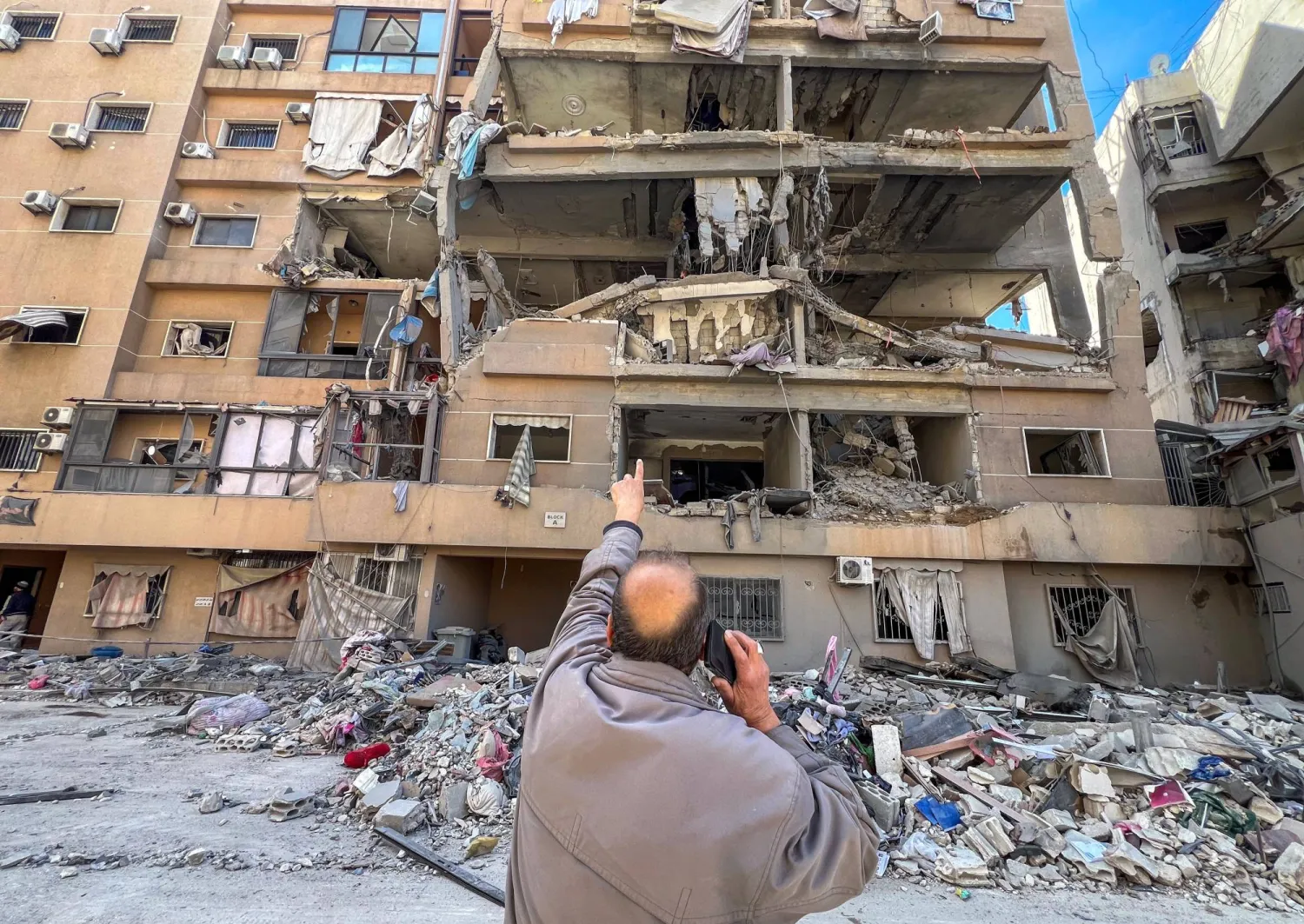
A man points at a building damaged by Israeli strikes in Beirut's southern suburbs, Lebanon, March 28, 2026. Picture taken with a mobile phone. REUTERS/Stringer
TT

Destruction from Two Wars Strains the Lebanese State

A man points at a building damaged by Israeli strikes in Beirut's southern suburbs, Lebanon, March 28, 2026. Picture taken with a mobile phone. REUTERS/Stringer

A pattern of systematic destruction pursued by Israel in the current war is becoming clearer by the day, extending in both context and objectives from the previous conflict and pushing entire Lebanese regions and governorates toward a “scorched earth” reality. The scale and nature of the targeting no longer suggest localized operations or limited military objectives.

Israeli operations are no longer confined to destroying sites, depots, and warehouses belonging to Hezbollah. They now extend to targeting entire built-up areas and residential neighborhoods, hindering the return of residents and prolonging displacement. This serves as a pressure tactic against Hezbollah’s support base on the one hand, and against the Lebanese state and its institutions on the other.

Lebanon was already unable to secure the resources needed for reconstruction after the previous war, making the task today even more difficult amid the massive and accumulating losses of the current conflict. The outlook is further darkened by the absence of any serious indications of external funding sources for recovery and reconstruction, as most countries that traditionally provided support are preoccupied with their own domestic conditions and major crises resulting from the ongoing war in the region. This makes it likely that Lebanon will be left to face its fate alone, burdened with costs far beyond its capacity- unless those concerned succeed in including a reconstruction funding clause in any potential ceasefire agreement.

Israeli Destruction Strategy

Former Lebanese minister Nasser Yassin points to a “strong similarity in the destruction strategy adopted by Israel between the previous war and the current one, particularly in terms of targeting buildings and facilities it claims belong to Hezbollah.” He notes that “the target bank often appears to be the same, with buildings struck in the previous war being targeted again.”

He adds that “what differs from the 2023–2024 war is the deliberate targeting of bridges to sever areas south of the Litani River and to pressure the Lebanese state,” adding: “Targeting official facilities may be partly linked to military plans and partly intended to pressure the state. This is a dangerous indicator that will impose high costs and cause additional direct losses amounting to billions of dollars.”

Yassin told Asharq Al-Awsat that “what Lebanon obtained after the previous war was a $250 million loan from the World Bank, in addition to $50 million allocated in the public budget- amounts that fall far short of the funding required for reconstruction.”

He adds that “this reality will worsen after the current war, as state revenues are insufficient. Gulf countries that typically contributed to reconstruction are now part of the war and are facing daily attacks from Iran, while major economic activity has been disrupted, shifting their focus more toward internal affairs. This is in addition to a political environment that may not be conducive to funding reconstruction, as successive governments have not demonstrated seriousness in implementing reforms.”

He adds: “Western countries also face their own challenges due to the repercussions of the Russia-Ukraine war and inflation driven by the regional conflict.”

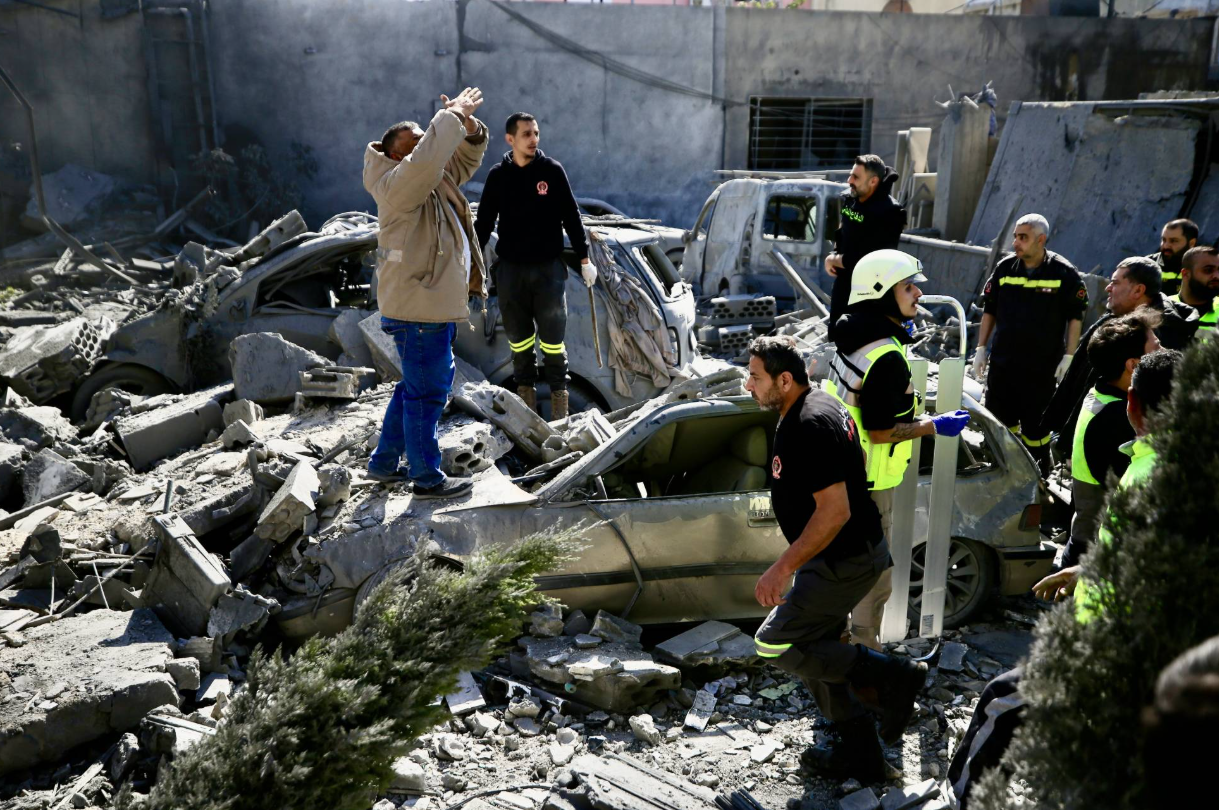
Civil defense personnel at a site targeted by Israeli shelling in the Saksakieh area of ​​southern Lebanon (EPA)

Preliminary Estimates of the Scale of Destruction

The continuation of the war makes it difficult to assess the full extent of newly inflicted damage less than a month after its onset. However, research Specialist at Information International Mohammad Chamseddine points to an initial picture indicating the destruction of “4,500 units in the south and 1,600 units in Beirut’s southern suburbs completely, in addition to various levels of damage to 12,000 units.” He notes that “what distinguishes the current Israeli approach from the previous war is that it is more intense and the scale of destruction is greater.”

According to Chamseddine , the number of housing units that sustained minor or moderate damage in the previous war reached 317,000, while 51,000 units were completely destroyed, including 9,000 in the southern suburbs, 1,500 in the Bekaa, and 22,000 in the border strip area.

The World Bank previously estimated that the direct cost of the last Israeli offensive on Lebanon reached approximately $14 billion, noting the destruction and damage of more than 100,000 housing units, in addition to severe damage to infrastructure and public facilities.


Palestinian Authority Condemns East Jerusalem Evictions

A Palestinian man (R) watch a settler family walks past a group of Israeli police officers as 11 Palestinian families in the Batan al-Hawa area of Silwan are evicted to make room for Israeli settlers, in the predominantly Arab neighbourhood of Silwan, in East Jerusalem on March 25, 2026. (Photo by Odd ANDERSEN / AFP)
TT

Palestinian Authority Condemns East Jerusalem Evictions

A Palestinian man (R) watch a settler family walks past a group of Israeli police officers as 11 Palestinian families in the Batan al-Hawa area of Silwan are evicted to make room for Israeli settlers, in the predominantly Arab neighbourhood of Silwan, in East Jerusalem on March 25, 2026. (Photo by Odd ANDERSEN / AFP)

The Palestinian Authority has condemned the recent eviction of multiple families from their homes in east Jerusalem and urged the international community to take "firm measures" to halt the displacements.

Several families were removed from their homes in the neighborhood of Silwan in Israeli-annexed east Jerusalem on Wednesday, AFP journalists saw.

Silwan has for decades been the target of a policy allowing Jews who lost property before the establishment of Israel in 1948 to reclaim it.

Israeli rights group B'Tselem said the evictions were the start of "a large wave of displacement affecting around 2,200 people" and were part of a policy aimed at "Judaizing the neighborhood".

In a statement released late on Friday by official news agency WAFA, the PA's foreign ministry "condemned the escalation by Israeli occupation authorities of forced eviction measures".

It said 15 families had been evicted from the hilltop neighborhood south of Jerusalem's Old City.

It also called on the international community to take "firm and more decisive steps to prevent the continuation of forced displacement against the Palestinian people".

Israeli authorities have evicted many Palestinian families from the area in recent years, while further families await the enforcement of eviction orders.

Hundreds of settlers, whose presence is illegal under international law, live among around 50,000 Palestinians in Silwan.

Their presence in the neighborhood dates back to the 1980s.

Israel captured east Jerusalem in 1967, later annexing it and declaring it part of its undivided capital, a move not recognized by the UN or most of the international community.

Palestinians aspire to make it the capital of a future Palestinian state.