Israeli Military Chief Says More than 1,000 Captives Taken in Gazahttps://english.aawsat.com/arab-world/4735001-israeli-military-chief-says-more-1000-captives-taken-gaza
Israeli Military Chief Says More than 1,000 Captives Taken in Gaza
Chief of the Israeli General Staff Major-General Herzi Halevi (Israeli Defense Ministry)
The Israeli army have taken more than 1,000 people captive in the war against Hamas in Gaza, Israel's military chief said on Sunday.
Addressing soldiers inside the bombarded enclave, Chief of the General Staff Major-General Herzi Halevi said that when combatants “lay down their arms and raise their hands, we arrest them, we don't shoot them,” according to Reuters.
“We get a lot of intelligence from the captives we have, we already have over a thousand,” Halevi said in a video distributed by the military.
Halevi's comments came after soldiers accidentally shot dead three Israeli hostages who the army says were waving a white flag and trying to be rescued.
Protesters March in London to Oppose the Rise of Political Righthttps://english.aawsat.com/arab-world/5256248-protesters-march-london-oppose-rise-political-right
Protesters March in London to Oppose the Rise of Political Right
A large crowd of protesters holding up signs and banners. Photograph: Hannah McKay/Reuters
Tens of thousands of protesters took to the streets of central London on Saturday for a "March to Stop the Far Right" with many demonstrators decrying the right-wing Reform UK party of Brexit campaigner Nigel Farage, which is topping opinion polls.
Backed by trade unions and civil society groups, the Together Alliance demonstration looked set to be one of the biggest in the British capital in recent years with about 30,000 people expected to take part, according to a police official, Reuters reported.
As well as placards opposing Reform UK and its anti-immigration stance, some Iranian flags were held aloft along with pro-Palestinian flags and banners. The march was due to end close to the British parliament building.
Reform leads the Labour Party of Prime Minister Keir Starmer as well as the other traditional British political parties, according to opinion polls. Zach Polanski, leader of the Green Party which is also challenging Labour, joined Saturday's march.
Israeli Strike Kills Three Lebanese Journalistshttps://english.aawsat.com/arab-world/5256245-israeli-strike-kills-three-lebanese-journalists
Journalists Ali Shaib and reporter Fatima Ftouni (National News Agency)
An Israeli strike on a car in southern Lebanon has killed three Lebanese journalists, Reuters reported.
Al Manar reporter Ali Shaib and reporter Fatima Ftouni, from broadcaster Al Mayadeen, were killed when their vehicle was hit. Ftouni's brother, cameraman Mohammed Ftouni, had also been killed in the strike.
The Israeli military said in a statement it had "eliminated" Shaib, whom it described as a "terrorist" in a Hezbollah intelligence unit who had reported on the locations of Israeli soldiers in southern Lebanon. It accused him of "incitement" against Israeli soldiers and civilians.
The military's statement made no mention of any other deaths and provided no evidence to support the assertion that Shaib was a member of Hezbollah.
Lebanese President Joseph Aoun described them in a statement on X as "civilians doing their professional duty."
"It is a brazen crime that violates all treaties and norms through which journalists enjoy international protection in war," he said.
For his part, Prime Minister Nawaf Salam also stressed that “targeting journalists constitutes a flagrant violation of international humanitarian law and a clear breach of the rules that guarantee the protection of journalists in times of war.”
He said: “Lebanon, which holds press freedom and its role in high regard, affirms its commitment to protecting journalists and calls for respect for international law, the safeguarding of civilian lives, and an end to Israeli attacks targeting them.”
Also, Information Minister Paul Morcos said that “the targeting of journalists is repeated and deliberate,” and that what occurred “constitutes a documented war crime against the media and the journalistic mission.”
He added that the incident “adds to a growing record of attacks targeting media outlets and journalists,” noting that Lebanon has submitted to the UN Special Coordinator for Lebanon, Jeanine Hennis-Plasschaert, a detailed list of assaults against journalists as well as health and medical personnel.
Destruction from Two Wars Strains the Lebanese Statehttps://english.aawsat.com/arab-world/5256241-destruction-two-wars-strains-lebanese-state
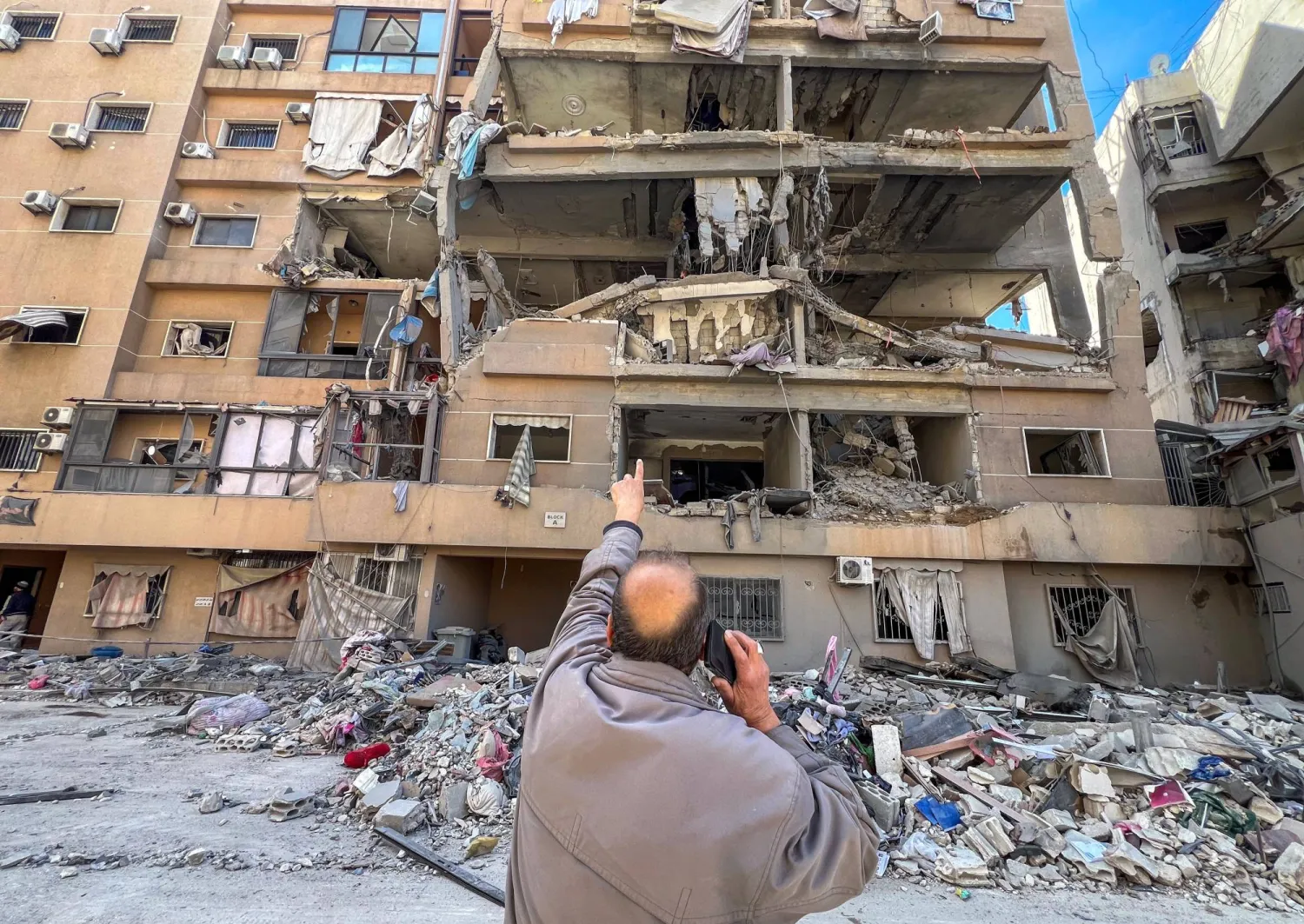
A man points at a building damaged by Israeli strikes in Beirut's southern suburbs, Lebanon, March 28, 2026. Picture taken with a mobile phone. REUTERS/Stringer
Destruction from Two Wars Strains the Lebanese State
A man points at a building damaged by Israeli strikes in Beirut's southern suburbs, Lebanon, March 28, 2026. Picture taken with a mobile phone. REUTERS/Stringer
A pattern of systematic destruction pursued by Israel in the current war is becoming clearer by the day, extending in both context and objectives from the previous conflict and pushing entire Lebanese regions and governorates toward a “scorched earth” reality. The scale and nature of the targeting no longer suggest localized operations or limited military objectives.
Israeli operations are no longer confined to destroying sites, depots, and warehouses belonging to Hezbollah. They now extend to targeting entire built-up areas and residential neighborhoods, hindering the return of residents and prolonging displacement. This serves as a pressure tactic against Hezbollah’s support base on the one hand, and against the Lebanese state and its institutions on the other.
Lebanon was already unable to secure the resources needed for reconstruction after the previous war, making the task today even more difficult amid the massive and accumulating losses of the current conflict. The outlook is further darkened by the absence of any serious indications of external funding sources for recovery and reconstruction, as most countries that traditionally provided support are preoccupied with their own domestic conditions and major crises resulting from the ongoing war in the region. This makes it likely that Lebanon will be left to face its fate alone, burdened with costs far beyond its capacity- unless those concerned succeed in including a reconstruction funding clause in any potential ceasefire agreement.
Israeli Destruction Strategy
Former Lebanese minister Nasser Yassin points to a “strong similarity in the destruction strategy adopted by Israel between the previous war and the current one, particularly in terms of targeting buildings and facilities it claims belong to Hezbollah.” He notes that “the target bank often appears to be the same, with buildings struck in the previous war being targeted again.”
He adds that “what differs from the 2023–2024 war is the deliberate targeting of bridges to sever areas south of the Litani River and to pressure the Lebanese state,” adding: “Targeting official facilities may be partly linked to military plans and partly intended to pressure the state. This is a dangerous indicator that will impose high costs and cause additional direct losses amounting to billions of dollars.”
Yassin told Asharq Al-Awsat that “what Lebanon obtained after the previous war was a $250 million loan from the World Bank, in addition to $50 million allocated in the public budget- amounts that fall far short of the funding required for reconstruction.”
He adds that “this reality will worsen after the current war, as state revenues are insufficient. Gulf countries that typically contributed to reconstruction are now part of the war and are facing daily attacks from Iran, while major economic activity has been disrupted, shifting their focus more toward internal affairs. This is in addition to a political environment that may not be conducive to funding reconstruction, as successive governments have not demonstrated seriousness in implementing reforms.”
He adds: “Western countries also face their own challenges due to the repercussions of the Russia-Ukraine war and inflation driven by the regional conflict.”
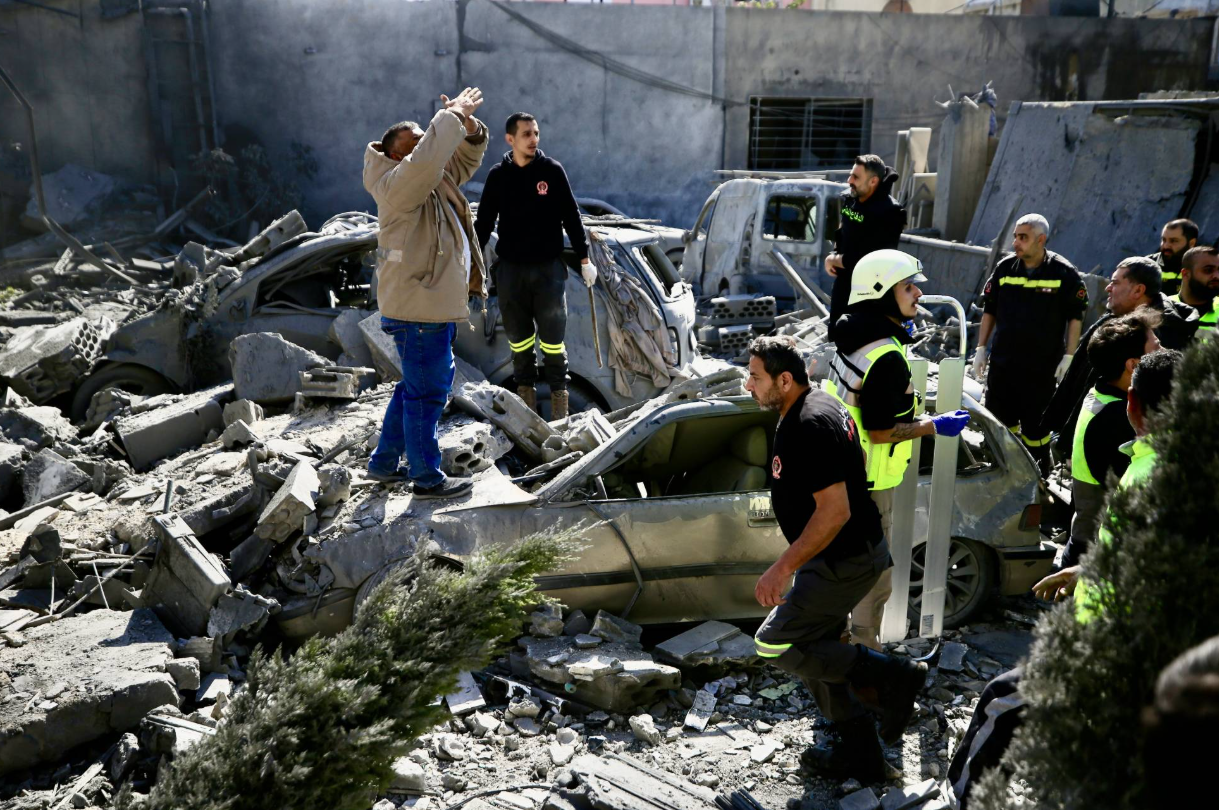
Civil defense personnel at a site targeted by Israeli shelling in the Saksakieh area of southern Lebanon (EPA)
Preliminary Estimates of the Scale of Destruction
The continuation of the war makes it difficult to assess the full extent of newly inflicted damage less than a month after its onset. However, research Specialist at Information International Mohammad Chamseddine points to an initial picture indicating the destruction of “4,500 units in the south and 1,600 units in Beirut’s southern suburbs completely, in addition to various levels of damage to 12,000 units.” He notes that “what distinguishes the current Israeli approach from the previous war is that it is more intense and the scale of destruction is greater.”
According to Chamseddine , the number of housing units that sustained minor or moderate damage in the previous war reached 317,000, while 51,000 units were completely destroyed, including 9,000 in the southern suburbs, 1,500 in the Bekaa, and 22,000 in the border strip area.
The World Bank previously estimated that the direct cost of the last Israeli offensive on Lebanon reached approximately $14 billion, noting the destruction and damage of more than 100,000 housing units, in addition to severe damage to infrastructure and public facilities.
لم تشترك بعد
انشئ حساباً خاصاً بك لتحصل على أخبار مخصصة لك ولتتمتع بخاصية حفظ المقالات وتتلقى نشراتنا البريدية المتنوعة