EU Sanctions 6 Companies Accused of Trying to Undermine Stability in Sudanhttps://english.aawsat.com/arab-world/4807731-eu-sanctions-6-companies-accused-trying-undermine-stability-sudan
EU Sanctions 6 Companies Accused of Trying to Undermine Stability in Sudan
This photograph taken in Brussels on January 19, 2024 shows a giant EU flag under the Cinquantenaire Arch. (Photo by Simon Wohlfahrt / AFP)
The European Union imposed sanctions Monday on six companies it said are responsible for trying to undermine stability in conflict-ravaged Sudan, largely targeting firms linked to weapons procurement and manufacturing.
Sudan plunged into chaos last April when long-simmering tensions between the military, led by Gen. Abdel Fattah Burhan, and the Rapid Support Forces paramilitary, commanded by Mohammed Hamdan Dagalo, erupted into street battles in the capital, Khartoum, and other areas including the western Darfur region.
The fighting has displaced 7 million people and killed 12,000, according to the United Nations. Local doctors' groups and activists say the true death toll is far higher.
Given the “gravity of the situation in Sudan,” the EU statement said, sanctions were imposed on two companies making weapons and vehicles for Sudan’s armed forces, the Zadna International Company for Investment controlled by the armed forces and three companies involved in procuring military equipment for the RSF.
The companies ’ assets will be frozen in the EU, and EU citizens are banned from making funds or economic resources available to them.
The United States in recent months has imposed sanctions on senior Sudanese military leaders and companies, including former Foreign Minister Ali Karti and a brother of Dagalo.
Burhan Warns Neighboring Countries Will ‘Pay the Price’ for Hostility Toward Sudanhttps://english.aawsat.com/arab-world/5346869-burhan-warns-neighboring-countries-will-%E2%80%98pay-price%E2%80%99-hostility-toward-sudan
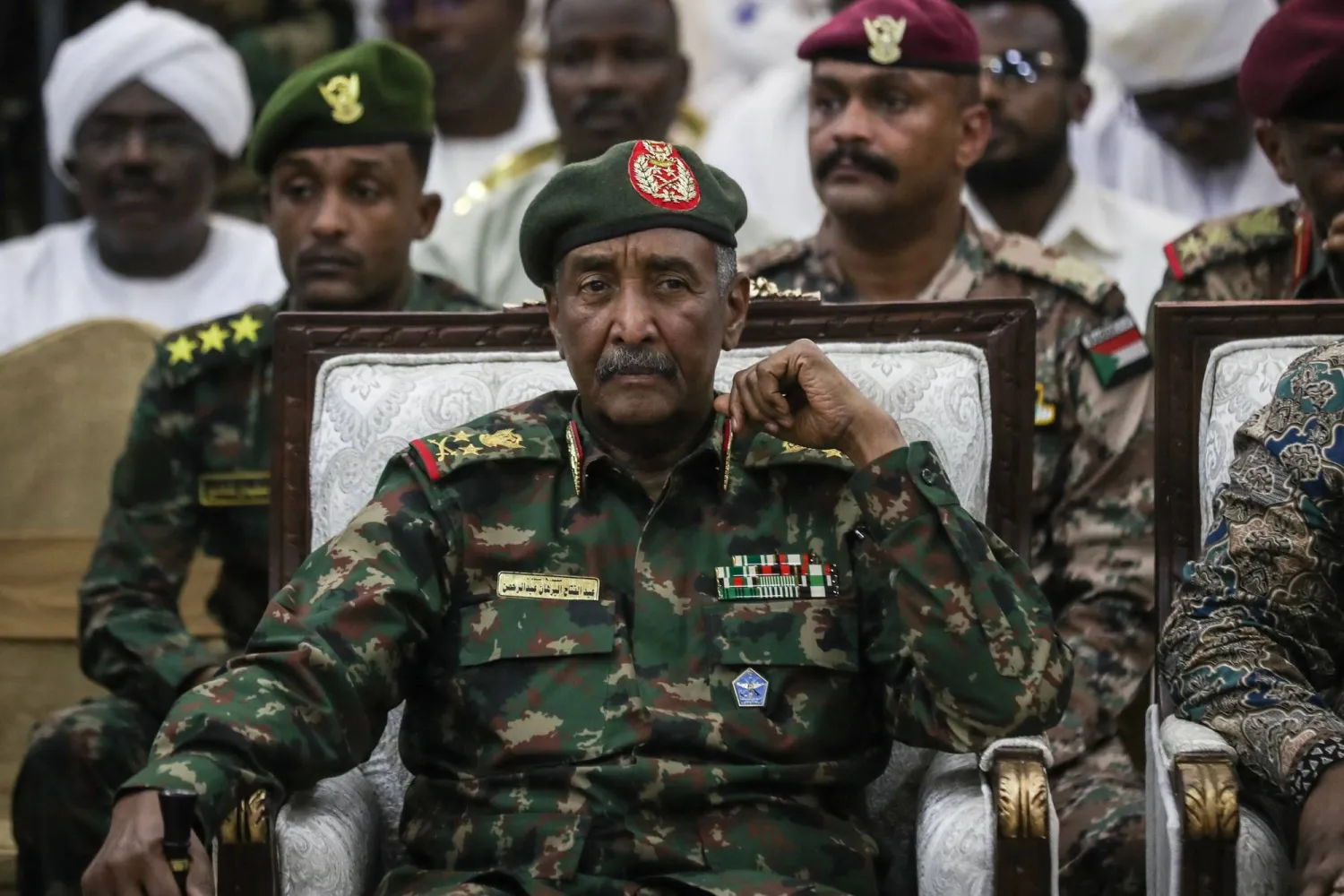
Sudan's army chief Abdel Fattah al-Burhan looks on during a meeting with injured fighters from armed groups allied with the Sudanese army in Omdurman on November 28, 2026. (Photo by Ebrahim HAMID / AFP)
Burhan Warns Neighboring Countries Will ‘Pay the Price’ for Hostility Toward Sudan
Sudan's army chief Abdel Fattah al-Burhan looks on during a meeting with injured fighters from armed groups allied with the Sudanese army in Omdurman on November 28, 2026. (Photo by Ebrahim HAMID / AFP)
Sudan’s Sovereign Council chairman and army chief Gen. Abdel Fattah al-Burhan has renewed his accusations against neighboring countries of acting hostile toward Sudan, warning that they would “pay the price sooner or later.”
His remarks came as the army announced the recapture of new areas in the Blue Nile region following clashes with the Rapid Support Forces (RSF) and its ally, the Sudan People’s Liberation Movement-North (SPLM-N).
Meanwhile, Sudanese political forces agreed on a common vision calling for an urgent humanitarian truce leading to a comprehensive and lasting ceasefire.
Speaking at a ceremony honoring wounded members of the Joint Force of Armed Movements allied with the army in Omdurman, Al-Burhan said on Saturday that “most neighboring countries have been turned against us through financial inducements.”
He added that the enemy is operating from Ethiopia, South Sudan, Chad, and Libya to attack Sudan.
He warned that everyone who has incited hostility against the Sudanese people “will pay the price sooner or later,” while stressing that Sudan would overcome its current challenges.
Al-Burhan reiterated the military’s commitment to continue fighting until every area under RSF control has been retaken, declaring that the armed forces “will not lay down their weapons before ending the rebellion.”
He said he had arrived late to the ceremony because he was following a battle in Ad-Damazin, the capital of Blue Nile State.
According to his account, anti-army forces withdrew from the battlefield, leaving behind 18 combat vehicles.
He also announced a $5 million contribution to a fund supporting wounded military personnel and pledged that the state would cover treatment costs for cases requiring medical care abroad.
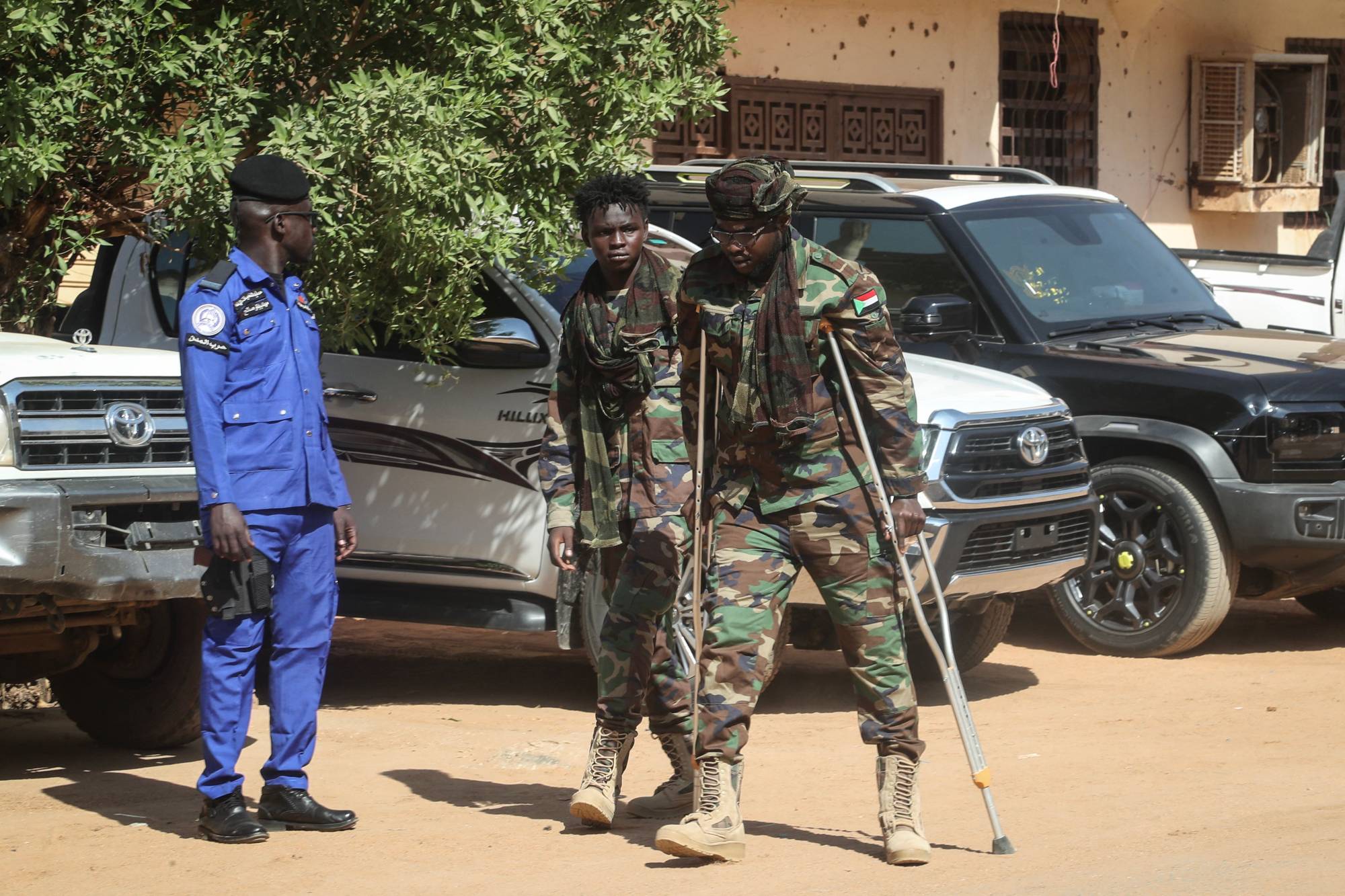
An injured fighter arrives at a gathering where Sudan's army chief met wounded fighters from armed groups allied with the Sudanese army in Omdurman on November 28, 2026. (Photo by Ebrahim HAMID / AFP)
Blue Nile Battles
The Sudanese army announced on Saturday that it had retaken the areas of Samsour and Village 11 in Blue Nile State after clashes with the RSF and the SPLM-N faction led by Abdelaziz al-Hilu.
The Fourth Infantry Division said in a statement that government troops and allied forces regained control of Village 11 following battles with forces allied to the RSF under Joseph Tuka. Military and local sources also reported the recapture of Samsour.
The advance followed the army’s announcement a day earlier that it had regained control of Khor Maganza in Bau County, days after the RSF and its allies said they had seized the area.
Conflicting reports emerged regarding casualties, with pro-RSF platforms claiming they had ambushed Sudan Shield Forces and inflicted dozens of deaths, while army-aligned sources reported heavy losses among opposing forces.
In a related development, Ad-Damazin was targeted early Saturday by new drone attacks. Military sources said the strikes targeted positions belonging to the Fourth Infantry Division and other sites in the city. Ground defenses reportedly intercepted several drones, though local reports spoke of explosions inside the division’s headquarters. No confirmed casualty figures were released.
Call for a Humanitarian Truce
Politically, Sudanese political and civilian groups concluded four days of consultations in Switzerland by agreeing on a shared vision emphasizing the need for an urgent humanitarian truce that would pave the way for a comprehensive and permanent ceasefire. Participants stressed that any truce must not become a prelude to the partition of Sudan.
The meetings were held as part of the seventh round of the Neuchâtel Process informal peace consultations, sponsored by the Swiss Foreign Ministry and facilitated by the organization Promediation.
Participants included representatives from the Civil Democratic Alliance of the Forces of the Revolution (Somoud), the army-aligned Democratic Bloc, the National Movement Forces, the Arab Socialist Baath Party, the Umma Party led by Mubarak al-Fadil, and a number of independent national figures.
The final statement reaffirmed the participants’ commitment to Sudan’s unity, sovereignty, and territorial integrity, rejecting any political or security arrangements that might entrench division or threaten national unity.
The groups also called for greater coordination between regional and international mediation mechanisms and for linking security arrangements to a broader political process that would restore civilian life and bring the war to an end.
The consultations also addressed the increasing use of drones against civilians, markets, and infrastructure, and the resulting deterioration of the humanitarian situation and growing risk of famine.
Participants called for continued dialogue among political and civilian actors and the creation of a national mechanism to bridge differences and prepare the ground for a comprehensive peaceful settlement.
The agreement was particularly significant because it brought together groups that have opposed the war and others that have supported the army, despite their sharply differing positions since the conflict erupted in April 2023.
Hezbollah Rejects Internationalizing Lebanon-Israel Framework Deal: What Are its Options?https://english.aawsat.com/arab-world/5346859-hezbollah-rejects-internationalizing-lebanon-israel-framework-deal-what-are-its
A Hezbollah supporter holds up a sign reading “We Will Not Give Up Our Weapons” on the second anniversary of the assassinations of former secretaries-general Hassan Nasrallah and Hashem Safieddine. (File photo - EPA)
Hezbollah Rejects Internationalizing Lebanon-Israel Framework Deal: What Are its Options?
A Hezbollah supporter holds up a sign reading “We Will Not Give Up Our Weapons” on the second anniversary of the assassinations of former secretaries-general Hassan Nasrallah and Hashem Safieddine. (File photo - EPA)
Hezbollah and the Amal Movement are mobilizing to counter a US push to internationalize the framework agreement Lebanon signed with Israel under US auspices in June by incorporating it into an updated UN Security Council Resolution (1701) as UNIFIL's mandate expires at the end of the year.
The move was among proposals discussed last week to avert a security vacuum in southern Lebanon once the mandate of the United Nations Interim Force in Lebanon expires.
The issue is particularly sensitive as Israel seeks to establish a new security order in the south, where the absence of an international force would allow it to impose direct coordination mechanisms between the Lebanese and Israeli armies.
The Shiite duo's options range from securing a unified official Lebanese position against the move and seeking a Russian or Chinese veto at the Security Council to mobilizing street protests or escalating on the ground.
Its room for maneuver, however, is narrowing as France re-enters the diplomatic fray, backing Washington's push and seeking to persuade Hezbollah and Amal to accept alternative arrangements that would avert a security vacuum opposed by most domestic and international actors.
Hezbollah Secretary-General Naim Qassem made clear in his latest address that any new international resolution must remain within the parameters of Resolution 1701 and the Nov. 27, 2024, ceasefire agreement with Israel.
He rejected any attempt to replace them with the framework agreement as "unconstitutional and illegal," warning that any force operating outside those parameters, regardless of its name or designation, would be treated as an "occupation force."
Amal has taken an identical stance, recently rejecting the inclusion of any new agreement or understanding alongside Resolution 1701 and the cessation of hostilities agreement in any new UN resolution or mandate.
Three options to push back
While some believe an international agreement would confront the Shiite duo with a fait accompli, political writer Qassem Qassir, who closely follows Hezbollah's positions, outlined several options for resisting the move.
"The first effort is domestic. No Security Council resolution can be adopted without Lebanon's consent. This naturally requires official approval, either through the government or coordination among the country's leaders," Qassir said.
"It is clear that Parliament Speaker Nabih Berri rejects internationalizing the framework agreement or incorporating it into Resolution 1701. This was conveyed to US envoy Mike Waltz during his latest visit to Beirut."
The second option, Qassir said, lies with the Security Council's major powers.
"Any Security Council resolution requires the approval of major powers, particularly Russia and China. Given the ongoing coordination with Moscow and Beijing, either country could exercise its veto if it objects to the resolution."
While no precise or confirmed information was available on that prospect, he said, it remained an option.
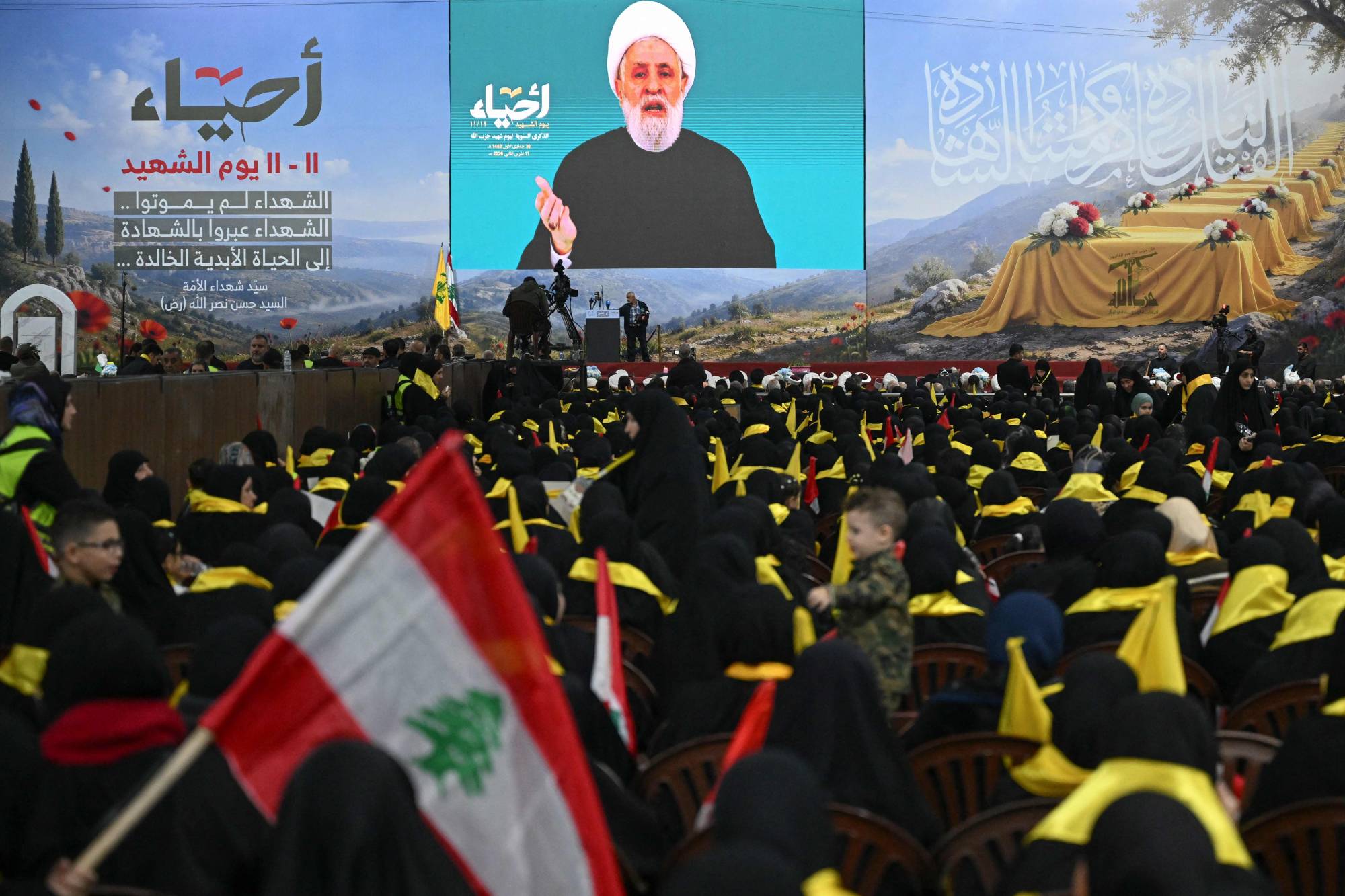
Hezbollah supporters watch a televised address on a big screen by Naim Qassem, the Secretary-General of the Iran-backed group, during the commemoration of Hezbollah's annual Martyrs' Day in Beirut's southern suburbs on November 11, 2026. (Photo by Joseph EID / AFP) /
Street mobilization
The third and most important scenario, Qassir told Asharq Al-Awsat, concerns how any resolution would be enforced on the ground.
"Any international forces deployed to Lebanon without the consent of local parties, particularly the Amal Movement, Hezbollah and the Higher Islamic Shiite Council, would be unacceptable. If these forces come in coordination with the Israeli enemy or through it, they will be treated as occupation forces," he said.
"According to available information, countries seeking to participate, such as Italy and France, are unwilling to deploy troops to Lebanon without the consent of local parties."
Qassir stressed that contacts and consultations were still underway, adding that street mobilization remained an option should it become necessary to oppose the move.
A 'suicidal move'
Political writer Ali Al-Amin, editor-in-chief of the Janoubia news website, disagreed with Qassir's assessment, arguing that the Shiite duo lacked the means to derail the process.
He said it could neither secure an official Lebanese position opposing the move nor leverage international opposition to block such a resolution at the Security Council.
"The framework agreement was approved by the Lebanese government. No Security Council member would oppose the draft resolution unless the Lebanese state formally requested it," Al-Amin said.
That prospect appeared unlikely, he added, given that the framework agreement had been linked to Resolution 1701 and France had reclaimed its role in Lebanese-Israeli affairs, joining Washington in shaping the post-UNIFIL landscape in southern Lebanon.
Al-Amin told Asharq Al-Awsat that Hezbollah was issuing both overt and veiled threats over the authorities' handling of its members detained in Dahr al-Baidar and between Bsharri and Batroun.
The group was also sending messages to the government and the president over their handling of the proposed international resolution, he said.
"Hezbollah could resort to military and security measures to demonstrate its grip on the ground and could even become embroiled in an internal military confrontation."
Such a decision, however, would amount to a "suicidal move" with catastrophic consequences for the group, Al-Amin said, given that it now faced a Lebanese public opposed to its weapons and committed to the state's exclusive control over arms.
Sowing chaos
Al-Amin pointed to another possible avenue of confrontation: sowing chaos through communal or sectarian clashes in which Hezbollah would not appear to be a party.
He cited possible scenarios including infighting among Palestinians in refugee camps, Sunni-Christian tensions between Bsharri and Dinniyeh, intra-Christian clashes, bombings or disputes between Syrians and Lebanese.
"Chaos is the most effective means of creating political confusion and hesitation among the authorities," he said.
It would help foster the impression that Lebanon could not withstand serious and decisive steps to assert state authority, he added, while Iran would seek to derail any domestic or international political process it had no hand in shaping.
Mladenov Presses Netanyahu to Honor Gaza Commitmentshttps://english.aawsat.com/arab-world/5346832-mladenov-presses-netanyahu-honor-gaza-commitments
FILED - 13 September 2024, Palestinian Territories, Rafah: FILE PHOTO - A photograph, taken during an embed with the Israeli army shows mlitary vehicles driving next to destroyed building of Rafah. Photo: Ilia Yefimovich/dpa
Mladenov Presses Netanyahu to Honor Gaza Commitments
FILED - 13 September 2024, Palestinian Territories, Rafah: FILE PHOTO - A photograph, taken during an embed with the Israeli army shows mlitary vehicles driving next to destroyed building of Rafah. Photo: Ilia Yefimovich/dpa
An Israeli official and two informed sources have revealed that the Board of Peace's lead envoy for Gaza sent a message to Israeli Prime Minister Benjamin Netanyahu, warning that the Board may be forced to withdraw its mandate to oversee Gaza's postwar reconstruction if Israel does not begin fulfilling its commitments under the ceasefire agreement signed last year.
US President Donald Trump set up the Board of Peace to oversee his ambitious plan to end Israel's war in Gaza and rebuild the shattered territory.
According to The Times of Israel, Mladenov's letter, sent on Tuesday, clarified that the Board of Peace is not asking Netanyahu for additional concessions regarding Gaza, but merely to implement the provisions of President Donald Trump's 20-point plan to end the Gaza war, announced in October 2025.
These commitments include meeting benchmarks for humanitarian in Gaza and allowing the operationalization of governing and security bodies tasked with replacing Hamas in administering the Strip.
The Board had previously established a Palestinian technocratic government, fielded applications for several thousand Palestinian recruits and trained hundreds of Moroccan soldiers to serve in its International Stabilization Force (ISF), which is tasked with helping secure Gaza in the postwar period.
But the National Committee for the Administration of Gaza (NCAG) has yet to enter the Strip, the police force has yet to begin training in Egypt, and the ISF has yet to deploy in the enclave.
Netanyahu's government has so far refused to sign off on the necessary approvals for these bodies to commence their work.
Mladenov's message came months after Hamas agreed to the Board of Peace's disarmament roadmap.
Israel rejected the proposal over its gradual framework and has prevented the enactment of the bodies meant to facilitate the weapons handover.
The Times of Israel reported: "For months, the board refrained from aggressively leaning on Israel, recognizing that Netanyahu was unlikely to take steps that his political rivals could frame as weakness during an election campaign. But the October 27 vote passed, and even though it did not produce a conclusive result, the Board of Peace has signaled it is done waiting.”
It has begun intensifying its public campaign against Netanyahu, with several Board of Peace officials sounding off against Netanyahu in media interviews.
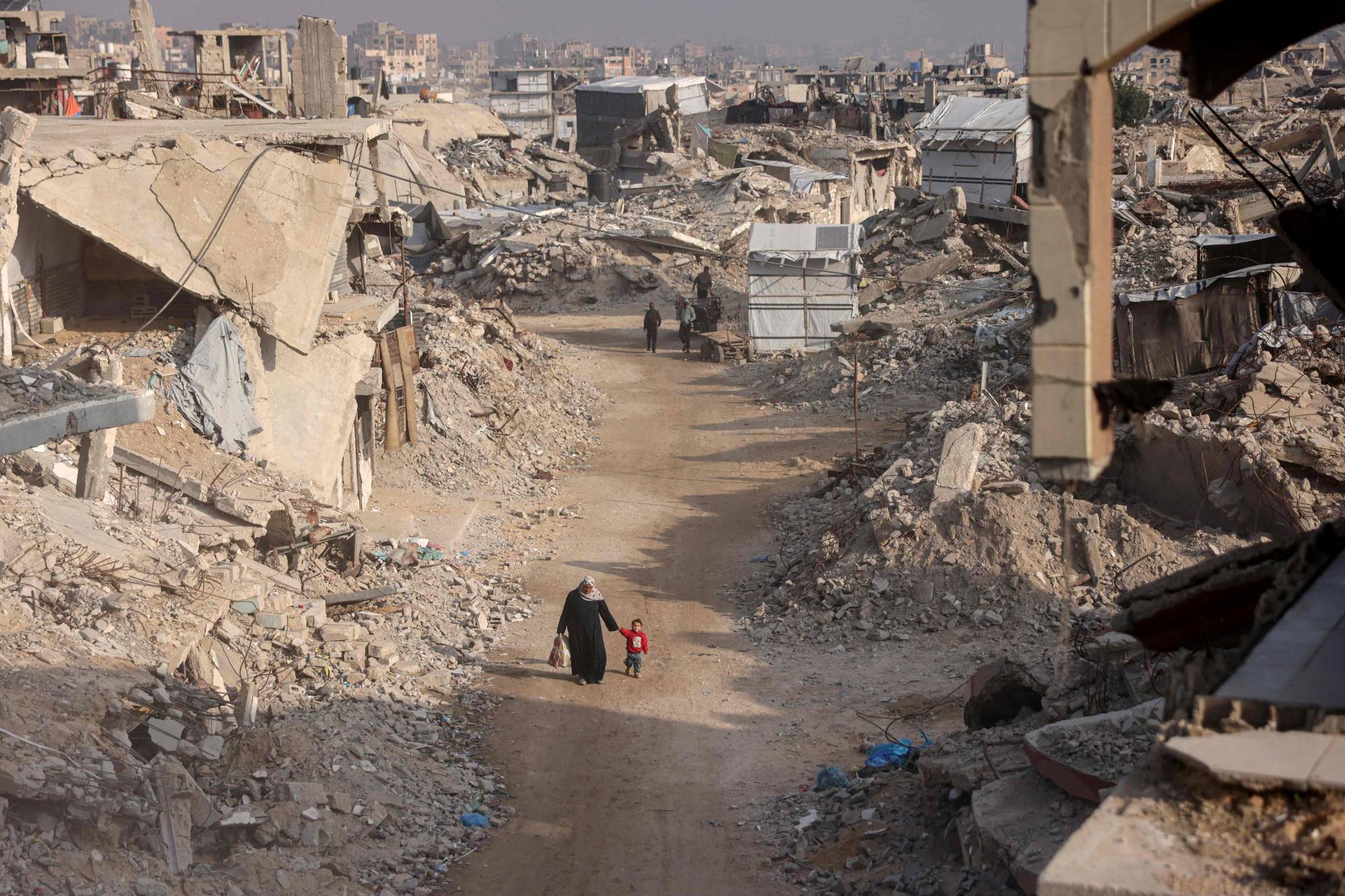
Palestinians walks past the rubble of homes and shops destroyed by the Israeli army during the Gaza war, in the Jabalia Palestinian refugee camp, in the northern Gaza Strip on November 28, 2026. (Photo by Bashar Taleb / AFP)
This week, Jared Kushner, described as the architect of the Board of Peace, warned that Israel is heading toward “global-pariah status” if it doesn’t shift its approach to Gaza.
The board’s senior adviser Josh Gruenbaum warned that continued Israeli blocking of the 20-point plan will lead the US-led panel to hand back its mandate for overseeing Gaza’s postwar management, leaving Israel, Hamas, the UN, the Palestinian Authority or a combination of some or all of them responsible for providing for the Strip’s two million inhabitants.
According to The Times of Israel, citing the Israeli official and the two informed sources, Mladenov's letter to Netanyahu largely echoed the same concerns expressed by Gruenbaum.
In November 2025, the UN Security Council voted to endorse Trump's 20-point plan and granted the Board a mandate to supervise Gaza's postwar transitional period through the end of 2027.
However, the Israeli official and the informed sources said Mladenov threatened to revoke the Board's mandate before that deadline if Israel continued obstructing its efforts and preventing progress on Gaza's recovery plan, though no specific deadline was mentioned.
They added that, in the days following the letter, the Board has seen signs that Netanyahu is willing to change his approach.
Netanyahu subsequently held a phone conversation with Kushner, during which he reportedly informed him that Israel would begin taking steps to implement the 20-point plan, according to the Israeli official.
Israel's Channel 12 reported that the security cabinet would convene on Sunday to approve a series of Gaza-related measures, including steps that would allow the deployment of the ISF.
The Israeli official said Israel is seeking to demonstrate progress before Mladenov delivers his briefing to the UN Security Council on Monday.
According to Channel 12, ministers are expected to discuss an updated draft resolution reflecting understandings reached during Netanyahu's earlier conversation with Kushner.
The measures expected to be approved include the construction of facilities to house troops from the ISF.
The force aims to deploy in Gaza in January and establish positions along sections of the so-called Yellow Line. It would also assist in collecting weapons surrendered by Hamas, according to the report.
As part of the second phase, the proposed measures include launching a pilot project to build temporary housing on the ruins of Rafah in southern Gaza under an initiative known as "Green Rafah."
The project would be administered by the new Palestinian technocratic government, which is expected to assume responsibility for governing Gaza following Hamas's departure from power.
لم تشترك بعد
انشئ حساباً خاصاً بك لتحصل على أخبار مخصصة لك ولتتمتع بخاصية حفظ المقالات وتتلقى نشراتنا البريدية المتنوعة