


Gaza Ceasefire Talks Have Ended without a Breakthrough with Ramadan Days Away, Egypt Says

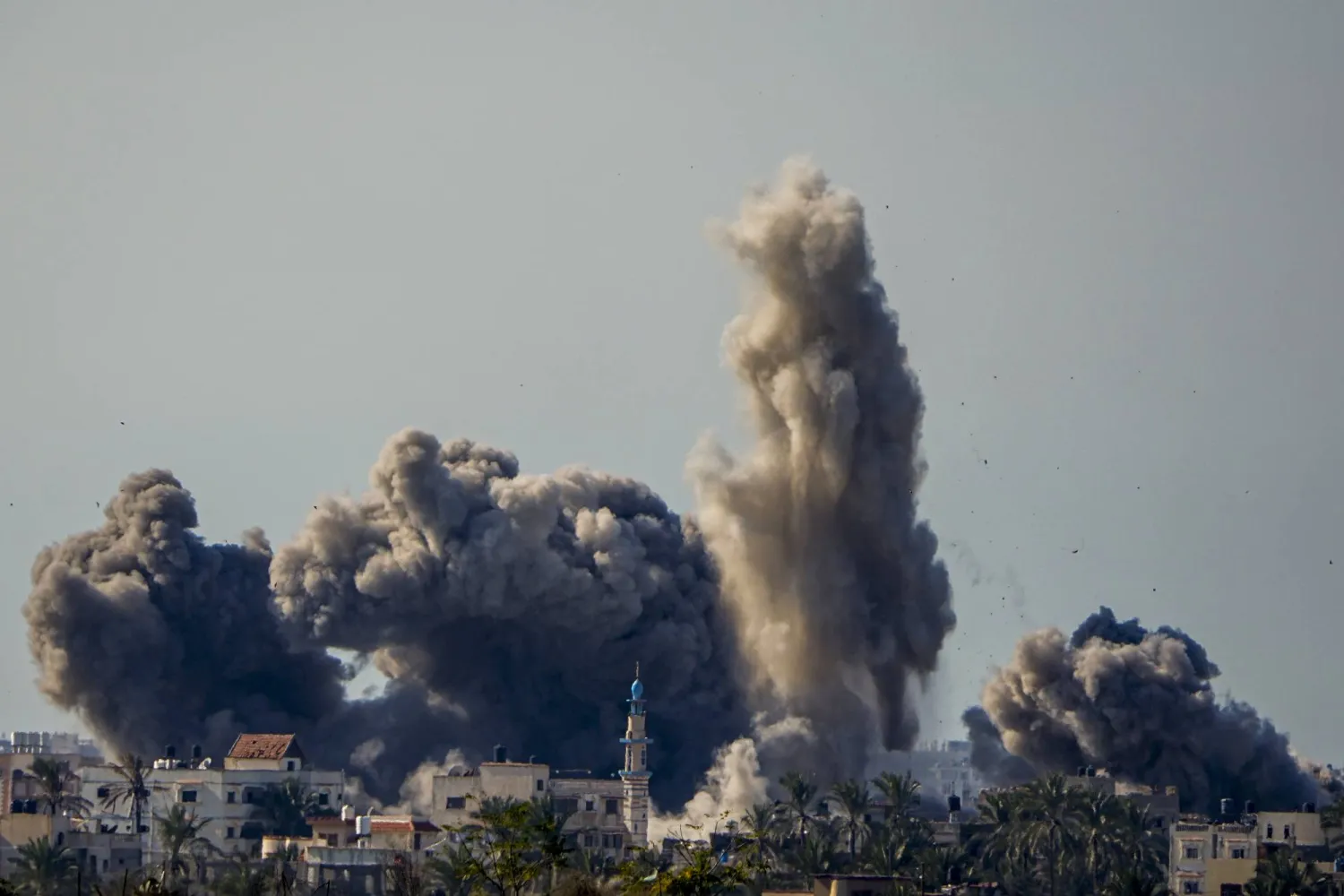
Smoke and explosion following Israeli bombardment inside the Gaza Strip, as seen from southern Israel, Sunday, Feb. 11, 2024. (AP Photo/Ariel Schalit)
TT

Gaza Ceasefire Talks Have Ended without a Breakthrough with Ramadan Days Away, Egypt Says

Smoke and explosion following Israeli bombardment inside the Gaza Strip, as seen from southern Israel, Sunday, Feb. 11, 2024. (AP Photo/Ariel Schalit)

Three days of negotiations with Hamas over a ceasefire in Gaza and the release of Israeli hostages ended Tuesday without a breakthrough, Egyptian officials said, less than a week before the start of the Muslim holy month of Ramadan, the informal deadline for a deal.

The United States, Qatar and Egypt have spent weeks trying to broker an agreement in which Hamas would release up to 40 hostages in return for a six-week ceasefire, the release of some Palestinian prisoners and an influx of aid to address the humanitarian catastrophe in the isolated territory.

Two Egyptian officials said the latest round of discussions had ended. They said Hamas presented a proposal that mediators would discuss with Israel in the coming days.

Hamas has refused to release all of the estimated 100 hostages it holds, and the remains of around 30 more, unless Israel ends its offensive, withdraws from Gaza and releases a large number of Palestinian prisoners, including senior militants serving life sentences.

US officials have said they are skeptical that Hamas actually wants a deal because the group has balked at a number of what the US and others believe are legitimate requests, including giving the names of hostages to be released.

“It is on Hamas to make decisions about whether it is prepared to engage,” US Secretary of State Antony Blinken said Tuesday.

“We have an opportunity for an immediate cease-fire that can bring hostages home, that can dramatically increase the amount of humanitarian aid getting in to Palestinians who so desperately need it, and can set the conditions for an enduring resolution,” Blinken said.

Jihad Taha, a Hamas spokesperson, said the negotiations were ongoing but “the ball is in the Israeli court.” He said Israel had thus far refused Hamas' demands for people who fled northern Gaza to be allowed to return and for guarantees of a long-term cease-fire and full Israeli withdrawal from Gaza.

“Hamas is open to proposals and initiatives that are consistent with its position calling for a ceasefire, withdrawal, the return of the displaced, the entry of relief convoys and reconstruction,” Taha said.

Israeli Prime Minister Benjamin Netanyahu has publicly rejected Hamas' demands and repeatedly vowed to continue the war until Hamas is dismantled and all the hostages are returned. Israel did not send a delegation to the latest round of talks.

An Israeli official said Israel was still waiting for Hamas to hand over a list of hostages who are alive as well the hostage-to-prisoner ratio it seeks in any release deal. It was not clear if that information was included in the latest proposal.

The Israeli and Egyptian officials spoke on condition of anonymity because they were not authorized to brief media on the negotiations.

Benny Gantz, a member of Netanyahu's War Cabinet and his main political rival, met with senior US officials in Washington on a visit that drew a rebuke from the prime minister, the latest sign of a growing rift within Israel's leadership.

Mediators had hoped to broker an agreement ahead of Ramadan, the month of dawn-to-dusk fasting that often sees heightened Israeli-Palestinian tensions linked to access to a major holy site in Jerusalem. The month is expected to begin around March 10, depending on the sighting of the moon.

“The negotiations are sensitive. I can’t say there is optimism or pessimism, but we haven’t yet reached a point at which we can achieve a ceasefire,” Egyptian Foreign Minister Sameh Shoukry said Monday.

The war began with a Hamas attack into southern Israel on Oct. 7 in which Palestinian militants killed some 1,200 people and took around 250 hostages. More than 100 of them were released during a weeklong cease-fire in November.

The attack sparked an Israeli invasion of the enclave of 2.3 million people that Gaza's Health Ministry says has killed more than 30,000 Palestinians. Aid groups say the fighting has displaced most of the territory’s population and pushed a quarter of the population to the brink of famine.

The UN children’s agency said Monday that at least 10 children have reportedly died in isolated northern Gaza because of dehydration and malnutrition.

“There are likely more children fighting for their lives somewhere in one of Gaza’s few remaining hospitals, and likely even more children in the north unable to obtain care at all,” Adele Khodr, the UNICEF regional director for the Middle East and North Africa, said in a statement.

“These tragic and horrific deaths are man-made, predictable and entirely preventable," she added.

The Gaza Health Ministry said Sunday that 15 children have starved to death at the Kamal Adwan Hospital in northern Gaza and another six were at risk of dying from malnutrition and dehydration. It was not clear if the children had underlying medical conditions that increased their vulnerability.

Northern Gaza, the first target of Israel’s offensive, has suffered mass devastation. The World Food Program recently suspended aid shipments to the north, citing the breakdown of security. An attempt by the Israeli military to bring in aid ended in tragedy last week when over 100 Palestinians were fatally shot by Israeli forces or trampled to death in a melee.

Up to 300,000 Palestinians are believed to remain in northern Gaza after Israel ordered the evacuation of the entire region, including Gaza City, in October. Many have been reduced to eating animal fodder to survive. The UN says one in six children under 2 in the north suffer from acute malnutrition.

The United States and other countries have carried out air drops in recent days, but aid groups say the expensive, last-ditch measure is not enough to address the soaring needs.

Israel is still carrying out strikes in all parts of Gaza and has threatened to expand its ground offensive to the southernmost city of Rafah, where around half of Gaza's population has sought refuge. Gantz has said the Rafah operation could begin as soon as Ramadan if there is no deal on the hostages.

Gaza’s Health Ministry said 97 people had been killed over the last 24 hours. bringing the overall Palestinian death toll to 30,631. The ministry does not differentiate between civilians and combatants in its figures, but says women and children make up around two-thirds of the total casualties.

Israel says it tries to avoid harming civilians and blames the high toll on Hamas because the militants operate in dense, residential areas. But the army rarely accounts for individual strikes, which often kill women and children.


Egypt’s Prime Minister and FM Head to Washington for Trump Peace Council Meeting

Egyptian Foreign Minister Badr Abdelatty speaks during a joint press conference with Kenyan Prime Cabinet Secretary/Cabinet Secretary for Foreign Diaspora Affairs Musalia Mudavadi in Nairobi, Kenya, Monday, Feb. 16, 2026. (AP)
TT

Egypt’s Prime Minister and FM Head to Washington for Trump Peace Council Meeting

Egyptian Foreign Minister Badr Abdelatty speaks during a joint press conference with Kenyan Prime Cabinet Secretary/Cabinet Secretary for Foreign Diaspora Affairs Musalia Mudavadi in Nairobi, Kenya, Monday, Feb. 16, 2026. (AP)

Egypt's Prime Minister Mostafa Madbouly headed to Washington on Tuesday ‌to ‌participate in ‌the inaugural ⁠meeting of a "Board of Peace" established by US President Donald ⁠Trump, the ‌cabinet ‌said.

Madbouly is ‌attending ‌on behalf of President Abdel ‌Fattah al-Sisi and is accompanied by ⁠Foreign ⁠Minister Badr Abdelatty.

Foreign Minister Gideon Saar will represent Israel at the inaugural meeting, his office said on Tuesday.

Hamas, meanwhile, called on the newly-formed board to pressure Israel to halt what it described as ongoing violations of the ceasefire in Gaza.

The Board of Peace, of which Trump is the chairman, was initially designed to oversee the Gaza truce and the territory's reconstruction after the war between Hamas and Israel.

But its purpose has since morphed into resolving all sorts of international conflicts, triggering fears the US president wants to create a rival to the United Nations.

Saar will first attend a ministerial level UN Security Council meeting in New York on Wednesday, and on Thursday he "will represent Israel at the inaugural session of the board, chaired by Trump in Washington DC, where he will present Israel's position", his office said in a statement.

It was initially reported that Prime Minister Benjamin Netanyahu might attend the gathering, but his office said last week that he would not.

Ahead of the meeting, Hamas spokesman Hazem Qassem told AFP that the Palestinian movement urged the board's members "to take serious action to compel the Israeli occupation to stop its violations in Gaza".

"The war of genocide against the Strip is still ongoing -- through killing, displacement, siege, and starvation -- which have not stopped until this very moment," he added.

He also called for the board to work to support the newly formed Palestinian technocratic committee meant to oversee the day-to-day governance of post-war Gaza "so that relief and reconstruction efforts in Gaza can commence".

Announcing the creation of the board in January, Trump also unveiled plans to establish a "Gaza Executive Board" operating under the body.

The executive board would include Turkish Foreign Minister Hakan Fidan and Qatari diplomat Ali Al-Thawadi.

Netanyahu has strongly objected to their inclusion.

Since Trump launched his "Board of Peace" at the World Economic Forum in Davos in January, at least 19 countries have signed its founding charter.


Palestinian Child Dies After Stepping on Mine in West Bank

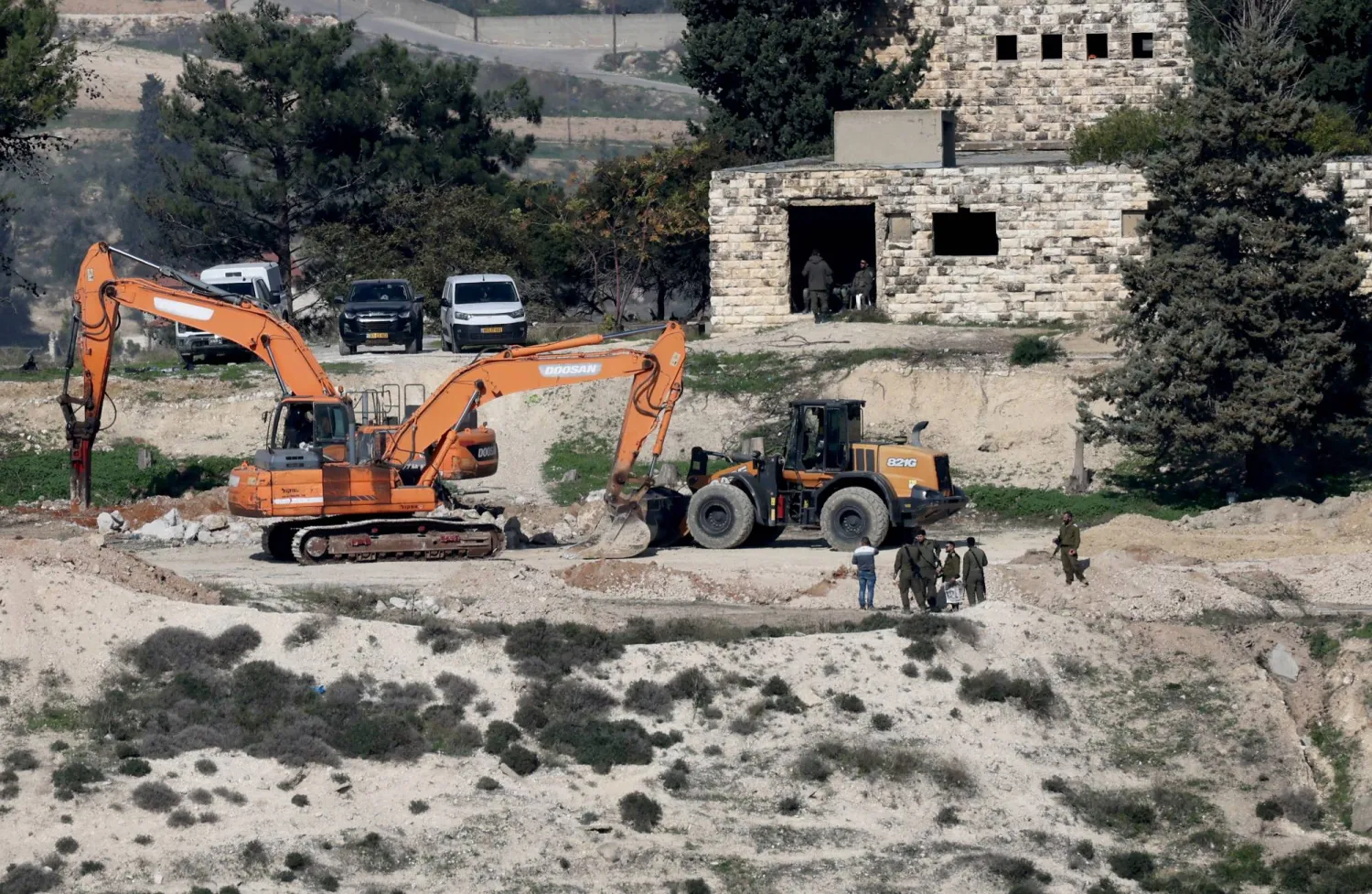
Israeli troops conduct a military raid in the village of Al-Yamoun, west of Jenin, West Bank, 17 February 2026. (EPA)
TT

Palestinian Child Dies After Stepping on Mine in West Bank

Israeli troops conduct a military raid in the village of Al-Yamoun, west of Jenin, West Bank, 17 February 2026. (EPA)

A Palestinian child died after stepping on a mine near an Israeli military camp in the occupied West Bank on Tuesday, the Palestinian Red Crescent said, with an Israeli defense ministry source confirming the death.

"Our crews received the body of a 13-year-old child who was killed after a mine exploded in one of the old camps in Jiftlik in the northern Jordan Valley," the Red Crescent said in a statement.

A source at COGAT, the Israeli defense ministry's agency in charge of civilian matters in the Palestinian territories, confirmed the death to AFP and identified the boy as Mohammed Abu Dalah, from the village of Jiftlik.

Israel's military had previously said in a statement that three Palestinians were injured "as a result of playing with unexploded ordnance", without specifying their ages.

It added that the area of the incident, Tirzah, is "a military camp in the area of the Jordan Valley", near Jiftlik and close to the Jordanian border.

"This area is a live-fire zone and entry into it is prohibited," the military said.

Jiftlik village council head Ahmad Ghawanmeh told AFP that three children, the oldest of whom was 16, were collecting herbs near the military base when they detonated a mine.

Jiftlik as well as the nearby Tirzah base are located in the Palestinian territory's Area C, which falls under direct Israeli control.

Israel has occupied the West Bank since 1967.

Much of the area near the border with Jordan -- which Israel signed a peace deal with in 1994 -- remains mined.

In January, Israel's defense ministry said it had begun demining the border area as part of construction works for a new barrier it says aims to stem weapons smuggling.


Hezbollah Rejects Disarmament Plan and Government’s Four-Month Timeline

29 July 2024, Iran, Tehran: Then Hezbollah deputy leader Sheikh Naim Qassem is pictured during a meeting in Tehran. (Iranian Presidency/dpa)
TT

Hezbollah Rejects Disarmament Plan and Government’s Four-Month Timeline

29 July 2024, Iran, Tehran: Then Hezbollah deputy leader Sheikh Naim Qassem is pictured during a meeting in Tehran. (Iranian Presidency/dpa)

Hezbollah rejected on Tuesday the Lebanese government's decision to grant the army at least four months to advance the second phase of a nationwide disarmament plan, saying it would not accept what it sees as a move serving Israel.

Lebanon's cabinet tasked the army in August 2025 with drawing up and beginning to implement a plan to bring all armed groups' weapons under state control, a bid aimed primarily at disarming Hezbollah after its devastating ‌war with ‌Israel in 2024.

In September 2025 the cabinet formally ‌welcomed ⁠the army's plan to ⁠disarm the Iran-backed Shiite party, although it did not set a clear timeframe and cautioned that the military's limited capabilities and ongoing Israeli strikes could hinder progress.

Hezbollah Secretary-General Sheikh Naim Qassem said in a speech on Monday that "what the Lebanese government is doing by focusing on disarmament is a major mistake because this issue serves the goals of Israeli ⁠aggression".

Lebanon's Information Minister Paul Morcos said during a press ‌conference late on Monday after ‌a cabinet meeting that the government had taken note of the army's monthly ‌report on its arms control plan that includes restricting weapons in ‌areas north of the Litani River up to the Awali River in Sidon, and granted it four months.

"The required time frame is four months, renewable depending on available capabilities, Israeli attacks and field obstacles,” he said.

Hezbollah lawmaker Hassan ‌Fadlallah said, "we cannot be lenient," signaling the group's rejection of the timeline and the broader approach to ⁠the issue of ⁠its weapons.

Hezbollah has rejected the disarmament effort as a misstep while Israel continues to target Lebanon, and Shiite ministers walked out of the cabinet session in protest.

Israel has said Hezbollah's disarmament is a security priority, arguing that the group's weapons outside Lebanese state control pose a direct threat to its security.

Israeli officials say any disarmament plan must be fully and effectively implemented, especially in areas close to the border, and that continued Hezbollah military activity constitutes a violation of relevant international resolutions.

Israel has also said it will continue what it describes as action to prevent the entrenchment or arming of hostile actors in Lebanon until cross-border threats are eliminated.
