


Berri to Asharq Al-Awsat: Temporary Ceasefire Call Marks Victory for Beirut Efforts

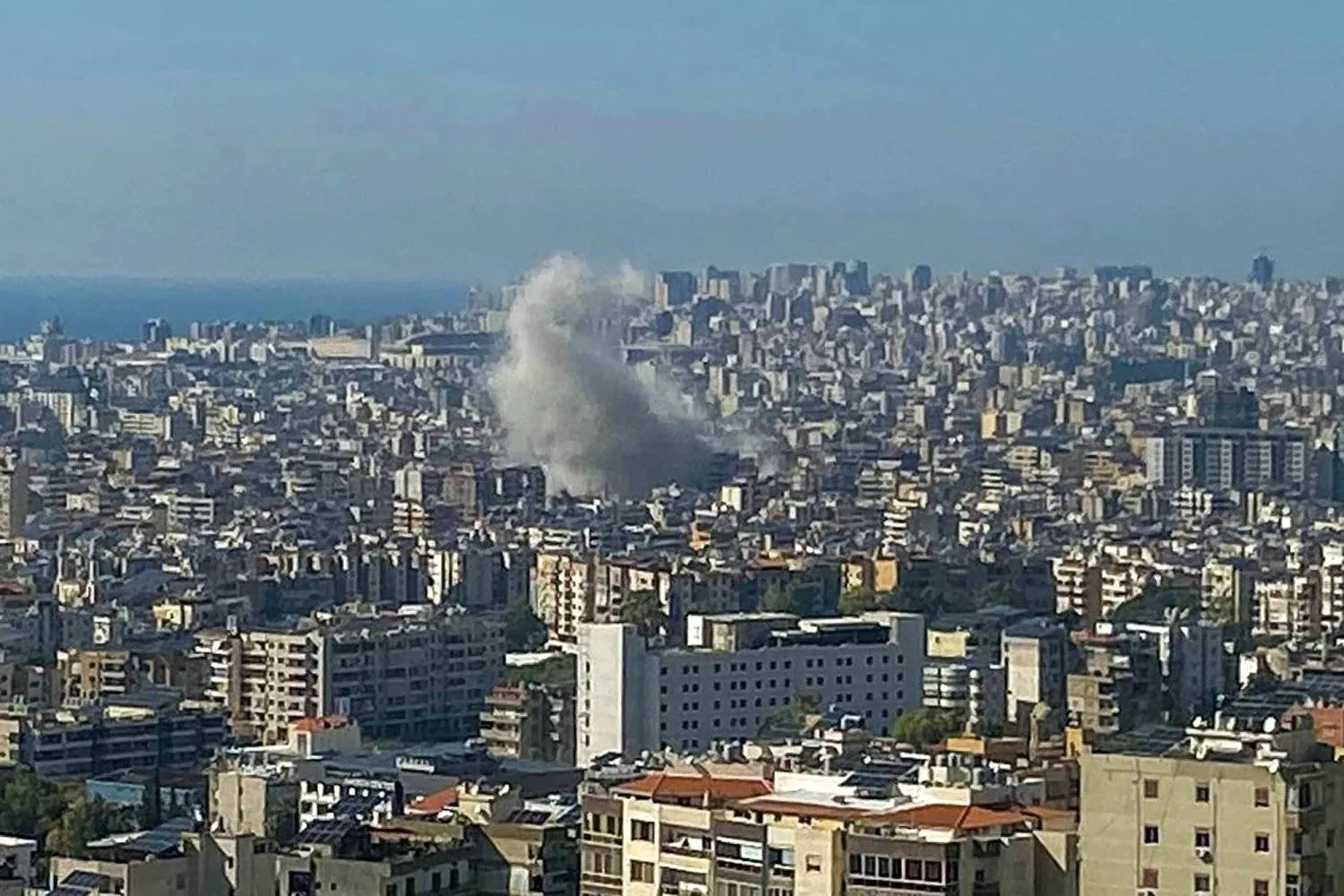
Smoke rises from the site of an Israeli airstrike targeting the southern suburbs of Beirut, Lebanon, on September 26, 2024 (AFP)
TT

Berri to Asharq Al-Awsat: Temporary Ceasefire Call Marks Victory for Beirut Efforts

Smoke rises from the site of an Israeli airstrike targeting the southern suburbs of Beirut, Lebanon, on September 26, 2024 (AFP)

Lebanese political and diplomatic activity is intensifying after the release of an “international-Arab call” for a ceasefire in Lebanon and Gaza.
“The key lies in implementation,” Lebanese Parliament Speaker Nabih Berri told Asharq Al-Awsat, describing the call itself “a victory for Lebanon’s efforts.”
Berri highlighted the role of major players, especially the US, in convincing Israel to accept the ceasefire.
He pointed out that Israeli Prime Minister Benjamin Netanyahu “says one thing and its opposite,” while stressing that Lebanon is committed to the call’s principles and ready to act.
“There is no problem on the Lebanese side, as the international joint statement addressed both Gaza and Lebanon together,” Berri stressed.
A Lebanese source involved in negotiations at the UN indicated that the obstinacy of both Israel and Hezbollah had blocked a proposed solution.

Now, efforts are focused on establishing a temporary ceasefire to allow for negotiations regarding the crisis that erupted when Hezbollah, backed by Iran, engaged with Israel to support Gaza.
The source explained that the proposed solution involved a new UN resolution to reinforce Resolution 1701, effective since the end of the 2006 Lebanon War.
However, Hezbollah’s insistence on linking a ceasefire in Gaza to this proposal and Israel’s refusal to do so thwarted the plan.
The source expressed hope for a three-week temporary ceasefire, with negotiations led by US envoy Amos Hochstein between Beirut and Tel Aviv.
In New York, Lebanese Prime Minister Najib Mikati held diplomatic discussions aimed at stopping the Israeli offensive against Lebanon, engaging with European and Arab officials during his visit.
Reports suggested that Mikati had “signed a proposed ceasefire agreement” after meeting US Secretary of State Antony Blinken and mediator Amos Hochstein.
However, the Prime Minister’s office denied these claims, asserting that they are “entirely untrue.”
The office reminded the public of Mikati’s remarks after the joint call initiated by the US and France, supported by the European Union and several countries, aimed at establishing a temporary ceasefire in Lebanon.
“We welcome the statement, but the crucial factor lies in Israel's commitment to implementing international resolutions,” said Mikati.
New York Meetings
Mikati met with Cypriot President Nikos Christodoulides, who outlined Cyprus’s efforts to support Lebanon and facilitate a ceasefire, including his talks with Netanyahu.
The Lebanese premier also discussed the situation in Lebanon and the region with British Foreign Secretary David Lammy, highlighting Britain’s efforts to stop the fighting.
Additionally, Mikati met with Qatari Prime Minister Sheikh Mohammed bin Abdulrahman Al Thani, thanking Qatar for its support of Lebanon, particularly for its backing of the Lebanese army.
The Qatari Prime Minister briefed Mikati on ongoing ceasefire negotiations in Gaza and Qatar’s role in the international committee working to elect a new president for Lebanon.



Syria President Discusses Security with Visiting Lebanon PM

Syrian President Ahmad al-Sharaa and Lebanese Prime Minister Nawaf Salam in Damascus in 2025 (File photo: AFP)
TT

Syria President Discusses Security with Visiting Lebanon PM

Syrian President Ahmad al-Sharaa and Lebanese Prime Minister Nawaf Salam in Damascus in 2025 (File photo: AFP)

Syrian President Ahmed al-Sharaa met Lebanon's Prime Minister Nawaf Salam in Damascus on Saturday on a visit tackling issues including security, transport and energy.

Beirut and Damascus have been rebuilding their ties after the December 2024 overthrow of longtime ruler Bashar al-Assad in Syria, whose family dynasty exercised control over Lebanese affairs for decades and is accused of assassinating numerous officials in Lebanon who expressed opposition to its rule.

A statement from the Syrian presidency said the officials discussed "developing economic and trade cooperation... and bolstering security coordination in order to support stability and confront challenges", as well as regional and international developments, AFP reported.

Syrian state news agency SANA said the visit aimed to "develop joint cooperation... particularly the economy, transportation and energy" sectors.

Salam was accompanied by Deputy Prime Minister Tarek Mitri as well as Lebanese ministers for energy, economy and transport.

Salam hailed "significant progress" on joint issues at the end of the visit, telling reporters that "we discussed continuing efforts to address the issue of detained Syrians (in Lebanon) and to uncover the fate of the missing and forcibly detained in both countries".

In March, Lebanon transferred more than 130 Syrian convicts to their home country to serve the remainder of their sentences there, as part of an agreement signed a month earlier.

Lebanon has also been seeking information on political assassinations in the country under the Assad dynasty.

The discussions also addressed "the need for stricter Syria-Lebanon border controls and preventing all types of smuggling", Salam added.

Lebanon and Syria share a porous, 330-kilometre (205-mile) border notorious for the smuggling of people and goods.

Last month, the main border crossing was closed for several days due to an Israeli threat to target it, with Israel accusing Hezbollah of using the crossing for military purposes and smuggling, though it ultimately did not carry out the strike.

Israel and Hezbollah have been fighting since the Iran-backed group drew Lebanon into the Middle East war with rocket fire at Israel on March 2, though a ceasefire was announced last month.

Hezbollah, which fought alongside Syrian government forces during the country's civil war, lost a major ally and cross-border supply route with Assad's ouster.

Syria's new authorities are hostile to the Lebanese group and its sponsor, and have announced the arrest of alleged Hezbollah-affiliated cells in recent months, while the group has denied having any presence in Syria.

Salam said that "we will not allow Lebanon to be used as a platform to harm any of its Arab brothers, including Syria".


Settlers Force Re-burial of Palestinian Man in West Bank, Family Says 

Israeli settlement structuers being installed in Sanur near Jenin, in the Israeli-occupied West Bank, May 9, 2026. REUTERS/Mohamad Torokman
TT

Settlers Force Re-burial of Palestinian Man in West Bank, Family Says 

Israeli settlement structuers being installed in Sanur near Jenin, in the Israeli-occupied West Bank, May 9, 2026. REUTERS/Mohamad Torokman

Israeli settlers in the occupied West Bank forced Palestinians to exhume the body of their father from his freshly dug village grave, his family said, near a settlement re-established by Prime Minister Benjamin Netanyahu's government.

Hussein Asasa, 80, died on Friday of natural causes and was buried that evening at the cemetery of Asasa village near Jenin, with all the necessary permits from Israel's military, whose forces were at the site, his son Mohammed said.

But shortly after the burial, the family was called back by some of the villagers, who said settlers were at the grave, ordering the grave be dug up.

"They said the land was for settlement and that burial was not allowed. We told them that this is the village's cemetery, not part of the settlement," said Asasa, Reuters reported.

The settlers then threatened to dig the grave up with a bulldozer, Asasa said, so the family decided to exhume their father's body themselves.

"We found that they already dug the grave and reached the body," Asasa said. "We continued digging and got the body and buried him in another cemetery," he said.

VIDEO SHOWS PEOPLE REMOVING A BODY

Video circulating on social media appeared to show settlers watching as people dig in the ground of a hill slope. They then carry away what looks like a body as Israeli troops walk behind them. Reuters verified the location as Asasa.

The Israeli military said that the funeral had been coordinated with it and that it had not instructed the family to rebury their father. Soldiers were sent to the scene following a report about a confrontation with settlers who were "digging in the area," the military said. "The soldiers confiscated digging tools from the Israeli civilians and remained at the location in order to prevent further friction," the military said. It added that it condemns actions that violate the "dignity of the living and the deceased".

The UN Human Rights Office condemned the incident.

"This is appalling and emblematic of the dehumanisation of Palestinians that we see unfolding across the OPT (Occupied Palestinian Territories). It spares no one, dead or alive," said Ajith Sunghay, head of the OHCHR Palestinian office.

Sa-Nur was one of 19 settlements evacuated under the 2005 Israeli disengagement plan, which also included Israel's withdrawal of settlers and troops from Gaza. Netanyahu's government approved Sa-Nur's re-establishment a year ago and construction has advanced rapidly, according to Peace Now, an Israeli settlement watchdog.

The West Bank is among the territories that Palestinians seek for an independent state. Israel cites historical and biblical ties to the land, as well as security needs.

Netanyahu's government, which staunchly opposes the establishment of a Palestinian state, has been accelerating settlement building, while a rise in attacks by settlers on Palestinians has drawn international alarm. The United Nations and most countries deem Israel's settlements on West Bank land captured in the 1967 war illegal, a view that Israel disputes.


Gaza Flotilla Activists to Be Released from Israel Detention and Deported

Global Sumud Flotilla Steering Committee members Susan Abdallah, Muhammad Nadir Al-Nuri, Suemeyra Akdeniz Ordu, Maimon Herawati, Thiago Avila and Saif Abukeshek, Eva Saldana, Greenpeace Spain; Maria Serra, GSF Catalunya and Oscar Camps, Open Arms attend a press conference as humanitarian flotilla prepares to depart for Gaza, from Barcelona, Spain, April 12, 2026. REUTERS/Albert Gea
TT

Gaza Flotilla Activists to Be Released from Israel Detention and Deported

Global Sumud Flotilla Steering Committee members Susan Abdallah, Muhammad Nadir Al-Nuri, Suemeyra Akdeniz Ordu, Maimon Herawati, Thiago Avila and Saif Abukeshek, Eva Saldana, Greenpeace Spain; Maria Serra, GSF Catalunya and Oscar Camps, Open Arms attend a press conference as humanitarian flotilla prepares to depart for Gaza, from Barcelona, Spain, April 12, 2026. REUTERS/Albert Gea

Two activists arrested last month when Israeli forces intercepted the Gaza-bound flotilla they were travelling on are expected to be deported in the coming days after being released from security detention on Saturday, their lawyers said. Saif Abu Keshek, a Spanish national, and Brazilian Thiago Avila were detained by Israeli authorities on April 29 and brought to Israel. The activists were part of a second Global Sumud Flotilla launched from Spain on April 12 to try to break Israel’s blockade of Gaza by delivering aid to the enclave.

Israel's foreign ministry said Abu Keshek was suspected of affiliation with a terrorist organization and Avila was suspected of illegal activity. Both denied the allegations, Reuters reported.

BRAZIL AND SPAIN SAID THE DETENTION WAS UNLAWFUL

The governments of Spain and Brazil said Abu Keshek's and Avila's detention was unlawful, but Israel's Ashkelon Magistrate’s Court remanded them in custody until May 10.

Human rights group Adalah, which has assisted in their legal defense and also said the detention was unlawful, said that Abu Keshek and Avila were informed that they will be released from detention on Saturday and handed over to immigration authorities' custody until their deportation.

"Adalah is closely monitoring developments to make sure that the release from detention goes ahead, followed by their deportation from Israel in the coming days," the group said. Israeli officials were not immediately reachable for comment.

Israeli authorities held them under suspicion of offences that included aiding the enemy and contact with a terrorist group.

Gaza is largely run by Palestinian militant group Hamas, which is designated as a terrorist group by Israel and much of the West. The group's October 7, 2023, attack on Israel started the Gaza war that has left much of the enclave's population homeless and dependent on aid - that humanitarian agencies say is arriving too slowly.