

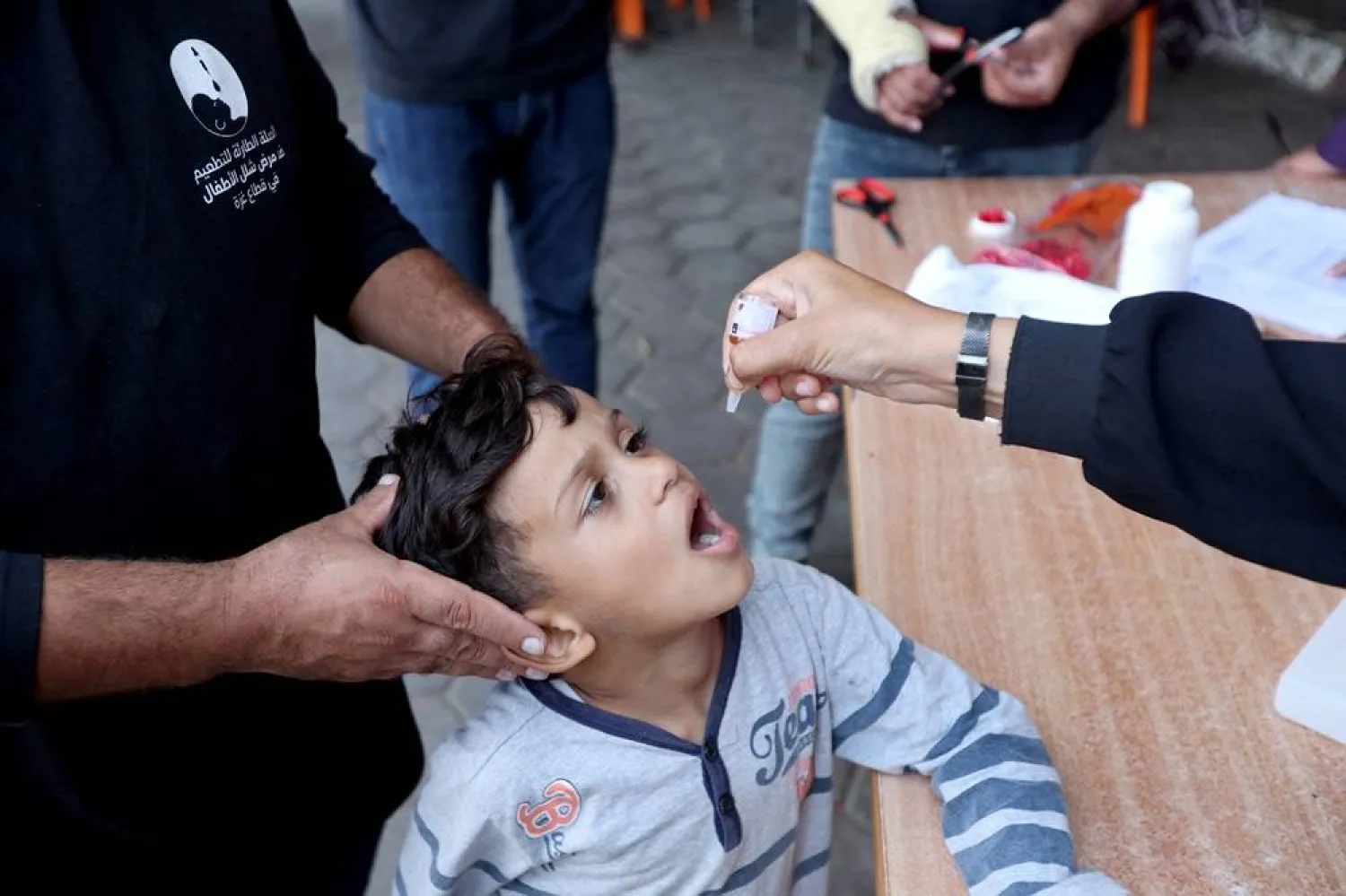

WHO Demands Space to Finish Gaza Polio Vaccination

Palestinian child is vaccinated against polio during the second round of a vaccination campaign, amid the Israel-Hamas conflict, in Deir Al-Balah in the central Gaza Strip, October 14, 2024. (Reuters)
TT

WHO Demands Space to Finish Gaza Polio Vaccination

Palestinian child is vaccinated against polio during the second round of a vaccination campaign, amid the Israel-Hamas conflict, in Deir Al-Balah in the central Gaza Strip, October 14, 2024. (Reuters)

The World Health Organization (WHO) on Wednesday urged Israel to ensure the necessary conditions to finish the job of vaccinating Gaza's children against polio, after reaching more than 150,000 with the required second dose.

Despite continuing Israeli military operations in some areas of the Palestinian territory, the second round of a polio vaccination campaign, aiming to reach more than 590,000 children under the age of 10, got under way on Monday.

"The total number of children who received a second dose of polio vaccine in central Gaza after two days of vaccination is 156,943," WHO director-general Tedros Adhanom Ghebreyesus said on X.

"The vaccination continues today. At the same time, 128,121 children received vitamin A supplements.

"We call for the humanitarian pauses to continue to be respected. We call for a ceasefire and peace," he said.

- 'Humanitarian pauses' -

As during the initial round of vaccination last month, the second will be divided into three phases, helped by localized "humanitarian pauses" in the fighting: first in central Gaza, then in the south and finally in the hardest-to-reach north of the territory.

Each phase is due to take three campaign days, along with one catch-up day for monitoring and for vaccinating any children who were missed.

"A minimum of two doses of vaccine are needed to interrupt poliovirus transmission. This will only be achieved if at least 90 percent of all eligible children are vaccinated in all communities and neighborhoods," Tedros told a press conference.

The vaccination drive began after the Gaza Strip confirmed its first case of polio in 25 years.

The disease has re-emerged in besieged Gaza, where the war has left most medical facilities and the sewage system in ruins.

Most often spread through sewage and contaminated water, poliovirus is highly infectious. It can cause deformities and paralysis, and is potentially fatal, mainly affecting children under the age of five.

- North Gaza concerns -

Rik Peeperkorn, the WHO's representative in the Palestinian territories, said the UN health agency was closing in on its target of reaching 180,000 in the central zone with a second oral polio vaccine dose.

Speaking from Gaza, he said 293,000 children needed to be reached in the southern zone and 119,000 in the north.

"We are concerned about the north because of the repeated evacuation orders, including for the hospitals and populations around that," he told the press conference.

"We have been successful with polio vaccination -- against all odds -- in the first round. We made a good start; we want to finish this job.

"We are very clear -- crystal clear -- that we will need an area-specific humanitarian pause, and this is also our assumption that we will get an area-specific humanitarian pause for the whole north of Gaza."

Peeperkorn said that above all, parents needed to be able to bring their children to the mobile and fixed vaccination points in safety.

"We cannot afford to falter in the second round. We need to stop this transmission of the poliovirus," he said, adding that WHO was "hopeful, and convinced, that this is going to work".

Israel launched a military campaign in Gaza after the October 7, 2023, attack by Hamas resulted in the deaths of 1,206 people in Israel, mostly civilians, according to an AFP tally of official Israeli figures, including hostages killed in captivity.

The Israeli campaign has killed 42,409 people, the majority civilians, according to figures from the health ministry in the Hamas-run territory which the UN considers reliable.



Abdelatty: Egypt Working with Pakistan on Lasting US-Iran Peace Plan

This handout photograph taken and released by Turkish Foreign Ministry on April 17, 2026, shows Türkiye's Foreign Minister Hakan Fidan (2nd R), Saudi Arabia's Foreign Minister Faisal bin Farhan Al-Saud (R), Egyptian counterpart Badr Abdelatty (L) and Pakistan's Foreign Minister Ishaq Dar (2nd L) poses family photo during the 5th edition of the Antalya Diplomacy Forum (ADF2026) in Antalya. (Photo by Turkish Foreign Ministery Press Service / TURKISH FOREIGN MINISTRY / AFP)
TT

Abdelatty: Egypt Working with Pakistan on Lasting US-Iran Peace Plan

This handout photograph taken and released by Turkish Foreign Ministry on April 17, 2026, shows Türkiye's Foreign Minister Hakan Fidan (2nd R), Saudi Arabia's Foreign Minister Faisal bin Farhan Al-Saud (R), Egyptian counterpart Badr Abdelatty (L) and Pakistan's Foreign Minister Ishaq Dar (2nd L) poses family photo during the 5th edition of the Antalya Diplomacy Forum (ADF2026) in Antalya. (Photo by Turkish Foreign Ministery Press Service / TURKISH FOREIGN MINISTRY / AFP)

Egypt is working closely with Pakistan on a framework aimed at securing a lasting peace between the US and Iran, ⁠Foreign Minister Badr ⁠Abdelatty said on Saturday.

He said Egypt, Türkiye, Pakistan and ⁠Saudi Arabia were coordinating a broader regional effort focused on preventing renewed escalation and laying the groundwork for a post-war security arrangement, stressing ⁠the ⁠importance of protecting Gulf states and stabilizing energy markets, supply chains and food security.

Abdelatty’s statement came as Iran has swiftly reversed course on reopening the Strait of Hormuz, reimposing restrictions on the critical waterway on Saturday after US President Donald Trump said that even after Tehran announced the strait's reopening on Friday, the American blockade “will remain in full force” until the country reaches a deal with the US, including on its nuclear program.

The conflict over the chokepoint threatened to deepen the energy crisis roiling the global economy after oil prices began to fall again on Friday on hopes the US and Iran were drawing closer to an agreement.


Yemen: Houthi Infighting Exposes Deepening Fractures

A gathering of Yemen’s Qaifa tribes rejecting Houthi death sentences against 11 of their members (X)
TT

Yemen: Houthi Infighting Exposes Deepening Fractures

A gathering of Yemen’s Qaifa tribes rejecting Houthi death sentences against 11 of their members (X)

Rising violence within Yemen’s Houthi movement is highlighting deep internal divisions, as competition over influence and resources intensifies amid growing isolation and public discontent, analysts and local sources say.

Recent incidents point to a weakness in managing internal disputes, with clashes increasingly erupting among the group’s own commanders. The absence of stable mechanisms to regulate rivalries, alongside declining trust in Houthi-run institutions, has fueled tensions.

One of the most serious episodes occurred last week in Jabal Ras district, south of Hodeidah province, where a local security headquarters turned into a battleground. Local sources said a dispute between Mohammed Abbas al-Qahif, the Houthi-appointed security chief, and field commander Abu Bashar Habib Mutlaq escalated into a gunfight inside the compound. Machine guns were used in a densely populated area, wounding fighters on both sides and critically injuring a civilian as the clashes spread outside.

The incident is part of a broader pattern. In recent weeks, several Houthi security and field leaders have been killed in the provinces of al-Jawf, al-Mahwit, Sanaa and al-Bayda.

Yemeni political researcher Salah Ali Salah said such conflicts “have become more frequent and visible,” reflecting the accumulation of competing power networks formed during years of war. These networks have reshaped internal hierarchies and weakened tribal and social actors that once supported or benefited from the group.

He added that tensions are increasingly shifting from the periphery into the core of the movement, with disputes among supervisors and commanders driven by competition over authority, resources and influence. These conflicts, he said, often require direct intervention from senior leadership to contain them.

Violence linked to personal disputes and widespread weapon ownership has also surged. In one case in Sanaa, tribal figure Abdulrazzaq al-Athri was killed by his brother Mohammed, described as a Houthi-affiliated gunman, following a land dispute in Arhab district.

In al-Bayda’s Radaa district, another tribal leader, Mohammed al-Rubaie, was killed in an ambush by unidentified gunmen, while an elderly man from Ibb province was shot dead in a separate incident. The district has become a hotspot for both lawlessness and confrontations between residents and Houthi forces.

Tensions have further escalated after a Houthi court sentenced 11 members of the Qaifa tribe to death over a previous tribal dispute with Sanhan tribes. Qaifa leaders say the ruling was issued without due legal process and accuse Houthi figure Yahya al-Razami of bias.

Analyst Bassem Mansour linked the growing chaos to the group’s isolation and leadership constraints. Senior figures, he said, are preoccupied with military and regional developments and often operate in secrecy for fear of Israeli targeting, leaving field commanders to act impulsively in the face of public resentment.

Residents report worsening living conditions and deteriorating services, fueling frustration that increasingly manifests in violent personal disputes. A Sanaa-based researcher, speaking anonymously for safety reasons, said public anger at Houthi policies is rising daily.

Security institutions, once tools of control, are now seen as arenas for settling scores, while judicial bodies have lost credibility due to perceived corruption and inefficiency. The proliferation of weapons have further undermined order.

As the situation persists, civilians remain the most vulnerable, caught between internal Houthi rivalries and unchecked violence, with little prospect of restored stability.


Barzani Denounces ‘Suspicious Deals’ over Kirkuk Governorship

Peshmerga fighters are positioned beneath a portrait of Masoud Barzani in Kirkuk (file photo – EPA)
TT

Barzani Denounces ‘Suspicious Deals’ over Kirkuk Governorship

Peshmerga fighters are positioned beneath a portrait of Masoud Barzani in Kirkuk (file photo – EPA)

Kurdish leader Masoud Barzani on Friday rejected a recent political agreement in Iraq’s northern Kirkuk province that led to the appointment of a new governor, describing the process as the result of “suspicious deals”.

Barzani, head of the Kurdistan Democratic Party (KDP), said the move amounted to “manipulation of the will of Kirkuk voters” and arrangements conducted outside official frameworks.

The provincial council elected Mohammed Samaan Agha as governor in a session boycotted by the KDP, following the acceptance of the resignation of his predecessor Rebwar Taha.

The post has now gone to a Turkmen figure for the first time in decades. Turkmen residents celebrated in Kirkuk’s city center and streets on Thursday night following the vote.

Turkmen are Iraq’s third-largest ethnic group after Arabs and Kurds, and are spread across several provinces including Nineveh, Kirkuk, Salah al-Din, Irbil, Diyala, Baghdad and Sulaymaniyah.

Unofficial estimates put their population at more than three million.

Barzani pointed to earlier political meetings in Baghdad, including at the Rashid Hotel, that resulted in arrangements to share control of the province among rival parties and ethnic groups.

In Baghdad, Shakhawan Abdullah, head of the KDP parliamentary bloc, described the election process as “illegitimate” and reiterated his party’s rejection of what he called the “Rashid Hotel deals”, stressing the need to respect the constitution and voters’ will.

The dispute comes amid rising political tensions in Kirkuk, where the KDP has lost ground to its Kurdish rival, the Patriotic Union of Kurdistan (PUK), led by Bafel Talabani, which has strengthened its position in the provincial council through alliances with other Iraqi factions.

Shiite leader Qais al-Khazali said the appointment of the new governor was the “result” of prior political understandings aimed at ensuring balance and partnership in running the province, adding that the agreement envisages a rotation of posts, including for Arab representatives.

Samaan Agha, for his part, stressed that his administration would represent all components of Kirkuk — Arabs, Kurds and Turkmen — and pledged to address fuel shortages, improve electricity supply and enhance public services.

He added that power-sharing would be central to local governance. PUK spokesman Karwan Kaznay said the rotation of the governorship stemmed from an agreement reached two years ago, describing the practice as a “natural democratic process”.

Oil-rich Kirkuk has long been a flashpoint between Baghdad and the Kurdistan region, with its mixed population making political balances fragile despite relative improvements in security in recent years.