Iraq's Kurdish Region Goes to the Polls With a Flagging Economy and Political Infighting Top of Mind

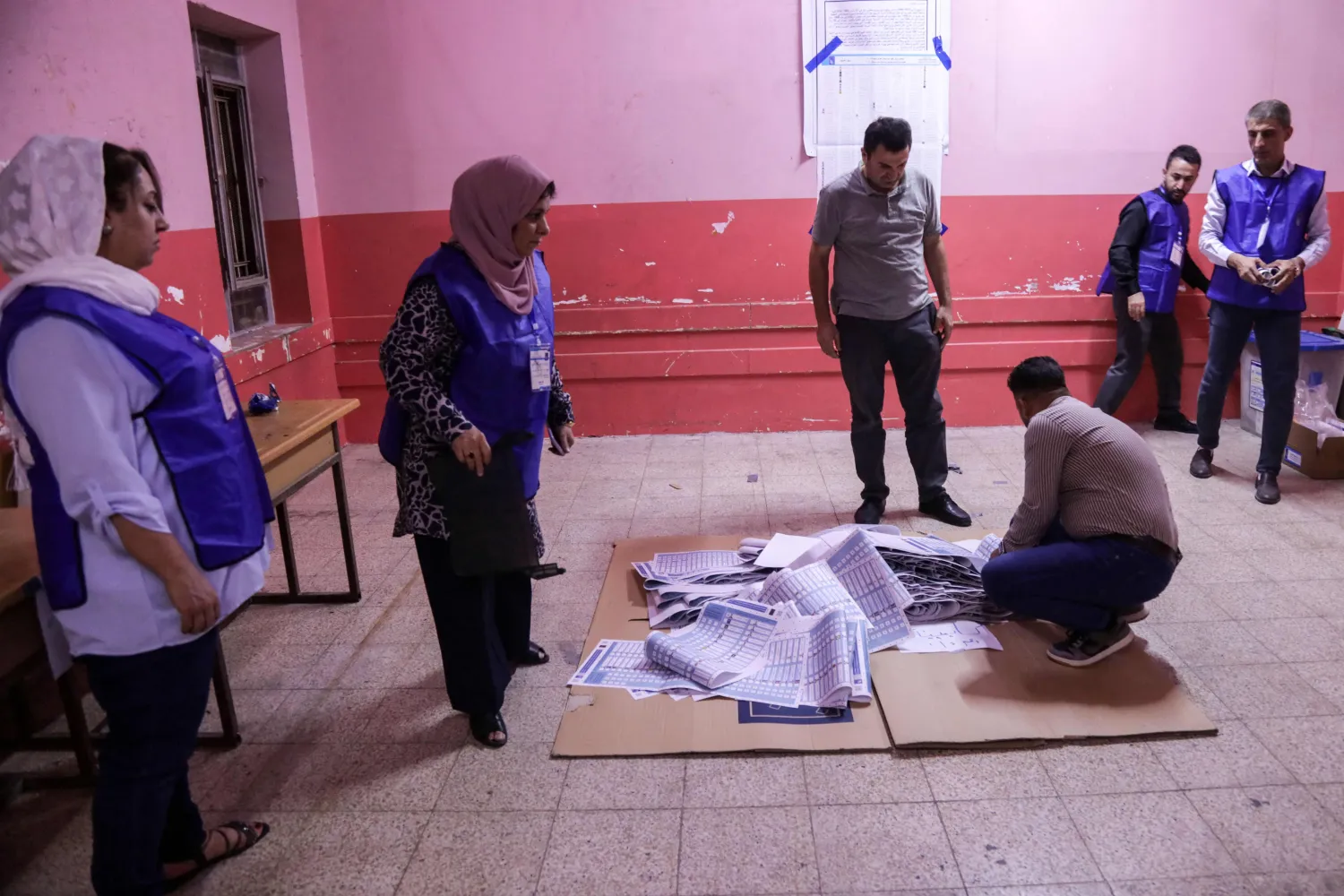
Employees of Iraq's Independent High Electoral Commission (IHEC) count votes at the end of the parliamentary election, at a polling station in Irbil, the capital of Iraq's autonomous northern Kurdish region, on October 20, 2024. (Photo by Safin HAMID / AFP)
TT

Iraq's Kurdish Region Goes to the Polls With a Flagging Economy and Political Infighting Top of Mind

Employees of Iraq's Independent High Electoral Commission (IHEC) count votes at the end of the parliamentary election, at a polling station in Irbil, the capital of Iraq's autonomous northern Kurdish region, on October 20, 2024. (Photo by Safin HAMID / AFP)

Residents of Iraq’s semi-autonomous northern Kurdish region went to the polls in long-awaited parliamentary elections Sunday under the shadow of ongoing rivalries, economic instability and unresolved disputes with Baghdad.
The primary competitors are the two dominant Kurdish parties: the Kurdistan Democratic Party and the Patriotic Union of Kurdistan. The two have historically controlled different parts of the region, with the KDP overseeing the regional capital, Irbil, and Dohuk and the PUK governing Sulaymaniyah.
This division has frequently led to political deadlock. The parliamentary elections, originally set for 2022, were postponed several times amid disputes over the election law and procedures.
Ministry of Interior personnel and peshmerga forces — the regional military — voted in special elections Friday, with the general public voting Sunday.
In Friday’s special election, the KDP secured a significant lead, capturing 60% of the votes, while the PUK got around 30%. The New Generation Movement, an opposition party that has seen a gradual rise in support, garnered 5.3% of the total, up from 3% in the 2018 special election. In that special election, the KDP garnered 40% of the vote and the PUK 28.5%.
While New Generation’s appeal continues to grow, particularly among younger voters frustrated with the traditional political system, it still faces significant challenges in competing with the well-established dominance of the KDP and PUK.
Results of Sunday's vote were expected to be announced Monday.
At some polling centers, there were delays due to malfunctions in fingerprint scanners used for biometric verification of voters’ identities. In some cases, it was unclear if voters whose fingerprints could not be scanned would be able to vote at all.
At a center in Irbil's Ankawa district, resident Raman Ramzi said his wife and mother hadn't been able to vote due to fingerprint and ID recognition issues caused by the biometric machines. A number of other would-be voters left the station without casting a vote due to the same issue.
At another polling station in Irbil, coordinator Sirwan Gardi said that three to four percent of prospective voters' fingerprints were not being recognized by the devices, particularly older people and women.
Rizgar Maghdid, whose fingerprint was not recognized, said he felt sad because he could not vote. Voting “is an essential right of humans,” he said. “I would like to vote for the person who would serve us and our country.”
Regional government Prime Minister Masrour Barzani, a KDP official, called on voters to “reward service and truthfulness and punish the parties that are playing with the rights and destiny of the people of Kurdistan," using the region's local name.
The region’s economic struggles are voters’ primary concern. Despite its oil wealth, the Kurdish region faces significant economic issues, including delayed payment of salaries to civil servants, fluctuating oil prices, and budget cuts from Baghdad. The public is deeply dissatisfied with the economy and lack of opportunities, and many blame political leaders for mismanagement.
“People want to have electricity and get paid their salary on time, and to have more jobs. This is all they want," said Ghazi Najib, who went to the polls in Irbil.
Corruption is also among the central issues in the election. For years, the regional government has faced allegations of nepotism and lack of transparency. Many voters, particularly among the younger generation, are calling for reforms to address these concerns.
Many voters, however, have lost hope for reforms and are also skeptical of opposition parties’ ability to make changes, given the longstanding hold the two major parties have over the political landscape.
Political cooperation with the central government is another key electoral issue. Relations between Irbil and Baghdad have remained tense since a 2017 referendum over independence for the Kurdish region, particularly over issues of oil revenue sharing and budget allocations.
Iraqi Prime Minister Mohammed al-Sudani in a recent visit to Irbil said, “We are committed to ensuring the rights of the Kurdish people, but this must be done within Iraq’s constitution.”
In certain areas, the current elections are significantly influenced by security concerns since the ISIS group sleeper cells are still active in areas that are disputed between the regional and central governments.
“We hope that Kurdistan will be more developed, and to see more safety and reconstruction in Kurdistan,” said Jamila Mohammed Amin, a voter in Irbil. “All political parties and entities should work together and achieve these goals and protect it against enemies.”



UN: Drone Attack Hits Sudan Aid Truck

Shops operate beneath a war-damaged building in Omdurman, on the outskirts of Khartoum, Sudan, Thursday, April 23, 2026. (AP Photo/Bernat Armangue)
TT

UN: Drone Attack Hits Sudan Aid Truck

Shops operate beneath a war-damaged building in Omdurman, on the outskirts of Khartoum, Sudan, Thursday, April 23, 2026. (AP Photo/Bernat Armangue)

A drone attack hit an aid truck in Sudan's North Darfur state, destroying all the supplies on board, the UN refugee agency said on Sunday, without identifying who was responsible.

Drone strikes by both the Sudanese army and the Rapid Support Forces (RSF), who have been locked in a brutal war since April 2023, have escalated in recent months, often killing dozens at a time.

The UNHCR-operated vehicle "came under drone attack" on Friday while transporting emergency shelter kits to Tawila, home to more than 700,000 displaced people who fled fighting elsewhere in the western Darfur region, AFP quoted the agency as saying.

The driver escaped unhurt, but all supplies were destroyed in the resulting fire, it added.

UNHCR condemned the attack, warning that it would "leave 1,314 families living in desperate conditions in Tawila without shelter" at a time when humanitarian needs are already overwhelming.

More than 127,000 people fled El-Fasher, North Darfur's capital and the army's last stronghold in the region, after it fell to paramilitary forces in October, with reports of mass killings, sexual violence, looting and rape following the takeover.

Fighting has since spread to neighboring Kordofan, now the main theatre of the war, and the southeastern Blue Nile state, raising fears of a longer and increasingly fragmented conflict.

According to the UN, nearly 700 civilians have been killed in drone strikes by both sides since January alone.

UNHCR voiced "deep concern" over the rising use of drones, calling repeated attacks on humanitarian operations "particularly abhorrent".

According to an assessment by the UN's Food and Agriculture Organization, 28.9 million people, around 62 percent of Sudan's population, are facing acute food insecurity.

That includes 10.2 million who face severe food insecurity, in particular in the wider Darfur region and South Kordofan state.

Famine was declared last year in El-Fasher and Kadugli, the capital of South Kordofan, with 20 other areas at risk in Darfur and Kordofan, a UN-backed assessment found.

The conflict has already killed tens of thousands, uprooted over 11 million and created the world's largest displacement and hunger crises.


Palestinian Leader's Loyalists Win Local Elections, including Some in Gaza

A Palestinian man votes during the municipal election at a polling station in Deir al-Balah, central Gaza Strip April 25, 2026. REUTERS/Mahmoud Issa
TT

Palestinian Leader's Loyalists Win Local Elections, including Some in Gaza

A Palestinian man votes during the municipal election at a polling station in Deir al-Balah, central Gaza Strip April 25, 2026. REUTERS/Mahmoud Issa

Loyalists of President Mahmoud Abbas won most races in Palestinian municipal elections, election officials said on Sunday, in a vote that for the first time in nearly two decades included a city in the Gaza Strip run by rival Hamas.

Saturday’s ballot marked the first elections of any kind in Gaza since 2006 and the first Palestinian polls since the Gaza war began more than two years ago with Hamas' cross-border attack on southern Israel.

Abbas' West Bank–based Palestinian Authority (PA) said the inclusion of the Gaza city Deir al-Balah, which suffered less damage than other areas of the coastal territory during the war, was intended to show that Gaza was an inseparable part of a future Palestinian state.

The elections, in which voter turnout was low, had been held "at a highly sensitive moment amid complex challenges and exceptional circumstances", Palestinian Prime Minister Mohammad Mustafa said as results were announced on Sunday.

But they represented "an important first step in a broader national process aimed at strengthening democratic life ... and ultimately achieving the unity of the land", he said.

POSSIBLE INDICATOR OF HAMAS SUPPORT

Hamas, which ousted the PA from Gaza in 2007, did not formally nominate candidates in Gaza and boycotted the race in the Israeli-occupied West Bank, where Fatah's victory was widely expected.

But some candidates on one of the Deir al-Balah lists were widely seen by residents and analysts as aligned with the movement, making the vote a potential indicator of support for the Islamist group.

Preliminary results showed that the list, known as Deir al-Balah Brings Us Together, won only two of the 15 seats contested in Gaza.

The Nahdat Deir al-Balah list, backed by Abbas' Fatah party and the Western-backed PA, secured six seats. The remaining seats were won by two other Gaza-based groups, Future of Deir al-Balah and Peace and Building, not affiliated with either faction.

Abbas loyalists swept the election in the West Bank, running unchallenged in many seats.

"By electing figures linked to Fatah, voters appear to be seeking unrestricted international support for municipal governance and a gradual political shift that could extend beyond the local level," said Palestinian political analyst Reham Ouda.

The recent war has left much of Gaza reduced to rubble, with many residents displaced and focused on survival. Israel has continued conducting strikes despite an October ceasefire.

In Gaza voter turnout reached just 23%, while in the West Bank it was 56%, according to Chairman of the Central Elections Commission Rami al-Hamdallah.

Al-Hamdallah said some of the ballot boxes and voting equipment did not make it into the enclave because of Israeli security restrictions, though those challenges were overcome.

Hamas' Gaza spokesperson, Hazem Qassem, downplayed the significance of the election results, saying that they had no impact on wider national issues.


Arab Parliament Condemns Attack Targeting Two Border Posts in Kuwait

Arab Parliament logo
TT

Arab Parliament Condemns Attack Targeting Two Border Posts in Kuwait

Arab Parliament logo

Arab Parliament Speaker Mohammed Al-Yamahi has condemned the blatant attack that targeted two sites at the northern land border posts of Kuwait using two explosive-laden drones coming from Iraq, SPA reported.

In a statement, Al-Yamahi stressed the Arab Parliament’s condemnation and categorical rejection of any infringement on the sovereignty of Kuwait or any attempt to undermine its security and stability.

He stressed the Arab Parliament’s full solidarity and support for Kuwait in confronting such attacks, reiterating its backing for all measures taken to protect its security and noting that the security of Kuwait is an integral part of Arab national security.