Lebanese Court Releases Rifaat al-Assad’s Granddaughter, her Mother
Syria’s Rifaat al-Assad and his granddaughter Shams Duraid al-Assad. Photo: X
Lebanese authorities have released Shams Duraid al-Assad, granddaughter of Syria’s Rifaat al-Assad, and her mother, Rasha Khazem, a week after their arrest at Beirut Airport for using forged passports to try to travel abroad.
A judicial source told Asharq Al-Awsat that Raed Abou Chakra, a deputy prosecutor general in Mount Lebanon, released the pair after the completion of the initial investigations.
They were charged with possessing and using forged passports, and the case was referred to Baabda Criminal Court for trial.
The source said their release followed the end of their pretrial detention period, noting the charge is a misdemeanor. The court may consider the detention sufficient or impose a fine.
Also, they must stay in Lebanon until their trial ends and the sentence is carried out. A judicial source described their legal situation as “difficult and complex.”
The source said that after the court’s ruling, General Security could issue documents allowing them to move freely in Lebanon until a legal way for them to leave is found.
This will remain the case until they obtain new passports, either from Syrian authorities or the Syrian embassy in Beirut. The embassy halted consular services after being linked to the forgery of their previous passports.
Moreover, they admitted after their arrest that they entered Lebanon illegally because their passports had expired. They said they were unprepared for the rapid collapse of Bashar al-Assad’s regime, which left them unable to obtain new passports.
A judicial source said the two women can legally return to Damascus to get new passports, as they face no charges in Syria.
“Many families linked to the Assad regime still live in Syria,” the source said, adding that Lebanon will not force them to return unless they choose to.
Exceptional School Year: South Lebanon Families Weigh Options Amid War Fearshttps://english.aawsat.com/arab-world/5310110-exceptional-school-year-south-lebanon-families-weigh-options-amid-war-fears
A member of the Red Cross provides learning activities to children inside a tent at Camille Chamoun Sports City stadium turned into a temporary shelter in Beirut, Lebanon, May 8, 2026. REUTERS/Mohamed Azakir
Exceptional School Year: South Lebanon Families Weigh Options Amid War Fears
A member of the Red Cross provides learning activities to children inside a tent at Camille Chamoun Sports City stadium turned into a temporary shelter in Beirut, Lebanon, May 8, 2026. REUTERS/Mohamed Azakir
For many families in southern Lebanon, choosing a school is no longer a decision made months in advance.
With September approaching, parents are still weighing where to enroll their children, watching the security situation and recalling the upheaval of the past two years, when thousands of students were kept out of classrooms, families were displaced and schools shifted from in-person to remote learning.
The uncertainty has produced starkly different choices. Some families are enrolling children in schools in the areas where they were displaced.
Others are opting for lower-cost public schools in case classrooms are forced to close again. Some are seeking schools in safer areas that stayed open during the previous war.
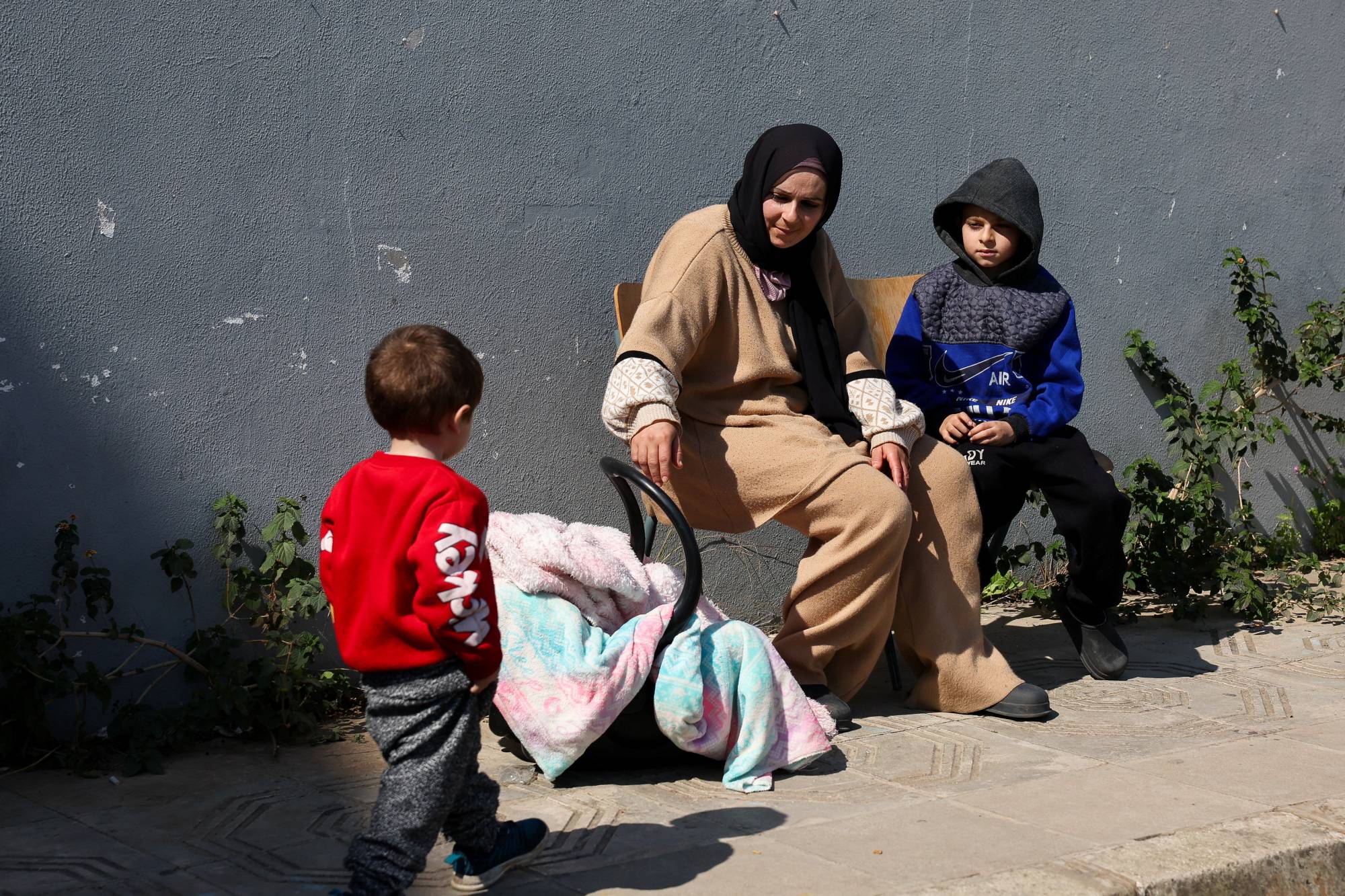
A displaced woman with children sits outside a school-turned-shelter, following an escalation between Hezbollah and Israel amid the US-Israeli conflict with Iran, in Beirut, Lebanon, March 3, 2026. REUTERS/Mohamed Azakir
Normally, most Lebanese schools, particularly private ones, complete enrollment by the end of the previous academic year, allowing the new school year to begin with student lists already finalized.
This year, some schools are keeping registration open through the first two weeks of September as parents hesitate over where to send their children.
“I enrolled my children, but I still haven’t bought their books,” said Abeer, a mother of three.
“Every day I look at the book lists and wonder: Should I wait, or pay for them and have the same thing happen as in the past two years? I’ll wait until mid-September before deciding.”
For Maryam, safety means keeping school close to home.
“My son is in first grade. I enrolled him in the public school near us in the village,” she said. “That way, if anything happens, I can pick him up quickly and flee at any moment.”
Parents from border areas who do not expect to return home soon are among those searching for schools where they have been displaced.
Others are turning to public schools, known for their lower fees, wary of paying high tuition only for schools to close again.
Some families are taking another approach: looking for schools in safer areas that managed to keep classrooms open during the previous war.
For parents reluctant to repeat the experience of remote learning, that has become a key condition.
“We decided to stay in the area where we were displaced,” said Um Ahmad. “So I looked for a school that did not close during the war and enrolled my children there.”
“I don’t believe remote learning is as beneficial as in-person education,” she said. “There is also the severe psychological strain that war places on my children and on us adults alike. So I believe in-person learning is better as long as it remains possible.”
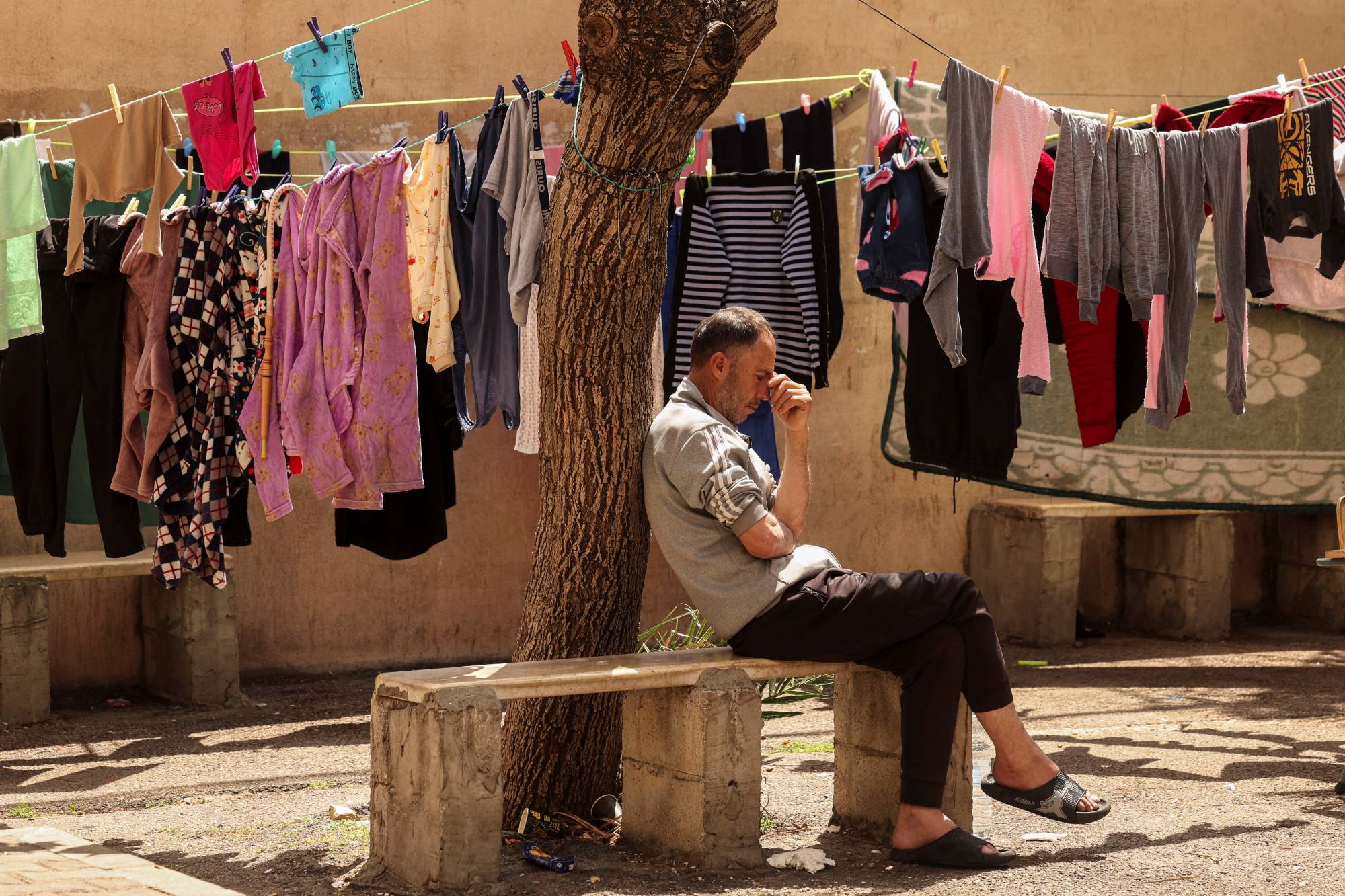
A displaced man, who fled his home after an Israeli evacuation order, sits in a university-turned shelter in Sidon, Lebanon, April 13, 2026. REUTERS/Aziz Taher
Schools prepare for both scenarios
Schools are facing the same uncertainty.
Several schools in southern Lebanon outside areas exposed to bombardment are preparing to open for the new academic year, but they are not assuming in-person learning will remain possible throughout it.
One private school in Nabatieh told parents it was preparing to “adopt in-person learning whenever security conditions allow.”
The message reflects a broader effort by schools to prepare for either in-person or remote teaching, depending on developments on the ground.
The approach is also in line with the Education Ministry’s plan for the 2026-27 academic year, which seeks to keep education running according to conditions in each area: in-person teaching where safety and preparedness allow, and remote learning in areas affected by the security situation.
Between school and home, safety comes first
Some families have made the opposite calculation, choosing remote learning as the safer option.
Leila’s children had been attending a secondary school in Toul, in the Nabatieh district. She decided to move them to another school in Zebdine after their former school said it would return to in-person teaching next year, while the new school announced it would continue remotely.
“I’ll keep them with me at home,” she said. “That will feel safer to me.”
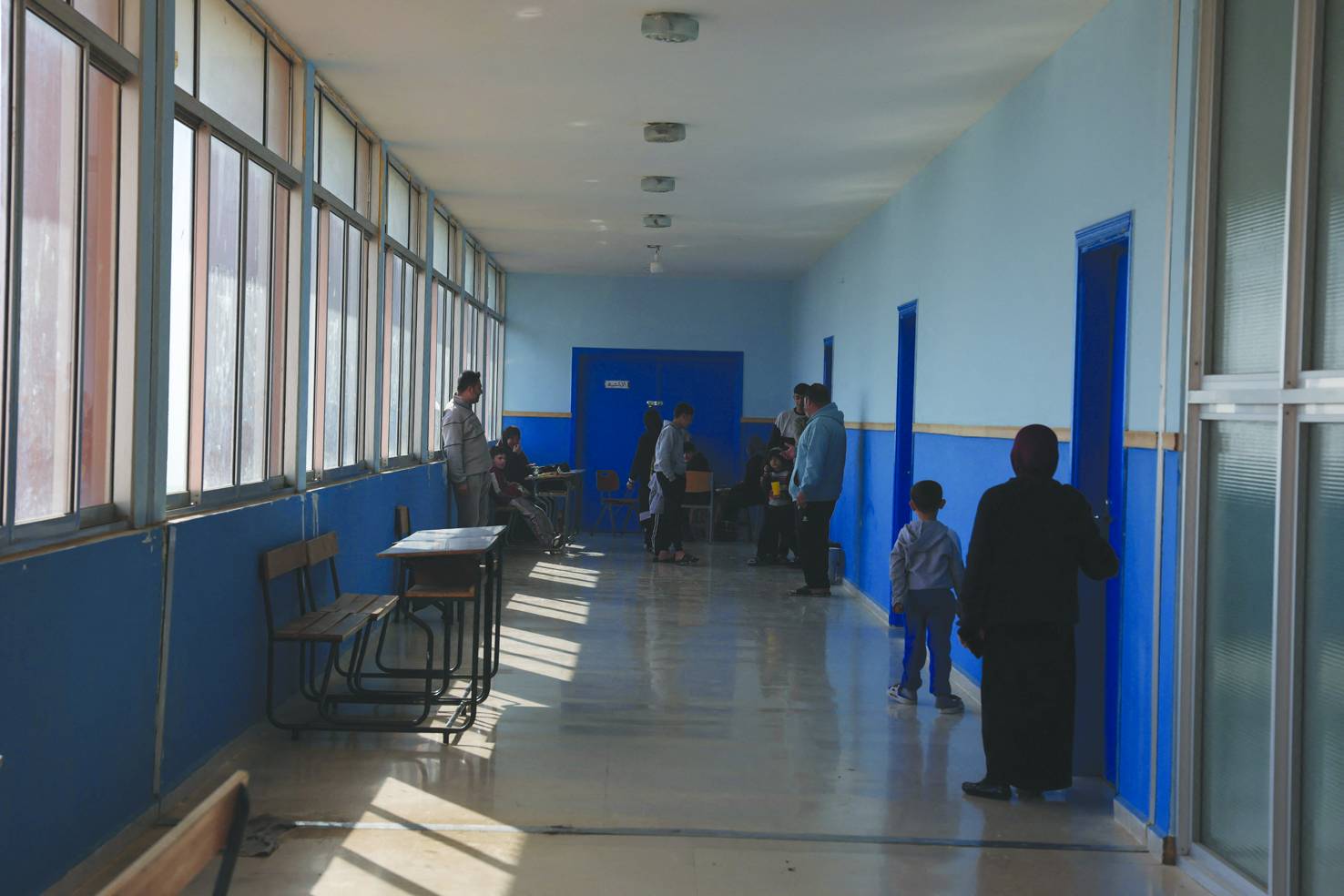
People shelter at a school, which is hosting displaced people, following an escalation between Hezbollah and Israel, amid the US-Israeli conflict with Iran, in Lebaa, Lebanon, March 15, 2026. REUTERS/Raghed Waked
The Tarhini family made a similar choice from abroad.
They left for Africa after the war broke out and enrolled their children in a Lebanese school offering remote learning while they waited for the situation to stabilize.
“The political and battlefield developments do not bode well, and it seems the war will undoubtedly return,” the father said, adding that the family’s decision gave him greater peace of mind for now.
Barrack: Israeli Strike on Syria’s Abu al-Duhur Base Sought to Bait Türkiyehttps://english.aawsat.com/arab-world/5310101-barrack-israeli-strike-syria%E2%80%99s-abu-al-duhur-base-sought-bait-t%C3%BCrkiye
Barrack: Israeli Strike on Syria’s Abu al-Duhur Base Sought to Bait Türkiye
Abu al-Duhur airbase following strikes, Syria, August 18, 2026. REUTERS/Stringer
The Israeli strike on the Abu al-Duhur military base in northern Syria near the Turkish border last Tuesday, may have been intended to provoke Ankara and is considered a “very dangerous game,” US Special Envoy to Syria and Ambassador to Türkiye Tom Barrack said on Saturday.
Eight Israeli airstrikes hit the airbase early Tuesday, targeting the runway and storage facilities, Syria’s state-run Al-Ikhbariya had reported.
In response, Ankara accused the Netanyahu government of using “cheap politics” for electoral gain and seeking to portray Türkiye as a new threat.
According to Barrack, the incident escalated from another Israeli strike in Syria into a moment that could have triggered a far more dangerous regional confrontation.
The ambassador invoked the downing of a Russian jet in late 2014 that escalated regional tensions.
In a YouTube interview with podcast host Mario Nawfal and in comments to PBS NewsHour, Barrack said the incident in which Israeli jets, without advance warning, struck the airbase in Syria - around 80 kilometers east of the Turkish border - intended to “bait” or provoke Ankara.
He described a situation in which fighter jets operate near a border without coordination or warning as a “very dangerous game.”
Last Tuesday, Israeli Prime Minister Benjamin Netanyahu’s office described the airstrikes as a warning to Türkiye against expanding its military presence in Syria or helping rebuild the Syrian armed forces.
In return, Syrian Foreign Minister Asaad al-Shaibani told Axios that Damascus had previously informed Israel there were no plans to establish a Turkish military base at Abu al-Duhur, which was being rehabilitated for use by the Syrian Air Force.
For its part, the Turkish presidency rejected the Israeli allegations as “baseless,” accusing Netanyahu of promoting them ahead of Israel’s October elections and calling on the international community to curb Israeli actions threatening regional peace and stability.
Barrack said Israel might have received intelligence indicating Turkish military personnel or military assets could be stationed at the Syrian base.
According to Barrack, Israel raised the concern with the United States about six days before the strike.
“We have some intelligence that there might be Turkish movement into this site, which we would be very concerned about,” Barrack said about the message delivered to Washington.
Barrack then confirmed reports that Mossad chief Roman Gofman had spoken with al-Shaibani several days before the strike to convey Israel’s concerns. He described the talks as a two-hour, in-depth conversation.
Despite those contacts, Israeli forces struck the base’s runways without Türkiye receiving advance warning of the operation.
Scenarios of Israeli Strikes on Abu Al-Duhur Base
According to Barrack, one possibility that led to the strikes on Abu al-Duhur is that “the Israelis were baiting the Turks.”
He directly linked this possibility to Israeli politics, saying that the strike may have been a “very aggressive but maybe a well-received pre-election concept.”
He added that another possible reason for the attack on Abu Duhur was a miscommunication between the Israeli military and the country’s intelligence agency.
Barrack said it was likely that Israel had intelligence suggesting Türkiye may be bolstering its presence in the area and “a commander somewhere in the field made a decision ‘We’re not going to let that happen’... What they didn’t do is tell us or Türkiye.”
Barrack said the Turkish leadership exercised “maximum restraint and patience” when they saw Israeli aircraft, and that they did not allow tensions to escalate into direct conflict.
He told PBS NewsHour that Türkiye had explicitly stated it has no aggressive intentions or posture toward Israel and does not want to participate in any military operation or direct conflict. “What the Turks want is a sovereign and independent Syria, and that is what we, Israel, and all the countries of the region want,” he said.
While the American diplomat acknowledged “Israel's legitimate security concerns,” he stressed that diplomacy and maintaining open channels of communication “are a priority under the current circumstances.”
Cheap Politics
For its part, Ankara said the Netanyahu government is seeking to portray Türkiye as a new threat as part of “cheap politics” aimed at gaining an electoral advantage.
Türkiye's Communications Directorate on Friday warned that Israel's increasingly aggressive threat rhetoric poses serious risks to regional and global stability.
It said the “cheap politics” pursued by Netanyahu and his associates, which it said was also designed to secure an advantage in elections, has no resonance in Israeli society, the region, the international community or Türkiye.
The directorate strongly rejected remarks by the Israeli Prime Minister's Office concerning President Recep Tayyip Erdogan.
The office on Friday called Erdogan an “antisemitic dictator.”
The directorate described the comments as an “impertinent rant” devoid of historical facts and political seriousness and another sign of the desperation of an administration seeking to evade accountability for war crimes and crimes against humanity.
Blast Targets Security Forces’ Bus Near Damascus, Causing Injurieshttps://english.aawsat.com/arab-world/5309982-blast-targets-security-forces%E2%80%99-bus-near-damascus-causing-injuries
Injuries were reported among the passengers. (SANA)
TT
TT
Blast Targets Security Forces’ Bus Near Damascus, Causing Injuries
Injuries were reported among the passengers. (SANA)
An explosive device targeted a bus carrying security forces near the Syrian capital Damascus on Saturday, resulting in injuries among the passengers, state media reported.
"An explosive device targeted a bus carrying Internal Security Forces personnel on the Maarounah-al-Tal road in Damascus countryside, leaving several personnel injured," state news agency SANA reported.
"Authorities are investigating the attack and working to identify those responsible," the news agency added, without immediately providing further details.
It published pictures showing a badly damaged bus at the side of a road, with its windows and one of its doors blown out, with glass scattered on the front seat.
Syria's authorities have faced significant security challenges since overthrowing longtime ruler Bashar al-Assad in late 2024, with Damascus and its suburbs the site of multiple attacks.
Earlier in August, a bus blast wounded 14 people in Jaramana, a town near Damascus.
In July, two blasts went off near a hotel where visiting French President Emmanuel Macron had been staying, though he was not in the facility at the time.
That blast killed one person and wounded 36 others, with authorities later saying they had arrested those responsible, adding that they were part of the ISIS group.
لم تشترك بعد
انشئ حساباً خاصاً بك لتحصل على أخبار مخصصة لك ولتتمتع بخاصية حفظ المقالات وتتلقى نشراتنا البريدية المتنوعة