


Israel Eases Shooting Orders for Soldiers in West Bank

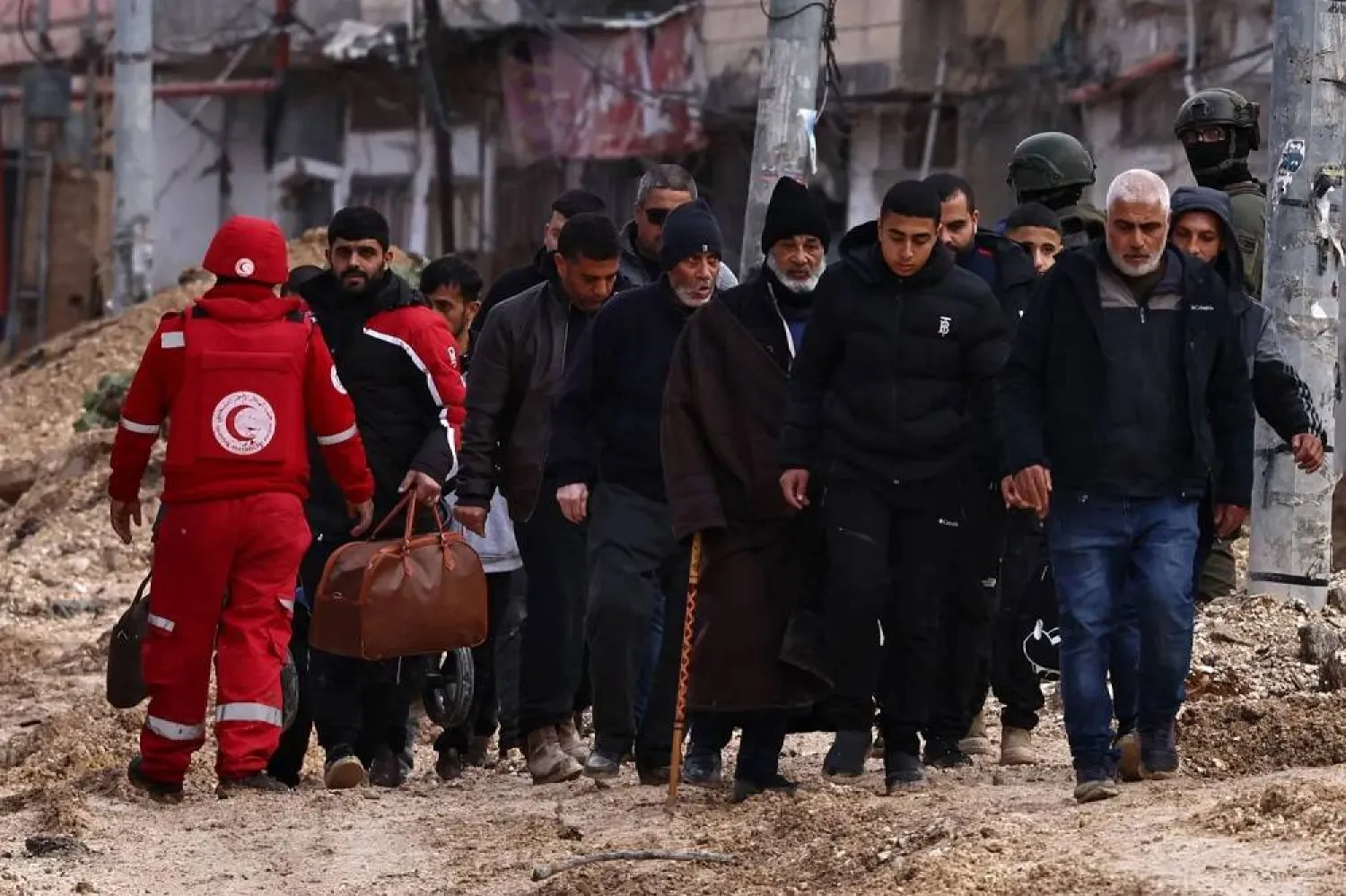
Israeli soldiers keep watch as Palestinians leave their homes for safety during a raid by the army in the Nur Shams refugee camp near Tulkarm in the occupied West Bank on February 10, 2025. (AFP) 
TT

Israel Eases Shooting Orders for Soldiers in West Bank

Israeli soldiers keep watch as Palestinians leave their homes for safety during a raid by the army in the Nur Shams refugee camp near Tulkarm in the occupied West Bank on February 10, 2025. (AFP) 

The Israeli Army has expanded its shooting orders for its soldiers in the occupied West Bank, leading to the recent high death toll of unarmed Palestinians, Israeli media said on Monday.

The Haaretz newspaper said the army has decided to implement the open-fire mechanism it used in the Gaza Strip, whether suspected or not, in the West Bank.

The change in the guidelines, according to the report, was initiated by the head of the Central Command, Avi Bluth, and the commander of the Judea and Samaria Division, Brig. Gen. Yaki Dolf.

Army sources told the newspaper Bluth ordered that the Israeli forces may shoot to kill anyone “messing with the ground” and that there is no need to apply the procedure for arresting a suspect in these cases.

Meanwhile, Dolf ordered that forces may fire live rounds at any vehicle coming toward a checkpoint from a combat zone to force the driver to stop before reaching it, according to the same source.

The Israeli army claimed the order's objective is to prevent Palestinians in the West Bank from planting explosive devices on roads where the Israeli army operate, but combat sources say that the expanded order has made soldiers on the ground “trigger-happy.”

Since January 21, Israeli forces have expanded their ongoing military campaign in the West Bank to include the camps of Nur Shams and Al-Fara'a, following similar attacks that killed dozens in Jenin and Tulkarm.

They say that the expanded open-fire orders by the Central Command have resulted in several serious incidents. On Sunday, soldiers shot to death a man and woman, who was eight months pregnant, when they drove toward an Israeli checkpoint near Tulkarm.

The army’s preliminary investigation found that the man was shot and killed inside the car without trying to breach the checkpoint or threaten the soldiers, reported Haaretz.

His pregnant wife, Sundus Shalabi, 23, was able to get out of the car and was shot three times in the chest.

According to the investigation, the woman “looked suspiciously at the ground.” She was unarmed, and no weapons were found near her that might have served as evidence she was trying to place an explosive device.

Haaretz said commanders and soldiers on the ground say that the Central Command decided to copy operating methods used in Gaza in the West Bank.

And while Israel has been concentrating its operations across the northern West Bank, killing, destroying and displacing Palestinians, the army is conducting large-scale arrest campaigns in other areas of the West Bank.

Prisoners' affairs groups said on Monday the army detained 580 Palestinians in the West Bank in January.

Most of the detainees were taken into custody from the northern city of Jenin and its refugee camp, where Israel has launched a deadly onslaught since Jan. 21, the Commission of Detainees’ Affairs and the Palestinian Prisoner Society said in a joint statement.

They said 17 women and 60 children were among the detainees.

At least 14,500 arrests have been reported in the West Bank since the eruption of the Gaza war in 2023 and until the ceasefire was reached on January 19, 2025, said the prisoners’ affairs groups.

This figure excludes the number of arrests in Gaza that are estimated in thousands.

Meanwhile, the UN agency that assists Palestine refugees UNRWA warned on Monday that the forced displacement of Palestinian communities in the northern part of the West Bank is escalating at an alarming pace.

Several refugee camps are nearly empty after Israeli forces launched Operation Iron Wall on January 21, making it the longest operation in the West Bank since the second intifada.

The operation started in Jenin camp and then expanded to Tulkarm, Nur Shams and Al-Fara'a camps, displacing 40,000 Palestine refugees, it said.

UNRWA said thousands of families have been forcibly displaced since Israel began carrying out large-scale operations in the West Bank in mid-2023.

“Repeated and destructive operations have rendered the northern refugee camps uninhabitable, trapping residents in cyclical displacement,” the agency stressed.



Lebanon Tells a UN Team the Country Will Need a Back-up Force Once Peacekeepers’ Term Ends

Lebanese Prime Minister Nawaf Salam, in front of the Lebanese flags (C), meets with a United Nations Security Council delegation at the government palace in Beirut, Lebanon, 05 December 2025. (EPA)
TT

Lebanon Tells a UN Team the Country Will Need a Back-up Force Once Peacekeepers’ Term Ends

Lebanese Prime Minister Nawaf Salam, in front of the Lebanese flags (C), meets with a United Nations Security Council delegation at the government palace in Beirut, Lebanon, 05 December 2025. (EPA)

The Lebanese prime minister on Friday told a visiting UN delegation that his country will need a follow-up force in southern Lebanon along the border with Israel to fill the vacuum once the UN peacekeepers' term expires by the end of next year.

The UN Security Council voted unanimously in August to terminate the UN Interim Force in Lebanon (UNIFIL) at the end of 2026 — nearly five decades after the force was deployed. The multinational force has played a significant role in monitoring the security situation in the region, including during the Israel-Hezbollah war last year.

But it has drawn criticism from officials in President Donald Trump’s administration, which has moved to slash US funding for the operation as Trump remakes America’s approach to foreign policy.

Lebanese Prime Minister Nawaf Salam held talks with the team representing the 15 members of the UN Security Council, saying he believes another, follow-up force would help Lebanese troops along the border where they have intensified efforts in the volatile area that witnessed the 14-month war between Israel and the Iran-backed Hezbollah group.

Salam proposed that a small follow-up force could work much like the UN observers force that has been deployed along Syria’s border with Israel since 1974.

There was no immediate response from the UN delegation, which arrived in Lebanon after a visit to Syria. Earlier Friday, the delegation also met with Lebanese President Joseph Aoun, who said Lebanon would welcome any country's decision to keep its forces in southern Lebanon after UNIFIL's term expires.

Aoun also touted Lebanon’s appointment of former ambassador to Washington, Simon Karam, to head the Lebanese delegation to a previously military-only committee that monitors the US-brokered ceasefire that halted the latest Israel-Hezbollah war.

The appointment has angered Hezbollah, whose leader Sheikh Naim Qassem said in a televised speech later Friday that the appointment of the ex-ambassador was allegedly a “concession" to Israel.

Qassem said it would not change "the enemy’s stance and its aggression,” referring to Israel’s almost daily airstrikes on what the Israeli military says are Hezbollah targets in Lebanon since the ceasefire went into effect in November last year. The UN says that the Israeli strikes since the ceasefire have killed 127 civilians.

Israel’s air force carried out a series of airstrikes on Thursday in south Lebanon, saying it struck Hezbollah’s infrastructure. Warnings were issued in advance to evacuate the area.

The latest Israel-Hezbollah war began a day after Hamas attacked southern Israel on Oct. 7, 2023, with Hezbollah firing rockets into Israel in solidarity with the Palestinian Hamas group. Israel's response operation that included bombardment and a ground operation last year has severely weakened Hezbollah.


Palestinians Say Israeli Army Killed Man in Occupied West Bank

 Israeli military vehicles roll during a raid in Ramallah, in the occupied West Bank on December 1, 2025. (AFP)
Israeli military vehicles roll during a raid in Ramallah, in the occupied West Bank on December 1, 2025. (AFP)
TT

Palestinians Say Israeli Army Killed Man in Occupied West Bank

 Israeli military vehicles roll during a raid in Ramallah, in the occupied West Bank on December 1, 2025. (AFP)
Israeli military vehicles roll during a raid in Ramallah, in the occupied West Bank on December 1, 2025. (AFP)

The Ramallah-based Palestinian health ministry said that Israeli forces killed a man in the northern occupied West Bank on Friday.

"Bahaa Abdel-Rahman Rashid (38 years old) was killed by Israeli fire in the town of Odala, south of Nablus," the health ministry said in a statement.

Shortly before, the Palestinian Red Crescent said its teams handled the case of a man "who suffered a critical head injury during clashes in the town of Odala near Nablus, and CPR is currently being performed on him".

The Israeli military told AFP it was looking into the incident.

Witness and Odala resident Muhammad al-Kharouf told AFP that Israeli troops were patrolling in Odala and threw tear gas canisters at men who were exiting the local mosque for Friday prayer.

Rashid was killed by live fire in the clashes that followed, added Kharouf, who had been inside the mosque with him.

The Israeli military said Friday it had completed a two-week counter-terrorism operation in the northern West Bank during which it killed six gunmen and questioned dozens of suspects.

It told AFP that Rashid was not among the six gunmen killed over the past two weeks.

Dozens of men including Rashid's father gathered at the nearby city of Nablus' Rafidia hospital to bid him goodbye on Friday, an AFP journalist reported.

Violence in the West Bank has soared since Hamas's October 2023 attack on Israel triggered the Gaza war.

It has not ceased despite the fragile truce between Israel and Hamas that came into effect in October.

Israeli troops or settlers have killed more than 1,000 Palestinians, many of them gunmen, but also scores of civilians, in the West Bank since the start of the Gaza war, according to an AFP tally based on Palestinian health ministry figures.

At least 44 Israelis, including both soldiers and civilians, have been killed in Palestinian attacks or Israeli military operations, according to official Israeli figures.


Lebanese President, Hezbollah Split Over Expanded Talks with Israel

A handout photo made available by the Lebanese Presidency press office shows Lebanese President Joseph Aoun (9-R) posing for a photo with a United Nations Security Council delegation following their meeting at the Presidential Palace in Baabda, east of Beirut, Lebanon, 05 December 2025. (Lebanese Presidency)
TT

Lebanese President, Hezbollah Split Over Expanded Talks with Israel

A handout photo made available by the Lebanese Presidency press office shows Lebanese President Joseph Aoun (9-R) posing for a photo with a United Nations Security Council delegation following their meeting at the Presidential Palace in Baabda, east of Beirut, Lebanon, 05 December 2025. (Lebanese Presidency)

Lebanon's president on Friday defended his decision to expand talks with Israel as a way to avoid further violence, but the head of armed group Hezbollah called it a blunder, lifting the lid on divisions at a watershed moment for the country.

Israel and Lebanon on Wednesday both sent civilian envoys to a military committee monitoring their ceasefire, a step towards a months-old US demand that the two countries broaden talks in line with President Donald Trump's Middle East peace agenda.

President Joseph Aoun told visiting representatives of the United Nations Security Council that his country "has adopted the option of negotiations with Israel" and that "there is no going back".

"These negotiations are mainly aimed at stopping the hostile actions carried out by Israel on Lebanese territory, securing the return of the captives, scheduling the withdrawal from the occupied areas, and resolving the disputed points along the Blue Line," Aoun said in a statement on Friday, referring to the UN-mapped line that separates Israel from Lebanon.

HEZBOLLAH CALLS MOVE 'FREE CONCESSION'

But the expanded talks were criticized by armed group Hezbollah.

Its head, Sheikh Naim Qassem, said on Friday afternoon that sending a civilian delegate to the truce monitoring committee was a "blunder," and urged the government to rethink its decision.

"You offered a free concession that will not change anything in the enemy's (Israel's) position or its attacks," Qassem said.

Lebanon and Israel have been officially enemy states for more than 70 years, and meetings between their civilian officials have been extraordinarily rare throughout their fraught history.

Over the last year, military officials have met as part of a committee, chaired by the United States, to monitor a 2024 truce that ended more than a year of fighting between Israel and Hezbollah which badly weakened the Lebanese Iran-backed armed group.

In that time, Israel has continued its air strikes on what it says are Hezbollah's attempts to re-arm in violation of the truce. Lebanon says those strikes and Israel's occupation of southern Lebanese territory are ceasefire breaches.

Fears are growing in Lebanon that Israel could expand its air campaign further to ratchet up pressure on the Lebanese government to disarm Hezbollah more swiftly across the country.

The group has refused to disarm in full and has raised the specter of internal strife if the state tries to confront it.