
Syria’s Sharaa Says Killings of Alawites Threaten Unity, Vows Justice

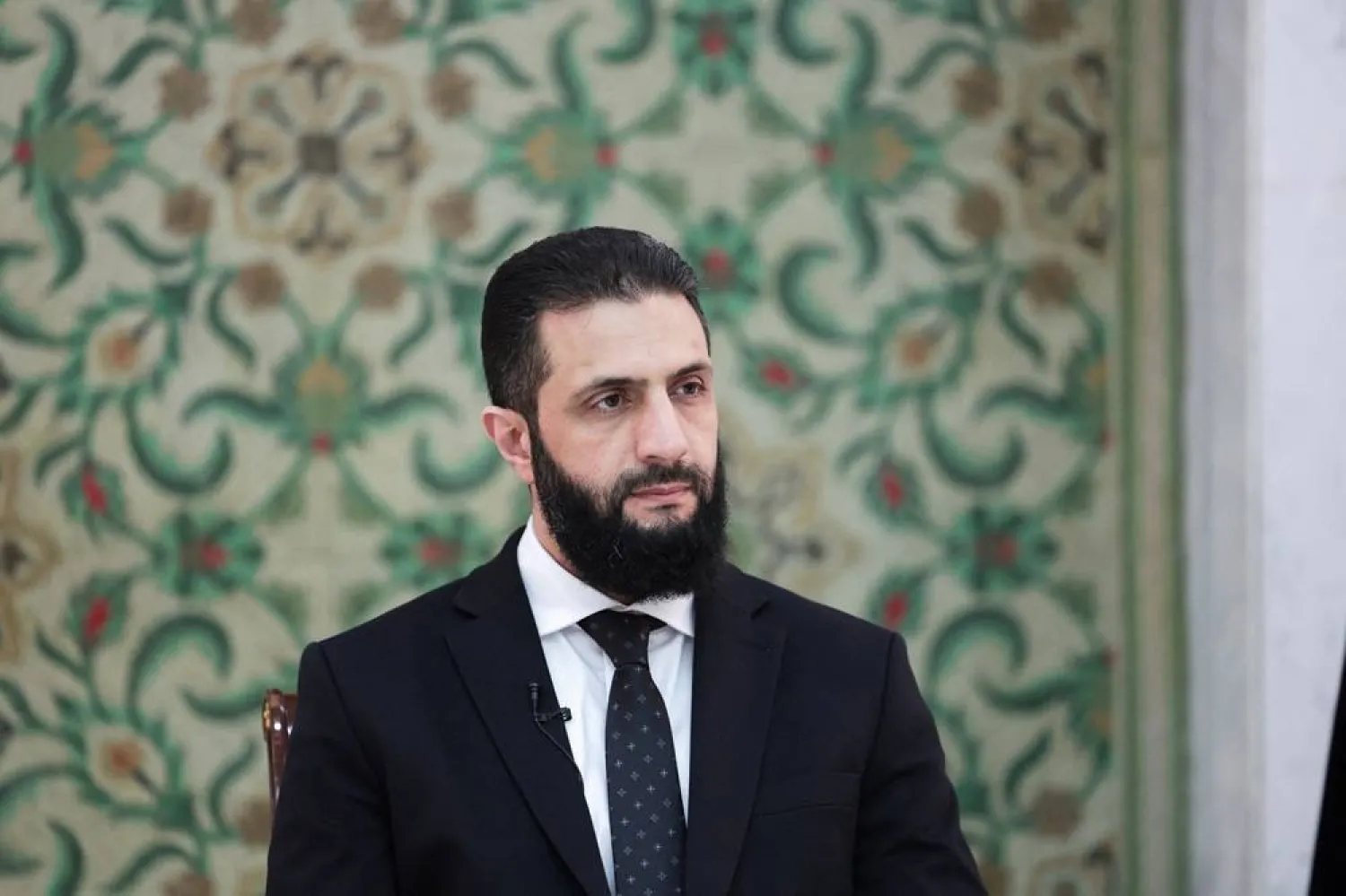
 Syria’s interim President Ahmed al-Sharaa attends an interview with Reuters at the presidential palace, in Damascus, Syria March 10, 2025. (Reuters)
Syria’s interim President Ahmed al-Sharaa attends an interview with Reuters at the presidential palace, in Damascus, Syria March 10, 2025. (Reuters)
TT

Syria’s Sharaa Says Killings of Alawites Threaten Unity, Vows Justice

 Syria’s interim President Ahmed al-Sharaa attends an interview with Reuters at the presidential palace, in Damascus, Syria March 10, 2025. (Reuters)
Syria’s interim President Ahmed al-Sharaa attends an interview with Reuters at the presidential palace, in Damascus, Syria March 10, 2025. (Reuters)

Syria's interim President Ahmed Sharaa said mass killings of members of ousted President Bashar al-Assad's minority sect were a threat to his mission to unite the country, and promised to punish those responsible, including his own allies if necessary.

In his first interview to a global news agency, held after hundreds died in four days of clashes between Alawite Muslims and Syria's new authorities, Sharaa blamed pro-Assad groups backed by foreigners for triggering the bloodshed but acknowledged that revenge killings had followed.

"Syria is a state of law. The law will take its course on all," he told Reuters from the Damascus presidential palace, where Assad resided until Sharaa's forces toppled him on December 8, forcing the ousted ruler to flee to Moscow.

"We fought to defend the oppressed, and we won't accept that any blood be shed unjustly, or goes without punishment or accountability, even among those closest to us," Sharaa said.

In a wide-ranging interview, Sharaa also said that his government had had no contacts with the United States since President Donald Trump had taken office. He repeated pleas for Washington to lift sanctions imposed in the Assad era.

He also held out the prospect of restoring relations with Moscow, Assad's backer throughout the war, which is trying to retain two major military bases in Syria.

He rejected criticism from Israel, which has captured territory in southern Syria since Assad was toppled. And he said he aimed to resolve differences with Kurds, including by meeting the head of a Kurdish-led group long backed by Washington.

While he blamed the outbreak of violence in recent days on a former military unit loyal to Assad's brother and an unspecified foreign power, he acknowledged that in response "many parties entered the Syrian coast and many violations occurred".

"It became an opportunity for revenge" for years of pent-up grievances, he said, although he said the situation had since been largely contained.

Sharaa said 200 members of the security forces had been killed in the unrest, while declining to say the overall death toll pending an investigation, which will be conducted by an independent committee announced on Sunday before his interview.

A UK-based war monitoring group, the Syrian Observatory for Human Rights, said that as of Sunday night as many as 973 Alawite civilians had been killed in revenge attacks, after fighting in which more than 250 Alawite fighters and more than 230 members of the security forces had died.

'MY CHEST TIGHTENS IN THIS PALACE'

After years in the field at the helm of a guerrilla movement that broke off from Al-Qaeda, the 42-year-old son of an Arab nationalist was soft-spoken.

"To be honest, my chest tightens in this palace. I'm astonished by how much evil against society emanated from every corner," Sharaa said.

The unrest of recent days, the bloodiest since Assad was ousted, was his biggest setback as he seeks international legitimacy, to fully lift US and other Western sanctions and assert his rule over a country fractured by 14 years of war.

He quickly welcomed a stream of foreign dignitaries and, along with his close circle, has toured the region to court support. But three months in, joy at Assad's ouster has largely been replaced by concern over the formidable challenges at home.

The economy remains in tatters, large parts of the country including its oil-rich northeast, are out of state control and Israel has struck an increasingly threatening tone backed by airstrikes, incursions and seizure of territory.

Sharaa recognized the violence of the past days threatened to derail his attempt to bring Syria together.

It "will impact this path," Sharaa said, but he vowed to "rectify the situation as much as we can".

To do that, Sharaa has set up an independent committee - the first body created by him that includes Alawites - to probe the killings within 30 days and bring perpetrators to account.

A second committee was set up "to preserve civil peace and reconciliation, because blood begets more blood," he added.

Sharaa declined to answer whether foreign fighters and other allied factions or his own security forces were involved in the mass killings, saying these were matters for the investigation.

The killings have shaken to the core Syria's coastal towns and cities of Latakia, Banyas and Jableh, forcing thousands of Alawites to flee to mountainous villages or cross the border into Lebanon.

Sharaa said Assad loyalists belonging to the 4th Division of Assad's brother, Maher, and an allied foreign power had triggered the clashes on Thursday "to foment unrest and create communal discord".

He did not identify the foreign power, but pointed to "parties that had lost out from the new reality in Syria", an apparent reference to long-time Assad ally Iran, whose embassy in Damascus is still closed. Tehran has rejected any suggestion it was involved in the violence.

'OUR DOOR IS OPEN'

Sharaa said security and economic prosperity were directly tied to lifting US sanctions imposed against Assad.

"We cannot establish security in the country with sanctions still in place against us."

But there has not been any direct contact with Trump's administration in the nearly two months since he took office, amid skepticism over Sharaa's former Al-Qaeda ties.

When asked why, he said: "The Syrian file is not on US's list of priorities. You should ask this question to them. Syria's door is open."

Meanwhile, talks are ongoing with Moscow over its military presence in the two strategic Mediterranean military bases, Tartous Naval Base and Hmeimin air base.

Sharaa said Moscow and Damascus had agreed to review all former agreements, but there had not yet been enough time to get into details.

"We do not want there to be a rift between Syria and Russia, and we do not want the Russian presence in Syria to pose a danger or threat to any country in the world, and we want to preserve these deep strategic relations," he added.


Israeli Reservist Rams Vehicle into Palestinian Man Praying in West Bank

Israeli security forces secure a street as they leave the Palestinian village of Bizariya, in the occupied West Bank, where Israeli authorities demolished the house of a Palestinian man killed in July after he and another man reportedly killed an Israeli settler on the same day, on December 24, 2025. (AFP)
TT

Israeli Reservist Rams Vehicle into Palestinian Man Praying in West Bank

Israeli security forces secure a street as they leave the Palestinian village of Bizariya, in the occupied West Bank, where Israeli authorities demolished the house of a Palestinian man killed in July after he and another man reportedly killed an Israeli settler on the same day, on December 24, 2025. (AFP)

An Israeli reservist soldier rammed his vehicle into a Palestinian man as he prayed on a roadside in ​the occupied West Bank on Thursday, after earlier firing shots in the area, the Israeli military said.

"Footage was received of an armed individual running over a Palestinian individual," it said in a statement, adding the individual was a reservist ‌and his ‌military service had ‌been terminated.

The ⁠reservist ​acted "in severe ‌violation of his authority" and his weapon had been confiscated, the military said.

Israeli media reported that he was being held under house arrest.

The Israeli police did not immediately respond to a Reuters request for comment.

The ⁠Palestinian man went to hospital for checks after ‌the attack, but was unhurt ‍and is now ‍at home.

Video which aired on Palestinian ‍TV shows a man in civilian clothing with a gun slung over his shoulder driving an off-road vehicle into a man praying on ​the side of the road.

This year ​was one of the most violent on ⁠record for Israeli civilian attacks against Palestinians in the West Bank, according to United Nations data that shows more than 750 injuries.

More than a thousand Palestinians were killed in the West Bank between October 7, 2023 and October 17, 2025, mostly in operations by security forces and some by settler violence, according to the UN In ‌the same period, 57 Israelis were killed in Palestinian attacks.


Deadly Blast Hits Mosque in Syria’s Homs, Saraya Ansar al-Sunna Claims Responsibility

Syrian security forces stand inside a damaged mosque after several people were killed in an explosion at a mosque as the Syrian Arab News Agency (SANA) said, in Homs, Syria December 26, 2025. REUTERS/Ali Ahmed al-Najjar
TT

Deadly Blast Hits Mosque in Syria’s Homs, Saraya Ansar al-Sunna Claims Responsibility

Syrian security forces stand inside a damaged mosque after several people were killed in an explosion at a mosque as the Syrian Arab News Agency (SANA) said, in Homs, Syria December 26, 2025. REUTERS/Ali Ahmed al-Najjar

A bombing at a mosque in Syria during Friday prayers killed at least eight people and wounded 18 others, authorities said.

Images released by Syria’s state-run Arab News Agency showed blood on the mosque’s carpets, holes in the walls, shattered windows and fire damage. The Imam Ali bin Abi Talib Mosque is located in Homs, Syria's third-largest city.

SANA, citing a security source, said that preliminary investigations indicate that explosive devices were planted inside the mosque. Authorities were searching for the perpetrators, who have not yet been identified, and a security cordon was placed around the building, Syria’s Interior Ministry said in a statement.

In a statement on Telegram, the Saraya Ansar al-Sunna said its fighters "detonated a number of explosive devices" in the mosque.

The same group had previously claimed a suicide attack in June in which a gunman opened fire and then detonated an explosive vest inside a Greek Orthodox church in Dweil’a, on the outskirts of Damascus, killing 25 people as worshippers prayed on a Sunday.

Several countries, including Saudi Arabia, Jordan and Lebanon, condemned the attack. 


Fuel Shortage Forces Gaza Hospital to Suspend Most Services

The sun sets behind a makeshift tent camp for displaced Palestinians set up in an area of al-Bureij camp, in the central Gaza Strip, Wednesday, Dec. 24, 2025. (AP)
TT

Fuel Shortage Forces Gaza Hospital to Suspend Most Services

The sun sets behind a makeshift tent camp for displaced Palestinians set up in an area of al-Bureij camp, in the central Gaza Strip, Wednesday, Dec. 24, 2025. (AP)

A major Gaza hospital has suspended several services because of a critical fuel shortage in the devastated Palestinian territory, which continues to face a severe humanitarian crisis, it said.

Devastated by more than two years of war, the Al-Awda Hospital in the central Gaza district of Nuseirat cares for around 60 in-patients and receives nearly 1,000 people seeking medical treatment each day.

"Most services have been temporarily stopped due to a shortage of the fuel needed for the generators," said Ahmed Mehanna, a senior official involved in managing the hospital.

"Only essential departments remain operational: the emergency unit, maternity ward and pediatrics."

To keep these services running, the hospital has been forced to rent a small generator, he added.

Under normal conditions, Al-Awda Hospital consumes between 1,000 and 1,200 liters of diesel per day. At present, however, it has only 800 liters available.

"We stress that this shutdown is temporary and linked to the availability of fuel," Mehanna said, warning that a prolonged fuel shortage "would pose a direct threat to the hospital's ability to deliver basic services".

He urged local and international organizations to intervene swiftly to ensure a steady supply of fuel.

Despite a fragile truce observed since October 10, the Gaza Strip remains engulfed in a severe humanitarian crisis.

While the ceasefire agreement stipulated the entry of 600 aid trucks per day into Gaza, only 100 to 300 carrying humanitarian assistance can currently enter, according to the United Nations and non-governmental organizations.

The remaining convoys largely transport commercial goods that remain inaccessible to most of Gaza's 2.2 million people.

- Health hard hit -

On a daily basis, the vast majority of Gaza's residents rely on aid from UN agencies and international NGOs for survival.

Gaza's health sector has been among the hardest hit by the war.

During the fighting, the Israeli miliary repeatedly struck hospitals and medical centers across Gaza, accusing Hamas of operating command centers there, an allegation the group denied.

International medical charity Doctors Without Borders now manages roughly one-third of Gaza's 2,300 hospital beds, while all five stabilization centers for children suffering from severe malnutrition are supported by international NGOs.

The war in Gaza was sparked on October 7, 2023, following an unprecedented Hamas attack on Israel that resulted in the deaths of 1,221 people, most of them civilians, according to an AFP tally based on official Israeli figures.

In Israel's ensuing military campaign in Gaza, at least 70,942 people - also mostly civilians - have been killed, according to the health ministry in the Hamas-run territory.