

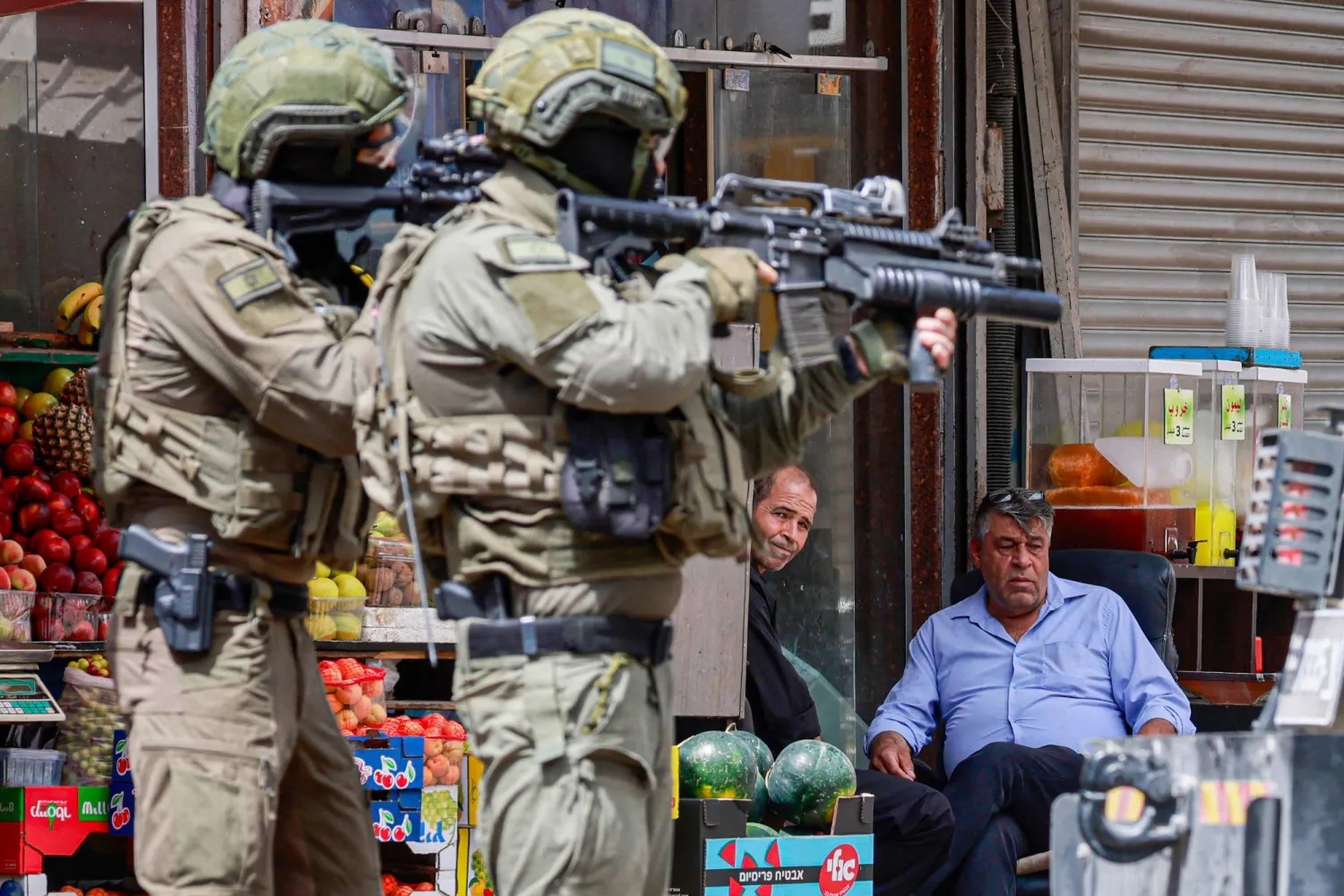

Israeli Forces Raid Money Exchange Companies in West Bank

Israeli troops aim their rifles during a raid in the heart of the Palestinian city Nablus in the occupied West Bank on May 27, 2025. (Photo by Jaafar ASHTIYEH / AFP)
TT

Israeli Forces Raid Money Exchange Companies in West Bank

Israeli troops aim their rifles during a raid in the heart of the Palestinian city Nablus in the occupied West Bank on May 27, 2025. (Photo by Jaafar ASHTIYEH / AFP)

Israeli forces on Tuesday raided several money exchange companies in what Israeli media described as part of a campaign to disrupt financial networks allegedly linked to Palestinian factions.

The campaign targeted most West Bank cities, where the occupation forces raided the offices of money exchange companies and confiscated computers and safes.

They also arrested several shop owners in Bethlehem, Ramallah, Nablus, Hebron and Jenin.

The forces confiscated cash, cryptocurrency and jewelry that were intended to finance terrorist attacks, according to the Yedioth Ahronoth newspaper.

“Israeli security forces launched a West Bank operation Tuesday targeting currency exchange businesses suspected of funneling terror funds, seizing approximately 7.5 million shekels ($2 million) in cash and assets,” the newspaper wrote.

Yedioth Ahronoth said the operation follows extensive planning by the Israeli army’s Central Command and West Bank divisions, focusing on intercepting funds used to finance “terror” activity.

In addition to cash, the newspaper wrote that the Israeli forces confiscated cryptocurrency (including Bitcoin), jewelry and other tools allegedly used by currency exchangers to transfer funds to terror networks.

Several suspects were arrested and businesses were shut down under military orders.
Since the Gaza war began on October 7, 2023, the army’s West Bank Division has escalated its financial crackdown, confiscating more than 28 million shekels ($7.5 million) in terror-linked assets, according to Yedioth Ahronoth.

It quoted Palestinian sources as saying that on Tuesday, Israeli forces raided a currency exchange company named Al-Khaleej (The Gulf) in Nablus, arresting an employee and seizing money and furniture.

On some money exchange shops, the Israeli forces left behind flyers that read: “Attention! Israeli security forces are taking action against this company due to its ties to terrorist organizations. As a resident, you should seek a different exchanger who operates lawfully. Any dealings with Al-Khaleej put you and your money at risk and may result in legal consequences. Stay away from this place.”

Al-Khaleej is the main money exchange company that Israeli forces targeted during their campaign in the West Bank.

Videos and photos showed the forces arresting several shop employees while confiscating sums of money and equipment.

The Ramallah-based Palestinian Authority did not immediately comment on the Israeli raids. But on previous occasions, it has described such campaigns as an “an act that aims to undermine the Palestinian banking sector.”

For years, Israel has been fighting what it calls the “Hamas money channels” in both Gaza and the West Bank.

Most of the seized money originated from Türkiye and Iran and was intended to support terror attacks in the West Bank and other areas, Yedioth Ahronoth said.

The Israeli army says that some of the money sent to Hamas were channeled through humanitarian aid and in hand-carry cash, while others via normal bank transfers.

It accuses the movement of smuggling money in ways that are difficult to uncover, using multiple money exchange businesses rather than a central office.



Red Crescent Says Israeli Settler Gunfire Kills Two Palestinians Including Child

A worker walks past a Palestinian flag installed along a street in Turmus Ayya village, north of Ramallah in the Israeli-occupied West Bank on April 19, 2026. (AFP)
TT

Red Crescent Says Israeli Settler Gunfire Kills Two Palestinians Including Child

A worker walks past a Palestinian flag installed along a street in Turmus Ayya village, north of Ramallah in the Israeli-occupied West Bank on April 19, 2026. (AFP)

The Palestinian Red Crescent said Israeli settler gunfire killed two people, including a 13-year-old child, in an attack on Tuesday near the city of Ramallah in the occupied West Bank.

"Two people were killed -- one aged 13 and the other 32 -- and four others were injured by live gunfire during a settler attack on the village of Al-Mughayyir near Ramallah," the Red Crescent said in a statement, adding the wounded had been taken to hospital.

When asked by AFP, the Israeli military -- which has occupied the West Bank since 1967 -- said it was looking into the incident.


Israel Says Applying Diplomatic, Military Pressure to Disarm Hezbollah

Mourners carry the flag-draped casket of a member of the Iran-backed Hezbollah group who was killed in southern Lebanon during their funeral in the Kafaat area in Beirut's southern suburbs on April 20, 2026. (AFP)
TT

Israel Says Applying Diplomatic, Military Pressure to Disarm Hezbollah

Mourners carry the flag-draped casket of a member of the Iran-backed Hezbollah group who was killed in southern Lebanon during their funeral in the Kafaat area in Beirut's southern suburbs on April 20, 2026. (AFP)

Israeli Defense Minister Israel Katz said Tuesday that his country's campaign in Lebanon relied on both military and diplomatic pressure to disarm Iran-allied Hezbollah.

"The overarching goal of the campaign in Lebanon is to disarm Hezbollah and remove the threat to the northern communities (of Israel), through a combination of military and diplomatic measures," Katz said during a ceremony marking Israel's national day of remembrance for fallen soldiers and victims of terror.

"We will act in the same way with regard to high-trajectory fire (towards Israel) from north of the Litani and from throughout Lebanon," he added, referring to the Litani river, a natural marker that cuts across southern Lebanon, below which Israel wants no more Hezbollah presence.

Though a truce between Israel and Lebanon took effect Friday, Israeli troops are still present and actively fighting Hezbollah fighters in Lebanon's south, with Katz saying Sunday that troops would use "full force" if threatened.

Israel has conducted airstrikes across Lebanon and invaded the country's south after Hezbollah entered the Middle East war in support of its backer Iran on March 2.

An Arabic-language spokesperson for Israel's military on Monday warned Lebanese residents of the country's south not to return to the homes it had earlier urged them to evacuate, saying it considered Hezbollah activities in the area to be ceasefire violations.

Israel and Lebanon are still engaged in talks under US mediation to prolong the current truce.

The two-week ceasefire between the US and Iran looms in the background of talks, with the truce set to expire overnight Tuesday with no new deal yet struck.


Lebanon Seeking to Leverage US Support in Negotiations with Israel

US Secretary of State Marco Rubio (C), alongside US State Department Counselor Michael Needham (2L) and US Ambassador to Lebanon Michel Issa (2R), speaks during a meeting with Lebanon's Ambassador to the US Nada Hamadeh Moawad (out of frame) and Israeli Ambassador to the US Yechiel Leiter (out of frame) at the State Department in Washington, DC, on April 14, 2026. (AFP)
TT

Lebanon Seeking to Leverage US Support in Negotiations with Israel

US Secretary of State Marco Rubio (C), alongside US State Department Counselor Michael Needham (2L) and US Ambassador to Lebanon Michel Issa (2R), speaks during a meeting with Lebanon's Ambassador to the US Nada Hamadeh Moawad (out of frame) and Israeli Ambassador to the US Yechiel Leiter (out of frame) at the State Department in Washington, DC, on April 14, 2026. (AFP)

Efforts to extend the ceasefire in Lebanon are accelerating amid Israeli reports of a new round of talks at the ambassador level paving the way for direct negotiations.

Lebanese officials say a meeting between President Joseph Aoun and US President Donald Trump could be scheduled “at any moment,” stressing it will remain bilateral and will not include Israeli Prime Minister Benjamin Netanyahu.

Parliament Speaker Nabih Berri has confirmed a US push to extend the ceasefire between Lebanon and Israel. However, official Lebanese sources told Asharq Al-Awsat that Beirut does not view the expected talks as limited to extending the truce, which expires at the end of the week.

The next step, the sources said, would be direct negotiations. Lebanon is ready to proceed after naming its delegation head, Ambassador Simon Karam, and preparing the necessary files.

Lebanese and Israeli representatives will hold talks in Washington on Thursday, a US State Department spokesperson told Reuters on Monday.

Aoun said Lebanon would conduct the talks through a delegation led by Karam, stressing no other party would represent or replace it.

Lebanese ministerial sources said the meeting would focus on extending the truce and setting a framework for direct negotiations, including their timing and location.

Meanwhile, US Ambassador to Lebanon Michel Issa met Aoun and Berri after returning to Beirut following the ceasefire announcement, without making public statements.

Berri confirmed to Asharq Al-Awsat that Washington is working to extend the truce but declined to comment on direct negotiations.

In a statement, Aoun noted the goal of the talks is to halt hostilities, end Israel’s presence in southern areas and deploy the Lebanese army along internationally recognized borders.

Trump had shown understanding of Lebanon’s position and intervened to help secure the ceasefire and launch a negotiating track aimed at restoring full Lebanese sovereignty, he remarked.

“The choice is between continued war, with its humanitarian, social and economic costs, or negotiations to end it and achieve lasting stability,” Aoun stated.

Hezbollah, for its part, has criticized the move toward direct talks. MP Hassan Fadlallah told AFP it would be in Lebanon’s interest to abandon that path and return to a national consensus, warning against unilateral decisions on issues tied to the country’s future.

He said the group would oppose any attempt to impose political concessions, calling for a sustained ceasefire, Israeli withdrawal, the return of displaced residents, the release of detainees and reconstruction.

Meanwhile, Information Minister Paul Morcos stressed that the Lebanese president values Saudi Arabia’s role in securing the ceasefire, noting Riyadh’s diplomacy contributed to the truce.

Lebanon continues to count on Saudi and broader Gulf support, he said, describing those ties as strategic and based on shared principles, including sovereignty and independence.