
Yemen’s al-Alimi Criticizes International Concessions Made to the Houthis

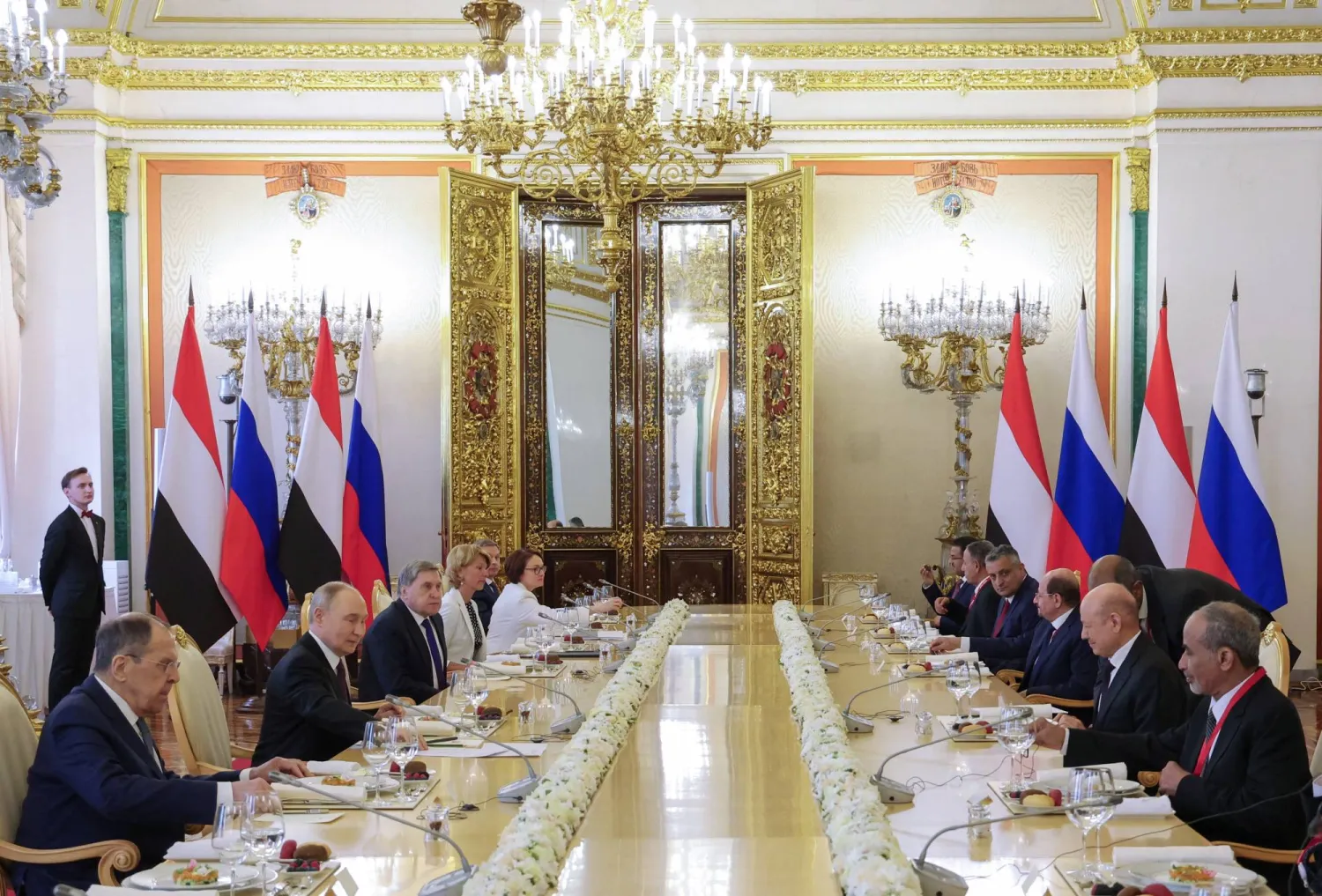
Members of the delegations, led by Russia's President Vladimir Putin and head of Yemen's Presidential Council Rashad Al-Alimi, attend a meeting at the Kremlin in Moscow, Russia, May 28, 2025. Sputnik/Vyacheslav Prokofyev/Pool via REUTERS
TT

Yemen’s al-Alimi Criticizes International Concessions Made to the Houthis

Members of the delegations, led by Russia's President Vladimir Putin and head of Yemen's Presidential Council Rashad Al-Alimi, attend a meeting at the Kremlin in Moscow, Russia, May 28, 2025. Sputnik/Vyacheslav Prokofyev/Pool via REUTERS

Chairman of Yemen’s Presidential Leadership Council Dr. Rashad al-Alimi has described the Houthis as an “enduring” threat to Yemen, the region and international shipping lanes, and criticized what he termed “incentives and concessions from certain international actors” made to the militias.

During a panel discussion organized by the Institute of Oriental Studies of the Russian Academy of Sciences in Moscow on Thursday, al-Alimi stated: We are confronting a sectarian theocratic project that does not recognize the state or the law and is rooted in the ideology of divine right to rule. These are the very ideas Russia has historically opposed in various arenas, in defense of the civil state.”

He criticized the lack of an accurate understanding of the Yemeni situation and the prevalence of misleading narratives in some international circles, including certain think tanks and decision-making institutions, which still view Yemen through a blurred lens or as part of a geopolitical conflict solvable through superficial compromises.

He identified among these false narratives claims portraying the Houthis as an “oppressed minority” suitable for political assimilation.

“The truth is we face an armed doctrinal movement grounding its authority in 'divine right' theology, while rejecting all civil state constructs and the principle of equal citizenship,” he said.

Al-Alimi deemed even more dangerous the designation of the Houthis as a “transient threat” linked to the repercussions of the Gaza war. He affirmed this to be a mistaken and misleading perception.

He explained that the Houthis are an enduring and structural danger to Yemen, the region, and international shipping lanes.

Al-Alimi drew attention to the fact that ship piracy, naval mine deployment, and Red Sea piracy did not begin in 2024, but have been a recurrent Houthi tactic for years.

He affirmed that the Houthis' criminal conduct mirrors that of organizations and groups that Moscow itself condemns, including targeting airports and seaports, booby-trapping mosques, schools, and hospitals, suppressing women's rights, child conscription, and militarizing civilian infrastructure.

He added: “Despite all this, the Houthis continue to receive incentives and concessions from certain international actors, while the legitimate government, representing Yemen's constitutional framework, stands accused of weakness or division. This completely ignores the reality that it effectively controls approximately 70% of Yemen's territory and unites all national components under its umbrella.”

“What is required today is restoring the logic of the state against claims of divine guardianship ... while supporting legitimate institutions against illegitimate armed groups. This is the same principle Russia has consistently upheld in its global counterterrorism efforts,” he added.

Al- Alimi reaffirmed Yemen's unequivocal position supporting the Palestinian people's right to an independent state and the imperative to halt Israeli aggressions. However, he stressed that this stance cannot be exploited to justify Iran's behavior in the region or to advance its agenda through proxies, as witnessed in Yemen.

“Iran’s expansionist policies threaten not only Yemen but also destabilize the entire Red Sea and Horn of Africa region,” he warned.

He noted with concern the Houthis’ close ties with al-Qaeda, ISIS, and other criminal organizations, entities that share ideological alignment, mutual interests, and logistical cooperation with the group. “This signals the resurgence of cross-border terrorist networks,” he said.

Al-Alimi held talks in Moscow on Wednesday with Russian President Vladimir Putin.


Israeli Military Says Detained Suspected ISIS Militant in Syria

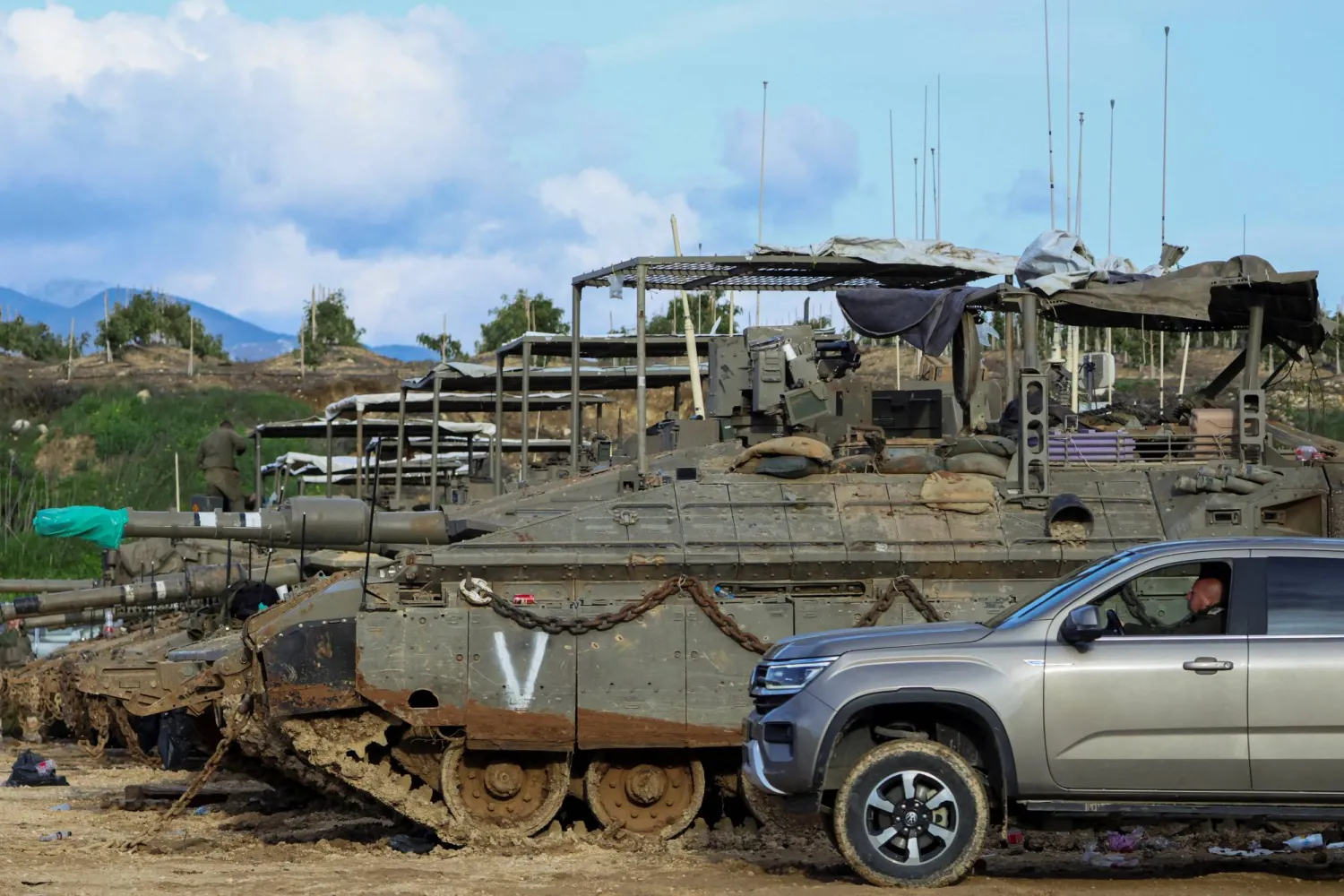
FILE PHOTO: Israeli military vehicles manoeuvre along the Israel-Lebanon border, as seen from northern Israel, November 24, 2025. REUTERS/Shir Torem/File Photo
TT

Israeli Military Says Detained Suspected ISIS Militant in Syria

FILE PHOTO: Israeli military vehicles manoeuvre along the Israel-Lebanon border, as seen from northern Israel, November 24, 2025. REUTERS/Shir Torem/File Photo

The Israeli military said on Saturday its forces had arrested a suspected ISIS militant in Syria earlier this week and taken him back to Israel.

In a statement, the military said that on Wednesday "soldiers completed an operation in the area of Rafid in southern Syria to apprehend a suspected terrorist affiliated with ISIS.”

"The suspect was transferred for further processing in Israeli territory," the statement said.


Report: Colombian Mercenaries in Sudan ‘Recruited by UK-registered Firms’

(COMBO) This combination of satellite images released by Planet Labs PBC on December 19, 2025, shows from top left to bottom right:- the graves near the United Nations Children's Fund (UNICEF) headquarters in El-Fasher, taken on the following dates: on October 8, 2025, on October 27, 2025, on January 15, 2025, and on December 14, 2025. (Photo by Handout / Planet Labs / AFP)
TT

Report: Colombian Mercenaries in Sudan ‘Recruited by UK-registered Firms’

(COMBO) This combination of satellite images released by Planet Labs PBC on December 19, 2025, shows from top left to bottom right:- the graves near the United Nations Children's Fund (UNICEF) headquarters in El-Fasher, taken on the following dates: on October 8, 2025, on October 27, 2025, on January 15, 2025, and on December 14, 2025. (Photo by Handout / Planet Labs / AFP)

An exclusive investigation by UK’s The Guardian has found companies hiring hundreds of Colombian fighters for Sudan’s Rapid Support Forces.

A one-bedroom flat off north London’s Creighton Road in Tottenham is, according to UK government records, tied to a transnational network of companies involved in the mass recruitment of mercenaries to fight in Sudan alongside the RSF, said the report.

Colombian mercenaries were directly involved in the RSF’s seizure of the southwestern Sudanese city of El Fasher in late October, which prompted a killing frenzy that analysts say has cost at least 60,000 lives.

“The flat in Tottenham is registered to a company called Zeuz Global, set up by two individuals named and sanctioned last week by the US treasury for hiring Colombian mercenaries to fight for the RSF,” said The Guardian.

“Both figures – Colombian nationals in their 50s – are described in documents at Companies House, the government register of firms operating in the UK, as living in Britain,” it said.

“The day after the US treasury announced sanctions on those behind the Colombian mercenary operation –December 9 – Zeuz Global abruptly moved its operation to the very heart of London. On 10 December the firm shared “new address details” Its new postcode matches One Aldwych, a five-star hotel in Covent Garden,” the report added.

Yet the first line of Zeuz Global’s new address is, confusingly, “4dd Aldwych,” which corresponds to the Waldorf Hilton hotel 100 meters away, according to The Guardian.

Both hotels said they had no link to Zeuz Global and had no idea why the firm had used their postcodes.

“It is of major concern that the key individuals the US government claims are directing this mercenary supply have been able to set up a UK company operating from a flat in north London, and even to claim that they’re resident in the UK,” said Mike Lewis, a researcher and former member of the UN panel of experts on Sudan.

When Companies House was asked if it had any knowledge of what Zeuz Global actually did, or is doing, it did not respond. The government agency would also not confirm whether the sanctioned individuals were, in fact, resident in the UK.

Contacting Zeuz proved fruitless; its website, set up in May, was labelled as “under construction” with no contact details provided.


Egyptian President Urges UN Security Council Reforms for Africa's Larger Role

In this photo, provided by Egypt's presidency media office, Egyptian President Abdel-Fattah el-Sisi, front right, greets Russian Foreign Minister Sergei Lavrov, left, before their meeting at the Presidential Palace in Cairo, Egypt, Saturday, Dec. 20, 2025. (Egyptian Presidency Media Office via AP)
TT

Egyptian President Urges UN Security Council Reforms for Africa's Larger Role

In this photo, provided by Egypt's presidency media office, Egyptian President Abdel-Fattah el-Sisi, front right, greets Russian Foreign Minister Sergei Lavrov, left, before their meeting at the Presidential Palace in Cairo, Egypt, Saturday, Dec. 20, 2025. (Egyptian Presidency Media Office via AP)

Egypt’s President Abdel-Fattah el-Sisi on Saturday reiterated calls for structural changes in the UN Security Council to grant Africa a larger role in shaping global decisions.

El-Sisi made the plea for a “more pluralistic” world order at a conference of the Russia-Africa partnership held in Cairo, which was attended by Russian Foreign Minister Sergei Lavrov and ministers from more than 50 African countries along with representatives from several African and regional organizations.

“The voice of Africa should be present and influential in making global decisions given the continent’s human, economic, political and demographic weight,” el-Sisi said in a statement read out by his foreign minister at the plenary session of the conference.

According to The Associated Press, he added that international financial institutions need to undergo similar reforms to ensure Africa an equitable representation.

Since 2005, the African Union has been demanding that Africa be granted two permanent seats with veto powers in the Security Council, arguing that such reforms would contribute to achieving peace and stability on the continent, which has been struggling with wars for decades.

The Security Council, which is charged with maintaining international peace and security, has not changed from its 1945 configuration: 10 non-permanent members from all regions of the world elected for two-year terms without veto power, and five countries that were dominant powers at the end of World War II are permanent members with veto power: The United States, Russia, China, Britain and France.

In his statement, el-Sisi said that the Russia-Africa ministerial conference will develop a plan to consolidate the partnership ahead of next year’s summit of heads of state.

“We remain a reliable partner for African states in strengthening their national sovereignty, both politically and in matters of security, as well as in other dimensions,” Lavrov said at the plenary session. “We’re committed to further unlocking the existing enormous potential of our practical cooperation.”