


US Veto Against UN Resolution Demanding Gaza Ceasefire Draws Criticisms

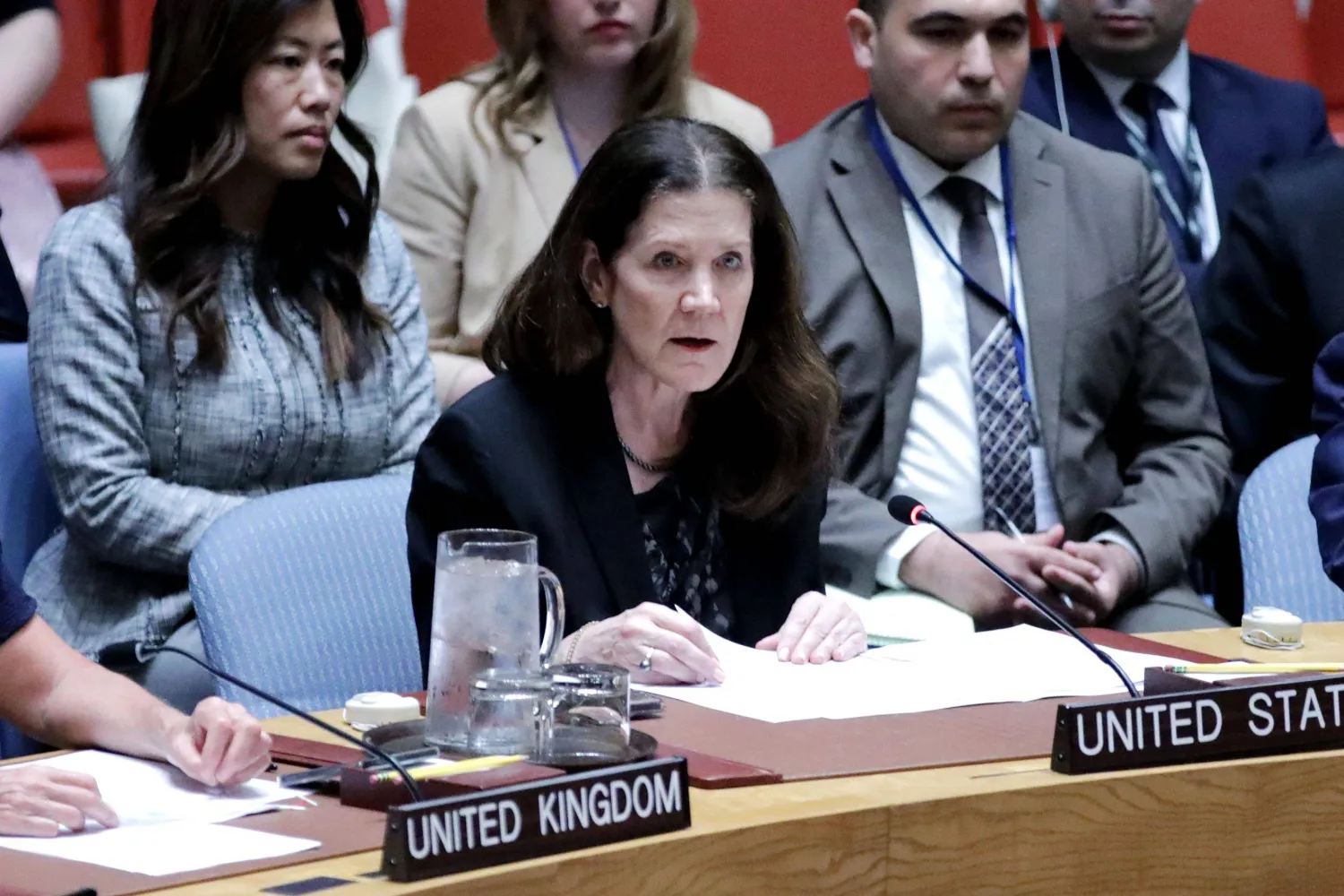
US Ambassador to the United Nations Dorothy Shea (C) speaks during a United Nations Security Council meeting to vote on a resolution calling for a ceasefire and unrestricted humanitarian access in Gaza, at UN headquarters in New York City on June 4, 2025. (Photo by Leonardo Munoz / AFP)
TT

US Veto Against UN Resolution Demanding Gaza Ceasefire Draws Criticisms

US Ambassador to the United Nations Dorothy Shea (C) speaks during a United Nations Security Council meeting to vote on a resolution calling for a ceasefire and unrestricted humanitarian access in Gaza, at UN headquarters in New York City on June 4, 2025. (Photo by Leonardo Munoz / AFP)

The United States on Wednesday vetoed a UN Security Council resolution demanding an immediate and permanent ceasefire in Gaza because it was not linked to the release of hostages, saying it would embolden Hamas militants.

All 14 other members of the council voted in favor of the resolution, which described the humanitarian situation in Gaza as “catastrophic” and called on Israel to lift all restrictions on the delivery of aid to the 2.1 million Palestinians in the territory.

The resolution before the UN's most powerful body also did not fulfill two other US demands: It did not condemn Hamas’ deadly attack in Israel on Oct. 7, 2023, which ignited the war, or say the militant group must disarm and withdraw from Gaza, The Associated Press reported.

Acting US Ambassador Dorothy Shea, speaking to the council immediately before the vote, said the resolution would undermine the security of Israel. a close US ally, and diplomatic efforts to reach a ceasefire “that reflects the realities on the ground."

US Secretary of State Marco Rubio said the resolution would only have empowered Hamas. “Hamas could end this brutal conflict immediately by laying down its arms and releasing all remaining hostages,” he said in a statement.

Israel’s UN Ambassador Danny Danon thanked the United States for refusing to abandon the hostages. He said the resolution’s failure to make the release of hostages a condition for a ceasefire would have put all the pressure on Israel and handed Hamas “time, leverage and political cover.”

What other members of the Security Council say

But the US veto of the resolution — its fifth since the start of the war — was roundly criticized by other members of the council, who accused the United States of providing Israel with impunity.

The Chinese ambassador to the UN said Israel's actions have “crossed every red line” of international humanitarian law and seriously violated UN resolutions. “Yet, due to the shielding by one country, these violations have not been stopped or held accountable," Ambassador Fu Cong said.

Britain’s UN Ambassador Barbara Woodward, a usual US ally, lashed out at Israel. “This Israeli government’s decisions to expand its military operations in Gaza and severely restrict aid are unjustifiable, disproportionate and counterproductive, and the UK completely opposes them,” she said.

Pakistan's Ambassador Asim Iftikhar Ahmad said the US veto "will be remembered as a complicity, a green light for continued annihilation. A moment where the entire world was expecting action. But yet again, this council was blocked and prevented by one member from carrying out its responsibility.”

Slovenia’s UN Ambassador Samuel Žbogar, the coordinator for the council's 10 elected members, stressed that it was never the intention to provoke a veto and therefore the resolution focused on the humanitarian crisis and the urgent need for unimpeded access to deliver aid.

“Starving civilians and inflicting immense suffering is inhumane and against international law,” he told the council after the vote. “No war objective can justify such action. We had hoped and expected that this was our shared understanding.”

Palestinian UN Ambassador Riyad Mansour said Palestinians are now urging governments to take “real measures” to pressure Israel to get out of Gaza before it implements what he called an Israeli plan “to destroy our people."

And in the coming days, he said, the Palestinians will head to the 193-member General Assembly, where there are no vetoes, with a similar humanitarian-focused resolution. Unlike in the Security Council, assembly resolutions are not legally binding, though they are seen as a barometer of world opinion.

The US vetoed the last Security Council resolution on Gaza in November, under the Biden administration, also because the ceasefire demand was not directly linked to the release of all hostages. Similarly, the current resolution demands those taken by Hamas and other groups be released, but it does not make it a condition for a truce.

President Donald Trump's administration has tried to ramp up its efforts to broker peace in Gaza after 20 months of war. However, Hamas has sought amendments to a US proposal that special envoy Steve Witkoff has called “totally unacceptable.”

Why food aid is not reaching people in Gaza

The vote followed a decision by an Israeli and US-backed foundation to pause food delivery in Gaza after health officials said dozens of Palestinians were killed in a series of shootings this week. Israel and the United States say the new system was designed to prevent Hamas from stealing aid previously distributed by the UN.

The United Nations has rejected the new system. The UN says its distribution system worked very well during the March ceasefire and is carefully monitored.

Gaza is almost completely reliant on international aid because Israel’s offensive has destroyed nearly all food production capabilities. Israel imposed a blockade on supplies into Gaza on March 2, and limited aid began to enter again late last month after pressure from allies and warnings of famine.

The war began when Hamas-led militants stormed into southern Israel on Oct. 7, 2023, killing around 1,200 people and abducting 251. They are still holding 58 hostages, a third of them believed to be alive, after most of the rest were released in ceasefire agreements or other deals.

Israel’s military campaign has killed more than 54,000 Palestinians, mostly women and children, according to Gaza’s Health Ministry, which doesn’t say how many of the dead were civilians or combatants.

The ministry is led by medical professionals but reports to the Hamas-run government. Its toll is seen as generally reliable by UN agencies and independent experts, though Israel has challenged its numbers



Gaza Ceasefire Enters Phase Two Despite Unresolved Issues

 Palestinians walk amid buildings destroyed by Israeli air and ground operations in Gaza City Thursday, Jan. 15, 2026. (AP)
Palestinians walk amid buildings destroyed by Israeli air and ground operations in Gaza City Thursday, Jan. 15, 2026. (AP)
TT

Gaza Ceasefire Enters Phase Two Despite Unresolved Issues

 Palestinians walk amid buildings destroyed by Israeli air and ground operations in Gaza City Thursday, Jan. 15, 2026. (AP)
Palestinians walk amid buildings destroyed by Israeli air and ground operations in Gaza City Thursday, Jan. 15, 2026. (AP)

A US-backed plan to end the war in Gaza has entered its second phase despite unresolved disputes between Israel and Hamas over alleged ceasefire violations and issues unaddressed in the first stage.

The most contentious questions remain Hamas's refusal to publicly commit to full disarmament, a non-negotiable demand from Israel, and Israel's lack of clarity over whether it will fully withdraw its forces from Gaza.

The creation of a Palestinian technocratic committee, announced on Wednesday, is intended to manage day-to-day governance in post-war Gaza, but it leaves unresolved broader political and security questions.

Below is a breakdown of developments from phase one to the newly launched second stage.

- Gains and gaps in phase one -

The first phase of the plan, part of a 20-point proposal unveiled by US President Donald Trump, began on October 10 and aimed primarily to stop the fighting in the Gaza Strip, allow in aid and secure the return of all remaining living and deceased hostages held by Hamas and allied Palestinian armed groups.

All hostages have since been returned, except for the remains of one Israeli, Ran Gvili.

Israel has accused Hamas of delaying the handover of Gvili's body, while Hamas has said widespread destruction in Gaza made locating the remains difficult.

Gvili's family had urged mediators to delay the transition to phase two.

"Moving on breaks my heart. Have we given up? Ran did not give up on anyone," his sister, Shira Gvili, said after mediators announced the move.

Israeli Prime Minister Benjamin Netanyahu said efforts to recover Gvili's remains would continue but has not publicly commented on the launch of phase two.

Hamas has accused Israel of repeated ceasefire violations, including air strikes, firing on civilians and advancing the so-called "Yellow Line," an informal boundary separating areas under Israeli military control from those under Hamas authority.

Gaza's Hamas-run health ministry said Israeli forces had killed 451 people since the ceasefire took effect.

Israel's military said it had targeted suspected fighters who crossed into restricted zones near the Yellow Line, adding that three Israeli soldiers were also killed by fighters during the same period.

Aid agencies say Israel has not allowed the volume of humanitarian assistance envisaged under phase one, a claim Israel rejects.

Gaza, whose borders and access points remain under Israeli control, continues to face severe shortages of food, clean water, medicine and fuel.

Israel and the United Nations have repeatedly disputed figures on the number of aid trucks permitted to enter the Palestinian territory.

- Disarmament, governance in phase two -

Under the second phase, Gaza is to be administered by a 15-member Palestinian technocratic committee operating under the supervision of a so-called "Board of Peace," to be chaired by Trump.

"The ball is now in the court of the mediators, the American guarantor and the international community to empower the committee," Bassem Naim, a senior Hamas leader, said in a statement on Thursday.

Mediators Egypt, Türkiye and Qatar said Ali Shaath, a former deputy minister in the Ramallah-based Palestinian Authority, had been appointed to lead the committee.

Shaath, in an interview, said the committee would rely on "brains rather than weapons" and would not coordinate with armed groups.

US Middle East envoy Steve Witkoff said phase two aims for the "full demilitarization and reconstruction of Gaza," including the disarmament of all unauthorized armed factions.

Witkoff said Washington expected Hamas to fulfill its remaining obligations, including the return of Gvili's body, warning that failure to do so would bring "serious consequences".

The plan also calls for the deployment of an International Stabilization Force to help secure Gaza and train vetted Palestinian police units.

For Palestinians, the central issue remains Israel's full military withdrawal from Gaza - a step included in the framework but for which no detailed timetable has been announced.

With fundamental disagreements persisting over disarmament, withdrawal and governance, diplomats say the success of phase two will depend on sustained pressure from mediators and whether both sides are willing - or able - to move beyond long-standing red lines.


Lebanon Charges Four Accused of Kidnapping for Israel’s Mossad

A handout photo from Israeli television made available on July 13, 2008, shows a photograph of Ron Arad, an Israeli Air Force navigator who was captured after his fighter jet was shot down in Lebanon in 1986. (Handout / AFP)
TT

Lebanon Charges Four Accused of Kidnapping for Israel’s Mossad

A handout photo from Israeli television made available on July 13, 2008, shows a photograph of Ron Arad, an Israeli Air Force navigator who was captured after his fighter jet was shot down in Lebanon in 1986. (Handout / AFP)

Four people accused of a kidnapping in Lebanon for Israel's Mossad spy agency last month have been charged, a judicial official said on Thursday, after a retired security officer whose brother was linked to an Israeli airman's disappearance went missing.

Israel has apprehended suspects in Lebanon before and Mossad is accused of regularly attempting to contact Lebanese people to facilitate its operations, while Lebanon has arrested dozens of people on suspicion of collaborating with Israel over the years.

Lebanese authorities believe the agency known for espionage operations outside of Israel's borders was behind the disappearance of retired security officer Ahmad Shukr last month.

Shukr, whose brother Hassan is suspected of involvement in the 1986 capture of Israeli air force navigator Ron Arad, disappeared in the Bekaa region of eastern Lebanon.

Authorities have arrested and charged one Lebanese man and charged three more who remain at large.

The four were charged with "communicating with and working for Mossad within Lebanon in exchange for money, and carrying out the kidnapping of Ahmad Shukr", a judicial official told AFP on condition of anonymity.

The three are "a Lebanese woman, a Lebanese-French man, and a Syrian-Swedish man," the official said.

The Israeli airman Ron Arad, whose plane went down in southern Lebanon during the country's civil war between 1975 and 1990, is now presumed dead and his remains were never returned.

Hassan Shukr was killed in 1988 in a battle between Israeli forces and local fighters, including from the Iran-backed Hezbollah group, a source close to the family told AFP last month, requesting anonymity.


Israeli Strikes Kill Five in Gaza, Say Local Health Authorities

 Makeshift tents shelter displaced Palestinians stand among buildings destroyed by Israeli air and ground operations in Gaza City Thursday, Jan. 15, 2026. (AP)
Makeshift tents shelter displaced Palestinians stand among buildings destroyed by Israeli air and ground operations in Gaza City Thursday, Jan. 15, 2026. (AP)
TT

Israeli Strikes Kill Five in Gaza, Say Local Health Authorities

 Makeshift tents shelter displaced Palestinians stand among buildings destroyed by Israeli air and ground operations in Gaza City Thursday, Jan. 15, 2026. (AP)
Makeshift tents shelter displaced Palestinians stand among buildings destroyed by Israeli air and ground operations in Gaza City Thursday, Jan. 15, 2026. (AP)

Two Israeli airstrikes killed five people, including a 16-year-old, in Deir al-Balah on Thursday, said local health authorities.

The Israeli military did not immediately respond to a Reuters request for comment on the incident.

It was not immediately clear what triggered the attacks, which were in areas outside the control of Israeli forces in the strip.

More than 400 Palestinians ‌and three Israeli ‌soldiers have been reported ‌killed ⁠since a ‌fragile ceasefire took effect in October.

Israel has razed buildings and ordered residents out of more than half of Gaza where its troops remain. Nearly all of the territory's more than 2 million people now live in ⁠makeshift homes or damaged buildings in a sliver of ‌territory where Israeli troops have withdrawn ‍and Hamas has ‍reasserted control.

The United Nations children agency ‍said on Tuesday that over 100 children have been killed in Gaza since the ceasefire, including victims of drone and quadcopter attacks.

Israel and Hamas have traded blame for violations of the ceasefire and remain far apart ⁠from each other on key issues, despite the United States announcing the second phase of the ceasefire on Wednesday.

Israel launched its operations in Gaza in the wake of an attack by Hamas-led fighters on October, 2023 which killed 1,200 people, according to Israeli tallies. Israel's assault has killed 71,000 people, according to health authorities in the strip, ‌and left much of Gaza in ruins.