
Inside the Tunnel Where Muhammad Sinwar Was Killed

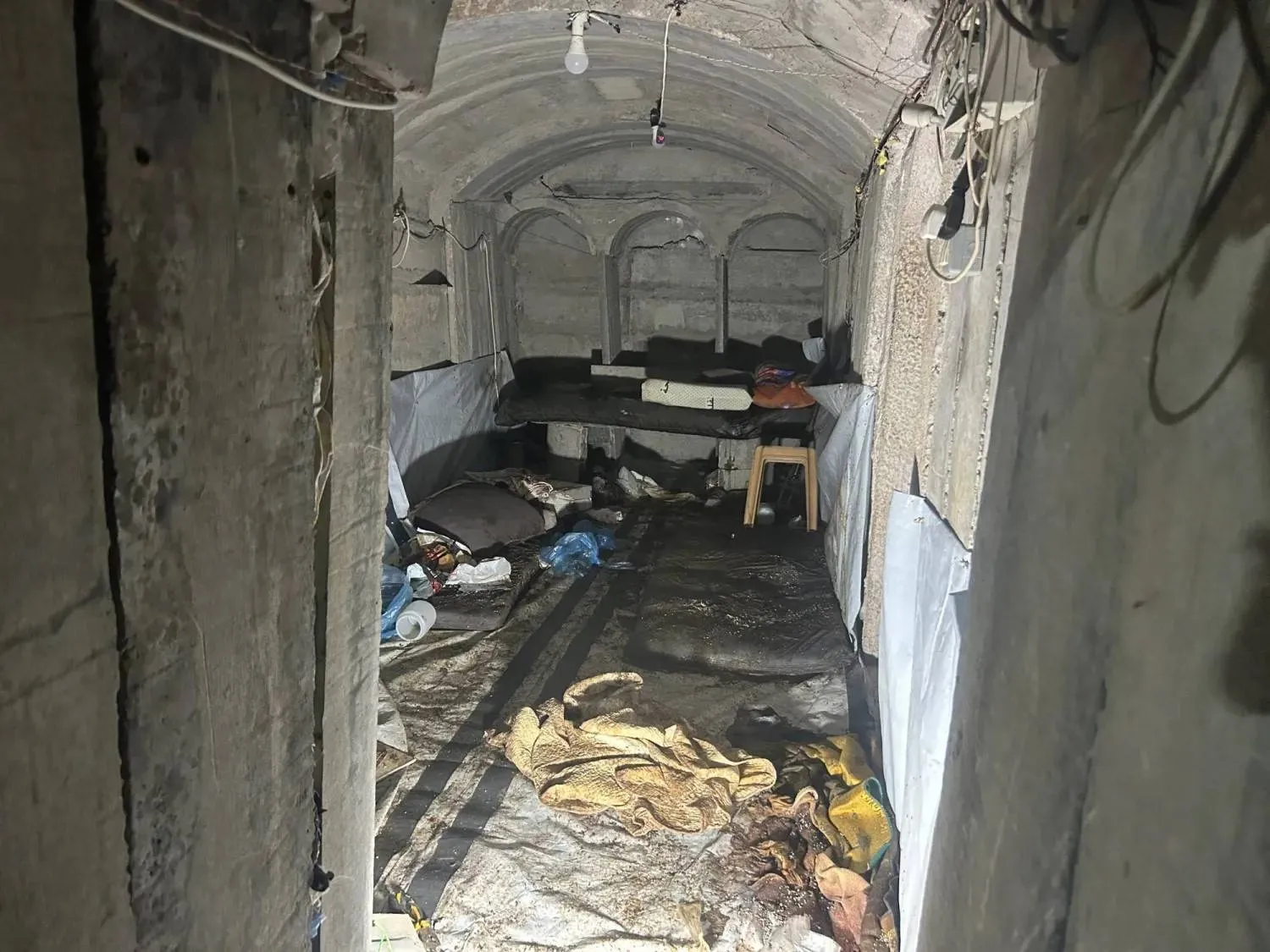
The room in which Muhammad Sinwar and four other militants are said to have died. (Patrick Kingsley/The New York Times) 
TT

Inside the Tunnel Where Muhammad Sinwar Was Killed

The room in which Muhammad Sinwar and four other militants are said to have died. (Patrick Kingsley/The New York Times) 

By Patrick Kingsley*

Two feet wide and less than six feet tall, the tunnel led deep beneath a major hospital in southern Gaza.

The underground air bore the stench of what smelled like human remains. After walking some 40 yards along the tunnel, we found the likely cause.

In a tiny room that the tunnel led to, the floor was stained with blood. It was here, according to the Israeli military, that Muhammad Sinwar - one of Hamas’s top commanders and the younger brother of slain Hamas leader Yahya Sinwar - was killed last month after a nearby barrage of Israeli strikes.

What we saw in that dark and narrow tunnel is one of the war’s biggest Rorschach tests (psychological assessment tool that uses inkblots to evaluate a person's personality), the embodiment of a broader narrative battle between Israelis and Palestinians over how the conflict should be portrayed.

The military escorted a reporter from The New York Times to the tunnel on Sunday afternoon, as part of a brief and controlled visit for international journalists that the Israelis hoped would prove that Hamas uses civilian infrastructure as a shield for military activity.

To Palestinians, Israel’s attack on, and subsequent capture of, the hospital compound highlighted its own disregard for civilian activity.

Body of Muhammad Sinwar

Last month, the military ordered the hospital’s staff and patients to leave the compound, along with the residents of the surrounding neighborhoods.

Then, officials said, they bored a huge hole, some 10 yards deep, in a courtyard within the hospital grounds.

Soldiers used that hole to gain access to the tunnel and retrieve Sinwar’s body, and they later escorted journalists there so we could see what they called his final hiding place.

There are no known entrances to the tunnel within the hospital itself, so we lowered ourselves into the Israeli-made cavity using a rope.

To join this controlled tour, The Times agreed not to photograph most soldiers’ faces or publish geographic details that would put them in immediate physical danger.

To the Israelis who brought us there, this hiding place - directly underneath the emergency department of the European Gaza Hospital - is emblematic of how Hamas has consistently endangered civilians, and broken international law, by directing its military operations from the cover of hospitals and schools.

Hamas has also dug tunnels underneath Al-Shifa hospital in Gaza City and a UN complex elsewhere in that city.

“We were dragged by Hamas to this point,” Brig. Gen. Effie Defrin, the chief Israeli military spokesman, said at the hospital on Sunday afternoon. “If they weren’t building their infrastructure under the hospitals, we wouldn’t be here. We wouldn’t attack this hospital.”

Defrin said that Israel had tried to minimize damage to the hospital by striking the area around its buildings, without a direct hit on the medical facilities themselves. “The aim was not to damage the hospital and, as much as we could, to avoid collateral damage,” he said.

Prioritize Destruction of Hamas

To the Palestinians who were forced from here, the Israeli attack on Sinwar embodied Israel’s willingness to prioritize the destruction of Hamas over the protection of civilian life and infrastructure, particularly the health system.

According to the World Health Organization, Israel has conducted at least 686 attacks on health facilities in Gaza since the start of the war, damaging at least 33 of Gaza’s 36 hospitals.

Many, like the European Gaza Hospital, are now out of service, fueling accusations from rights groups and foreign governments — strongly denied by the Israelis— that Israel is engaged in genocide, in part by wrecking the Palestinian health system.

“It’s morally and legally unacceptable, but Israel thinks it is above the law,” Dr. Salah al-Hams, the hospital spokesman, said in a phone interview from another part of southern Gaza.

Though Israel targeted the periphery of the hospital site, leaving the hospital buildings standing, al-Hams said the strikes had wounded 10 people within the compound, damaged its water and sewage systems and dislodged part of its roof. It killed 23 people in buildings beyond its perimeter, he said, 17 more than were reported the day of the attack.

The tremors caused by the strikes were like an “earthquake,” al-Hams said.

Al-Hams said he had been unaware of any tunnels beneath the hospital. Even if they were there, he said: “This does not justify the attack. Israel should have found other ways to eliminate any wanted commander. There were a thousand other ways to do it.”

Piles of Rubble

Our journey to the hospital revealed much about the current dynamics of the war in Gaza.

In a roughly 20-minute ride from the Israeli border, we saw no Palestinians — the result of Israel’s decision to order the residents of southern Gaza to abandon their homes and head west to the sea.

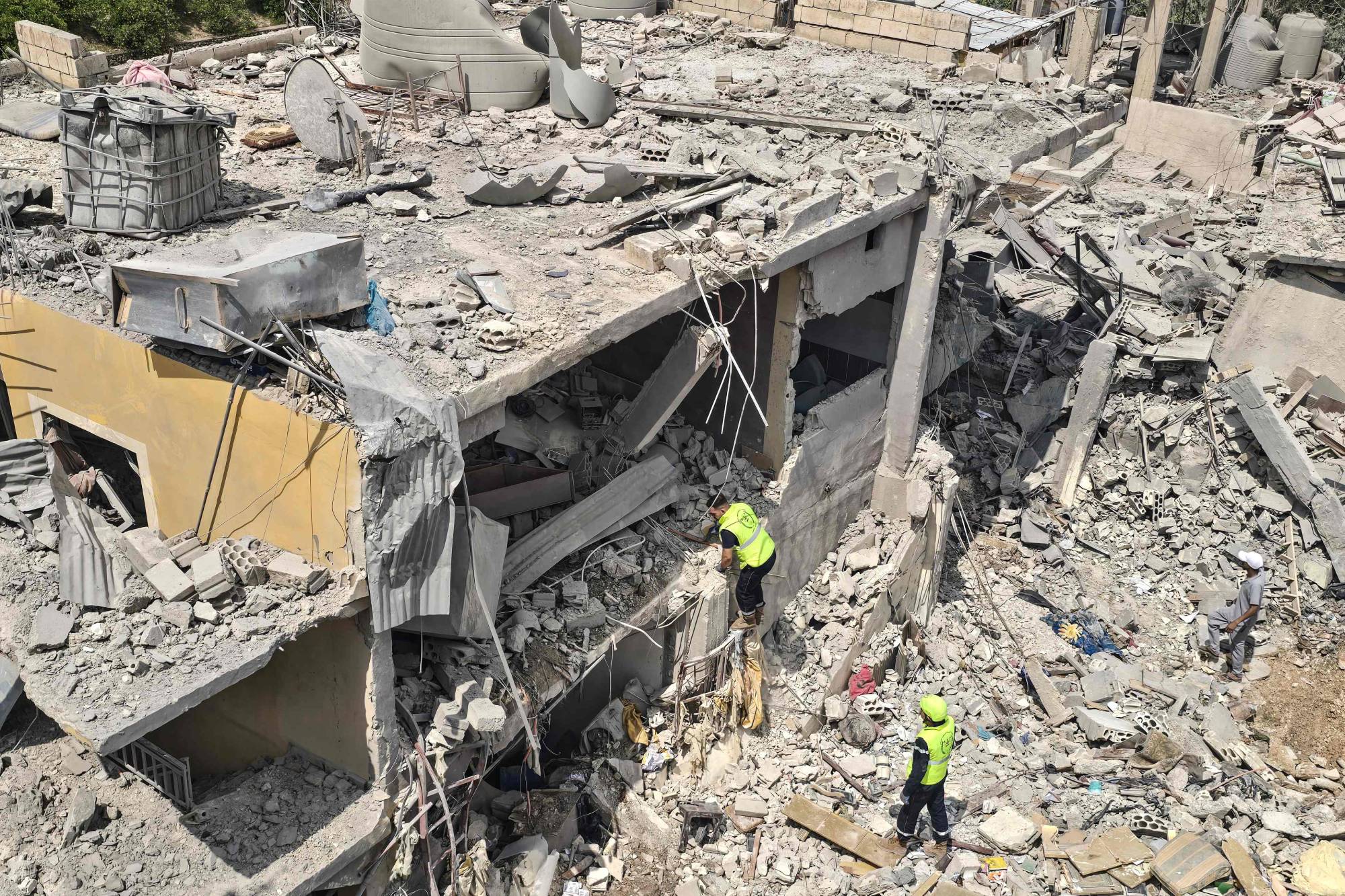
Many buildings were simply piles of rubble, destroyed either by Israeli strikes and demolitions or Hamas’ booby-traps. Here and there, some buildings survived, more or less intact; on one balcony, someone had left a tidy line of potted cactuses.

We drove in open-top jeeps, a sign that across this swath of southeastern Gaza, the Israeli military no longer fears being ambushed by Hamas fighters.

Until at least the Salah al-Din highway, the territory’s main north-south artery, the Israeli military seemed to be in complete command after the expansion of its ground campaign in March.

The European Gaza Hospital and the tunnel beneath it are among the places that now appear to be exclusively under Israeli control.

Under the laws of war, a medical facility is considered a protected site that can be attacked only in very rare cases. If one side uses the site for military purposes, that may make it a legitimate target, but only if the risk to civilians is proportional to the military advantage created by the attack.

The Israeli military said it had tried to limit harm to civilians by striking only around the edges of the hospital compound. But international legal experts said that any assessment of the strike’s legality needed also to take into account its effect on the wider health system in southern Gaza.

In a territory where many hospitals are already not operational, experts said, it is harder to find legal justification for strikes that put the remaining hospitals out of service, even if militants hide beneath them.

Sinwar and 4 Fellow Militants

When we entered the tunnel on Sunday, we found it almost entirely intact. The crammed room where Sinwar and four fellow militants were said to have died was stained with blood, but its walls appeared undamaged.

The mattresses, clothes and bedsheets did not appear to have been dislodged by the explosions, and an Israeli rifle — stolen earlier in the war, the soldiers said — dangled from a hook in the corner.

It was not immediately clear how Sinwar was killed, and Defrin said he could not provide a definitive answer. He suggested that Sinwar and his allies may have suffocated in the aftermath of the strikes or been knocked over by a shock wave unleashed by explosions.

If Sinwar was intentionally poisoned by gases released by such explosions, it would raise legal questions, experts on international law said.

“It would be an unlawful use of a conventional bomb — a generally lawful weapon — if the intent is to kill with the asphyxiating gases released by that bomb,” said Sarah Harrison, a former lawyer at the US Defense Department and an analyst at the International Crisis Group.

Defrin denied any such intent. “This is something that I have to emphasize here, as a Jew first and then as a human being: We don’t use gas as weapons,” he said.

In other tunnels discovered by the Israeli military, soldiers have used Palestinians as human shields, sending them on ahead to scour for traps.

The general denied the practice. The tunnel was excavated by Israelis, he said.


The New York Times


Fidan, Barrack Discuss Merging of SDF in Syrian Army, Erdogan Warns of Israeli Violations

Turkish Foreign Minister Hakan Fidan and US special envoy to Syria Tom Barrack meet on Tuesday. (Turkish Foreign Ministry)
TT

Fidan, Barrack Discuss Merging of SDF in Syrian Army, Erdogan Warns of Israeli Violations

Turkish Foreign Minister Hakan Fidan and US special envoy to Syria Tom Barrack meet on Tuesday. (Turkish Foreign Ministry)

Turkish Foreign Minister Hakan Fidan and US special envoy to Syria Tom Barrack held talks on Tuesday on the latest developments in Syria a year after the ouster of Bashar al-Assad's regime.

They discussed the measures needed to establish stability in Syria and maintain its territorial integrity.

Turkish sources said the meeting focus primarily on the implementation of the agreement between Syrian interim President Ahmed al-Sharaa and Syrian Democratic Forces (SDF) leader Abdi Mazloum on the merger of the Kurdish forces in the Syrian army.

The agreement was signed in Damascus in March and should have been completed by December.

Fidan and Barrack also tackled the Israeli violations and attacks against Syria and their “negative impact on its stability and unity.” They discussed sanctions on Syria and the support for political steps during the country’s transition, added the sources.

Fidan had on Saturday accused Israel of “encouraging” the SDF to renege on the March agreement.

In a televised interview, he warned that the developments in southern Syria were the “greatest danger.” He explained that the problem isn’t in the extent of the developments, but in how Israel has intervened in them.

The danger in Syria could impact Türkiye, he added.

He stressed the need for the SDF to fulfill its commitments to the March agreement and to dissolve itself and for its foreign fighters to leave Syria.

Turkish President Recep Tayyip Erdogan condemned on Tuesday the Israeli violations in Syria, saying they were the “greatest obstacle” to the country’s security and stability at the time and for the long-term.

Speaking before ambassadors to Türkiye, he vowed that Ankara will continue to support Damascus “as it has always done”.

He echoed Fidan’s demand on the SDF to commit to the March agreement, saying any delay will lead to a new crisis in Syria.

He also slammed the international silence over the “massacres that were committed in Syria” during its 13 years of civil war.

Throughout those years, “except for a few with a real conscience, we didn’t hear anything from the supporters of democracy and defenders of human rights,” he added.


Sudanese Powers Sign Declaration of Principles to End the War 

The gatherers in Nairobi held the warring parties and their allies fully responsible for any violations and war crimes. (Asharq Al-Awsat)
TT

Sudanese Powers Sign Declaration of Principles to End the War 

The gatherers in Nairobi held the warring parties and their allies fully responsible for any violations and war crimes. (Asharq Al-Awsat)

The political and civilian parties of Sudan’s Somoud alliance signed in Nairobi on Tuesday a joint declaration of principles with the Sudan Liberation Movement/Army, led by Abdul Wahid al-Nur, and the Arab Socialist Baath Party to end the war in Sudan and completely eliminate the Islamic movement from politics.

The declaration is the first act of rapprochement between Sudanese parties that are opposed to the ongoing war between the army and Rapid Support Forces (RSF). Former Prime Minister and Somoud leader Abdalla Hamdok was among the signatories.

The declaration said that “there can be no military solution to the crisis”, urging the immediate end to the war.

It called for greater pressure to be applied on the military and RSF to end the conflict and commit to the roadmap drafted by the international Quad that includes Saudi Arabia, the US, United Arab Emirates and Egypt in August.

The declaration called for the swift implementation of a proposed three-month humanitarian truce and for an unconditional ceasefire.

Sudan Liberation Movement/Army deputy leader Abdullah Harran said the signatories of the declaration agreed on the need to expand it further and to bring in more parties to sign it, excluding the ousted National Congress.

Harran told a press conference that the declaration aims to establish a wide popular civilian base that will embark on a transitional phase, leading up to holding free and transparent elections.

The Sudan Liberation Movement/Army holds some regions in central Darfur and has extended its influence in northern parts of the province. It has received tens of thousands of refugees from el-Fasher in areas under its control.

Leading member of the Arab Socialist Baath Party Wajdi Saleh said the gatherers in Nairobi agreed on a “unified vision” to end the war.

They signed three documents, he revealed. The first is the declaration of principles to build a new nation, the second is a roadmap to stop the war and the third aims to designate the National Congress and Islamic movement as terrorist.

Moreover, he declared that the warring parties would be barred from taking part in the democratic transition.

The gatherers held the warring parties and their allies fully responsible for any violations and war crimes, calling on regional and international powers, led by the Quad, to intervene decisively to implement a humanitarian truce.


Israeli Settler Kills 16-Year-Old Palestinian in West Bank, Mayor Says

Friends and family gather around the body of Ammar Yasser Sabbah, 16, ahead of his funeral at a morgue in Bethlehem on December 16, 2025, after he was killed by Israeli forces in the town of Tuqu’, east of Bethlehem during a military raid the day before. (AFP)
TT

Israeli Settler Kills 16-Year-Old Palestinian in West Bank, Mayor Says

Friends and family gather around the body of Ammar Yasser Sabbah, 16, ahead of his funeral at a morgue in Bethlehem on December 16, 2025, after he was killed by Israeli forces in the town of Tuqu’, east of Bethlehem during a military raid the day before. (AFP)

An Israeli settler shot dead a 16-year-old Palestinian in Tuqu' on Tuesday after the funeral of another teenager, the town's mayor said.

Violence has escalated in the West Bank since the beginning of the war in Gaza in October 2023. Attacks by Israeli settlers against Palestinians in the West Bank have increased sharply, with the UN reporting the highest number of attacks on record in October.

The Israeli military did not immediately respond to a request for comment on Muheeb Jibril's death on Tuesday.

"Today, after the funeral of 16-year-old Ammar Sabah, who was killed yesterday by the Israeli army in the town center, a number of youths were gathered by the main street when a settler shot 16-year-old Muheeb Jibril in the head," Tuqu' Mayor Mohammed al-Badan told Reuters by telephone.

Israeli forces killed Sabah on Monday during a military raid on the town, the Palestinian health ministry said. The military said the incident was under review. It said rocks were thrown at soldiers who used riot dispersal means and later responded with fire.

The West Bank is home to 2.7 million Palestinians who have limited self-rule under Israeli military occupation. Hundreds of thousands of Israelis have settled there.

Most world powers deem Israel's settlements, on land it captured in a 1967 war, illegal, and numerous UN Security Council resolutions have called on Israel to halt all settlement activity.

Israel denies the illegality of the settlements, citing biblical and historical connections to the land.