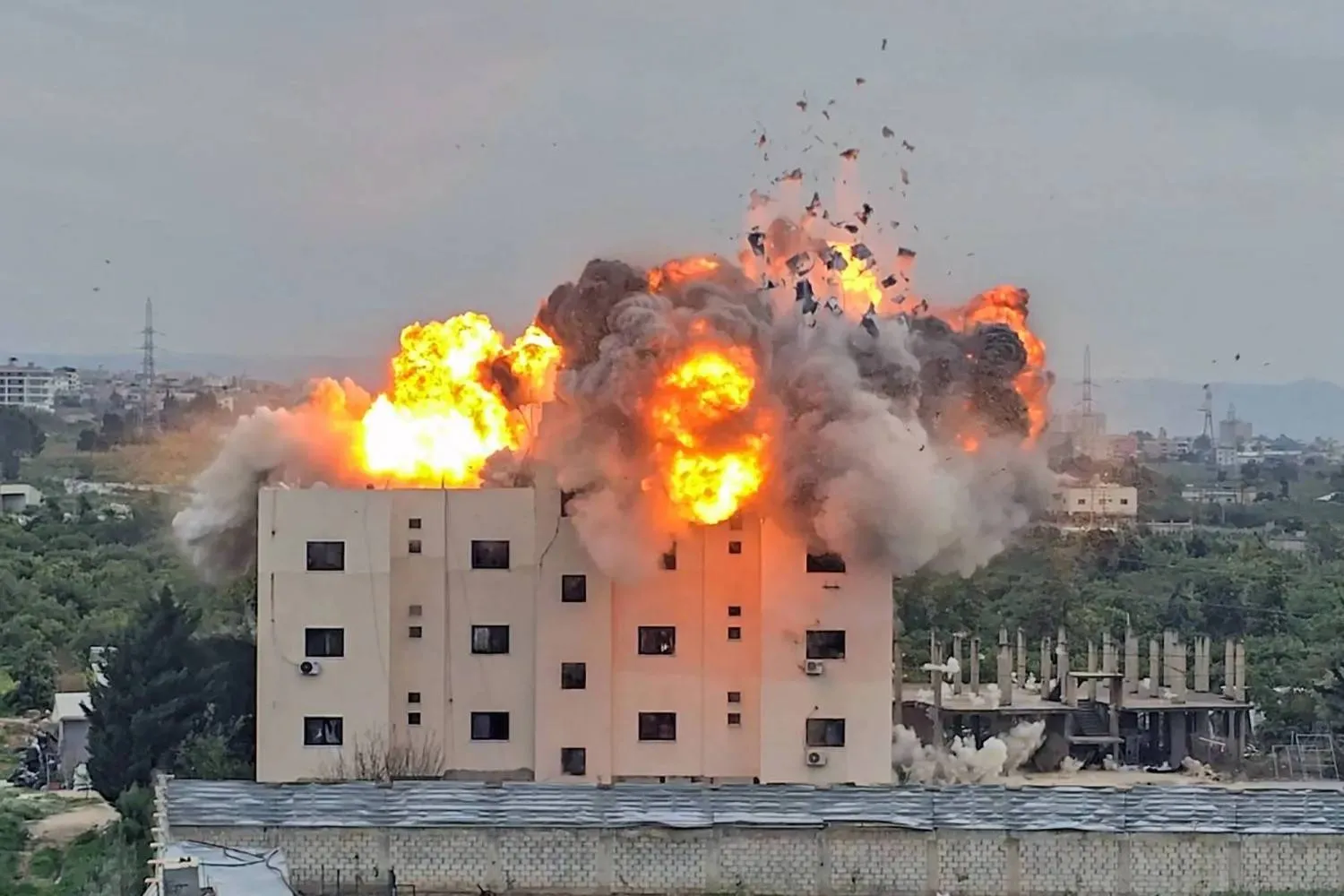

Israel on Friday began striking targets belonging to the Lebanese state and said it intended to hit civilian facilities, as preparations continued for a ground operation in the south.
Early signs of the operation appeared as limited, temporary incursions that expanded on Friday toward the outskirts of the Litani River, with a commando unit deployed to carry out a mission in the second line along the border with Israel.
The Israeli military began targeting civilian assets of the Lebanese state on Thursday, striking a bridge over the Litani River in the Qantara area that links Wadi al-Hujair to villages along the frontline of the border.
It later struck another major bridge over the Litani connecting the towns of Zrariyeh and Tair Falsay, cutting off large parts of the area south of the river from the north.
The Israeli military secured political backing for targeting civilian facilities following threats issued on Wednesday, after Hezbollah fired about 200 rockets toward Israel within a few hours.
Israel’s public broadcaster said Prime Minister Benjamin Netanyahu asked the military to prepare additional civilian targets for approval after the Litani bridge was destroyed.
"This is just the beginning and the Lebanese government and the state of Lebanon will pay an increasing price in damage to Lebanese national infrastructure used by Hezbollah terrorists," Israeli Defense Minister Israel Katz said on Friday.
He said Lebanon would suffer "loss of territory -- until it fulfils its central commitment of disarming Hezbollah.”
Katz’s remarks point to a ground operation the Israeli military has been preparing to launch inside Lebanese territory.
Preparations began last week, with four military divisions and two brigades massed along the border with Lebanon ahead of a possible incursion.
Israeli forces have already carried out limited raids inside Lebanese territory.
Largest incursions in Khiam
A Lebanese security source said the deepest incursion occurred from Tel al-Hamames toward the center of the town of Khiam, where Israeli forces expanded their presence and reached the town center.
The furthest advance from the border was recorded overnight from Thursday to Friday, when an Israeli commando unit reached the outskirts of Majdal Selm.
The unit is believed to have infiltrated through a concealed route in Wadi al-Slouki and detonated a house in the area.
The source described the lines of Israeli incursions in southern Lebanon, saying Israeli forces advanced from Tel al-Hamames toward Khiam and from the town of Adaisseh toward Rab al-Thalathin, expanding from there toward Taybeh.
Fierce clashes were reported and spread to the Mashari’ al-Taybeh area, though the source said Israeli forces did not enter the town.
South of that axis, Israeli forces advanced from an area between Markaba and Houla toward Tallousa in an attempt to reach vantage points overlooking Wadi al-Hujair.
There were also movements from Houla toward Wadi al-Slouki opposite the town of Shaqra, aiming to oversee the valley without descending into it.
The source said this axis saw the largest and most dangerous incursions, in what appeared to be an attempt to reach the Litani River and Wadi al-Hujair, areas Israel views as particularly sensitive.
Other axes saw smaller and less deep incursions despite troop movements, notably the Aitaroun-Yaroun-Bint Jbeil axis, where Israeli forces entered and withdrew. In the town of Qouzah, forces advanced to the outskirts of Beit Lif but did not enter it.
In the western sector, operational Israeli military presence in the towns of Dhayra and Alma al-Shaab remained limited.
Israeli forces nevertheless crossed the Blue Line from multiple directions as the Lebanese army withdrew from border positions to barracks and assembly points under a redeployment plan announced last week.
The move followed a Lebanese government decision not to confront the Israeli incursion. Hezbollah says its fighters are engaging advancing forces inside Lebanese territory and shelling Israeli troop gatherings along the border with rockets and artillery.
The source described the bridge strikes as dangerous, saying the targets were “not purely military” and carried indications of tightening pressure on civilians by forcing them toward specific routes or threatening to trap them inside the area.