


Where Do the Israel-Hamas Ceasefire Talks Stand?

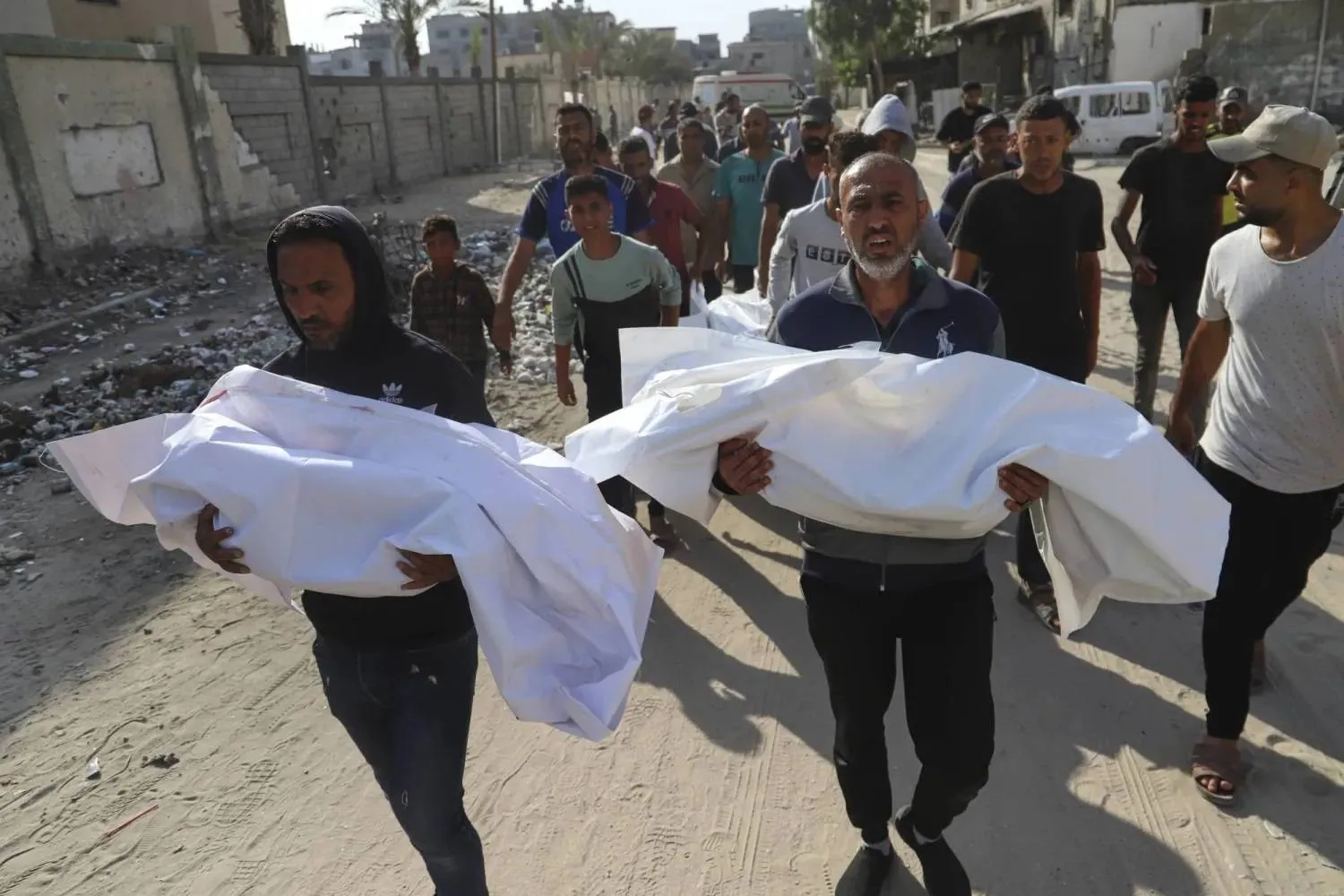
Palestinians carry bodies of relatives killed in Israeli strike in Khan Younis on Tuesday. (AP)
TT

Where Do the Israel-Hamas Ceasefire Talks Stand?

Palestinians carry bodies of relatives killed in Israeli strike in Khan Younis on Tuesday. (AP)

Israeli media has intensified coverage of a potential breakthrough in negotiations with Hamas aimed at securing a temporary ceasefire in the Gaza Strip, which could pave the way for more serious talks on a permanent truce, according to both Israeli officials and sources within the Palestinian group.

Hamas sources confirmed to Asharq Al-Awsat that indirect negotiations are still underway, although no tangible progress has been achieved so far.

They described the process as “ongoing but fluctuating,” citing shifts in momentum due to regional distractions, including the Iranian-Israeli conflict, and the mediators’ engagement with other files they deem more pressing.

On Sunday, Israeli Prime Minister Benjamin Netanyahu hinted at possible progress, saying he might dispatch a delegation to resume negotiations and had instructed officials to push forward with talks.

Senior Hamas officials inside and outside Gaza said there have been moments of increased activity in the talks, but no major breakthrough has occurred. However, they acknowledged some progress based on “positive signals” conveyed by mediators regarding a proposal recently advanced by US envoy Steve Witkoff.

The US plan reportedly includes a 60-day ceasefire period during which Israeli hostages held by Hamas would be released in stages.

According to Hamas sources, mediators have assured the group that such a phased release would ensure Israel’s commitment to the ceasefire throughout the full duration of the truce.

Sources have not ruled out the possibility of a “serious breakthrough” in ceasefire negotiations in the coming days, but warned that any progress ultimately depends on Israel’s stance.

“The main obstacle is not just ensuring a 60-day ceasefire,” one Hamas official told Asharq Al-Awsat.

“The real issue is securing clear guarantees that serious negotiations will follow that could lead to a comprehensive agreement to end the war. Israel continues to stall on this point, and that could once again derail the entire process,” they added.

The official dismissed recent Israeli media reports claiming “significant progress” had been made, calling them “nothing but political maneuvering.”

“Everything depends on Israel,” the source told Asharq Al-Awsat. “But so far, the Netanyahu government has failed to offer any clear commitments to ending the war. What’s being circulated in the Israeli media is just part of Israel’s ongoing evasive tactics.”

Hamas sources said mediators had offered reassurances regarding the implementation of a humanitarian protocol and steps to alleviate Gaza’s worsening humanitarian crisis - issues the group says must be addressed alongside any ceasefire arrangement.

Israeli daily Yedioth Ahronoth reported Tuesday that unnamed regional sources have pointed to “very significant progress” in negotiations toward a potential hostage deal, which could include a ceasefire and steps to end the war in Gaza.

“The two sides have shown flexibility, but both are wary of the consequences of confronting Iran,” one source was quoted as saying. The report added that the Israeli delegation has yet to travel to Doha out of concern that doing so could slow, rather than accelerate, the pace of negotiations.

According to the newspaper, US officials recently told the families of Israeli hostages that there are “extremely positive signs” of a potential breakthrough.

However, an unnamed Israeli official cautioned that the talks cover far more than just the initial stage of releasing eight to ten living captives. “The issues at hand are much broader and relate to effectively ending the war,” the official said.

Families of the Israeli hostages have been urging the government to prioritize their release and to seize the opportunity presented by the situation with Iran to push for a resolution.



Türkiye Begins Black Box Analysis of Jet Crash That Killed Libyan Military Chief and 7 Others

Libyan national flags fly at half-mast in Tripoli on December 24, 2025, after the head of Libya's armed forces and his four aides died in a plane crash in Türkiye. (AFP)
TT

Türkiye Begins Black Box Analysis of Jet Crash That Killed Libyan Military Chief and 7 Others

Libyan national flags fly at half-mast in Tripoli on December 24, 2025, after the head of Libya's armed forces and his four aides died in a plane crash in Türkiye. (AFP)

The technical analysis of the recovered black boxes from a jet crash that killed eight people, including western Libya’s military chief, began as the investigation proceeded in cooperation with Libyan authorities, the Turkish Ministry of Defense said Thursday.

The private jet with Gen. Muhammad Ali Ahmad al-Haddad, four other military officials and three crew members crashed on Tuesday after taking off from Türkiye’s capital, Ankara, killing everyone on board. Libyan officials said the cause of the crash was a technical malfunction on the plane.

The high-level Libyan delegation was on its way back to Tripoli after holding defense talks in Ankara aimed at boosting military cooperation between the two countries.

The wreckage was scattered across an area covering 3 square kilometers (more than a square mile), complicating recovery efforts, according to the Turkish Interior Minister Ali Yerlikaya.

A 22-person delegation, including five family members, arrived from Libya early on Wednesday to assist in the investigation.


Lebanese President: We are Determined to Hold Parliamentary Elections on Time

President Joseph Aoun between Prime Minister Nawaf Salam and Speaker Nabih Berri (Lebanese Presidency file photo)
TT

Lebanese President: We are Determined to Hold Parliamentary Elections on Time

President Joseph Aoun between Prime Minister Nawaf Salam and Speaker Nabih Berri (Lebanese Presidency file photo)

Lebanese President Joseph Aoun reiterated on Thursday that the country’s parliamentary elections are a constitutional obligation that must be carried out on time.

Lebanon’s state-run National News Agency quoted Aoun as saying that he, alongside Prime Minister Nawaf Salam and Parliament Speaker Nabih Berri, is determined to hold the elections on schedule.

Aoun also emphasized that diplomatic efforts have continued unabated to keep the specter of war at bay, noting that "things are heading in a positive direction".

The agency also cited Berri reaffirming that the elections will take place as planned, with "no delays, no extensions".

The Lebanese parliamentary elections are scheduled for May next year.


Israel Calls Countries Condemning New West Bank Settlements ‘Morally Wrong’

Newly constructed buildings are pictured in the Israeli settlement of Givat Zeev near the Palestinian city of Ramallah in the occupied West Bank on October 24, 2025. (AFP)
TT

Israel Calls Countries Condemning New West Bank Settlements ‘Morally Wrong’

Newly constructed buildings are pictured in the Israeli settlement of Givat Zeev near the Palestinian city of Ramallah in the occupied West Bank on October 24, 2025. (AFP)

Israel reacted furiously on Thursday to a condemnation by 14 countries including France and Britain of its approval of new settlements in the occupied West Bank, calling the criticism discriminatory against Jews.

"Foreign governments will not restrict the right of Jews to live in the Land of Israel, and any such call is morally wrong and discriminatory against Jews," Foreign Minister Gideon Saar said.

"The cabinet decision to establish 11 new settlements and to formalize eight additional settlements is intended, among other things, to help address the security threats Israel is facing."

On Sunday, Israel's far-right Finance Minister Bezalel Smotrich announced that authorities had greenlit the settlements, saying the move was aimed at preventing the establishment of a Palestinian state.

Fourteen countries, including Britain, France, Germany, Spain and Canada, then issued a statement urging Israel to reverse its decision, "as well as the expansion of settlements".

Such unilateral actions, they said, "violate international law", and risk undermining a fragile ceasefire in Gaza in force since October 10.

They also reaffirmed their "unwavering commitment to a comprehensive, just and lasting peace based on the two-state solution... where two democratic states, Israel and Palestine, live side-by-side in peace and security".

Israel has occupied the West Bank following the 1967 Arab-Israeli war.

Excluding east Jerusalem, which was occupied and annexed by Israel in 1967, more than 500,000 Israelis live in the West Bank, along with about three million Palestinian residents.

Earlier this month, the United Nations said the expansion of Israeli settlements in the West Bank, all of which are illegal under international law, had reached its highest level since at least 2017.