Israel Wages ‘Psychological War’ on Residents of Southern Lebanonhttps://english.aawsat.com/arab-world/5158408-israel-wages-%E2%80%98psychological-war%E2%80%99-residents-southern-lebanon
Israel Wages ‘Psychological War’ on Residents of Southern Lebanon
Lebanese inspect damage from an Israeli strike on Beirut’s southern suburbs. AP
Residents of southern Lebanon say they are living under the constant shadow of an Israeli “psychological war,” as drones hover overhead, sound bombs explode near villages, and airstrikes fuel a growing climate of fear across the border region.
While Israeli air raids and ground incursions have escalated in recent weeks, locals in towns such as Mays al-Jabal, Hula, and Kfar Kila report an additional, subtler kind of assault: one that aims not to destroy buildings, but to break spirits.
“Drones don’t leave our skies,” Mohammad, a resident of Bint Jbeil, told Asharq Al-Awsat.
“Explosions near homes, constant buzzing, and open threats on Israeli media – it’s designed to keep people afraid.”
The psychological toll has been mounting. Sound bombs were dropped in Hula on Wednesday, while Israeli forces crossed the border near the village of Tufa, setting fire to a truck clearing rubble.
In the town of Mansouri, a man was injured by an Israeli drone strike and hospitalized in nearby Tyre. In a separate incident, a man in his thirties was wounded by unexploded ordnance.
Israel’s tactics, residents say, aim to paralyze daily life and force displacement.
“This is more than a military campaign. It’s a war on the mind,” said former Mays al-Jabal mayor Abdel Moneim Shuqair, noting that only around 500 residents have returned to the town out of a pre-escalation population of 7,000.
Movement in the south has become increasingly perilous. Roads like the one linking Maroun al-Ras to Bint Jbeil are now considered too risky to travel.
“People avoid them because they’re completely exposed to Israeli surveillance. Any moment, a car could be targeted,” Shuqair told Asharq Al-Awsat.
On that note, Mohammed added that Israel doesn’t just want locals to leave; it wants to break their will to return.
In Kfar Kila, resident Mona Awadah described fleeing her home after it was targeted. Her husband survived the attack, but their home was no longer safe.
“We were one of the first families to return after the truce,” she said. “We put up a prefabricated home on our farmland, but even that was targeted. It’s as if they’re saying: you’re not safe anywhere – not even on your own land.”
Locals say the absence of a comprehensive state-led reconstruction plan is exacerbating their sense of abandonment. Efforts to rebuild homes or install mobile housing units have reportedly drawn further Israeli strikes. Some families have taken shelter in public schools, sleeping on makeshift bedding.
“There’s no alternative for us but this country and this army,” said Shuqair. “We need a clear stance from the state and a serious plan for a safe and dignified return,” he added.
As fear becomes routine, some residents warn of an even more dangerous development – adaptation. “The biggest danger is that people are starting to get used to the emptiness,” said Mohammad. “That’s what the occupation wants – for us to forget our land.”
Gaza Flotilla Activists to Be Released from Israel Detention and Deportedhttps://english.aawsat.com/arab-world/5271302-gaza-flotilla-activists-be-released-israel-detention-and-deported
Global Sumud Flotilla Steering Committee members Susan Abdallah, Muhammad Nadir Al-Nuri, Suemeyra Akdeniz Ordu, Maimon Herawati, Thiago Avila and Saif Abukeshek, Eva Saldana, Greenpeace Spain; Maria Serra, GSF Catalunya and Oscar Camps, Open Arms attend a press conference as humanitarian flotilla prepares to depart for Gaza, from Barcelona, Spain, April 12, 2026. REUTERS/Albert Gea
Gaza Flotilla Activists to Be Released from Israel Detention and Deported
Global Sumud Flotilla Steering Committee members Susan Abdallah, Muhammad Nadir Al-Nuri, Suemeyra Akdeniz Ordu, Maimon Herawati, Thiago Avila and Saif Abukeshek, Eva Saldana, Greenpeace Spain; Maria Serra, GSF Catalunya and Oscar Camps, Open Arms attend a press conference as humanitarian flotilla prepares to depart for Gaza, from Barcelona, Spain, April 12, 2026. REUTERS/Albert Gea
Two activists arrested last month when Israeli forces intercepted the Gaza-bound flotilla they were travelling on are expected to be deported in the coming days after being released from security detention on Saturday, their lawyers said. Saif Abu Keshek, a Spanish national, and Brazilian Thiago Avila were detained by Israeli authorities on April 29 and brought to Israel. The activists were part of a second Global Sumud Flotilla launched from Spain on April 12 to try to break Israel’s blockade of Gaza by delivering aid to the enclave.
Israel's foreign ministry said Abu Keshek was suspected of affiliation with a terrorist organization and Avila was suspected of illegal activity. Both denied the allegations, Reuters reported.
BRAZIL AND SPAIN SAID THE DETENTION WAS UNLAWFUL
The governments of Spain and Brazil said Abu Keshek's and Avila's detention was unlawful, but Israel's Ashkelon Magistrate’s Court remanded them in custody until May 10.
Human rights group Adalah, which has assisted in their legal defense and also said the detention was unlawful, said that Abu Keshek and Avila were informed that they will be released from detention on Saturday and handed over to immigration authorities' custody until their deportation.
"Adalah is closely monitoring developments to make sure that the release from detention goes ahead, followed by their deportation from Israel in the coming days," the group said. Israeli officials were not immediately reachable for comment.
Israeli authorities held them under suspicion of offences that included aiding the enemy and contact with a terrorist group.
Gaza is largely run by Palestinian militant group Hamas, which is designated as a terrorist group by Israel and much of the West. The group's October 7, 2023, attack on Israel started the Gaza war that has left much of the enclave's population homeless and dependent on aid - that humanitarian agencies say is arriving too slowly.
EU Official Urges Increased Humanitarian Access in South Lebanonhttps://english.aawsat.com/arab-world/5271290-eu-official-urges-increased-humanitarian-access-south-lebanon
Israeli troops maneuver on the Lebanese side of the border, as seen from the Upper Galilee in northern Israel, 08 May 2026, amid a ceasefire between Israel and Lebanon. EPA/ATEF SAFADI
EU Official Urges Increased Humanitarian Access in South Lebanon
Israeli troops maneuver on the Lebanese side of the border, as seen from the Upper Galilee in northern Israel, 08 May 2026, amid a ceasefire between Israel and Lebanon. EPA/ATEF SAFADI
European Union crisis management chief Hadja Lahbib on Saturday urged increased humanitarian access in south Lebanon, where Israel has kept up strikes and Hezbollah has been launching attacks despite a ceasefire.
"Humanitarian aid is ready, but too often it cannot reach those who need it most," Lahbib told a news conference on the second day of her visit to Lebanon, ahead of an expected EU aid delivery.
A ceasefire came into effect on April 17 but Israel has kept up strikes. Its troops are operating inside an Israeli-announced "yellow line" that runs around 10 kilometres (six miles) deep inside Lebanon along the border, where Lebanese have been warned not to return.
Under the terms of the ceasefire, Israel reserves the right to act against "planned, imminent or ongoing attacks".
With both sides trading accusations of truce violations, the Iran-backed Hezbollah has also announced attacks, mainly on Israeli targets in south Lebanon.
"South of the Litani River, access is still severely restricted due to evacuation orders and Israeli military activity. And this includes 55 villages below the so-called yellow line," Lahbib said.
The Litani River runs around 30 kilometres from the border, an area where many of the attacks since the ceasefire have taken place.
She noted that key infrastructure including bridges over the Litani have been destroyed, "and that means longer routes, people waiting days and days for help".
"Even north of the Litani River, where some of these constraints have eased, it is still not enough. We need humanitarian access in full respect of international humanitarian law. Aid cannot save lives if it cannot reach people," she said.
Lahbib said that since the start of the war, the European Union had announced some 100 million euros in new humanitarian support for Lebanon and had sent six planes carrying aid, with a seventh due to arrive in the coming days.
Authorities say more than 2,750 people have been killed since March 2, including at least 104 health and emergency workers, with Israeli strikes having killed dozens since the ceasefire.
More than one million people have been displaced.
"Hospitals and ambulances targeted and journalists attacked for simply doing their job -- there is no justification for this. International humanitarian law must be respected," Lahbib said.
"This crisis is not over, so all support for the Lebanese people must continue," she said.
Geagea: Negotiations Must Deliver Lasting Stability on Border, Not Temporary Calmhttps://english.aawsat.com/arab-world/5271283-geagea-negotiations-must-deliver-lasting-stability-border-not-temporary-calm
Geagea: Negotiations Must Deliver Lasting Stability on Border, Not Temporary Calm
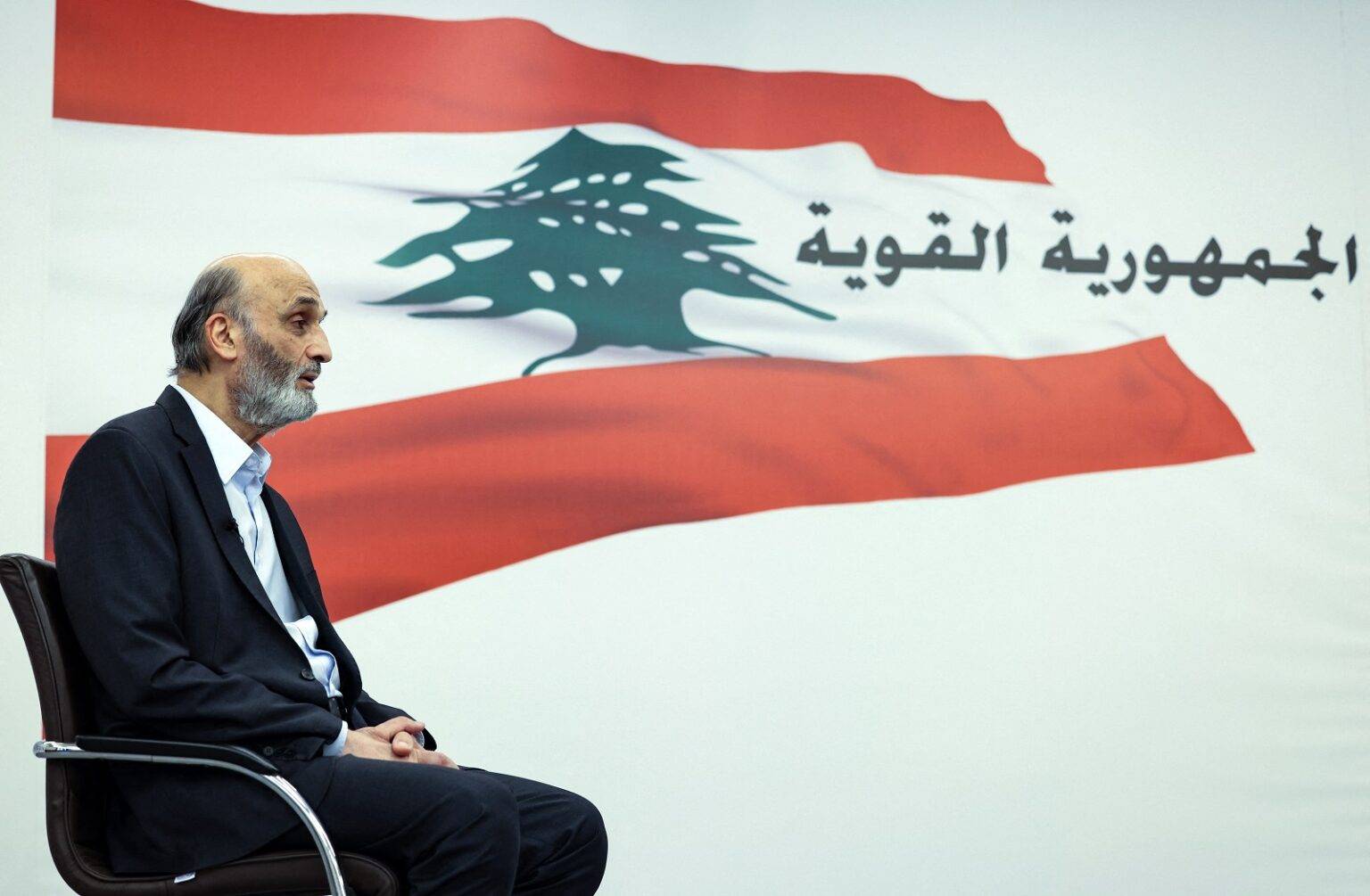
Leader of the Lebanese Forces Samir Geagea - AFP
The leader of the Lebanese Forces, Samir Geagea, said Lebanon “is facing an extremely complex dilemma, to the extent that merely observing developments is no longer enough to resolve it, because the root of the problem remains unresolved without effective treatment.”
In an interview with Asharq Al-Awsat, Geagea stressed that any negotiations or settlements currently under way “must lead to ending the state of open confrontation on Lebanon’s southern border once and for all, not to temporary calm or theoretical solutions.” He said what is required is “to restore normal conditions in Lebanon as an independent and sovereign state, away from external interventions and conflicts.”
Geagea said the objective of the Lebanese-Israeli negotiations due to begin next Thursday should be “to reach a normal and lasting situation on Lebanon’s southern border, not temporary calm followed by renewed confrontations every few months or years.” He said the Lebanese could no longer endure repeated cycles of escalation and anxiety, stressing the need to establish stability permanently.
He said how this objective could be achieved “should be left to the course of negotiations and the political authority, represented by the president, the prime minister and official institutions,” adding that the outcome of the talks would become clearer over time.
Geagea described the negotiations taking place in Washington as the most significant development at the current stage, “not because of a desire for negotiations in themselves, but because there is no serious alternative capable of pulling the country out of its current crisis.”
He said any party that had another “practical and serious” proposal should present it, considering negotiations to be the only available option for now.
Leader of the Lebanese Forces Samir Geagea speaking after parliamentary elections in 2022 (File- AFP)
Regional complexities
Geagea said the regional scene currently appeared highly complex amid the major uncertainty surrounding the US-Iran confrontation, adding that it remained difficult to predict how the confrontation might end or what its repercussions on the region would be.
As for Lebanon, Geagea said Iranian influence had entered a phase of decline, arguing that the “Iranian phase” in Lebanon was almost over or nearing its end, and that regional and international circumstances no longer allowed the previous reality to continue as it had.
He said Lebanon could not continue as an arena tied to external conflicts, but instead needed to reposition itself as a normal state with independent national decision-making, adding that any foreign role, whether Iranian or otherwise, should not come at the expense of Lebanese sovereignty and state institutions.
Asked about Lebanon’s red lines in the negotiations, Geagea said a realistic approach required looking for what can succeed with the fewest losses and complications, adding that any settlement must begin from Lebanon’s interests first.
Asked whether what was happening today was limited to security arrangements aimed at controlling the border and preventing escalation, or whether it could become a prelude to a broader process extending beyond security toward peace or political normalization in the future, Geagea said it was still impossible to determine the nature of the path events might ultimately take.
He said the current approach was based on testing the minimum steps needed to achieve stability, but that in the end it would be necessary to move forward with the option that was viable and implementable.
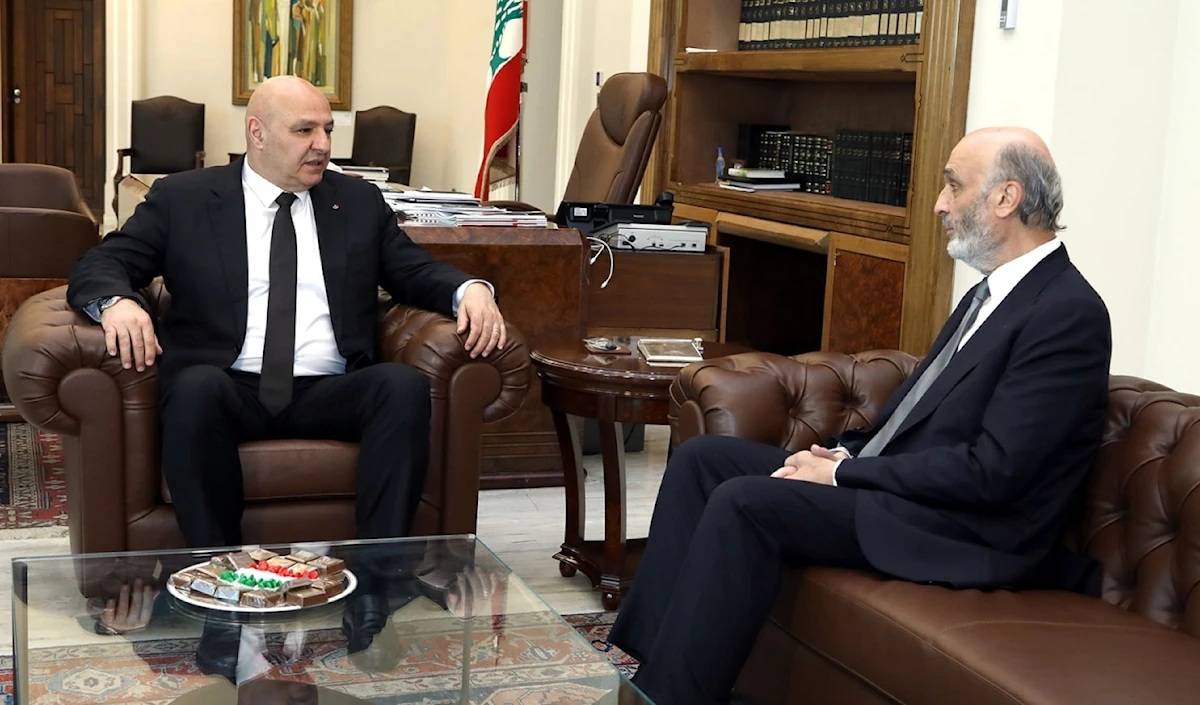
Lebanese President Joseph Aoun and Lebanese Forces Party leader Samir Geagea at the Presidential Palace in June 2025 (File- Lebanese Presidency)
Official meetings after conditions are met
Geagea said the negotiations were being managed by President Joseph Aoun “in a proper manner,” explaining that no understanding with Israel would be announced before it included all Lebanese demands.
“The understanding is prepared first at the level of substance, and once practical results that meet Lebanese conditions become clear, it becomes possible to move to the stage of official meetings and the announcement or signing of the agreement,” he said.
Geagea said the president was handling this issue in a “good and organized” manner at the current stage, arguing that alternatives tested over the past 20 years “had not produced real solutions,” despite some parties continuing to cling to them.
He said Lebanon’s southern border had, over the past 60 years, been the main gateway to every crisis and period of instability the country had witnessed, and that resolving this issue permanently therefore constituted a national necessity.
Geagea added that the nature of the results the current negotiations might produce remained unclear, saying it was still too early to judge their final outcome.
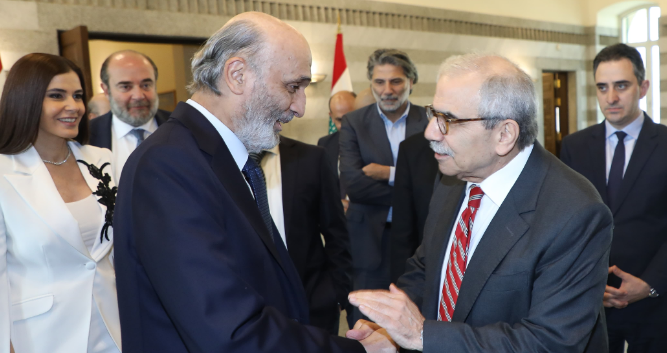
Lebanese Prime Minister Nawaf Salam and Geagea at the Grand Serail in Beirut (File -NNA)
National cover for negotiations
Geagea rejected claims that the negotiations lacked national backing, saying President Aoun enjoyed full constitutional and popular legitimacy. He noted that Aoun had been elected by a large majority of 98 votes in the 128-member parliament, reflecting broad Lebanese consensus around him.
He said this legitimacy was no less important than any democratic legitimacy elsewhere in the world, noting that US President Donald Trump had come to power with around 52 percent of the vote while fully exercising his constitutional powers.
Geagea added that Prime Minister Nawaf Salam also enjoyed similar legitimacy because he had been designated according to constitutional procedures and his government had won the confidence of a parliament elected through genuine competitive elections. He said Lebanon today possessed “a fully legitimate authority” representing the Lebanese at this stage, even if there was no complete consensus within any democratic system.
“Political divisions are normal in democracies,” Geagea said, citing the United States, where some Americans opposed Trump’s policies without stripping him of the legitimacy to negotiate and make decisions on behalf of the state. He concluded by stressing that the Lebanese delegation negotiating in Washington was doing so on the basis of this official legitimacy representing the Lebanese state.
Geagea said the Lebanese state, at the political level, had implemented what had been requested of it, citing a number of government decisions he described as “strategic,” in addition to measures taken at specific times over the past period.
“Deep state”
According to Geagea, the core problem remained what he called the “deep state” inside Lebanon, which he said delayed implementation of political decisions. He argued that this structure made any confrontation with it extremely complicated, because anyone entering into conflict with it faced two equally difficult options: submission or exclusion.
Hezbollah
Regarding Hezbollah’s position toward whatever the negotiations might produce, Geagea said the decisive moment had not yet arrived, unless an “unexpected change” prompted party officials to reconsider their approach. He also expressed pessimism about the possibility of such a shift, arguing that the party’s final decision was entirely linked to Iran, including for fighters on the ground who might understand the reality of the situation but did not control their own decision-making.
Geagea said it was natural in pluralistic democracies for there to be a party, even one with significant popular support, that adopted a different political approach, adding that this in itself was not a problem. He stressed, however, that political differences did not justify obstructing the work of the state or delaying implementation of its decisions.
“What is happening now gives the impression that there is more than one authority managing decision-making in the country,” he said, adding that each side appeared to be acting separately from the others. He described this situation as unacceptable, saying the state must be the sole decision-maker and the only authority in managing national affairs.
Geagea said a broad segment of this environment had lived for more than 40 years within a specific political and ideological climate for various historical, spiritual, emotional, material and economic reasons. He said exiting this reality could not happen overnight, but instead required time and gradual transformations.
At the same time, he stressed that this reality did not mean ignoring or bypassing other Lebanese components, saying that in a pluralistic country like Lebanon, it was natural for other groups to hold different views and approaches.
“How can the country be run if one side imposes its vision while other components oppose it?” he asked, in reference to the need to respect internal balances and abide by the logic of the state and institutions.
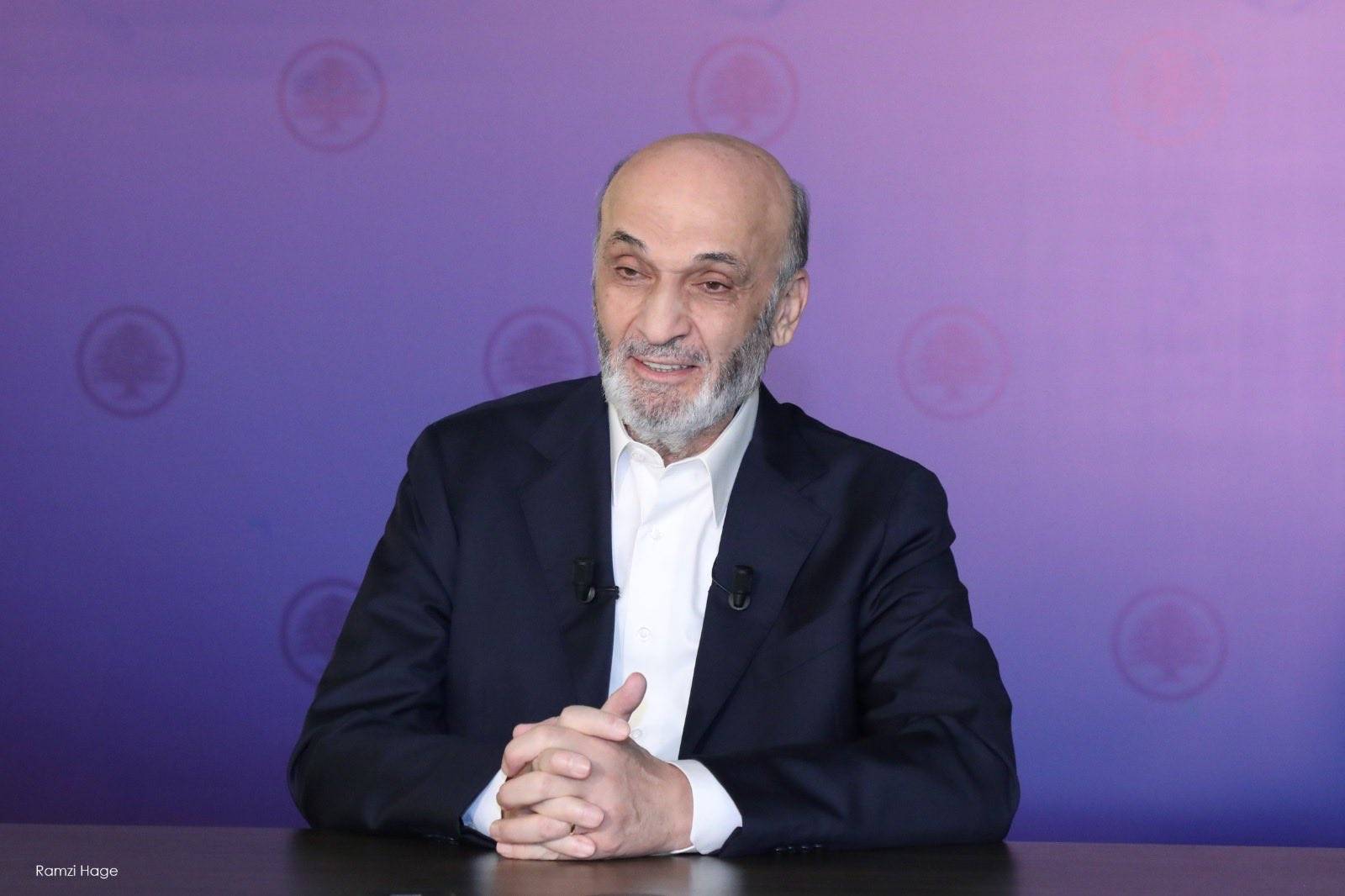
Leader of the Lebanese Forces, Samir Geagea( Lebanese Forces website)
Managing disagreements through Taif
Geagea said having Lebanese groups with differing views required a return to constitutional mechanisms and official institutions to manage those differences. He noted that the Lebanese had originally agreed to regulate their disputes through the Taif Agreement, which produced a constitution placing authority in state institutions, from parliament to the cabinet and the presidency.
Geagea said Lebanon had lived for nearly 60 years in a state of permanent confrontation, particularly along its southern border, which remained “open” to various conflicts and armed organizations. He noted that the southern arena had moved from the presence of Palestinian factions to other Lebanese factions, eventually culminating in Hezbollah’s full control of the scene after sidelining other parties. This, he argued, turned Lebanon into an arena for settling regional and international scores, particularly after the Iraq war.
Geagea said this reality had left the Lebanese state, and Lebanon as a whole, in a constant state of fragility, leading over past decades to a major drain of younger generations searching for a future and opportunities for a normal life.
He stressed that Lebanese youth, despite education and hard work, found themselves facing a lack of job opportunities and absence of prospects because of the continuing political and security conditions.
State legitimacy and unified authority
Geagea stressed that having official legitimacy and state institutions remained far preferable to chaos or multiple competing authorities, arguing that any legitimate system, regardless of criticisms against it, was still capable of providing a minimum level of stability and governance.
The core issue lay in finding a final solution to Lebanon’s legitimacy crisis, so that the state alone would hold decision-making authority and sovereignty, he noted.
Geagea stressed that the continuation of ungoverned spaces and open fronts could not build a stable country, but instead kept Lebanon vulnerable to constant instability and conflict, and warned that building the state in Lebanon required courage, decisions and sacrifices, arguing that no one would hand the Lebanese a ready-made state if they did not take the initiative to build it themselves.
“The opportunity still exists,” he said, “but what is required is to seize it and carry it through to the end, instead of merely managing crises or waiting for external solutions.”
No risk of civil war
Regarding the internal Lebanese situation and divisions linked to the war imposed on the country, especially given the absence of a unified Lebanese position on the conflict and the charged atmosphere that continually revives memories of civil war and sectarian tensions, Geagea said he saw no real indications of the outbreak of civil war.
He argued that any war of this kind required two willing sides, and said he did not sense a desire among other parties to enter such a path.
According to Geagea, even if Hezbollah had different calculations, what mattered more was that state institutions, including what he had previously described as the “deep state,” moved quickly whenever internal tensions emerged to prevent the situation from spiraling out of control.
He cited shooting incidents in Beirut’s southern suburbs during the funeral of one fighter, saying the intervention of the security agencies and the containment of the situation indicated that there is a real decision to prevent any slide into chaos.
Geagea concluded by saying that although he believed the Lebanese state had not yet imposed its full authority across all Lebanese territory, he did not believe matters would be left to slide into internal confrontation, but rather that the state would intervene to prevent any friction that could lead to sectarian strife or civil conflict.
لم تشترك بعد
انشئ حساباً خاصاً بك لتحصل على أخبار مخصصة لك ولتتمتع بخاصية حفظ المقالات وتتلقى نشراتنا البريدية المتنوعة