
Türkiye Reasserts its Red Lines in Syria

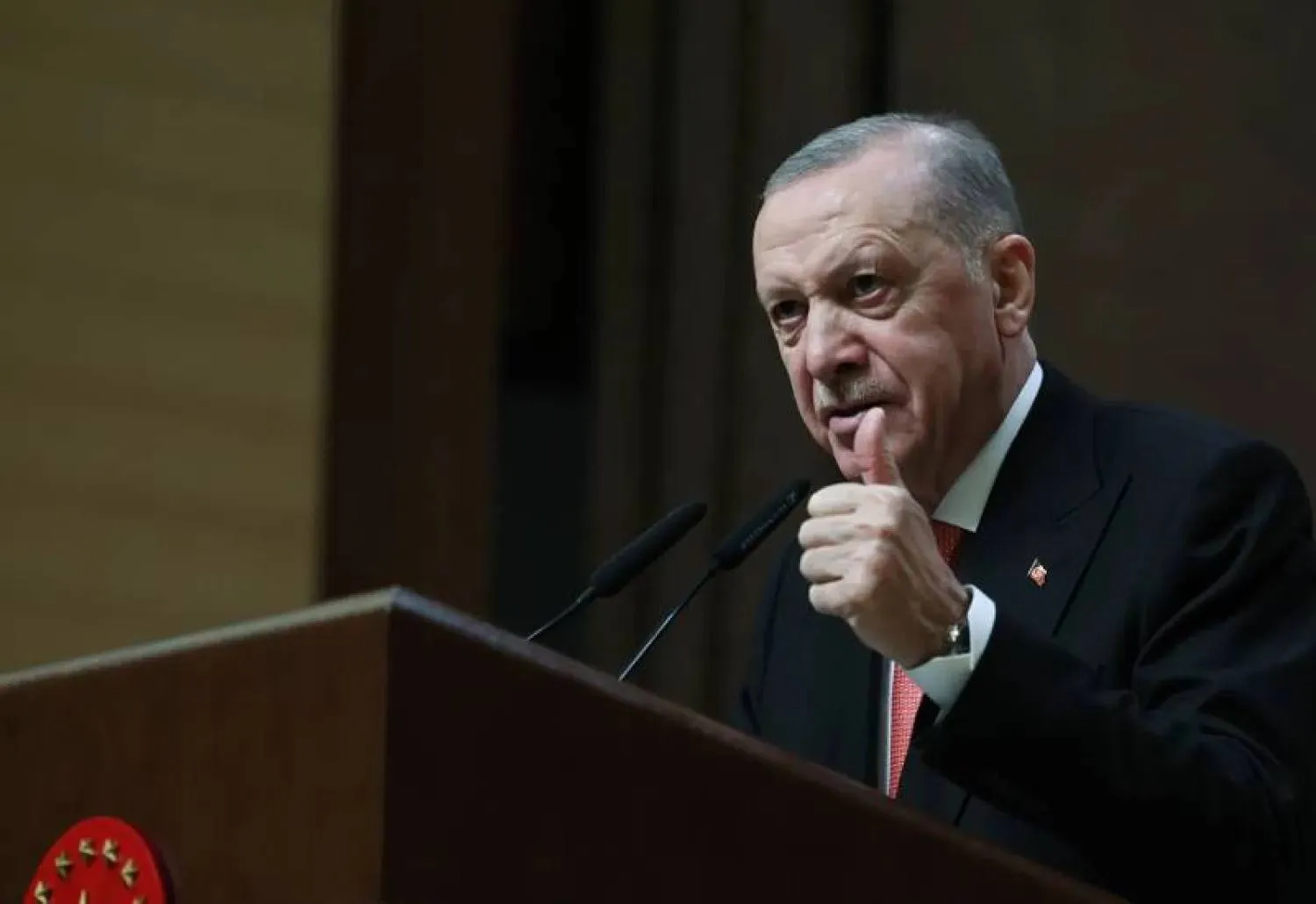
Turkish President Recep Tayyip Erdogan (Turkish Presidency)
TT

Türkiye Reasserts its Red Lines in Syria

Turkish President Recep Tayyip Erdogan (Turkish Presidency)

Türkiye has redrawn its red lines in Syria, firmly rejecting any move to legitimize organizations it labels as terrorist, while pledging support for efforts that could secure a stable and prosperous future for Syria, including Washington’s proposal for Damascus to join the Abraham Accords with Israel.

President Recep Tayyip Erdogan stressed that Türkiye would not tolerate plans to grant legitimacy to the Syrian Democratic Forces (SDF) or their affiliates. Speaking to Turkish journalists on his return flight from Azerbaijan, where he attended the 17th Economic Cooperation Organization Summit, Erdogan stressed that Syria’s territorial integrity remains a critical priority for Ankara.

Responding to questions about the proposed integration of SDF fighters into the Syrian Army, he said: “The unity of Syrian territory is of utmost importance to us. We have taken active measures on the ground, through the Euphrates Shield, Olive Branch, and Peace Spring operations, to secure our borders and end instability.”

He added that Ankara supports eliminating all armed groups in Syria so that the Syrian Army alone controls the country.

“Lasting peace and stability in Syria are in our interest too. Anyone who seeks to obstruct this will find Türkiye standing against them,” he said.

Erdogan has repeatedly accused the SDF of stalling implementation of the integration deal signed in March between Syria’s interim President Ahmad Al-Shara and SDF commander Mazloum Abdi.

While the US endorses the agreement between Damascus and the SDF, it continues to back the Kurdish People’s Protection Units (YPG), the backbone of the SDF. Türkiye considers the YPG an extension of the PKK, which it designates as a terrorist group, while Washington views it as a crucial partner against ISIS.

To persuade the US to end its support, Ankara has proposed aiding Damascus in combating ISIS and transferring control over prisons and camps holding ISIS fighters and families to the Syrian government. Türkiye also floated a regional cooperation plan, including Iraq, Jordan, Lebanon, and Syria, to coordinate counterterrorism operations from a center in Damascus. However, progress has been slow.

Erdogan also welcomed US and European decisions to lift sanctions on Syria and to initiate preliminary security talks between Syria and Israel. He noted that normalization between Ankara and Damascus is advancing rapidly, with plans for joint economic initiatives such as free trade zones and cross-border markets.

Finally, he revealed that Azerbaijan has agreed to supply natural gas to Syria, viewing it as an important step for regional stability.


Army: Lebanese Soldier among Those Killed in Monday Israeli Strike

Lebanese soldiers secure the site of an Israeli drone strike that targeted a truck in the village of Sibline, south of Beirut, on December 16, 2025. (Photo by Mahmoud ZAYYAT / AFP)
TT

Army: Lebanese Soldier among Those Killed in Monday Israeli Strike

Lebanese soldiers secure the site of an Israeli drone strike that targeted a truck in the village of Sibline, south of Beirut, on December 16, 2025. (Photo by Mahmoud ZAYYAT / AFP)

A Lebanese soldier was among three people killed in an Israeli air strike on a car in the country's south, the army said Tuesday, denying Israeli claims that he was also a Hezbollah operative.

Israel has kept up regular strikes on Lebanon, usually saying it is targeting Hezbollah, despite a November 2024 ceasefire that sought to end more than a year of hostilities with the Iran-backed militant group, which it accuses of rearming.

Lebanon's state-run National News Agency said Monday's strike on a vehicle was carried out by an Israeli drone around 10 kilometers (six miles) from the southern coastal city of Sidon and "killed three people who were inside".

The Lebanese army said on Tuesday that Sergeant Major Ali Abdullah had been killed the previous day "in an Israeli airstrike that targeted a car he was in" near the city of Sidon.

The Israeli army said it had killed three Hezbollah operatives in the strike, adding in a statement on Tuesday that "one of the terrorists eliminated during the strike simultaneously served in the Lebanese intelligence unit".

A Lebanese army official told AFP it was "not true" that the soldier was a Hezbollah member, calling Israel's claim "a pretext" to justify the attack.

Under heavy US pressure and amid fears of expanded Israeli strikes, Lebanon has committed to disarming Hezbollah, starting with the south.

The Lebanese army plans to complete the group's disarmament south of the Litani River -- about 30 kilometers from the border with Israel -- by year's end.

The latest strike came after Lebanese and Israeli civilian representatives on Friday took part in a meeting of the ceasefire monitoring committee for a second time, after holding their first direct talks in decades earlier this month.

The committee comprises representatives from Lebanon, Israel, the United States, France and the United Nations Interim Force in Lebanon (UNIFIL).

More than 340 people have been killed by Israeli fire in Lebanon since the ceasefire, according to an AFP tally of Lebanese health ministry reports.


Israel Defense Minister Vows to Stay in Gaza, Establish Outposts

Israeli Defense Minister Israel Katz. (dpa)
TT

Israel Defense Minister Vows to Stay in Gaza, Establish Outposts

Israeli Defense Minister Israel Katz. (dpa)

Defense Minister Israel Katz on Tuesday vowed Israel will remain in Gaza and pledged to establish outposts in the north of the Palestinian territory, according to a video of a speech published by Israeli media. 

His remarks, reported across Israeli media, come as a fragile US-brokered ceasefire between Israel and Hamas holds in Gaza, said AFP. 

Mediators are pressing for the implementation of the next phases of the truce, which would involve an Israeli withdrawal from the territory. 

Speaking at an event in the Israeli settlement of Beit El in the occupied West Bank, Katz said: "We are deep inside Gaza, and we will never leave Gaza -- there will be no such thing." 

"We are there to protect, to prevent what happened (from happening again)," he added, according to a video published by Israeli news site Ynet. 

Katz also vowed to establish outposts in the north of Gaza in place of settlements that had been evacuated during Israel's unilateral disengagement from the territory in 2005. 

"When the time comes, God willing, we will establish in northern Gaza, Nahal outposts in place of the communities that were uprooted," Katz said, referring to military-agricultural settlements set up by Israeli soldiers. 

"We will do this in the right way and at the appropriate time." 

Katz's remarks were slammed by former minister and chief of staff Gadi Eisenkot, who accused the government of "acting against the broad national consensus, during a critical period for Israel's national security." 

"While the government votes with one hand in favor of the Trump plan, with the other hand it sells fables about isolated settlement nuclei in the (Gaza) Strip," he wrote on X, referring to the Gaza peace plan brokered by US President Donald Trump. 

The next phases of Trump's plan would involve an Israeli withdrawal from Gaza, the establishment of an interim authority to govern the territory in place of Hamas and the deployment of an international stabilization force. 

It also envisages the demilitarization of Gaza, including the disarmament of Hamas, which the group has refused. 

On Thursday, several Israelis entered the Gaza Strip in defiance of army orders and held a symbolic flag-raising ceremony to call for the reoccupation and resettlement of the Palestinian territory. 


A Shaky Start for Lebanon’s Financial Gap Bill

Depositors hold protest banners against the draft deposit recovery law during popular demonstrations on the road to the Presidential Palace (Asharq Al-Awsat). 
TT

A Shaky Start for Lebanon’s Financial Gap Bill

Depositors hold protest banners against the draft deposit recovery law during popular demonstrations on the road to the Presidential Palace (Asharq Al-Awsat). 

A widening wave of objections in Lebanon to the draft “financial gap” bill has exposed the hurdles facing its passage in parliament.

Prepared by a ministerial and legal committee chaired by Prime Minister Nawaf Salam, the bill has drawn resistance from influential political and sectoral actors, bolstering the opposition voiced by depositors’ associations and the banking lobby.

Conflicting ministerial positions ahead of Monday’s special cabinet session to review the final draft underscore the sharp disputes likely to intensify once the bill is formally sent to parliament, a senior financial official told Asharq Al-Awsat.

With parliamentary elections due next spring, candidates are wary of confronting voters or powerful interest groups.

According to the government’s forthcoming brief, the bill marks the end of years of disorder and the start of a clear path to restore rights, protect social stability, and rebuild confidence in the financial system after six years of paralysis, silent erosion of deposits, and crisis mismanagement.

It is framed not as a narrow technical fix, but as a strategic shift, from denying losses and letting them fall haphazardly, to acknowledging and organizing them within an enforceable legal framework.

The government argues the plan would protect about 85% of depositors by enabling access to a guaranteed portion of savings, up to $100,000 over four years, while preserving the nominal value of all deposits via central bank–guaranteed bonds maturing in 10, 15, and 20 years.

Banks, however, have openly declared their “fundamental reservations and strong objection” to the bill on financial regularization and deposit treatment.

Professional associations and unions have joined depositors’ groups in opposing proposals they say would load the bulk of losses onto depositors, either through direct haircuts or by stretching repayment over one to two decades.

The Beirut Order of Engineers added its voice, warning that the near-final draft manages collapse rather than delivers reform, distributing losses unfairly at the expense of depositors and productive sectors, and failing to explicitly protect union funds.

Legal objections have also surfaced over provisions with retroactive effect, taxes, levies, and accounting adjustments applied to transfers made after the crisis erupted in autumn 2019, as well as to past deposit returns.

Banks say such measures constitute an unjustified infringement of rights and lack sound legal and financial grounding or precedent.

The financial official noted that these retroactive elements could be challenged before the State Council, as they contradict the principle that laws apply only after promulgation. Most transactions, he added, were conducted under then-valid laws and central bank approvals.

By contrast, previous governments compelled the central bank to spend more than $11 billion on poorly controlled subsidies, much of which was smuggled abroad, notably to Syrian markets.

Banks insist that any credible solution must begin with a precise, transparent assessment of the financial gap at the Central Bank, based on audited, unified accounts and realistic financial modeling.

They argue that the plan effectively wipes out banks’ capital and - under loss-sharing rules set by Law 23/2025 - ultimately hits depositors, while the state avoids settling its debts to the central bank or covering its balance-sheet shortfall.