

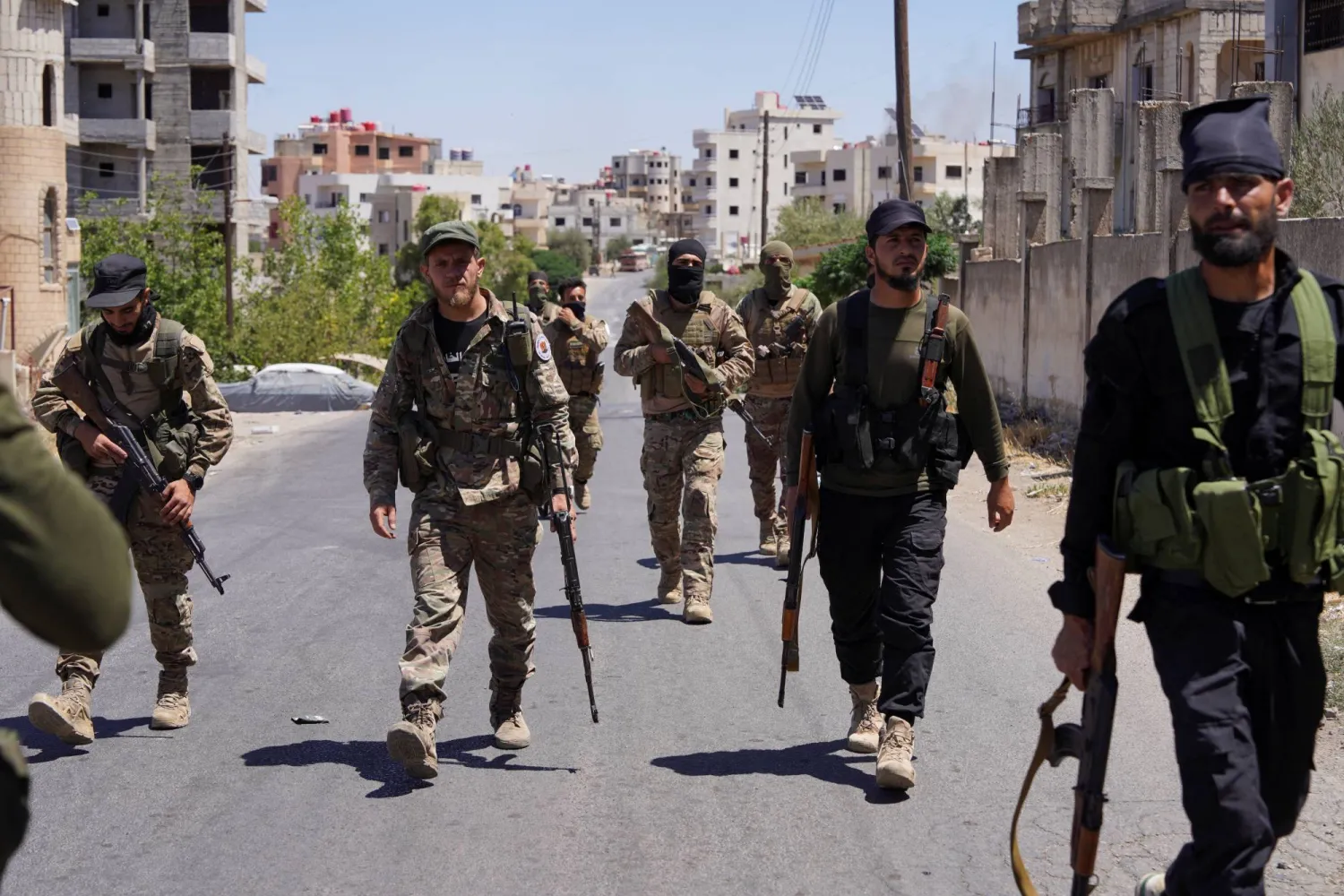

Syrian Government Forces Begin Withdrawing from Sweida

Syrian security forces walk together along a street, after clashes between Syrian government troops and local Druze fighters resumed in the southern Druze city of Sweida early on Wednesday, collapsing a ceasefire announced just hours earlier that aimed to put an end to days of deadly sectarian bloodshed, in Sweida, Syria July 16, 2025. REUTERS/Karam al-Masri
TT

Syrian Government Forces Begin Withdrawing from Sweida

Syrian security forces walk together along a street, after clashes between Syrian government troops and local Druze fighters resumed in the southern Druze city of Sweida early on Wednesday, collapsing a ceasefire announced just hours earlier that aimed to put an end to days of deadly sectarian bloodshed, in Sweida, Syria July 16, 2025. REUTERS/Karam al-Masri

Syrian government officials and leaders in the Druze religious minority announced a renewed ceasefire Wednesday after days of clashes that have threatened to unravel the country’s postwar political transition and drawn military intervention by powerful neighbor Israel.

Convoys of government forces began withdrawing from the city of Sweida, but it was not immediately clear if the agreement, announced by Syria's Interior Ministry and in a video message by a Druze religious leader, would hold. A previous ceasefire announced Tuesday quickly fell apart, and a prominent Druze leader, Sheikh Hikmat Al-Hijri, disavowed the new agreement.

Israeli strikes continued after the ceasefire announcement, reported The Associated Press.

Rare Israeli airstrikes in the heart of Damascus

The announcement came after Israel launched rare airstrikes in the heart of Damascus, an escalation in a campaign that it said was intended to defend the Druze and push militants away from its border. The Druze form a substantial community in Israel as well as in Syria and are seen in Israel as a loyal minority, often serving in the military.

The escalation in Syria began with tit-for-tat kidnappings and attacks between local Bedouin tribes and Druze armed factions in the southern province of Sweida.

The violence appeared to be the most serious threat yet to efforts by Syria’s new rulers to consolidate control of the country after an offensive by opposition factions ousted longtime despotic leader Bashar Assad in December, ending a nearly 14-year civil war.

Interim President Ahmad al-Sharaa, in footage on state television early Thursday, called the Druze an integral part of Syria and denounced Israel's actions as sowing division.

“We affirm that protecting your rights and freedoms is among our top priorities,” he said, specifically addressing Druze people in Syria. "We reject any attempt — foreign or domestic — to sow division within our ranks. We are all partners in this land, and we will not allow any group to distort the beautiful image that Syria and its diversity represent.”

He said Israel sought to break Syrian unity and turn the country into a theater of chaos but that Syrians were rejecting division.

He said Syrians did not fear renewed war but sought the path of Syrian interest over destruction. “We assigned local factions and Druze spiritual leaders the responsibility of maintaining security in (Sweida), recognizing the gravity of the situation and the need to avoid dragging the country" into a new war, he said.

No official casualty figures have been released for the latest fighting since Monday, when the Interior Ministry said 30 people had been killed. The UK-based war monitor Syrian Observatory for Human Rights said more than 300 people had been killed as of Wednesday morning, including four children, eight women and 165 soldiers and security forces.

Israel threatens further escalation

Israel has launched dozens of strikes targeting government troops and convoys heading into Sweida, and on Wednesday struck the Syrian Defense Ministry headquarters next to a busy square in Damascus that became a gathering point after Assad's fall.

That strike killed three people and injured 34, Syrian officials said. Another Israeli strike hit near the presidential palace in the hills outside Damascus.

Israeli Defense Minister Israel Katz said after the initial Damascus airstrike in a post on X that the “painful blows have begun.”

Israel has taken an aggressive stance toward Syria’s new leaders, saying it doesn’t want militants near its borders. Israeli forces have seized a UN-patrolled buffer zone on Syrian territory along the border with the Golan Heights and launched hundreds of airstrikes on military sites in Syria.

Kats said in a statement that the Israeli army “will continue to attack regime forces until they withdraw from the area — and will also soon raise the bar of responses against the regime if the message is not understood.”

An Israeli military official who spoke on condition of anonymity in line with regulations said the army was preparing for a “multitude of scenarios" and that a brigade, normally comprising thousands of soldiers, was being pulled out of Gaza and sent to the Golan Heights.



Israel Considers Special Military Court to Seek Death Penalty for Hamas Fighters

A fighter from the Izz ad-Din al-Qassam Brigades, affiliated with Hamas, oversees the search for the bodies of Israeli hostages, with the participation of Red Cross personnel, in the Jabalia refugee camp in northern Gaza, Dec. 1, 2025. (EPA) 
TT

Israel Considers Special Military Court to Seek Death Penalty for Hamas Fighters

A fighter from the Izz ad-Din al-Qassam Brigades, affiliated with Hamas, oversees the search for the bodies of Israeli hostages, with the participation of Red Cross personnel, in the Jabalia refugee camp in northern Gaza, Dec. 1, 2025. (EPA) 

Israel is weighing extraordinary legal measures that could result in the execution of up to 100 Hamas fighters accused of taking part in the Oct. 7, 2023 attack.

Defense Minister Israel Katz and Justice Minister Yariv Levin have discussed the creation of a dedicated military court to try hundreds of members of Hamas’ elite “Nukhba” unit, part of the Izz ad-Din al-Qassam Brigades, according to Israeli media reports.

Officials familiar with the deliberations said the proposed court would have the authority to impose the death penalty, with military prosecutors expected to seek capital punishment for about 100 defendants facing the gravest charges.

Senior figures from the Israeli army and the Justice Ministry attended the talks, including Itai Ofir, the chief military prosecutor, the Times of Israel reported. Katz said Israel was determined to punish those responsible for the attack “in a way that leaves no ambiguity,” adding that anyone who harms Israeli civilians “will be held fully accountable.”

The discussions come shortly after the far-right Otzma Yehudit party, led by National Security Minister Itamar Ben-Gvir, released updated principles for controversial legislation that would mandate the death penalty for those involved in the October 7 assault.

The bill, which passed an initial Knesset vote in November and is now being debated in the National Security Committee, would allow military courts to impose capital punishment on Palestinians by a simple majority of judges.

Military sources said Israel is holding about 450 Palestinian prisoners classified as Hamas “elite” fighters, far fewer than the thousands initially cited at the start of the war.

According to Israeli officials, prosecutors intend to seek death sentences, most likely by firing squad, after the Israeli Medical Association reportedly declined to take part in executions by lethal injection.

Channel 14 said the detainees are being held at a special military facility under heavy guard, in conditions that have drawn criticism from international human rights organizations.

Officials have spent nearly two years debating how to prosecute the suspects in a way that would ensure execution.

The preferred option, according to the report, is to conduct trials outside the regular judicial system in highly public proceedings, likened to the trial of Nazi official Adolf Eichmann, who was abducted by the Mossad in Argentina in 1960, tried by a special tribunal in Jerusalem, and executed in 1962.

Critics warned that such high-profile trials could become a platform for putting Israel itself on trial over events preceding Oct. 7 and the subsequent war in Gaza.

Israeli authorities said they have compiled extensive evidence, including documents seized in Gaza, interrogations of detainees, and video footage recorded by Hamas and Palestinian Islamic Jihad fighters during the attack.

The move comes amid rising tensions in Israeli prisons. Prison Service Commissioner Kobi Yaakobi recently warned of a possible inmate uprising due to harsh conditions.

The Prison Service later said his comments were taken out of context, insisting its policies, which are overseen by Ben-Gvir, are effective and that it is prepared for “any scenario.”

More than 9,500 Palestinians are currently held in Israeli prisons, including 3,360 in administrative detention without charge or trial. Palestinian prisoner groups say at least 110 detainees have died in custody since the war began, including 50 from Gaza.


US-Yemen Engagement Seeks to Bolster Partnership, Contain Divisions

Al-Alimi met with US Ambassador Steven Fagin in Riyadh (SABA)
TT

US-Yemen Engagement Seeks to Bolster Partnership, Contain Divisions

Al-Alimi met with US Ambassador Steven Fagin in Riyadh (SABA)

Several meetings held by US Ambassador to Yemen Steven Fagin with the leadership of Yemen’s Presidential Leadership Council (PLC) point to American attempts to reinforce the political and security partnership with the Yemeni government while containing internal divisions within the internationally recognized camp.

The move comes amid a complex domestic environment and growing regional challenges affecting Yemen’s security and stability.

The engagement included talks with PLC President Rashad al-Alimi, a meeting with council member Sheikh Othman Mujalli, and a video call with Major General Sultan al-Aradah.

Discussions focused on bilateral relations, political and military developments, and certain priorities, notably counterterrorism and confronting threats posed by the Iran-backed Houthi militia.

Discussions with al-Alimi reportedly centered on the scope of Yemeni-US partnership and Washington’s role in supporting the Yemeni state, politically in international forums and through counterterrorism cooperation, as well as efforts to curb Iran-linked arms smuggling and financial networks.

Government reforms were also raised, in light of the need for international backing to ease economic and humanitarian pressures.

The talks addressed recent developments in Yemen’s eastern governorates and unilateral measures taken there, alongside regional efforts led by Saudi Arabia and the United Arab Emirates to contain tensions and restore normal conditions.

Yemeni leaders stressed the need to preserve consensus within the framework of legitimacy and prevent internal disputes from undermining unified security and military decision-making.

Yemeni officials also stressed adherence to the key references governing the transitional phase, particularly the Declaration on the Transfer of Power and the Riyadh Agreement, warning that bypassing these frameworks could create security vacuums exploited by the Houthis and terrorist groups.

In a broader assessment during his call with Fagin, al-Aradah described Yemen’s current phase as one in which political, military, and economic challenges intersect, calling for a firmer international stance and practical support to restore state institutions, cut off militia funding, and safeguard UN-led efforts.

In his meeting with Mujalli, Fagin discussed Iran’s role in enhancing Houthi military capabilities and the resulting risks to Yemen, neighboring states, and maritime security in the Red Sea and the Arabian Sea.

According to Yemeni official media, the US ambassador reaffirmed Washington’s support for the country’s unity and territorial integrity, the cohesion of the PLC and government, and continued partnership in counterterrorism, humanitarian relief, and efforts to promote stability and development.


ISIS, in First Comment, Calls Palmyra Attack a Blow to US and Syrian Forces

A police vehicle of the interim Syrian government moves through a street by the Saha Mosque in Palmyra in central Syria on February 7, 2025. (Photo by Omar HAJ KADOUR / AFP)
TT

ISIS, in First Comment, Calls Palmyra Attack a Blow to US and Syrian Forces

A police vehicle of the interim Syrian government moves through a street by the Saha Mosque in Palmyra in central Syria on February 7, 2025. (Photo by Omar HAJ KADOUR / AFP)

The ISIS group said the killing of US Pentagon personnel in Syria's ancient city of Palmyra was a "blow" to US forces and Syrian armed factions opposed to it, in its first public comment on the incident.

Two US Army soldiers and a civilian interpreter were killed on Saturday when an attacker targeted a convoy of American and ‌Syrian forces ‌in Palmyra before ‌being ⁠shot dead, the ‌US military said. Three US soldiers were wounded.

In an article published on its Telegram channel on Thursday, ISIS accused the United States and its Syrian-based allies of forming a single front against it. ⁠It used religious language to frame the assault as ‌a decisive moment intended ‍to dispel doubt among ‍its supporters, but did not explicitly ‍claim responsibility.

US President Donald Trump called the incident "terrible" and vowed retaliation.

Syria's Interior Ministry said on Sunday it had arrested five people suspected of links to the shooting, describing the attacker as a member of the Syrian ⁠security forces suspected of sympathizing with ISIS.

The ministry said security units in Palmyra carried out the arrests in coordination with international coalition forces.

Syria has been cooperating with a US-led coalition against ISIS. The United States has troops stationed in northeastern Syria as part of a decade-long campaign against the group, which controlled large ‌parts of Syria and Iraq from 2014 to 2019.