


Toddler Evacuated from Gaza with Rare Disease Recovers from Malnutrition in Italian Hospital

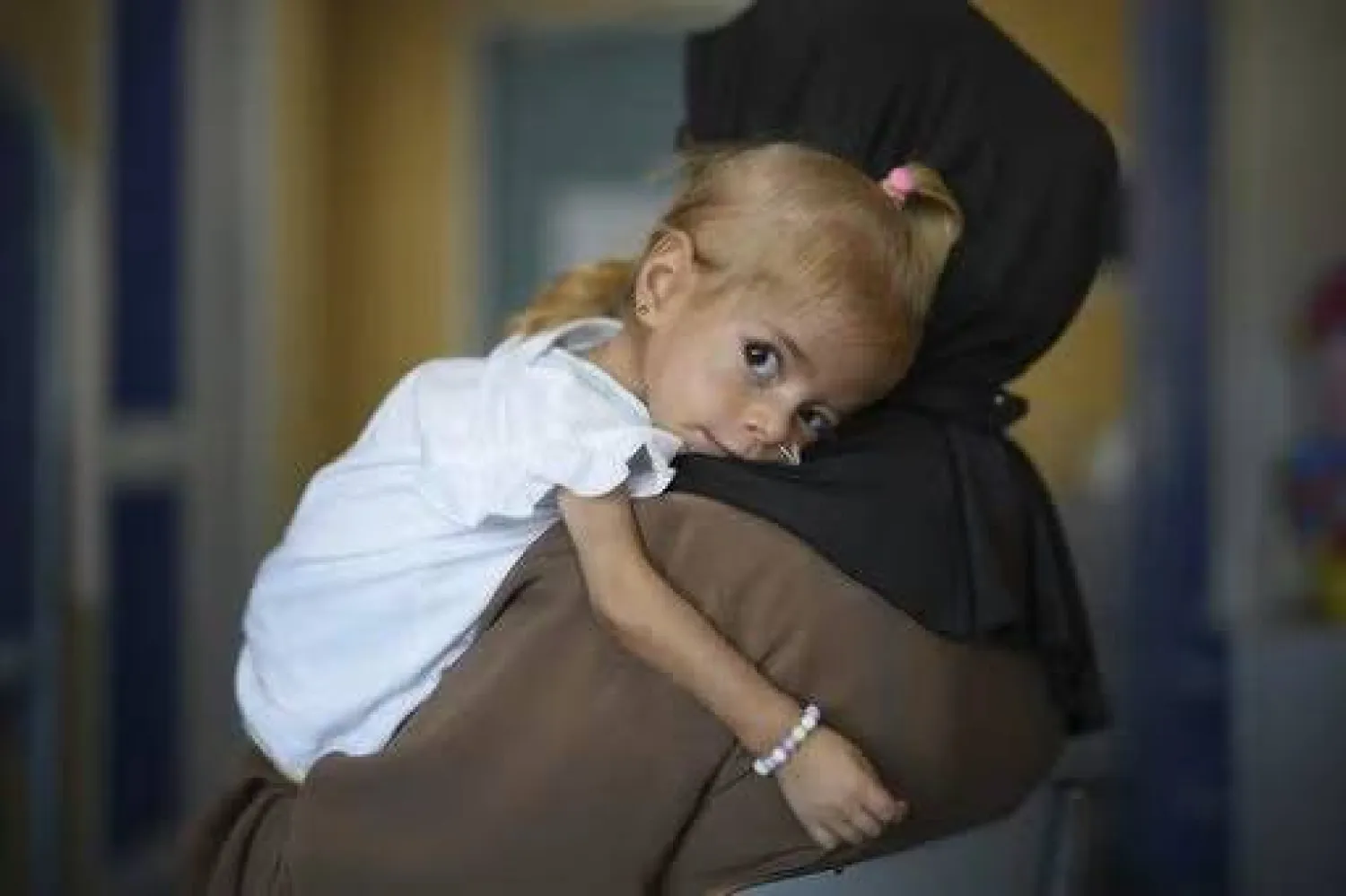
Islam Qudeih holds her daughter, Shamm Qudeih, 2, during an interview with The Associated Press at the Santobono Pausilipon Children's Hospital in Naples, southern Italy, Tuesday, Sept. 2, 2025, where Shamm is being treated after being evacuated from Gaza. (AP Photo/Andrew Medichini)
TT

Toddler Evacuated from Gaza with Rare Disease Recovers from Malnutrition in Italian Hospital

Islam Qudeih holds her daughter, Shamm Qudeih, 2, during an interview with The Associated Press at the Santobono Pausilipon Children's Hospital in Naples, southern Italy, Tuesday, Sept. 2, 2025, where Shamm is being treated after being evacuated from Gaza. (AP Photo/Andrew Medichini)

Since arriving emaciated in Italy from Gaza, little Shamm Qudeih has celebrated her second birthday and gained weight on a new diet that includes a special porridge — progress welcomed by doctors treating her for severe malnutrition worsened by a genetic metabolic disease.

Just weeks ago, the toddler was all skin and bones as she clung to her mother in a hospital in southern Gaza, after months of being unable to get the food and treatment she needed because of an Israeli blockade aimed at pressuring the Hamas militant group to release hostages. Then she was evacuated to Italy for medical treatment, along with six other Palestinian children.

A striking photo of Shamm wincing in her mother’s arms, with her hair matted and ribs protruding from her chest, was taken by Associated Press freelance journalist Mariam Dagga just days before the child left Gaza on Aug. 13. It was one of Dagga’s last images. She was among 22 people killed in an Aug. 25 Israeli strike on the same hospital in southern Gaza.

More than half a million people in Gaza, a quarter of the population, are experiencing catastrophic levels of hunger because of the blockade and ongoing military operations, the world's leading authority on hunger crises said last month. Gaza City, in the north, is experiencing famine, it said.

Toddler perks up

By this week, Shamm was sitting up, alert in a hospital crib in Naples, her fine blonde hair pulled into a high ponytail. She wore a T-shirt emblazoned with the word “cute.” Her wide eyes gleamed as her older sister and mother called her name from across the room, and she broke into a smile.

Weighing around 4 kilograms (9 pounds) when she arrived in Italy, Shamm was “in a serious and challenging clinical state,” said Dr. Daniele de Brasi, a pediatric genetic disease specialist who is treating her at Santobono Pausilipon Children’s Hospital in Naples.

She now weighs 5.5 kilograms (just over 12 pounds), which is still no more than half of the median weight for a child of her age, de Brasi said.

The doctor said “a big part” of her undernourishment was due to a genetic metabolic disease called glycogen storage disease, which interferes with the absorption of nutrients, particularly carbohydrates, and can cause muscle weakness and impede growth. The condition is primarily managed through a high-carbohydrate diet.

So far, “We are very satisfied with her progress,’’ de Brasi said.

A mother's struggle

Shamm suffered from malnutrition from birth, just weeks before the Oct. 7, 2023, attack in which Hamas-led militants killed around 1,200 people, mostly civilians, and took another 251 hostage. Forty-eight hostages are still in Gaza, around 20 of them believed to be alive, after most of the rest were returned in ceasefires or other deals.

Israel responded with an offensive that Gaza health officials say has killed more than 64,000 Palestinians in nearly two years of fighting. The Gaza Health Ministry, which is part of the Hamas-run government and run by medical professionals, does not say how many were civilians or combatants but that around half of those killed were women and children.

The family was forced to move more than a dozen times, and Shamm’s mother, Islam, struggled to get her proper medical care, visiting many hospitals and clinics. Doctors suspected the rare condition but could not test for it, much less treat it properly. They sometimes offered antibiotics.

“It became worse as a result of the lack of food, treatment and possibilities," Islam said in an interview with Shamm resting on her shoulder. “We have been displaced maybe about 15 times, from tent to tent. We walked long distances and, along the way, it was hot, and the sun was hitting us.”

For a while, doctors administered a special formula, but Shamm would not take it, having lost the habit of drinking milk after supplies in Gaza became scarce.

The UN warned last month that starvation and malnutrition in Gaza are at the highest levels since the war began. Nearly 12,000 children under 5 were found to have acute malnutrition in July — including more than 2,500 with severe malnutrition, the most dangerous level. The World Health Organization says the numbers are likely an undercount.

A final photograph in Gaza

It was at Nasser Hospital in the southern Gaza city of Khan Younis that Dagga photographed Shamm for the last time on Aug. 9. During the visit, Shamm cried in pain in her hospital bed. Her arms, legs and ribs were skeletal, her belly swollen.

Islam had gone to school with Dagga, who visited the hospital, and remembered her fondly.

“She was always coming to the hospital to check on me and Shamm,” right up to the day of their departure for Italy, Islam said. “She stayed until the last step of the stairs to say goodbye to me."

After arriving in Italy, Islam learned that Dagga had died in an attack that killed four other journalists.

"I was upset when I heard and knew that she had died,'' Islam said.

Ongoing treatment

Shamm is among 181 Palestinian children being treated in Italy, according to the Italian Foreign Ministry. About one-third of those have arrived since March, when Israel ended a ceasefire with Hamas and imposed the 2 1/2 month blockade on all imports, including food and medicine.

Israel denies there is starvation in Gaza, despite accounts to the contrary from witnesses, UN agencies and experts. It says it allowed enough aid to enter before and after the tightened blockade and has allowed increased supplies in recent weeks.

In Naples, Shamm now has a feeding tube in her nose to ensure she gets the right mix of nutrients overnight. Doctors aim to remove the tube in about a month. During the day, she is free to eat solid food, including meat and fish. A cornerstone of her diet is the carbohydrate-rich porridge.

Her current intake is around 500 calories a day, which doctors are gradually increasing.

"In these cases, growing too fast can cause problems,'' de Brasi said.

Her 10-year-old sister, Judi, was brought to Italy as an accompanying family member, and doctors began treating her after noting that she was at least three or four kilograms underweight, de Brasi said. She has gained two kilograms (nearly 5 pounds) and is in good condition.

With both daughters improving, Shamm’s mother is allowing herself to experience relief. But it is too soon to think about going back to Gaza, where Shamm's father is.

“Now there is no way to go back, as long as the war is going on. There are no possibilities for my daughters,’’ she said.



Al-Khanbashi: Hadramout Has Been Liberated from Al-Zubaidi, UAE's Hegemony

Hadramout Governor and a member of the Yemeni Presidential Leadership Council, Salem al-Khanbashi gives a media briefing in the port city of Mukalla in Hadramout, Yemen, January 19, 2026. (Reuters)
TT

Al-Khanbashi: Hadramout Has Been Liberated from Al-Zubaidi, UAE's Hegemony

Hadramout Governor and a member of the Yemeni Presidential Leadership Council, Salem al-Khanbashi gives a media briefing in the port city of Mukalla in Hadramout, Yemen, January 19, 2026. (Reuters)

Presidential Leadership Council (PLC) member and Governor of Yemen's eastern Hadramout province Salem al-Khanbashi accused on Monday the United Arab Emirates of exploiting its participation in the coalition to support legitimacy in Yemen to pursue its own agenda.

Speaking at a press conference in Mukalla city, he said the UAE's actions in Hadramout were a shock to the people and local authorities.

The authorities had hoped that the UAE would act as a supporter to the Yemeni people as part of the coalition, but its actions on the ground went against those expectations, he remarked.

Hadramout has suffered from the hegemony of armed factions affiliated with Aidarous al-Zubaidi, leader of the Southern Transitional Council, with direct support from the UAE, added all-Khanbashi.

Hadramout has been liberated from al-Zubaidi and the UAE's hegemony, he stressed.

He accused groups loyal to al-Zubaidi of looting public institutions, terrorizing the people and committing wide violations against them, leading to instability in Hadramout.

He vowed that the authorities will take "all legal measures" against the UAE and al-Zubaidi's armed groups.

Justice will prevail, he declared, pledging to support the victims of the violations and hold to account the perpetrators.

Moreover, al-Khanbashi revealed that the UAE was running "several large secret prisons" in Hadramout. Explosives were also stored in the al-Riyan airbase that were going to be used to in assassinations and attacks in the province.

He said that Hadramout has closed a "dangerous and bitter chapter" in its history through direct support from Saudi Arabia.

This backing has helped restore stability, boost the state's authority and end a period of chaos and violations, he continued.


Syria Says Sharaa, Trump Discuss Kurdish Rights as Forces Deploy in Country’s North, East

Syrian government forces brandish their weapons as they take possession of the SDF military base as they enter the city of Raqqa on January 19, 2026. (AFP)
TT

Syria Says Sharaa, Trump Discuss Kurdish Rights as Forces Deploy in Country’s North, East

Syrian government forces brandish their weapons as they take possession of the SDF military base as they enter the city of Raqqa on January 19, 2026. (AFP)

Syrian President Ahmed al-Sharaa and US President Donald Trump discussed guaranteeing Kurdish rights in a phone call on Monday, Syria's presidency said, a day after Damascus reached a deal with Kurdish forces including a truce.

Sharaa met Mazloum Abdi, head of the Kurdish-led Syrian Democratic Forces, to discuss the agreement, which includes integrating the Kurds' administration into the state, but a Kurdish source with knowledge of the talks told AFP they were not positive.

Analysts said the deal -- following rapid government gains in Kurdish-controlled territory after driving Kurdish fighters out of Aleppo city earlier this month -- marked a blow for the minority's long-held ambitions of preserving the de facto autonomy they had exercised in swathes of north and northeast Syria for over a decade.

In the phone call, Sharaa and Trump, "emphasized the need to guarantee the Kurdish people's rights and protection within the framework of the Syrian state", the Syrian presidency said.

They "affirmed the importance of preserving the unity and independence of Syrian territory" and discussed "cooperation on combating" the ISIS extremist group, it added.

Requesting anonymity, the Kurdish source with knowledge of Monday's talks between Sharaa and Abdi said differences concerned "the mechanism for implementing the terms of the agreement".

Despite the ceasefire, brief clashes erupted on Monday evening in Raqqa city, with an AFP correspondent hearing heavy bombardment.

The SDF said government forces shelled the Al-Aqtan prison "which holds ISIS members and leaders, in an attempt to storm it".

Raqqa was once the extremist group's de facto capital in Syria.

A defense ministry source later told AFP that the clashes had halted, without elaborating.

- 'Stability' -

Sunday's agreement included the Kurdish administration's immediate handover of Arab-majority Deir Ezzor and Raqqa provinces to the government, which will also take responsibility for ISIS prisoners and their families held in Kurdish-run jails and camps.

A defense ministry map published on Monday showed the government controlled all of Deir Ezzor and Raqqa provinces, while the eastern parts of Hasakeh province were still under Kurdish control.

In Deir Ezzor province, an AFP correspondent saw military vehicles heading east of the Euphrates, while cars and pedestrians waited at a bridge leading to the eastern bank.

Driver Mohammed Khalil, 50, told AFP that "we hope things will be better than before. There was... no freedom" under the SDF.

Teacher Safia Keddo, 49, said that "we're not asking for a miracle, we just want stability and a normal life".

Authorities announced a curfew in Hasakeh province's Shadadi after the army said the SDF released ISIS detainees from the town's prison, while the Kurds said they lost control of the facility after an attack by Damascus.

The sides had earlier traded blame for attacks that the military said killed three soldiers.

The SDF had seized swathes of Deir Ezzor and Raqqa provinces as they expelled ISIS during Syria's civil war, supported by an international coalition led by Washington.

- 'Protecting civilian lives' -

Raqqa resident Khaled al-Afnan, 34, said "we support Kurdish civil rights... but we don't support them having a military role".

Turkish President Recep Tayyip Erdogan, a close ally of Damascus who is hostile to the SDF, hailed Syria's army for its "careful" offensive despite what he called "provocations".

EU foreign policy chief Kaja Kallas instead said "all military activities must cease immediately".

The SDF on Sunday withdrew from areas under its control including the Al-Omar oil field, the country's largest, and the Tanak field.

Local fighters from tribes in the Arab-majority Deir Ezzor province sided with Damascus and seized the areas before the arrival of government forces.

The SDF's Abdi said Sunday he agreed to the deal to avoid civil war and end a conflict "imposed" on the Kurds.

Mutlu Civiroglu, a Washington-based analyst and expert on the Kurds, said the government's advance had raised "serious doubts about the durability" of the ceasefire and a March agreement between the government and the Kurds.

Sharaa had on Friday issued a decree granting the Kurds official recognition, but the Kurds said it fell short of their expectations.

In Qamishli, the main Kurdish city in the country's northeast, activist Hevi Ahmed, 40, said Sunday's deal was "a disappointment after years of hope that the Syrian constitution might contain a better future for the Kurds".


Syria Tightens Grip After Kurdish Pullback, Says ISIS Prisoners Escape

 A member of Syrian military police stands guard near Raqqa prison, after the army took control of the city of Raqqa, Syria January 19, 2026. (Reuters)
A member of Syrian military police stands guard near Raqqa prison, after the army took control of the city of Raqqa, Syria January 19, 2026. (Reuters)
TT

Syria Tightens Grip After Kurdish Pullback, Says ISIS Prisoners Escape

 A member of Syrian military police stands guard near Raqqa prison, after the army took control of the city of Raqqa, Syria January 19, 2026. (Reuters)
A member of Syrian military police stands guard near Raqqa prison, after the army took control of the city of Raqqa, Syria January 19, 2026. (Reuters)

Syrian government troops tightened their grip on Monday across a swathe of northern and eastern territory after it was abruptly abandoned by Kurdish forces in a dramatic shift that has consolidated President Ahmed al-Sharaa's rule. 

A day after the Kurdish-led Syrian Democratic Forces (SDF), once the main US ally in Syria, agreed to quit large areas under a ceasefire, the Syrian army said "a number of" ISIS militants had escaped a prison that had been under SDF control in the eastern city of Shaddadi, accusing the SDF of releasing them. 

The SDF said it had lost control of the prison following an attack by government fighters. The Syrian army denied attacking the jail and said its forces would work to secure the prison and re-arrest the escapees. 

The SDF said Shaddadi prison had held thousands of militants. The army did not say how many ISIS detainees had fled. 

The SDF withdrawals mark the biggest change in Syria's control map since fighters led by Sharaa toppled President Bashar al-Assad in 2024, tilting the power balance Sharaa's way after months of deadlock in talks with the SDF over government demands its forces merge fully with Damascus.  

After days ‌of fighting with ‌government forces, the SDF agreed on Sunday to withdraw from both Raqqa and Deir al-Zor - two Arab-majority ‌provinces ⁠they had controlled for ‌years and the location of Syria's main oil fields. 

GOVERNMENT TROOPS DEPLOY AT OILFIELD, IN RAQQA 

Türkiye, which has repeatedly sent forces into northern Syria to curb Kurdish power since 2016, welcomed the deal signed by its ally Sharaa and SDF commander Mazloum Abdi. Turkish President Recep Tayyip Erdogan urged the swift implementation of the agreement that requires the full integration of Kurdish fighters into Syria's armed forces. 

The SDF, spearheaded by the Kurdish YPG militia, had established control of a quarter or more of Syria during the 2011-2024 civil war, whilst fighting with the support of US troops against ISIS. The United States, which has since established close ties with Sharaa under President Donald Trump, has been closely involved in mediation between the sides. 

The SDF media office said in a statement that the prison at Shaddadi - one of ⁠three under its control in the Hasakah region - had come under repeated attack by "Damascus factions", and that dozens of SDF fighters were killed or wounded defending it. 

The statement added that the ‌US-led coalition against ISIS had not intervened despite repeated appeals to a nearby coalition base. The ‍US military's Central Command did not immediately respond to an emailed ‍request for comment. 

In its denial of the SDF account, the Syrian Ministry of Defense said army forces had bypassed Shaddadi, in line with deployment ‍plans, and offered aid to SDF forces inside. The Syrian army announced it had established control over the city of Shaddadi and the prison. 

The Syrian Defense Ministry also denied an SDF account of clashes between government and SDF forces near a jail in Raqqa, which the SDF said was holding ISIS inmates. It said the army had arrived "at the vicinity of al-Aqtan prison ... and began securing it and its surroundings despite the presence of SDF forces inside". 

The SDF said nine of its fighters were killed and 20 wounded in clashes around al-Aqtan. 

Hasakah province, which largely remains under SDF control, is home to the Kurdish-majority city of Qamishli, the main prisons holding ISIS detainees, and a camp holding thousands of IS-linked prisoners. 

GOVERNMENT FORCES DEPLOY 

Reuters journalists saw ⁠government forces deployed in the city of Raqqa that the SDF had captured from ISIS in 2017, and at oil and gas facilities in the eastern province of Deir Ezzor - both areas the Kurdish forces had held for years. 

It follows the withdrawal of Kurdish forces from districts of Aleppo city they had controlled for years after fighting there earlier this month. 

The 14-point deal published by Syria's presidency showed Abdi's signature alongside Sharaa's. 

It stipulates that the prisons, along with all border crossings and oil and gas fields, would be handed to government control - steps the SDF had long resisted. 

The timing of the handover of the prisons and camps was not announced. 

Abdi, the SDF commander, confirmed on Sunday that the SDF had agreed to withdraw from Deir Ezzor and Raqqa provinces. 

Abdi said he is set to meet Sharaa in Damascus on Monday and would share the details of the agreement with the public after his return to SDF-held territory, Kurdish media reported. 

The deal says that all SDF forces will be merged into the defense and interior ministries as "individuals" and not as units, as the SDF had sought. 

It commits the SDF to expel all non-Syrian figures affiliated to the Kurdistan Workers' Party (PKK), a Kurdish militant group which fought a decades-long insurgency in Türkiye. 

Senior figures ‌from Erdogan’s ruling AK Party said this removed a major obstacle to Türkiye’s peace process with PKK militants.