


Gaza Displacement Grinds on in Endless Cycle of Suffering

Watfa Abu Armanah (Asharq Al-Awsat)
TT

Gaza Displacement Grinds on in Endless Cycle of Suffering

Watfa Abu Armanah (Asharq Al-Awsat)

Residents of Gaza City say they are enduring the harshest phase of displacement since the war began, as Israeli forces launched a new operation that has flattened what remained of partly damaged neighborhoods and blown up the last of its high-rises. Entire districts such as Shujaia, Zeitoun and Tuffah had already been reduced to rubble in earlier assaults.

For more than two weeks, southern districts of the city – particularly Zeitoun and Sabra – have seen a mass flight of residents. In recent days, the exodus has spread to the north, including Jabalia and Nazla, as well as parts of Sheikh Radwan after a wave of Israeli air strikes.

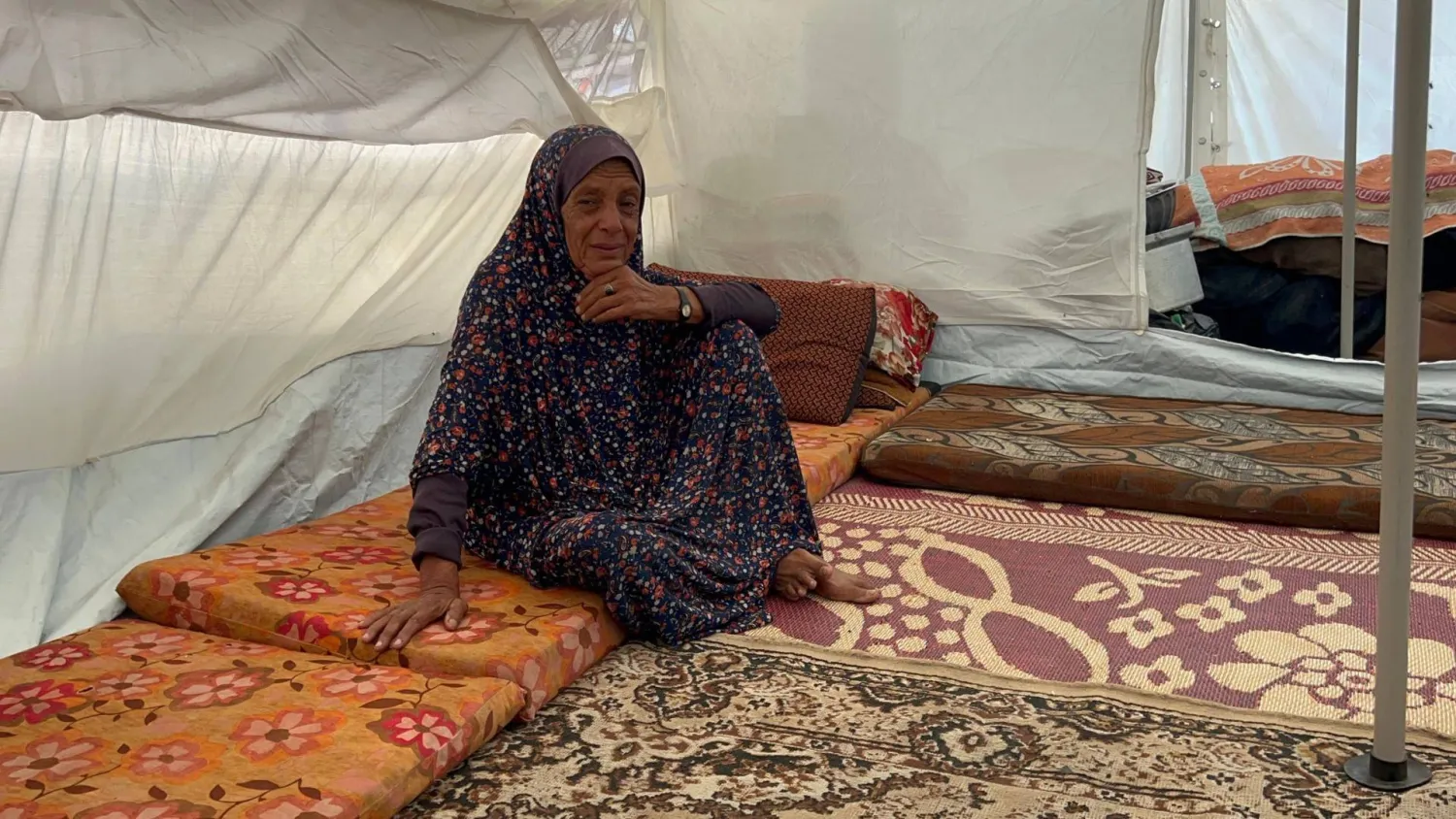
Watfa Abu Armanah, an elderly woman from Zeitoun, has been uprooted repeatedly since the start of the conflict in 2023. “This time is the hardest,” she told Asharq Al-Awsat.

Her home was destroyed in the early days of the war, forcing her to a school-turned-shelter in central Gaza’s Nuseirat camp, where she was injured in an air strike. She later fled to Rafah, then to Zawaida in Deir al-Balah, before returning to Zeitoun after a January ceasefire, only to be displaced again weeks later.

Under that truce with Hamas, Israel allowed more than a million Palestinians to return to Gaza City and the north after more than a year in displacement. Hamas had made their return a condition for releasing Israeli hostages.

Abu Armanah said her latest departure from Zeitoun was under artillery and air bombardment. She sheltered briefly in her brother’s house and a tent near her ruined home before Israeli troops again ordered civilians to leave. She moved with her children to Asqoula, between Zeitoun and Sabra, but was forced out once more when bombardment spread there.

With shelters full and landowners demanding rent from the displaced, she and her son set up a tent on an open patch facing the Rashad al-Shawa cultural center in Gaza City, destroyed in earlier raids. She lost one son in the war and said she is struggling to support the rest of her children, now orphans after their father’s death years ago.

“If people leave again, I will leave with them. We have no options,” she said.

Israeli operations are now focused on southern Gaza City districts, including Zeitoun and Sabra, and on the northern areas of Jabalia and Sheikh Radwan, with the stated aim of pushing residents westward toward the coast and eventually into the southern strip.

Nearby, Nawal al-Tawil has been living in a tent beside Abu Armanah. She recalled her family’s escape from Zeitoun under heavy shelling, drones overhead and leaflets warning residents to evacuate. They first moved to Asqoula, then to Zawaida, but returned to Gaza City after being told to pay rent for staying on farmland.

“This displacement is the worst,” Tawil said. “We are in the middle of the street, under the burning sun, with insects, no water and no life.” Still, she rejected leaving Gaza altogether. “Other countries may offer better conditions, but our homeland is our homeland.”

Israel says it wants to push Gaza’s population south again and is in talks with foreign states to accept Palestinians abroad, according to officials briefed on the plan.

The spiraling crisis is also felt by men like Hussein Karsou, who fled with his children and elderly mother from heavy bombardment near UNRWA’s al-Falah schools in southern Gaza City. “I preferred death in my house to displacement,” he said, but left with nothing as shells rained down.

Transport has become another burden. A ride from Gaza City to central areas can cost as much as 1,000 shekels ($294), far beyond most families’ reach.

“Civilians in Gaza are enduring appalling conditions,” said Julien Lerisson, head of delegation for the International Committee of the Red Cross in Israel and the Occupied Territories. “Forcing them into ever-smaller areas is unacceptable. Any large-scale evacuation risks further harm given the circumstances on the ground.”

After months of bombardment and repeated uprooting, he added, “the people of Gaza are utterly exhausted. What they need is relief, not more pressure – a chance to breathe, not more fear.”



3 Killed in Houthi Attack on Cargo Ship in Bab el-Mandeb Strait

The navigation bridge of a sunken vessel is all that is seen at the surface of the water in the Port of Mokha the day after an attack by the Houthis on the city Mokha, held by Yemen's legitimate government on August 10, 2026. (AFP)
TT

3 Killed in Houthi Attack on Cargo Ship in Bab el-Mandeb Strait

The navigation bridge of a sunken vessel is all that is seen at the surface of the water in the Port of Mokha the day after an attack by the Houthis on the city Mokha, held by Yemen's legitimate government on August 10, 2026. (AFP)

A small cargo ship was attacked on Tuesday by Yemen's Iran-aligned Houthis in the Bab el-Mandeb Strait, killing three crew members, said two Yemeni coast guard sources and two military officials in the government.

Maritime security sources told Reuters a small cargo ship was believed to have been targeted in the Red Sea, but ‌the fate of ‌the crew was unclear.

If confirmed, ‌the ⁠fatalities on the ⁠Tanzania-flagged Tihamah would be the first deaths in a Houthi strike on a ship since Middle East conflict was triggered by US-Israeli attacks on Iran at the end of February.

The Houthis have not yet claimed the attack, which Yemeni sources said killed two Pakistanis and one Indonesian person on the boat sailing ‌from Salalah in Oman via Djibouti.

Attacks on ships in the Bab ⁠el-Mandeb ⁠Strait have increased uncertainty for shipping companies already hobbled by the closure of the Strait of Hormuz.

An average of 32 ships per day passed through the Bab el-Mandeb strait last week, Kpler data showed. Prior to the blockade an average of 50 ships per day transited the strait.

The Houthis also attacked the government-held port city of Mokha on the Red Sea coast and other areas of the country, deepening fears over threats to strategic shipping routes and a potential return to civil war.

Yemen's military said the militants targeted both Mokha and the central province of Marib with missiles and drones.

The Houthis struck Marib and the eastern province of Hadramawt last week, killing dozens of government troops and civilians. They hit Mokha with missiles and drones over the weekend and killed at least seven people, including three troops, according to the Yemeni military.


Lebanon Abolishes Death Penalty in Landmark Parliament Vote

Lebanese lawmakers attend a parliamentary session to discuss a proposed general amnesty law, the abolition of the death penalty and the salaries of retired members of Lebanon’s security forces in Beirut, Lebanon, 11 August 2026. (EPA)
TT

Lebanon Abolishes Death Penalty in Landmark Parliament Vote

Lebanese lawmakers attend a parliamentary session to discuss a proposed general amnesty law, the abolition of the death penalty and the salaries of retired members of Lebanon’s security forces in Beirut, Lebanon, 11 August 2026. (EPA)

Lebanon's parliament Tuesday abolished the death penalty, making it the first country in the Arab world to replace the sentencing with life imprisonment with aggravated hard labor.

The country has committed to an unofficial moratorium on executions since January 2004. However, dozens of death sentences since then have been issued, but later suspended or commuted.

A majority of Lebanon's 128-member parliament voted in favor of ending the death penalty, with the exception of the parliamentary bloc of Hezbollah.

Justice Minister Adel Nassar, who was in Parliament, called it a “historic step” for the country.

Rights groups that have called for formalizing the moratorium or ending the death penalty altogether have also celebrated the vote.

Ramzi Kaiss, Lebanon Researcher at Human Rights Watch, says Lebanon is “marking a final break from a cruel sentence that should never be imposed.”

“Capital punishment is unique in its cruelty and finality and is plagued with arbitrariness, prejudice, and error,” he said.

It's unclear how aggravated hard labor would be enforced, as some legislators said the terms of the new punishment are not yet clear. Lebanon does have the punishment of hard labor written into law and court decisions, but even those have been rarely enforced in recent years due to cash-strapped Lebanon's lack of resources and capacity within its overcrowded prisons.

Lebanon's abolition of the death penalty comes as parliament is debating a controversial general amnesty law, the largest since the end of its 15-year civil war in 1990, that could reduce sentences or even release convicted militants and drug dealers, with some exceptions.

Family members of Lebanese soldiers and servicemen killed or attacked by extremist militant groups have repeatedly protested against the law, some saying they had hoped to see the perpetrators who killed their family members executed rather than be issued reduced prison sentences.

Hezbollah did not immediately issue a comment about the landmark vote. Neither did Lebanon's diverse religious institutions, where the death penalty is considered legal in some their respective court systems.


Lebanon Says Israeli Strike on South Wounds Two, Damages Ambulance

Smoke rises following an Israeli airstrike in the town of Deir Seryan as seen from the 'pilot zone' village of Zawtar al-Gharbiyah, Nabatieh Governorate, southern Lebanon, 31 July 2026, following a US-brokered security agreement between Lebanon and Israel. EPA/STRINGER
TT

Lebanon Says Israeli Strike on South Wounds Two, Damages Ambulance

Smoke rises following an Israeli airstrike in the town of Deir Seryan as seen from the 'pilot zone' village of Zawtar al-Gharbiyah, Nabatieh Governorate, southern Lebanon, 31 July 2026, following a US-brokered security agreement between Lebanon and Israel. EPA/STRINGER

An Israeli double-tap strike on southern Lebanon wounded two people on Tuesday and damaged an ambulance, the Lebanese health ministry said, condemning the "continued targeting" of rescuers. 

The incident is the latest Israeli strike despite an ongoing truce in the war between Israel and Iran-backed Hezbollah. 

Lebanon's state-run National News Agency said the strike targeted a vehicle in the southern city of Nabatieh, with the health ministry reported two wounded. 

The ministry said the Israeli military struck again when rescuers from the Risala Scouts Association, linked to the Hezbollah-allied Amal movement, came to the scene, damaging the ambulance. 

"The ministry reiterates its condemnation of the enemy's continued targeting of rescue teams, which constitutes an unacceptable violation of international humanitarian law and all international norms," it said. 

Lebanon's civil defense meanwhile said that its personnel were targeted by an Israeli drone strike while they were trying to extinguish a bushfire, also in the Nabatieh area. 

No one was wounded, but the incident forced them to leave. 

Hezbollah drew Lebanon into the Middle East war in March with rocket fire at Israel in support of its backer Iran. 

Israel responded with heavy air strikes and a ground invasion that Lebanon says have killed more than 4,300 people. 

While violence has significantly decreased since the signing of a US-Iran memorandum of understanding in June and a framework agreement between Lebanon and Israel days later, Beirut still reports intermittent Israeli strikes and demolitions. 

The Israel-Lebanon deal involves the disarmament of Hezbollah, a gradual withdrawal of Israeli forces from south Lebanon and the deployment of the Lebanese army to the region, starting in two "pilot zones". 

Hezbollah rejects the deal and refuses to disarm.