
Lebanon: Palestinian Factions Hand Over Weapons in Ain al-Hilweh

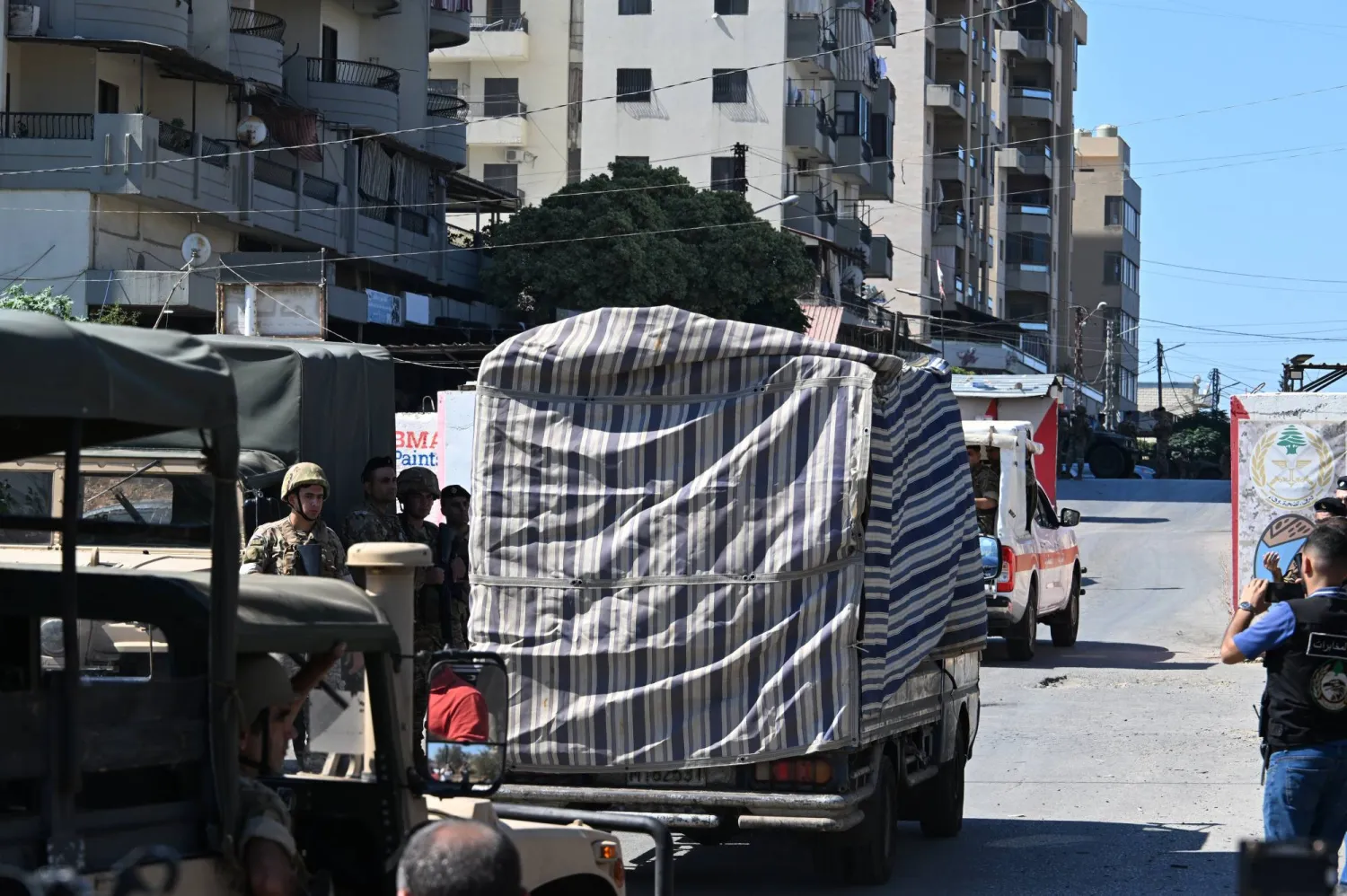
A pickup truck carrying weapons at Beddawi Palestinian refugee camp, northern Lebanon, 13 September 2025. EPA/WAEL HAMZEH
TT

Lebanon: Palestinian Factions Hand Over Weapons in Ain al-Hilweh

A pickup truck carrying weapons at Beddawi Palestinian refugee camp, northern Lebanon, 13 September 2025. EPA/WAEL HAMZEH

The Lebanese state and the Palestinian Authority have taken a major step forward by successfully securing the removal of weapons from the Ain al-Hilweh refugee camp near the southern city of Sidon.

The disarmament of Ain al-Hilweh is seen as the most sensitive part of the operation launched by the Lebanese army to disarm Palestinian camps.

The size of Ain al-Hilweh, the largest in Lebanon, and its complex security environment serve as a refuge for a number of wanted individuals of various nationalities.

A Palestinian source in the camp told Asharq Al-Awsat that the weapons were gathered in the Jabal al-Halib area before being handed over to the Lebanese army.

The source said "the operation was carried out away from the spotlight” after accusations of betrayal had spread on social media, fueled by individuals affiliated with the Islamic factions, which have strongly criticized the operation.

The source explained that people in the camp are divided between those who support the handover of heavy weapons and the regulation of light arms, and those who reject any disarmament.

The Lebanese army confirmed that it received "five truckloads of weapons from the Ain al-Hilweh camp” and "three trucks from the Beddawi camp in Tripoli,” in northern Lebanon.

"The delivery included various types of weapons, shells, and ammunition," the army said in a statement.

The Lebanese-Palestinian Dialogue Committee, a body affiliated with the Lebanese prime minister's office that is overseeing the arms transfer process, announced in a statement that it is continuing its "meetings with various Palestinian factions, including Hamas and Islamic Jihad."

It said the discussions were part of its commitment to extending Lebanon’s sovereignty over all its territory.

Hamas sources revealed to Asharq Al-Awsat that a meeting will be held in the coming days with the Committee to discuss the issue of weapons handover and other related matters.

The sources stressed that "Palestinian weapons in Lebanon carry more than just military significance - they are symbolic. This symbolism is linked to the Palestinians' right of return and the continuation of armed struggle against the Zionist enemy until a just and comprehensive solution to the Palestinian cause is achieved."

According to information received by Asharq Al-Awsat, Hamas is holding meetings with Islamic factions in Ain al-Hilweh to unify their stance. Reportedly, the main obstacle hindering a mutual understanding is the issue of the wanted individuals and the mechanism for dealing with them.

Abdel Hadi al-Asadi, who is the spokesman for the Palestinian National Security Forces in Lebanon, said the umbrella group conducted "the operation of delivering new batches of weapons.”

During a visit to Beirut in May, Palestinian president Mahmoud Abbas agreed with Lebanese President Joseph Aoun that weapons in Lebanon's Palestinian refugee camps would be handed over to the Lebanese authorities.


Syrian Army Deploys in Deir Ezzor Province After Kurdish Withdrawal

A military vehicle of the Syrian army is parked on the highway near Tabqa, after the Syrian army took control of it, Syria, January 19, 2026. (Reuters)
TT

Syrian Army Deploys in Deir Ezzor Province After Kurdish Withdrawal

A military vehicle of the Syrian army is parked on the highway near Tabqa, after the Syrian army took control of it, Syria, January 19, 2026. (Reuters)

Syria's army on Monday deployed its forces in parts of the eastern Deir Ezzor province formerly controlled by Kurdish forces following their withdrawal from the area.

After two days of rapid gains in Kurdish-controlled territory, Syrian President Ahmed al-Sharaa announced on Sunday a deal with their leader Mazloum Abdi that includes a ceasefire and the integration of the Kurdish administration and forces into the central state.

The government push captured Arab-majority areas that came under Kurdish control during the fight against the ISIS group.

In Deir Ezzor, an AFP correspondent saw dozens of military vehicles heading to the east of the Euphrates river, which once separated Damascus-controlled areas to the west from the US-backed, Kurdish-led Syrian Democratic Forces to the east.

Lines of cars, trucks and motorcycles formed in front of a small bridge leading to the eastern bank.

Some people were also heading there on foot.

"Our joy over liberation is indescribable," Mohammed Khalil, a 50-year-old driver in Deir Ezzor, told AFP.

"We hope things will be better than before. There was... no freedom under the SDF."

Safia Keddo, a 49-year-old teacher, told AFP "the past few years, but today we must turn the page".

"We want children to return to school without fear, and for electricity, water, and bread to be restored. We're not asking for a miracle; we just want stability and a normal life."

The Syrian army said in a statement that it "started the deployment" into the eastern Jazira region "to secure it under the agreement between the Syrian state and the SDF".

The agreement calls for the immediate handover of the provinces of the Arab-majority Raqqa and Deir Ezzor provinces.

The SDF had announced on Sunday that it was withdrawing from areas under its control in the eastern Deir Ezzor countryside, including the Al-Omar and Tanak oil fields.

The SDF had taken control of part of Deir Ezzor after defeating the ISIS group with the support of an international coalition led by the United States.


Qassem's Threat of Civil War Widely Condemned in Lebanon

Hezbollah's then deputy leader Sheikh Naim Qassem speaks during an interview with The Associated Press in Beirut's southern suburbs, Lebanon, July 2, 2024. (AP)
TT

Qassem's Threat of Civil War Widely Condemned in Lebanon

Hezbollah's then deputy leader Sheikh Naim Qassem speaks during an interview with The Associated Press in Beirut's southern suburbs, Lebanon, July 2, 2024. (AP)

Hezbollah Secretary-General Sheikh Naim Qassem's continued refusal to lay down his party's weapons in defiance of the state have sparked outrage in Lebanon.

In a televised address on Saturday, Qassem declared that Hezbollah "will not surrender", accusing Foreign Minister Youssef Raggi of "undermining civil peace and inciting strife." He also called on the government to replace the minister.

Ministerial sources close to the presidency told Asharq Al-Awsat that some of Qassem's remarks were viewed as a response to President Joseph Aoun's recent statements in which he indirectly called on the Iran-backed party to "return to reason and the state and hand over its weapons that have become a burden on its community and Lebanon."

The sources told Asharq Al-Awsat that official "decisions were taken to be implemented. Nothing will change the president's convictions."

Qassem escalated his rhetoric to save face in front of Hezbollah supporters, they added, ruling out the possibility that the party would take its objections to the streets.

The process of imposing state monopoly over arms is on the right path, they stressed.

Meanwhile, officials expressed their outrage over Qassem's remarks.

In a post on the X platform, Justice Minister Adel Nassar said: "Those threatening civil war to preserve their weapons must cease giving lectures about patriotism to a minister in government."

Lebanese Forces MP Razi al-Hajj slammed Hezbollah as a "calamity" on Lebanon. In a post on X, he said: "Naim Qassem is working outside the state, manipulating civil peace, inciting strife and standing against the presidency, government and will of the Lebanese people."

"He refuses to hand over Hezbollah's weapons and makes threats of civil war. Day and night he attacks the Lebanese state's official positions and works against them. Hezbollah is Lebanon's real calamity," he remarked.

LF MP Ghayath Yazbeck slammed Qassem for "verbally" and "morally" assaulting LF ministers, "in complete disregard of ethical principles".

He warned that Qassem’s remarks may be a prelude to the assassination of the ministers and "the assassination of the Lebanese state."

"Our ministers represent dignity, sovereignty and the state," he stressed. Indirectly addressing Qassem, he said: "Act smart. Your predecessors made these mistakes and ended up in history’s trash bin. Haven’t you learned anything?"

Responding to Qassem, Kataeb MP Nadim Gemayel said: "The foreign minister's stance is based on the humiliating agreement that you signed after the 'support war'. Lebanon officially agreed to the deal that effectively embodies the president's swearing in oath and government's policy statement in terms of imposing state monopoly over arms across the country."

In a post on X, he hoped the president and prime minister would issue a clear stance in support of FM Raggi.

Addressing Qassem, LF MP Elias Hankach said on X: "By continuing to rebel against state decisions and threaten the Lebanese people, you have become an outlaw gang."

"Just as the army imposed state monopoly over arms south of the Litani River, it will soon do so to its north," he said.

MP Waddah Sadek slammed Qassem, saying on X: "He himself does not believe what he is saying... He is living in a parallel world while the state continues to firmly reclaim its institutions regardless of the critics."

"The only thing Qassem got right was that Lebanon has indeed entered a new phase," he noted. Addressing the Hezbollah leader, he added: "Your weapons are a burden and no longer serve a purpose."

"For years, we have listened to your speeches and endured defeats and destruction that you brought onto the country. Yours is just another speech that won't make a difference," he stated.

MP Fuad Makhzoumi expressed his rejection of Qassem's statements, saying he is "detached from reality" and posing a "frank challenge to the state and its institutions."

In a post on X, he wrote: "You are part of the government, so how can you object to decisions you were a partner to? Whoever objects to government decisions must resign, not defy the state from the inside."

He urged Hezbollah to commit to the ceasefire, United Nations Security Council resolution 1701, and hand over its weapons, otherwise face the responsibility of violating state decisions.

"No one is above the law in Lebanon and threats have only led to destruction that the Lebanese people alone have paid the price of," he added.


Palestinian President’s Advisor: Board of Peace, Related Entities Are a ‘Temporary Arrangement’

Palestinian President Mahmoud Abbas’ advisor Dr. Mahmoud Al-Habbash. WAFA
TT

Palestinian President’s Advisor: Board of Peace, Related Entities Are a ‘Temporary Arrangement’

Palestinian President Mahmoud Abbas’ advisor Dr. Mahmoud Al-Habbash. WAFA

Palestinian President Mahmoud Abbas’ advisor Dr. Mahmoud Al-Habbash said that the situation in the Gaza Strip, along with the formation of the Board of Peace and its related entities is not a Palestinian choice.

This is “a temporary arrangement (mandated by the UN Security Council) that the Palestinian leadership rejects under any circumstances... but it is the lesser of two evils,” Al-Habbash told Asharq Al-Awsat.

Speaking from Ramallah, Al-Habbash said that the Palestinian leadership “chose this arrangement to stop the massacre and open a potential window ... leading to a Palestinian state.”

US President Donald Trump announced last week the formation of the Board of Peace, a new body of world leaders meant to oversee next steps in Gaza.

The White House said there would be a main board, chaired by Trump himself, a Palestinian committee of technocrats meant to govern the war-wracked territory, and a second "executive board" that appears designed to have a more advisory role.

“Our clear and firm position is that we did not create this reality,” said Al-Habbash. “Rather, it is a reality imposed on us for two reasons: First, Israel’s aggression ... and second, the reckless adventure carried out by Hamas movement, which whetted Israel’s appetite to liquidate the Palestinian cause.”

According to Al-Habbash, “this transitional arrangement is the least harmful to the Palestinian cause,” because it ensures that Palestinians remain in the Gaza Strip and prevents displacement.