Taiz Police Kill Main Suspect in Murder of Yemeni Official

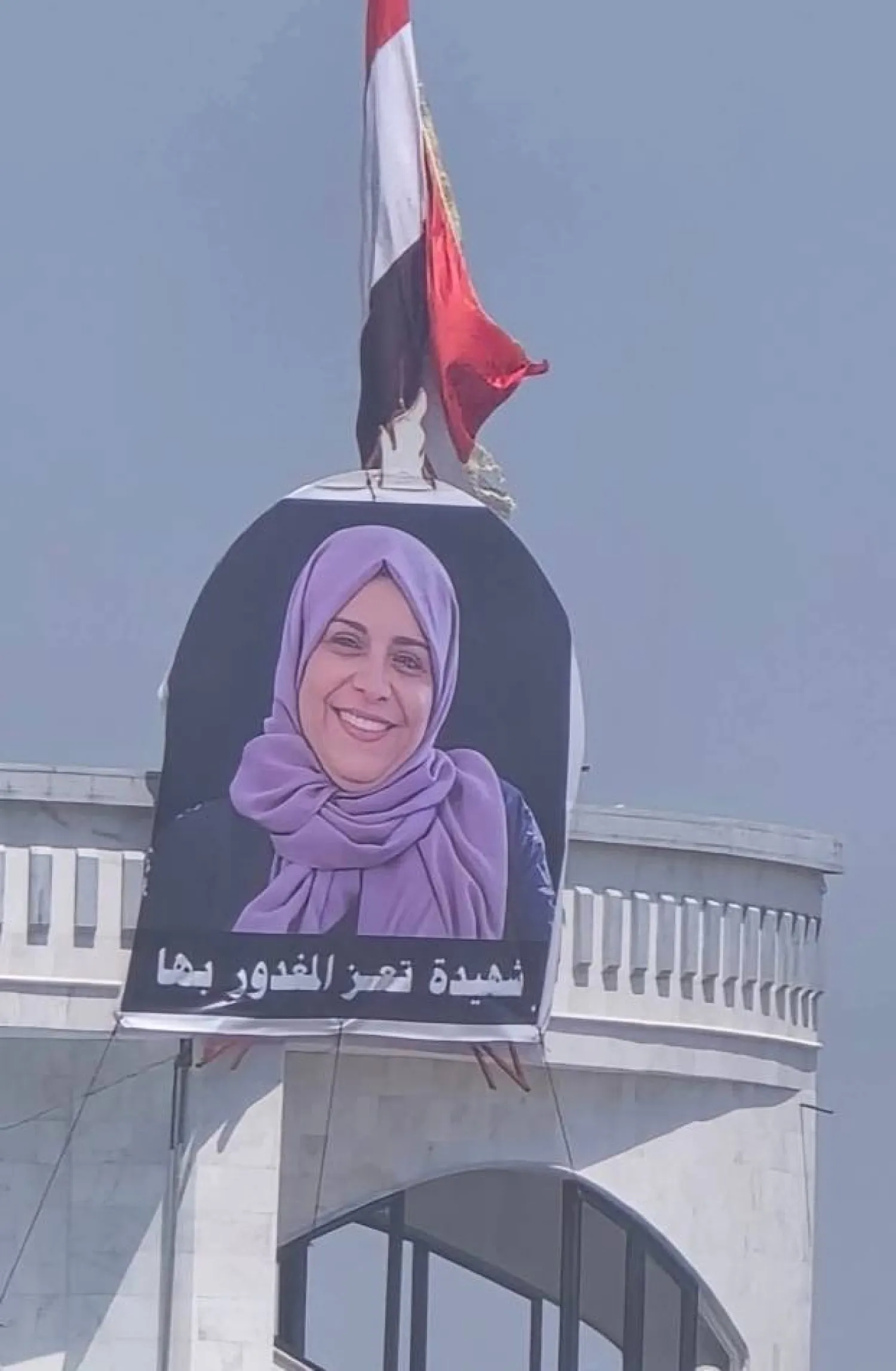
Protesters display photo of Iftihan al-Mashhari at government building (X)
TT

Taiz Police Kill Main Suspect in Murder of Yemeni Official

Protesters display photo of Iftihan al-Mashhari at government building (X)

Security forces in Yemen’s southern city of Taiz on Wednesday killed the prime suspect in the assassination of Iftihan al-Mashhari, Director of the Taiz Cleaning Fund, and arrested another, in a case that has triggered public anger and exposed rifts between security and military leaders.

Authorities said the man, a member of a local military brigade, was shot dead after resisting arrest during a raid in al-Rawda district, north of the city. Police said he used rifles, grenades and large amounts of ammunition while moving across rooftops and even shielding himself behind children.

Images shared on social media showed his bloodied body lying beside a school wall before security forces removed it.

Rights activists and lawyers condemned the killing, warning it could derail investigations into a crime they say is linked to entrenched corruption networks. A judicial source told Asharq al-Awsat the death deprived courts of a key witness and risked letting those behind the attack escape accountability.

Mashhari’s killing last month sparked outrage in Taiz, where residents accuse military leaders of shielding suspects and fueling lawlessness. She had previously received death threats from the slain suspect, who stormed her office in August, shut it down and threatened to kill her, according to official documents.

The dispute has widened into a showdown between security forces and army brigades. Police spokesman Osama al-Sharabi accused a commander in the 170th Air Defense Brigade, Mohammed Saeed al-Makhlafi, of blocking the manhunt. Makhlafi denied the charges, threatened to sue Sharabi, and appeared with armed supporters outside police headquarters.

Earlier this week, a joint statement by Taiz’s military command and police said four suspects had been arrested, including the motorcycle driver used in the assassination, and that operations were expanding in northern districts where the brigade holds sway. Police said 14 suspects have been detained in total.

Mashhari’s relatives, residents and hundreds of sanitation workers under her supervision have staged sit-ins outside government buildings, demanding justice and the dismissal of military commanders they accuse of complicity. Protesters erected tents at the governor’s office, vowing to continue until all perpetrators are brought to justice.

Taiz police chief Brigadier General Mansour al-Akhali promised to pursue wanted men “into their hideouts,” praising cooperation between police and the army. But rights defenders warned that killings during raids and rivalries between military and security units risk destroying evidence and silencing witnesses.


Egypt Moves to Step Up Fuel Supply Ahead of Rise in Power Demand This Summer

 Egyptian youths play football in an open area beside a mountain near Cairo, Egypt, June 29, 2026, as the country follows the FIFA World Cup. (Reuters)
Egyptian youths play football in an open area beside a mountain near Cairo, Egypt, June 29, 2026, as the country follows the FIFA World Cup. (Reuters)
TT

Egypt Moves to Step Up Fuel Supply Ahead of Rise in Power Demand This Summer

 Egyptian youths play football in an open area beside a mountain near Cairo, Egypt, June 29, 2026, as the country follows the FIFA World Cup. (Reuters)
Egyptian youths play football in an open area beside a mountain near Cairo, Egypt, June 29, 2026, as the country follows the FIFA World Cup. (Reuters)

Egypt's ‌electricity and petroleum ministers met on Tuesday to coordinate fuel supply and grid management ahead of a summer in which power demand is expected to rise 8% over last year's record peak of 40,000 megawatts, according to a joint ministry statement.

Electricity Minister Mahmoud Esmat and ‌Petroleum Minister Karim ‌Badawi said the two ‌ministries ⁠were working as "one ⁠team" to secure fuel supplies for power stations and stabilize the national grid during peak hours.

Esmat said the electricity sector planned to add 2,200 MW of renewable ⁠energy capacity and 1,300 MW ‌of battery ‌storage to the grid this year, and ‌had already cut fuel consumption ‌per kilowatt to below 170 grams.

Badawi said that LNG regasification vessels were operating at high efficiency to supplement gas ‌production, while the Damietta LNG export terminal was being used ⁠to ⁠store LNG cargoes to be used when needed.

Egypt suffered severe rolling blackouts in 2023 and had to rely on foreign funding to stabilize its grid in 2024.

Egypt's gas production stood at 3,214 million cubic meters in April, while imports were 2,190 million cubic meters, according to the Joint Organizations Data Initiative (JODI).


Arab League Secretary-General Condemns Israeli Attacks on Syria

A man holds an unexploded artillery shell that fell during reported overnight Israeli bombardment that hit the village of Abidin in Syria's southwestern Daraa province, close to the Israeli-occupied Golan Heights, on June 29, 2026. (AFP)
TT

Arab League Secretary-General Condemns Israeli Attacks on Syria

A man holds an unexploded artillery shell that fell during reported overnight Israeli bombardment that hit the village of Abidin in Syria's southwestern Daraa province, close to the Israeli-occupied Golan Heights, on June 29, 2026. (AFP)

Outgoing Arab League Secretary-General Ahmed Aboul Gheit strongly condemned on Tuesday the Israeli attacks and repeated incursions into Syrian territory, most recently the artillery shelling that targeted the governorates of Quneitra and Daraa.

He described these actions as a “blatant violation” of Syria's sovereignty and a “flagrant breach” of international law.

In a statement, Aboul Gheit warned that “the continued violations by the Israeli forces threaten to widen the scope of the conflict and undermine efforts to restore security and stability.”

He called on the United Nations Security Council “to fulfill its responsibilities by taking action to end these aggressive actions and ensure Israel's compliance with the 1974 Disengagement Agreement.”


Lebanon’s Shiite Alliance United Against Israel Framework Deal, Divided Over Protests

Hezbollah supporters block the old airport road in Beirut’s southern suburbs with burning tires on Saturday to protest the 2026 trilateral agreement signed by the United States, Israel, and Lebanon (AFP)
TT

Lebanon’s Shiite Alliance United Against Israel Framework Deal, Divided Over Protests

Hezbollah supporters block the old airport road in Beirut’s southern suburbs with burning tires on Saturday to protest the 2026 trilateral agreement signed by the United States, Israel, and Lebanon (AFP)

Calls by Hezbollah supporters to take to the streets in protest against the US-sponsored framework agreement between Lebanon and Israel has drawn only a few dozen demonstrators in downtown Beirut.

Also, dozens of motorcyclists blocked the airport road before the Lebanese army reopened it, underscoring the limited scale of the protests.

Observers attributed this to the absence of supporters from the Amal Movement, led by Parliament Speaker Nabih Berri, highlighting one of the main obstacles to any attempt to mobilize the street.

The Israel-Lebanon deal calls for Hezbollah to be disarmed before Israel will withdraw its troops from southern Lebanon. Israel agreed to withdraw initially from a couple of “pilot zones” where the Lebanese army would then deploy, but no details have been shared about how that will work in practice.

While Hezbollah and Amal - the two pillars of Lebanon’s Shiite alliance - remain united in rejecting the agreement, sources familiar with Amal’s position told Asharq Al-Awsat that the priority is to challenge it through constitutional institutions while keeping all options open as events unfold.

Opponents of the alliance, however, argue that there’s a growing discord between the two parties on how to navigate the next phase.

Unified rejection

Mohammad Khawaja, a member of the parliamentary Development and Liberation bloc, told Asharq Al-Awsat that the bloc categorically rejects the agreement, describing it as “a bad and completely unacceptable deal.”

Khawaja dismissed reports of differences between Amal and Hezbollah, insisting that “all talk of divisions within the Shiite duo is unfounded."

He added that the agreement was unacceptable in its current form and expressed hope that those behind it would reconsider it.

No decision on street protests

Sources within the Shiite duo told Asharq Al-Awsat that it is “premature” to offer assurances about whether street protests will or will not be held.

The sources said the current stage requires patience and that the alliance’s response will depend on political and constitutional developments surrounding the agreement. All options, they added, remain on the table.

That position broadly aligns with recent statements by Hezbollah officials, who have argued that the agreement “will not survive.”

At the same time, the party has sought to distance itself from recent street protests, saying they reflect public distrust of the authorities. While Hezbollah rejects both the agreement and the direct negotiations that produced it, it denies organizing or mobilizing the demonstrations.

Opponents of the Shiite alliance argue that differences are becoming increasingly apparent, particularly on how the agreement could reshape Lebanon’s domestic political landscape.

While both Hezbollah and Amal continue to emphasize their united rejection of the deal and favor constitutional and political channels for now, critics believe the coming months will reveal whether that cohesion endures or evolves into a more visible political divide.

Independent MP Ibrahim Mneimneh told Asharq Al-Awsat that Berri appears fully aware of the responsibility he bears and may seek to give state-building a genuine opportunity, while Hezbollah continues to rely on a highly polarizing political discourse.