


Israel Moves Prisoners Ahead of Gaza Deal Exchange as US Troops Land

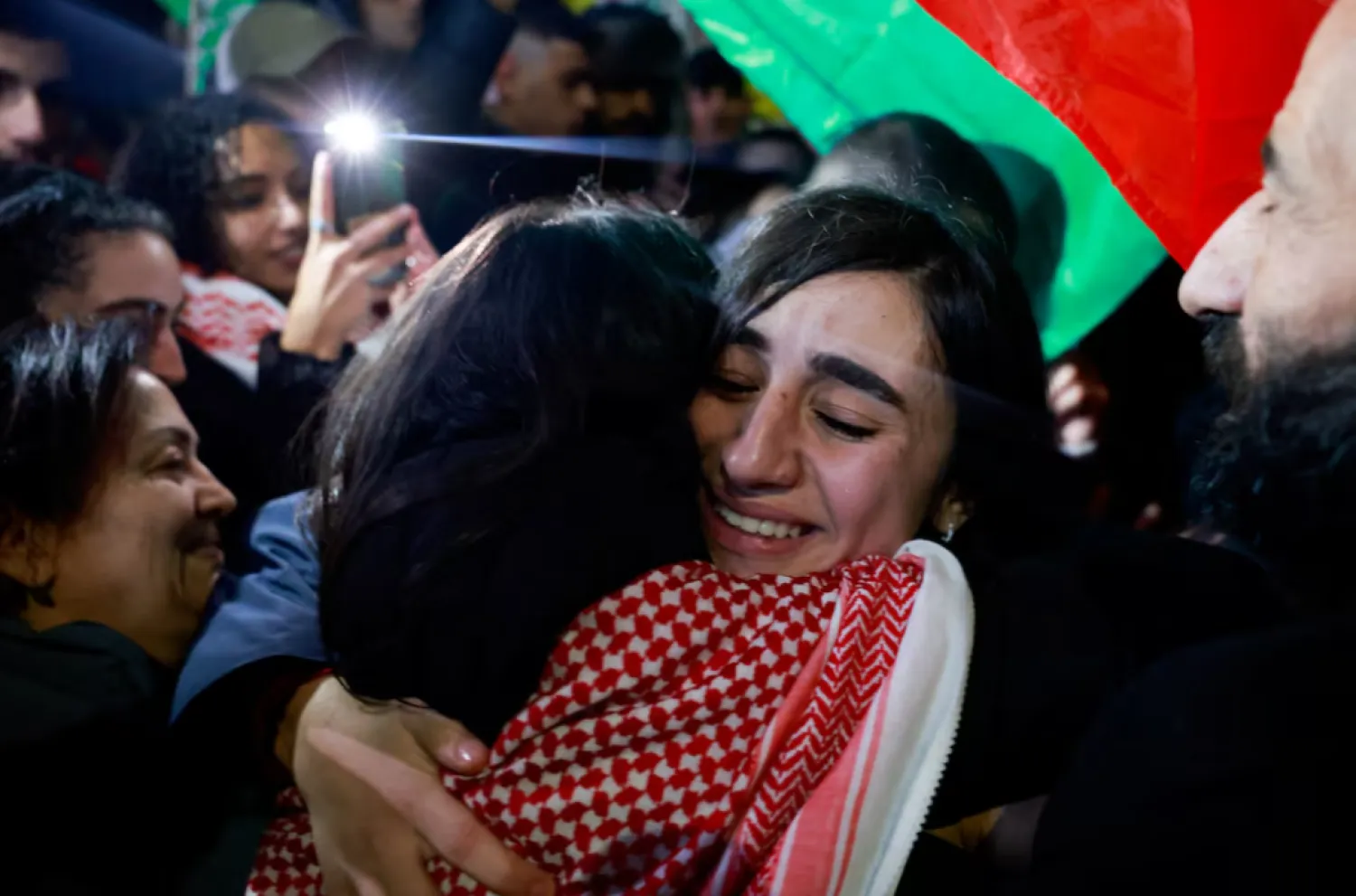
FILE:  People embrace after released Palestinian prisoners are released amid a hostages-prisoners swap deal between Hamas and Israel, in Ramallah in the Israeli-occupied West Bank, November 28. REUTERS/Ammar Awad
FILE: People embrace after released Palestinian prisoners are released amid a hostages-prisoners swap deal between Hamas and Israel, in Ramallah in the Israeli-occupied West Bank, November 28. REUTERS/Ammar Awad
TT

Israel Moves Prisoners Ahead of Gaza Deal Exchange as US Troops Land

FILE:  People embrace after released Palestinian prisoners are released amid a hostages-prisoners swap deal between Hamas and Israel, in Ramallah in the Israeli-occupied West Bank, November 28. REUTERS/Ammar Awad
FILE: People embrace after released Palestinian prisoners are released amid a hostages-prisoners swap deal between Hamas and Israel, in Ramallah in the Israeli-occupied West Bank, November 28. REUTERS/Ammar Awad

Israel has begun transferring prisoners to two jails ahead of their release as part of the Gaza ceasefire deal, designed to lead to the release of hostages held by Hamas, the prison service said Saturday.

Thousands of staff, including prison officers, "operated throughout the night in order to implement the government's decision: 'The framework for the release of all Israeli hostages'," a statement said, AFP reported.

Under the truce deal Israel is supposed to release 250 prisoners, including some serving life sentences for deadly attacks. In exchange, Hamas has until Monday to hand over its 48 remaining Israeli hostages -- living and dead.

Meanwhile, tens of thousands of displaced Palestinians made their way back to their Gaza neighborhoods on Saturday, weaving through dust-shrouded streets as bulldozers clawed through the wreckage of two years of war and a ceasefire held in its second day.

Aid groups urged Israel to reopen more crossings to allow humanitarian aid into Gaza, and about 200 US troops arrived in Israel to help retrieve hostages and monitor the ceasefire with Hamas.

According to The AP news, the US troops will set up a center to facilitate the flow of aid as well as logistical and security assistance. The head of the US military’s Central Command said he visited Gaza on Saturday to prepare it.

“This great effort will be achieved with no US boots on the ground in Gaza,” Adm. Brad Cooper said in a statement, noting that his command would lead the center.

Aid is just one issue for Palestinians returning to their destroyed homes.

“When people get there, they’re going to find rubble. They’ll find that their homes and their neighborhoods have been reduced to dust,” UNICEF spokesperson Tess Ingram told The AP on Friday from central Gaza.

“A ceasefire alone is not enough,” Ingram added, and called for a “surge of humanitarian aid that begins to address the tremendous damage that has been done over the past two years.”



Hezbollah Official Says Lebanon-Israel Talks 'Do Not Concern Us'

A Hezbollah flag is displayed from a car window, next to a dog, as displaced people make their way to return to their homes after a 10-day ceasefire between Lebanon and Israel went into effect, in Sidon, Lebanon, April 18, 2026. REUTERS/Aziz Taher
TT

Hezbollah Official Says Lebanon-Israel Talks 'Do Not Concern Us'

A Hezbollah flag is displayed from a car window, next to a dog, as displaced people make their way to return to their homes after a 10-day ceasefire between Lebanon and Israel went into effect, in Sidon, Lebanon, April 18, 2026. REUTERS/Aziz Taher

Senior Hezbollah official Mahmud Qamati said on Saturday that his group was not concerned by Lebanon's planned direct talks with Israel, labelling them a failure, Reuters reported.

In a press conference in Beirut's southern suburbs, Qamati said his group was "not concerned with the negotiations being conducted by the state", saying they were "a failure, weak, defeated... and submissive negotiations".

"The resistance is the one that imposes. We are the land... and we are the ones who draw up the decisions, not those who have an official status," he said, adding that while his group did not mind Beirut "coordinating with us... not in this way that leads to surrender".


Abdelatty: Egypt Working with Pakistan on Lasting US-Iran Peace Plan

This handout photograph taken and released by Turkish Foreign Ministry on April 17, 2026, shows Türkiye's Foreign Minister Hakan Fidan (2nd R), Saudi Arabia's Foreign Minister Faisal bin Farhan Al-Saud (R), Egyptian counterpart Badr Abdelatty (L) and Pakistan's Foreign Minister Ishaq Dar (2nd L) poses family photo during the 5th edition of the Antalya Diplomacy Forum (ADF2026) in Antalya. (Photo by Turkish Foreign Ministery Press Service / TURKISH FOREIGN MINISTRY / AFP)
TT

Abdelatty: Egypt Working with Pakistan on Lasting US-Iran Peace Plan

This handout photograph taken and released by Turkish Foreign Ministry on April 17, 2026, shows Türkiye's Foreign Minister Hakan Fidan (2nd R), Saudi Arabia's Foreign Minister Faisal bin Farhan Al-Saud (R), Egyptian counterpart Badr Abdelatty (L) and Pakistan's Foreign Minister Ishaq Dar (2nd L) poses family photo during the 5th edition of the Antalya Diplomacy Forum (ADF2026) in Antalya. (Photo by Turkish Foreign Ministery Press Service / TURKISH FOREIGN MINISTRY / AFP)

Egypt is working closely with Pakistan on a framework aimed at securing a lasting peace between the US and Iran, ⁠Foreign Minister Badr ⁠Abdelatty said on Saturday.

He said Egypt, Türkiye, Pakistan and ⁠Saudi Arabia were coordinating a broader regional effort focused on preventing renewed escalation and laying the groundwork for a post-war security arrangement, stressing ⁠the ⁠importance of protecting Gulf states and stabilizing energy markets, supply chains and food security.

Abdelatty’s statement came as Iran has swiftly reversed course on reopening the Strait of Hormuz, reimposing restrictions on the critical waterway on Saturday after US President Donald Trump said that even after Tehran announced the strait's reopening on Friday, the American blockade “will remain in full force” until the country reaches a deal with the US, including on its nuclear program.

The conflict over the chokepoint threatened to deepen the energy crisis roiling the global economy after oil prices began to fall again on Friday on hopes the US and Iran were drawing closer to an agreement.


Yemen: Houthi Infighting Exposes Deepening Fractures

A gathering of Yemen’s Qaifa tribes rejecting Houthi death sentences against 11 of their members (X)
TT

Yemen: Houthi Infighting Exposes Deepening Fractures

A gathering of Yemen’s Qaifa tribes rejecting Houthi death sentences against 11 of their members (X)

Rising violence within Yemen’s Houthi movement is highlighting deep internal divisions, as competition over influence and resources intensifies amid growing isolation and public discontent, analysts and local sources say.

Recent incidents point to a weakness in managing internal disputes, with clashes increasingly erupting among the group’s own commanders. The absence of stable mechanisms to regulate rivalries, alongside declining trust in Houthi-run institutions, has fueled tensions.

One of the most serious episodes occurred last week in Jabal Ras district, south of Hodeidah province, where a local security headquarters turned into a battleground. Local sources said a dispute between Mohammed Abbas al-Qahif, the Houthi-appointed security chief, and field commander Abu Bashar Habib Mutlaq escalated into a gunfight inside the compound. Machine guns were used in a densely populated area, wounding fighters on both sides and critically injuring a civilian as the clashes spread outside.

The incident is part of a broader pattern. In recent weeks, several Houthi security and field leaders have been killed in the provinces of al-Jawf, al-Mahwit, Sanaa and al-Bayda.

Yemeni political researcher Salah Ali Salah said such conflicts “have become more frequent and visible,” reflecting the accumulation of competing power networks formed during years of war. These networks have reshaped internal hierarchies and weakened tribal and social actors that once supported or benefited from the group.

He added that tensions are increasingly shifting from the periphery into the core of the movement, with disputes among supervisors and commanders driven by competition over authority, resources and influence. These conflicts, he said, often require direct intervention from senior leadership to contain them.

Violence linked to personal disputes and widespread weapon ownership has also surged. In one case in Sanaa, tribal figure Abdulrazzaq al-Athri was killed by his brother Mohammed, described as a Houthi-affiliated gunman, following a land dispute in Arhab district.

In al-Bayda’s Radaa district, another tribal leader, Mohammed al-Rubaie, was killed in an ambush by unidentified gunmen, while an elderly man from Ibb province was shot dead in a separate incident. The district has become a hotspot for both lawlessness and confrontations between residents and Houthi forces.

Tensions have further escalated after a Houthi court sentenced 11 members of the Qaifa tribe to death over a previous tribal dispute with Sanhan tribes. Qaifa leaders say the ruling was issued without due legal process and accuse Houthi figure Yahya al-Razami of bias.

Analyst Bassem Mansour linked the growing chaos to the group’s isolation and leadership constraints. Senior figures, he said, are preoccupied with military and regional developments and often operate in secrecy for fear of Israeli targeting, leaving field commanders to act impulsively in the face of public resentment.

Residents report worsening living conditions and deteriorating services, fueling frustration that increasingly manifests in violent personal disputes. A Sanaa-based researcher, speaking anonymously for safety reasons, said public anger at Houthi policies is rising daily.

Security institutions, once tools of control, are now seen as arenas for settling scores, while judicial bodies have lost credibility due to perceived corruption and inefficiency. The proliferation of weapons have further undermined order.

As the situation persists, civilians remain the most vulnerable, caught between internal Houthi rivalries and unchecked violence, with little prospect of restored stability.