Iraq Criticizes US Sanctions on Firm, Militias over Ties to Iran

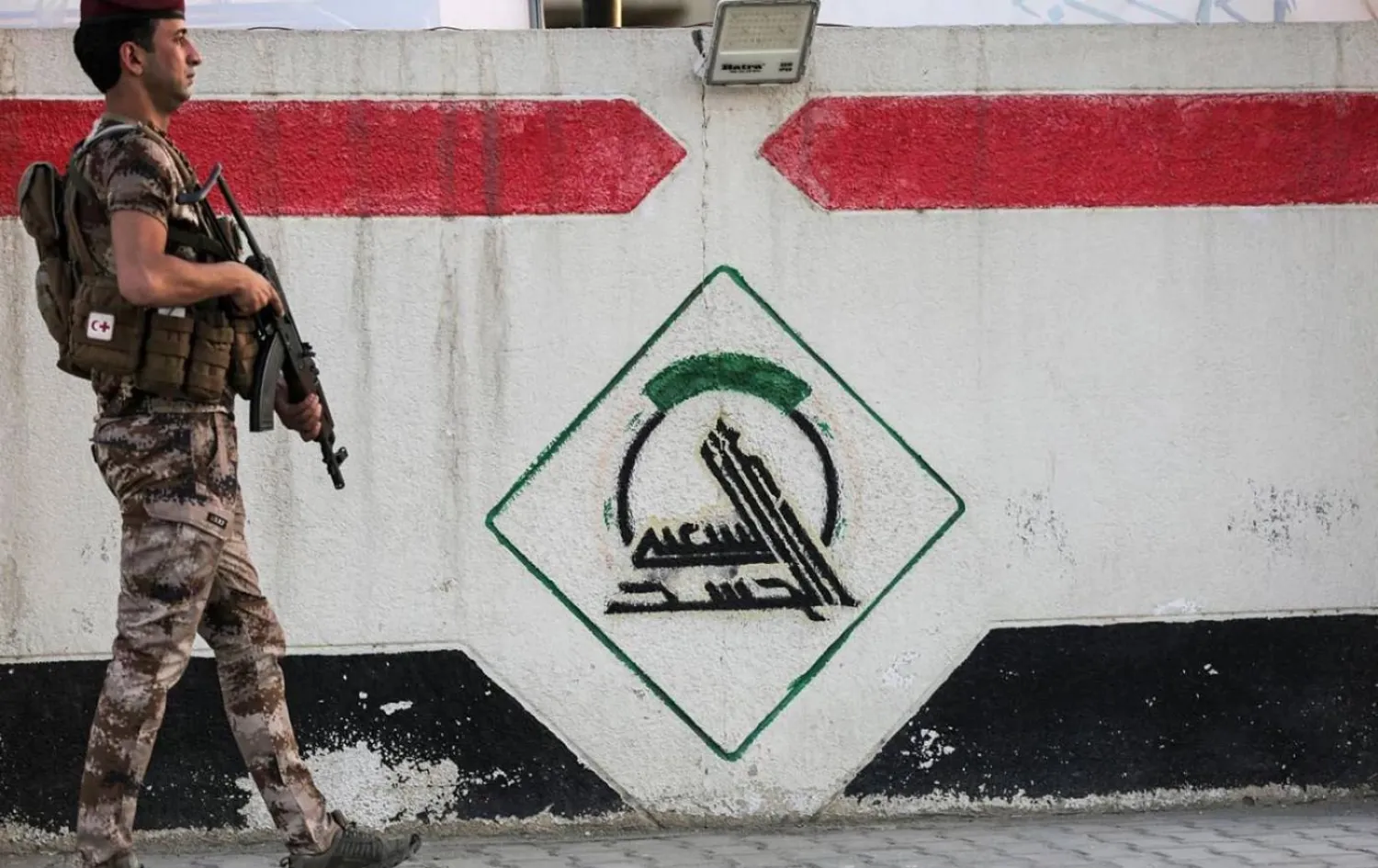
A mural depicting the logo of the Popular Mobilization Forces (PMF). (AFP)
TT

Iraq Criticizes US Sanctions on Firm, Militias over Ties to Iran

A mural depicting the logo of the Popular Mobilization Forces (PMF). (AFP)

Iraq on Saturday criticized US sanctions on a company, individuals and armed groups Washington has said have ties with Iran-backed militias, calling the move "deeply regrettable".

The US government on Thursday announced sanctions on the Al-Muhandis company, a firm with links to the Popular Mobilization Force (PMF), armed groups trained by Iran during the war against the ISIS group.

Washington also targeted individuals and other Iraqi militias the US Treasury said had aided Tehran in "evading US sanctions, smuggling weapons, and engaging in widespread corruption in Iraq".

"The Government of Iraq views this unilateral action as deeply regrettable, as it contradicts the spirit of friendship and mutual respect that has long characterized the bilateral relationship between the two countries," Iraqi government spokesman Basim Alawadi said in a statement.

"Taking such a decision without prior consultation or dialogue represents a negative precedent in the approach to relations between allied nations," he added.

The US sanctions targeted Kataeb Hezbollah, a powerful Iraqi armed faction that has been listed as a terrorist organization by the United States.

Kataeb Hezbollah was integrated into Iraq's regular security forces like other armed groups, but the faction has developed a reputation for sometimes acting on its own.

Other US sanctions announced on Thursday targeted Aqeel Muftin, the president of Iraq's National Olympic Committee, who was accused of managing an Iraqi commercial bank associated with Iran's Revolutionary Guards' Quds Force.


Sharaa: Golan is Syrian Land, Any Other Status is Invalid

Syrian President Ahmed al-Sharaa during a panel discussion at the Antalya Diplomacy Forum in Türkiye on Friday (Turkish media)
TT

Sharaa: Golan is Syrian Land, Any Other Status is Invalid

Syrian President Ahmed al-Sharaa during a panel discussion at the Antalya Diplomacy Forum in Türkiye on Friday (Turkish media)

Syrian President Ahmad al-Sharaa said the Golan Heights are “occupied Syrian land” and that any recognition of Israeli sovereignty there would be “null and void,” stressing that the international community does not accept Israel’s claim.

Speaking at the fifth Antalya Diplomacy Forum, Sharaa said Israel was violating the 1974 disengagement agreement and that Damascus was working to secure a security deal ensuring Israeli withdrawal from areas it seized after the fall of Bashar al-Assad on Dec. 8, 2024, and a return to the 1974 lines.

“We are seeking to establish new rules — either revive the disengagement agreement or conclude a new deal guaranteeing both sides’ security,” he said, adding that success could open the door to long-term negotiations on the Golan issue.

Sharaa described current regional conditions as “difficult” and requiring exceptional solutions. He said conflicts in the Middle East have deep roots and that Syria aims to avoid alignment with rival blocs, positioning itself instead as a bridge between major powers.

He added that Damascus now maintains “ideal relations” with the US, Russia, China, Britain, France, Germany and regional states.

Sharaa said Syria had previously faced Iranian attacks linked to Tehran’s support for Assad against the Syrian people but had avoided being drawn into confrontation involving Iran, the US and Israel. “We pushed to prevent war because of its dangerous repercussions,” he said.

He also praised efforts by US President Donald Trump to end the war in Lebanon and expressed hope for a broader regional reset to prevent future conflicts.

Syria, he said, had suffered years of war, displacement and chemical attacks, and avoiding new conflicts was “the natural and correct path.”

US envoy to Syria and ambassador to Türkiye Tom Barrack said Washington had shifted its approach, reducing its military presence and withdrawing troops from its last base in Syria after years of fighting ISIS.

Barrack said Syria — once marked by internal divisions, tensions with Kurdish and Druze communities and close ties to Iran — had become one of the region’s more stable areas.

He noted that Syria had not fired “a single shot” at Israel since Dec. 8, 2024, while repeatedly signaling openness to a non-aggression pact and normalization.

Addressing the lack of an agreement despite Syria’s restraint, Barrack said Israel viewed Syria’s Druze community as closely linked and had crossed the border to “protect” them after unrest in Sweida. He cited Israeli Prime Minister Benjamin Netanyahu as saying everything changed after Oct. 7, 2023, with Israel less bound by previous lines, including those of 1967 and 1974.

Barrack argued that military solutions do not deliver lasting peace and criticized reliance on force, saying it fuels cycles of hatred. He cited Lebanon, saying Israeli strikes had strengthened Hezbollah, and warned that militias backed by states such as Iran cannot be eliminated militarily alone.

He said the ceasefire between Hezbollah and Israel was only a starting point and emphasized the need for regional solutions, pointing to the Abraham Accords as a potential framework for long-term stability.

Barrack described Syria’s transition as a “test case” developed in cooperation with Türkiye, highlighting Ankara’s economic strength and its role as a leading regional power and key member of NATO.

On the sidelines of the forum, Sharaa met Turkish Foreign Minister Hakan Fidan and intelligence chief Ibrahim Kalin, alongside Syrian officials including Foreign Minister Asaad al-Shaibani and intelligence chief Hussein al-Salama.

Sharaa said efforts were ongoing to integrate the Kurdish-led Syrian Democratic Forces into state institutions and that northeast Syria was now free of foreign bases.

He outlined plans for reconstruction driven by investment, stressing that aid should not be politicized or conditional. He also highlighted growing economic ties with Türkiye, including plans for a joint free zone in Idlib to boost industry and facilitate trade and transport links with cities such as Aleppo and Damascus.

Separately, Sharaa met with Kurdistan Region President Nechirvan Barzani and UN High Commissioner for Refugees Filippo Grandi.


Israeli Military Says Suspect Neutralized in West Bank

A Palestinian woman (R) reacts as an Israeli soldier pushes a man while Palestinians are forcibly removed as they try to reach their land after Israeli settlers reportedly attacked local farmers working on their fields, spraying them with pepper spray, near the Palestinian village of Halhoul, south of the Israel-occupied West Bank city of Hebron, on April 17, 2026. October 2023. (Photo by HAZEM BADER / AFP)
TT

Israeli Military Says Suspect Neutralized in West Bank

A Palestinian woman (R) reacts as an Israeli soldier pushes a man while Palestinians are forcibly removed as they try to reach their land after Israeli settlers reportedly attacked local farmers working on their fields, spraying them with pepper spray, near the Palestinian village of Halhoul, south of the Israel-occupied West Bank city of Hebron, on April 17, 2026. October 2023. (Photo by HAZEM BADER / AFP)

Israel's military said Saturday that a suspected militant carrying a knife had been "neutralized" at a settlement in the occupied West Bank.

"Following the alert that was activated regarding a suspected terrorist infiltration in the community of Negohot, a terrorist armed with a knife was identified and neutralized," the Israeli military said in a statement, adding security forces were conducting a search of the area.

The statement said it had no reports of other injuries but did not provide details on who had neutralized the suspect or their condition.

Violence in the West Bank, which Israel has occupied since 1967, has risen sharply since the October 7, 2023 Hamas attack on Israel triggered the Gaza war.

According to an AFP tally based on Palestinian health ministry figures, Israeli troops or settlers have killed at least 1,050 Palestinians -- many of them militants, but also scores of civilians -- in the West Bank since the start of the Gaza war.

Official Israeli figures say at least 45 Israelis, including soldiers and civilians, have also been killed in Palestinian attacks or during Israeli military operations.


Lebanon Bets on US Pressure to Win Israeli Concessions

Displaced residents return to southern Lebanon (AFP)
TT

Lebanon Bets on US Pressure to Win Israeli Concessions

Displaced residents return to southern Lebanon (AFP)

US President Donald Trump announced a 10-day ceasefire between Lebanon and Israel, opening the door to direct negotiations between the two sides.

Without a truce, the war between Israel and Hezbollah would remain open-ended, bringing more destruction and displacement to southern Lebanon.

But a ceasefire alone is not enough unless it runs in parallel with Lebanese-Israeli talks and can be extended to allow time for a deal, a ministerial source told Asharq Al-Awsat.

Trump’s move also satisfied Iran by involving it in the contacts that led to the truce, while aligning with Lebanese President Joseph Aoun, who made a ceasefire a precondition for negotiations.

Washington brings Iran in

Washington drew Iran into the ceasefire in hopes of extracting concessions by pressing Hezbollah to uphold the truce and accept joining the government in direct talks, the source said.

The talks still face opposition from the Shiite duo, Hezbollah and Amal, despite mounting local and international pressure to unify behind a Lebanese delegation expected to be headed by former ambassador Simon Karam.

No meeting is expected soon between Aoun and Israeli Prime Minister Benjamin Netanyahu at the White House under Trump’s sponsorship, at least during the ceasefire.

Any such meeting should seal a comprehensive agreement, not launch negotiations, the source said.

He added that there is no need to rush. The priority is for Washington to press Israel to offer incentives that could help secure a deal. Without that, a meeting would be meaningless as long as Israeli forces remain, residents are barred from returning south of the Litani River, Lebanese prisoners are held, and towns face systematic destruction.

Under such conditions, the source asked, would a meeting simply impose a reality rejected by Aoun, who insists the timing is wrong unless Israel shows goodwill on the ground toward ending its occupation.

Separating Iran from Lebanon

The source said a ceasefire is essential to start talks, but involving Iran does not mean Lebanon will tie its fate to Tehran’s negotiations with Washington, contrary to claims by a Shiite duo source.

That source suggested Lebanon would be part of a broader US-Iran settlement that could ease tensions, without explaining how this would reassure the Lebanese.

Washington’s outreach to Iran to help resume talks in Islamabad does not mean handing Lebanon’s file to Tehran, the source said, noting strong domestic, Arab and international opposition to linking the two tracks.

He questioned how Iran can negotiate directly with the United States while Lebanon is denied the same option in the absence of alternatives.

He also asked what alternative exists, and whether Lebanon can withstand another war after Hezbollah backed Gaza and Iran without returning to the government’s authority.

He raised doubts over how returning residents can be reassured, as areas south of the Litani have been devastated and are no longer fit for living.

Residents have the right to regain stability and ease fears about their future while awaiting reconstruction, which hinges on Hezbollah accepting the state’s monopoly on arms as a core item in negotiations. In return, Washington would need to secure Israel’s withdrawal and complete border demarcation in line with the armistice.

The question remains whether the Shiite duo will continue to reject direct talks overseen by Aoun, who insists on fully liberating the south.

That puts pressure on Parliament Speaker Nabih Berri, who has voiced reservations, as Aoun and international actors continue to seek a unified Lebanese position to prevent the ceasefire from unraveling.