

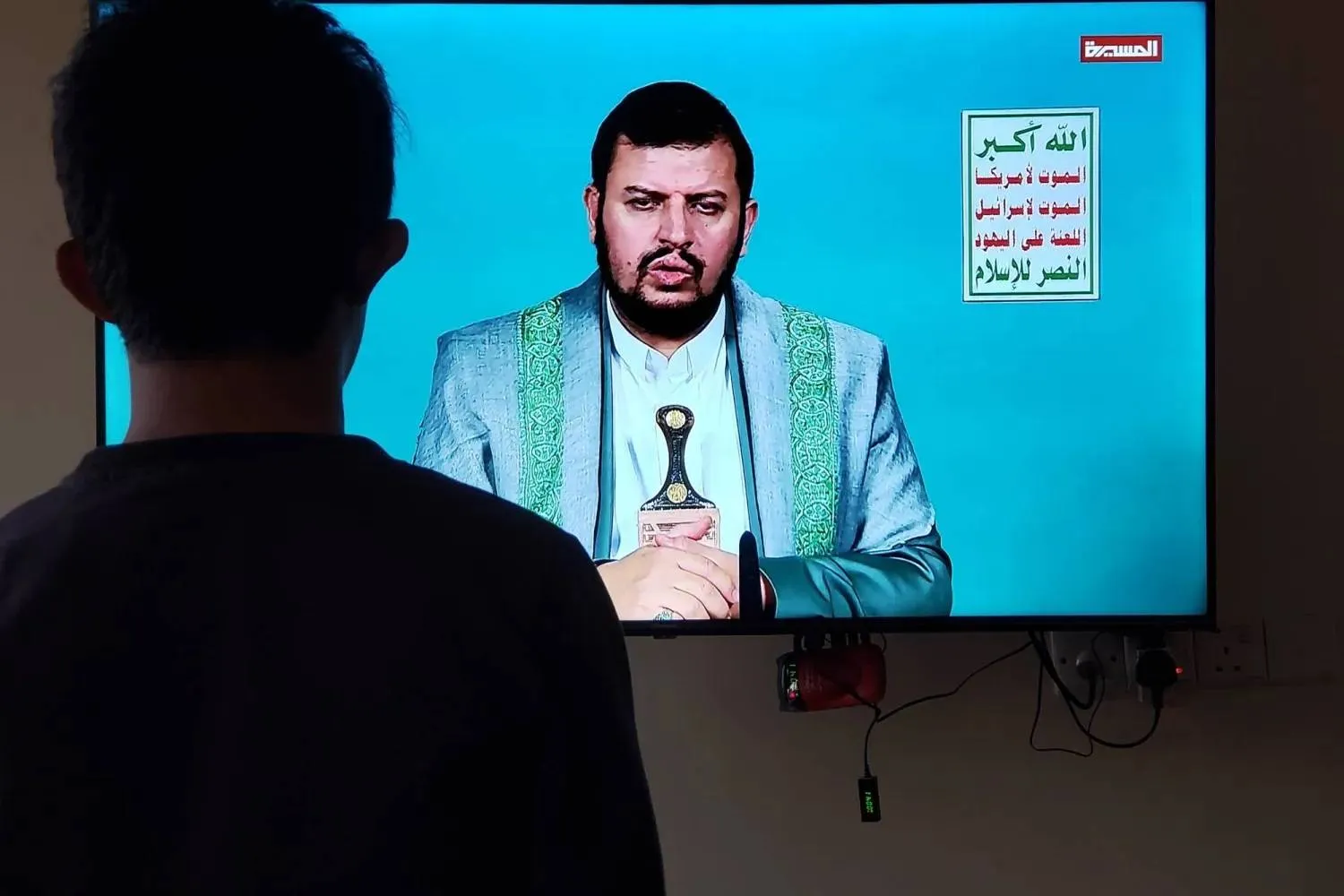

Houthi Leader Targets UN Staff, Accuses Aid Workers of Spying

Houthi leader Abdul-Malik al-Houthi has unleashed his group against UN staff (EPA)
TT

Houthi Leader Targets UN Staff, Accuses Aid Workers of Spying

Houthi leader Abdul-Malik al-Houthi has unleashed his group against UN staff (EPA)

Houthi leader Abdul-Malik al-Houthi has placed United Nations staff at the top of his list of “enemies,” accusing employees of the World Food Program (WFP) and UNICEF of carrying out “espionage” for the United States and Israel, and holding some responsible for the killing of his government’s prime minister, Ahmed Ghaleb al-Rahawi, and nine ministers in an Israeli airstrike on Sanaa in late August.

The accusations came in al-Houthi’s weekly sermon on Thursday evening, at a time when 53 UN staff members remain detained, some for up to four years. Humanitarian and rights observers fear his remarks could signal a new wave of prosecutions, possibly including death sentences, amid charges of “espionage” and “collaboration.”

In his address, al-Houthi framed the security apparatus as “a twin of the military field in confronting enemies,” claiming that his group’s security forces “arrested espionage cells working for Americans and Israelis under the cover of humanitarian work.”

He alleged that some of these cells included personnel from the WFP and UNICEF, claiming they “provided information and coordinates to Israeli intelligence,” which led to the targeting of a government meeting in Sanaa and the killing of Prime Minister al-Rahawi and several ministers.

Al-Houthi further asserted that these “espionage cells” used their affiliation with UN organizations “as a cover for hostile activities,” and that “safety and security officials in one UN agency played a central role in the crime targeting the government.”

He claimed that his group possesses “conclusive evidence” of their involvement in surveillance and communication breaches, adding that “instead of holding the perpetrators accountable, the United Nations blames our security forces,” a charge the UN has repeatedly and firmly denied.

Concerns Over Wider Abuses

Analysts say the Houthi attacks on the UN aim to divert attention from mounting losses among field commanders and justify widespread arrests of UN personnel in Sanaa and other areas under Houthi control.

Observers also note that the escalation against aid workers comes as the group faces increasing isolation. Its naval attacks in the Red Sea and Bab el-Mandeb have led to its international designation as a “terrorist group threatening maritime navigation.”

Relief sources warn that the coming days could see further Houthi crackdowns on international staff, particularly as the group insists on linking humanitarian activity to what it calls “US-Israeli aggression.”

Yemeni human rights circles fear the group could carry out executions of some detainees to intimidate aid workers and tighten control over their operations in a country grappling with the world’s worst humanitarian crisis.

In recent comments, the UN envoy to Yemen, Hans Grundberg, said he discussed with ambassadors from the five permanent members of the Security Council, as well as others, the continued detention of UN personnel, diplomats, and NGO workers by the Houthis.

Grundberg stressed that such actions obstruct humanitarian operations and undermine peace efforts. He underscored that the safety of all aid workers is a top UN priority and called for the immediate and unconditional release of all detained staff.

Acknowledging Losses

Al-Houthi’s escalation against UN staff follows the group’s admission of the killing of its chief of staff, Muhammad Abdel Karim al-Ghamari, in an Israeli airstrike believed to have targeted Sanaa in mid-June, and the appointment of leader Youssef al-Madani as his replacement.

Al-Ghamari was among the group’s top military commanders, closely aligned with al-Houthi ideologically and operationally, responsible for mine deployment, oversight of missile and naval attacks, and maintaining ties with Iran’s Revolutionary Guard.

Commenting on the development, Yemeni Information Minister Moammer al-Eryani said the Houthi acknowledgment of al-Ghamari’s death “reveals the group’s security failures and internal confusion.”

He added that “the delayed admission reflects leadership chaos within the group and confirms its declining capacity to manage frontlines or maintain internal cohesion.”

Al-Eryani noted that “the past months have seen precise strikes targeting first- and second-tier Houthi leadership,” causing “a clear fracture in the group’s military, political, and media hierarchy.” He emphasized that “the late acknowledgments and recent hostile statements expose the group’s fragility and the erosion of its terrorist project.”



Israeli Military Says Detained Suspected ISIS Militant in Syria

FILE PHOTO: Israeli military vehicles manoeuvre along the Israel-Lebanon border, as seen from northern Israel, November 24, 2025. REUTERS/Shir Torem/File Photo
TT

Israeli Military Says Detained Suspected ISIS Militant in Syria

FILE PHOTO: Israeli military vehicles manoeuvre along the Israel-Lebanon border, as seen from northern Israel, November 24, 2025. REUTERS/Shir Torem/File Photo

The Israeli military said on Saturday its forces had arrested a suspected ISIS militant in Syria earlier this week and taken him back to Israel.

In a statement, the military said that on Wednesday "soldiers completed an operation in the area of Rafid in southern Syria to apprehend a suspected terrorist affiliated with ISIS.”

"The suspect was transferred for further processing in Israeli territory," the statement said.


Report: Colombian Mercenaries in Sudan ‘Recruited by UK-registered Firms’

(COMBO) This combination of satellite images released by Planet Labs PBC on December 19, 2025, shows from top left to bottom right:- the graves near the United Nations Children's Fund (UNICEF) headquarters in El-Fasher, taken on the following dates: on October 8, 2025, on October 27, 2025, on January 15, 2025, and on December 14, 2025. (Photo by Handout / Planet Labs / AFP)
TT

Report: Colombian Mercenaries in Sudan ‘Recruited by UK-registered Firms’

(COMBO) This combination of satellite images released by Planet Labs PBC on December 19, 2025, shows from top left to bottom right:- the graves near the United Nations Children's Fund (UNICEF) headquarters in El-Fasher, taken on the following dates: on October 8, 2025, on October 27, 2025, on January 15, 2025, and on December 14, 2025. (Photo by Handout / Planet Labs / AFP)

An exclusive investigation by UK’s The Guardian has found companies hiring hundreds of Colombian fighters for Sudan’s Rapid Support Forces.

A one-bedroom flat off north London’s Creighton Road in Tottenham is, according to UK government records, tied to a transnational network of companies involved in the mass recruitment of mercenaries to fight in Sudan alongside the RSF, said the report.

Colombian mercenaries were directly involved in the RSF’s seizure of the southwestern Sudanese city of El Fasher in late October, which prompted a killing frenzy that analysts say has cost at least 60,000 lives.

“The flat in Tottenham is registered to a company called Zeuz Global, set up by two individuals named and sanctioned last week by the US treasury for hiring Colombian mercenaries to fight for the RSF,” said The Guardian.

“Both figures – Colombian nationals in their 50s – are described in documents at Companies House, the government register of firms operating in the UK, as living in Britain,” it said.

“The day after the US treasury announced sanctions on those behind the Colombian mercenary operation –December 9 – Zeuz Global abruptly moved its operation to the very heart of London. On 10 December the firm shared “new address details” Its new postcode matches One Aldwych, a five-star hotel in Covent Garden,” the report added.

Yet the first line of Zeuz Global’s new address is, confusingly, “4dd Aldwych,” which corresponds to the Waldorf Hilton hotel 100 meters away, according to The Guardian.

Both hotels said they had no link to Zeuz Global and had no idea why the firm had used their postcodes.

“It is of major concern that the key individuals the US government claims are directing this mercenary supply have been able to set up a UK company operating from a flat in north London, and even to claim that they’re resident in the UK,” said Mike Lewis, a researcher and former member of the UN panel of experts on Sudan.

When Companies House was asked if it had any knowledge of what Zeuz Global actually did, or is doing, it did not respond. The government agency would also not confirm whether the sanctioned individuals were, in fact, resident in the UK.

Contacting Zeuz proved fruitless; its website, set up in May, was labelled as “under construction” with no contact details provided.


Egyptian President Urges UN Security Council Reforms for Africa's Larger Role

In this photo, provided by Egypt's presidency media office, Egyptian President Abdel-Fattah el-Sisi, front right, greets Russian Foreign Minister Sergei Lavrov, left, before their meeting at the Presidential Palace in Cairo, Egypt, Saturday, Dec. 20, 2025. (Egyptian Presidency Media Office via AP)
TT

Egyptian President Urges UN Security Council Reforms for Africa's Larger Role

In this photo, provided by Egypt's presidency media office, Egyptian President Abdel-Fattah el-Sisi, front right, greets Russian Foreign Minister Sergei Lavrov, left, before their meeting at the Presidential Palace in Cairo, Egypt, Saturday, Dec. 20, 2025. (Egyptian Presidency Media Office via AP)

Egypt’s President Abdel-Fattah el-Sisi on Saturday reiterated calls for structural changes in the UN Security Council to grant Africa a larger role in shaping global decisions.

El-Sisi made the plea for a “more pluralistic” world order at a conference of the Russia-Africa partnership held in Cairo, which was attended by Russian Foreign Minister Sergei Lavrov and ministers from more than 50 African countries along with representatives from several African and regional organizations.

“The voice of Africa should be present and influential in making global decisions given the continent’s human, economic, political and demographic weight,” el-Sisi said in a statement read out by his foreign minister at the plenary session of the conference.

According to The Associated Press, he added that international financial institutions need to undergo similar reforms to ensure Africa an equitable representation.

Since 2005, the African Union has been demanding that Africa be granted two permanent seats with veto powers in the Security Council, arguing that such reforms would contribute to achieving peace and stability on the continent, which has been struggling with wars for decades.

The Security Council, which is charged with maintaining international peace and security, has not changed from its 1945 configuration: 10 non-permanent members from all regions of the world elected for two-year terms without veto power, and five countries that were dominant powers at the end of World War II are permanent members with veto power: The United States, Russia, China, Britain and France.

In his statement, el-Sisi said that the Russia-Africa ministerial conference will develop a plan to consolidate the partnership ahead of next year’s summit of heads of state.

“We remain a reliable partner for African states in strengthening their national sovereignty, both politically and in matters of security, as well as in other dimensions,” Lavrov said at the plenary session. “We’re committed to further unlocking the existing enormous potential of our practical cooperation.”