


Syria Hopes for Full Lifting of US Sanctions in Coming Months

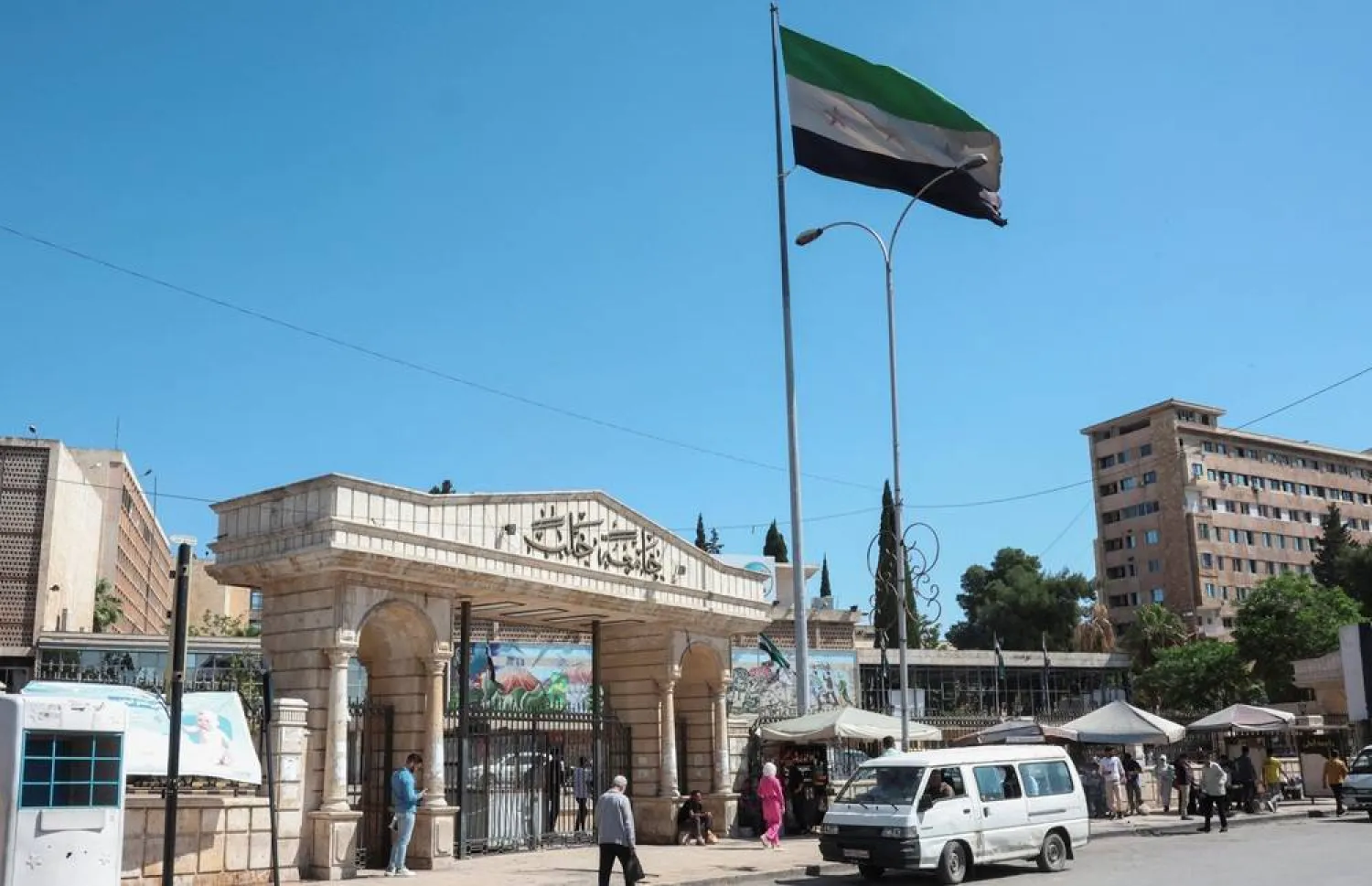
People walk near the Syrian flag, as US President Donald Trump announced that he would order the lifting of sanctions on Syria, in Aleppo, Syria May 14, 2025. (Reuters)
TT

Syria Hopes for Full Lifting of US Sanctions in Coming Months

People walk near the Syrian flag, as US President Donald Trump announced that he would order the lifting of sanctions on Syria, in Aleppo, Syria May 14, 2025. (Reuters)

Syria hopes US sanctions will be fully lifted in the coming months and has started the process of restructuring billions of dollars of debt amassed during Bashar al-Assad's rule, Economy Minister Mohammad Nidal al-Shaar said.

President Donald Trump ordered the lifting of most US sanctions on Syria in May after meeting President Ahmed al-Sharaa, but the Caesar Syria Civilian Protection Act of 2019 that authorizes them remains US law.

"We have to do some push and some lobbying to continue with this path that started in the right direction, and we're hoping by the end of the year the bill (to scrap the act) will reach the president (Trump), and hopefully he'll sign it," al-Shaar told Reuters during a conference in London.

"And once that happens, then we are sanctions-free," he said on the sidelines of the Future Resilience Forum.

HOPES FOR A REDUCTION OF US TARIFFS

The act's removal will enable foreign investment, restore access to international banking and help revive key industries.

Al-Shaar hopes Washington will reduce its 41% tariffs on trade with Syria and that US firms will invest in the country as the economy opens up.

Gulf countries have pledged support and Chinese firms have committed hundreds of millions of dollars, Al-Shaar said, for "big" new cement, plastic and sugar factories.

The government is on course to introduce a new currency early next year, he said.

Sources said in August that new banknotes would be issued in December, removing two zeros - and Assad's face - from the currency, to try to restore public confidence.

Syria's pound has lost over 99% of its value since the civil war began in 2011 but has been broadly stable in recent months.

"We're consulting with many entities, international organizations, experts, and eventually it will come very soon," al-Shaar said of the currency.

RECONSTRUCTION COSTS

A World Bank report on Tuesday estimated the cost of Syria's reconstruction at $216 billion, saying the figure was a "conservative best estimate".

Al-Shaar said the amount could be over 1 trillion dollars if the rebuild brought infrastructure up to date but would be spread over a long time, with the rebuilding of houses alone likely to take 6-7 years.

Asked about plans to overhaul Syria's debt burden, al-Shaar said the process had started already.

"The sovereign debt that we have, which is not very big actually, will be restructured," he said, adding that Syria would be asking for grace periods and other relief.

Assad left Syria in disarray when he was ousted last December and fighting continued in the oil-producing north until a ceasefire was struck this month.

"I'm hopeful that the next maybe few weeks, or maybe a month or two, we will reach some kind of an agreement with those who are controlling that part of Syria," Al-Shaar said.

"Once that happens, I think we will have greater ability, financial, natural resources, to really start meaningful (investment) projects," he said, predicting a "quantum leap in our GDP".


Strike Kills at Least Four Iraqi Fighters Near Syria Border

Members of the Iraqi border forces patrol along a concrete wall on the Iraqi-Syrian border, in the town of al-Baghuz in the Al-Qaim district of western Iraq, on January 21, 2026. (AFP)
TT

Strike Kills at Least Four Iraqi Fighters Near Syria Border

Members of the Iraqi border forces patrol along a concrete wall on the Iraqi-Syrian border, in the town of al-Baghuz in the Al-Qaim district of western Iraq, on January 21, 2026. (AFP)

A strike on Monday near Iraq's western border with Syria killed at least four fighters from a former coalition, two security officials said.

The fighters from the Popular Mobilization Forces (PMF), now part of Iraq's regular army -- "were killed and three others were wounded" in the late afternoon attack on a checkpoint at the entrance to the city of al-Qaim, a local security official said, AFP reported.

An official with the PMF, which includes pro-Iranian groups, put the toll higher, at six dead, blaming the United States for the strike.

He said the checkpoint, which also housed army and police personnel, was targeted again when ambulances arrived to help victims.

Iraq has recently regained a sense of stability following years of conflict, and was unwillingly drawn into the current Middle East war after having long been a proxy battleground between the US and Iran.

Since the start of the Middle East war on February 28, bases belonging to PMF have been hit several times, with strikes mostly targeting Tehran-backed armed groups.

These groups are also united under a loose alliance called the Islamic Resistance in Iraq, which has claimed attacks against US bases in Iraq.


Israel Steps Up Campaign in Lebanon

Israeli soldiers gather on the Israeli side of the border with Lebanon, amid escalation between Hezbollah and Israel, and amid the US-Israeli conflict with Iran, in northern Israel, March 16, 2026. REUTERS/Shir Torem
TT

Israel Steps Up Campaign in Lebanon

Israeli soldiers gather on the Israeli side of the border with Lebanon, amid escalation between Hezbollah and Israel, and amid the US-Israeli conflict with Iran, in northern Israel, March 16, 2026. REUTERS/Shir Torem

The war in the Middle East raged on multiple fronts on Monday, as the US and Israel pummeled military targets in Iran’s capital, Israel stepped up its campaign against Lebanon and Iran retaliated with a drone strike that temporarily shut Dubai’s airport, a crucial hub for travelers.
Massive explosions were heard in Beirut as Israel launched new attacks on the Lebanese capital before dawn, saying it was striking infrastructure related to Hezbollah.

The Israeli army has issued evacuation orders for many neighborhoods in Beirut as well as southern Lebanon. To date, more than 800,000 people have been displaced by Israel’s campaign in Lebanon, The AP news reported.

In southern Lebanon, seven people were killed in Israeli airstrikes, according to authorities and news reports. Lebanon’s state-run National News Agency said two of them were paramedics responding to an earlier strike.

At least 850 people in Lebanon have been killed by Israeli strikes so far.

Not long after Israel’s military announced it had launched new strikes on Tehran, targeting infrastructure, explosions were heard in the Iranian capital and outlying areas.

More details were not immediately available with information coming out of Iran severely limited by internet outages, round-the-clock airstrikes and tight restrictions on journalists.

More than 1,300 people have been killed in Iran so far, according to the Iranian Red Crescent.

Israel has carried out some 7,600 strikes on Iran so far, knocking out 85% of its air defenses, military spokesman Lt. Col. Nadav Shoshani told reporters Monday. It has also destroyed 70% of Iran’s missile launchers, but Shoshani said Israel still has thousands of targets to hit and would continue attacks “for as long as needed.”

In Israel, 12 people have been killed by Iranian missile fire. At least 13 US military members have been killed.


Iraq Hopes to Ship Oil to Türkiye by Pipeline as War Cuts off Exports

Technicians working at the Majnoon oil field in Basra, Iraq. (Reuters)
TT

Iraq Hopes to Ship Oil to Türkiye by Pipeline as War Cuts off Exports

Technicians working at the Majnoon oil field in Basra, Iraq. (Reuters)

Iraq is hoping to ship up to 250,000 barrels of oil per day to a port in Türkiye via a rehabilitated pipeline, its oil minister said, after the US-Israeli war on Iran cut off its main export route.

The amount would be just a fraction of the roughly 3.5 million barrels per day (bpd) that Iraq exported before the conflict, mostly through its southern Basra port and the Strait of Hormuz, where traffic has been severely disrupted by the war.

Authorities want to restore an old pipeline -- out of service for years -- that links the northern Kirkuk oil fields to the Turkish port of Ceyhan, where the oil could be shipped onwards to international buyers.

Oil Minister Hayan Abdel Ghani said late Sunday that the pipeline's rehabilitation is "complete, but there is a 100-kilometer section that needs to be inspected".

Teams will "conduct a hydrostatic test, which is the final phase of the pipeline's rehabilitation", hopefully "within a week", Ghani added, citing an export target of roughly 250,000 bpd.

The pipeline was damaged by the ISIS group in 2014.

Its use, however, requires "contact with the Turkish side and an agreement on logistical and technical issues", said oil expert Assem Jihad.

Initially, Baghdad wanted to send exports to the Ceyhan port via another pipeline that runs through Kurdistan.

But "so far, no agreement has been reached", Ghani said, as relations between the autonomous Iraqi Kurdistan and the federal government in Baghdad have deteriorated.

He acknowledged that "Iraqi oil exports were halted two or three days after the start of the war".

The country is also considering the possibility of transporting 200,000 bpd by tanker trucks, primarily via Jordan and Syria.

Iraq derives more than 90 percent of its revenue from oil.

Experts have warned that without this income, the state -- Iraq's largest employer -- will be unable to pay civil servants' salaries and risks a foreign currency shortage to finance imports or stabilise its exchange rate.