
Ortagus Briefed on Hezbollah Activities in Lebanon during Israel Visit

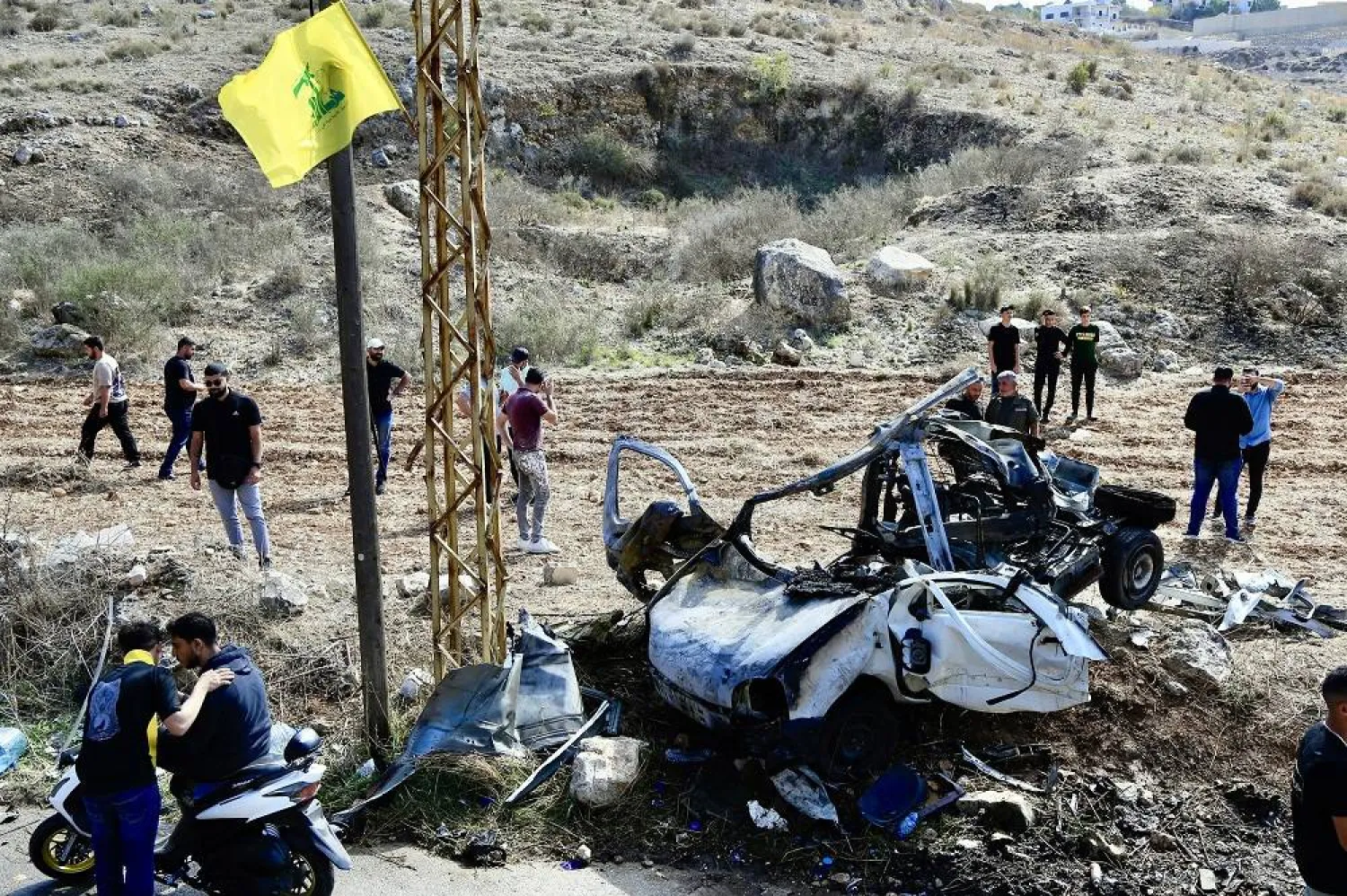
People inspect the wreckage of a vehicle targeted by an Israeli drone in the village of Harouf in the Nabatieh Governorate, southern Lebanon, 25 October 2025. (EPA)
TT

Ortagus Briefed on Hezbollah Activities in Lebanon during Israel Visit

People inspect the wreckage of a vehicle targeted by an Israeli drone in the village of Harouf in the Nabatieh Governorate, southern Lebanon, 25 October 2025. (EPA)

US envoy to Lebanon and Israel Morgan Ortagus was briefed on Sunday on Hezbollah’s activities and attempts to rebuild its military infrastructure in Lebanon. 

During a visit to Israel, she was also briefed on the army’s defensive and offensive plans along the border with Lebanon. 

Ortagus, Defense Minister Israel Katz, US Ambassador to Israel Mike Huckabee, Israeli Ambassador to the US Yechiel Leiter, Commander of Israel’s Northern Command Rafi Milo, and representatives of the US Central Command and Israeli national security council toured the Israeli border with Lebanon on Sunday, a day before Ortagus is set to visit Beirut to attend meetings of the committee overseeing the ceasefire between Lebanon and Israel. 

The meeting is set to be held on Wednesday as Israel has intensified its assassinations of members of Iran-backed Hezbollah. Since Thursday, it has killed eleven people, including at least seven Hezbollah members. 

Israel has assassinated over 365 members of the party since the ceasefire was reached in November in what it says are efforts to prevent Hezbollah from rebuilding its military capabilities and infrastructure. 

During Sunday's tour, Katz expressed his gratitude to US President Trump and Ortagus for their support for Israel and its efforts to protect its borders. 

Israel will continue to defend its northern regions against any threats, he vowed. 

On Sunday, Israeli Prime Minister Benjamin Netanyahu warned that his country would seek no approval to strike targets in Gaza or Lebanon, despite agreeing to ceasefires.  

"Israel is an independent state. We will defend ourselves by our own means and we will continue to determine our fate," Netanyahu told a meeting of government ministers.  

"We do not seek anyone's approval for this. We control our security," he said, following a week of visits by a parade of the highest level US officials seeking to consolidate the ceasefire in Gaza. 

Lebanon is under international pressure to disarm Hezbollah and implement its government decision to impose state monopoly over arms. Hezbollah has remained defiant, however, refusing to lay down its weapons despite the daily Israeli attacks against its members. 

Head of Hezbollah’s parliamentary bloc MP Mohammed Raad said on Sunday: "Key to Lebanon's security and stability does not lie in meeting the conditions of the enemy, but in making Israel meet its commitments and really cease its attacks." 

He underlined the need to bolster national unity to confront Israel’s ambitions. 

Moreover, he said it was "wrong to claim that the resistance [Hezbollah] was to blame for the enemy’s shameful attacks. Rather, Israel is attacking Lebanon because it is pursuing an expansionist agenda and it wants Lebanon to yield to it." 

On Sunday, the Lebanese Health Ministry said one person was killed in an Israeli strike on a vehicle in the southern town of al-Naqoura. Another person was killed in an Israeli drone strike on the town of al-Nabi Chit and a third, a Syrian, was killed in a strike on the town of al-Hafir on Sunday night. 

Israel killed two people on Saturday on a strike on a car and motorcycle. Its army said it targeted members of Hezbollah’s Radwan Unit. 

Lebanese political parties are demanding that Hezbollah lay down its weapons. 

Member of the Strong Republic bloc MP Said al-Asmar said an Israeli military escalation is still on the table. "This is what we have been hearing from American officials, and the Lebanese people will pay the price of such a development," he warned, saying the solution lies in Hezbollah’s disarmament. 

"We are not acquitting Israel of anything, but we also have a responsibility that we are not meeting. Israel will continue to attack us as long as Hezbollah keeps on asserting that it is recovering its capabilities and ready to go to war at any moment," he added. 


Saudi Intervention Ends Socotra Power Crisis

Socotra power generators restarted after Saudi intervention (X)
TT

Saudi Intervention Ends Socotra Power Crisis

Socotra power generators restarted after Saudi intervention (X)

Electricity has returned to Yemen’s Socotra archipelago after urgent Saudi intervention ended days of outages that disrupted daily life and crippled vital institutions, including the general hospital, the university and the technical institute.

The breakthrough followed a sudden shutdown of the power plants after the operating company withdrew and disabled control systems, triggering widespread blackouts and deepening hardship for residents.

The Saudi Program for the Development and Reconstruction of Yemen said its engineering and technical teams moved immediately after receiving an appeal from local authorities. Specialists were dispatched to reactivate operating systems that had been encrypted before the company left the island.

Generators were brought back online in stages, restoring electricity across most of the governorate within a short time.

The restart eased intense pressure on the grid, which had faced rising demand in recent weeks after a complete halt in generation.

Health and education facilities were among the worst affected. Some medical departments scaled back services, while parts of the education sector were partially suspended as classrooms and laboratories were left without power.

Socotra’s electricity authority said the crisis began when the former operator installed shutdown timers and password protections on control systems, preventing local teams from restarting the stations. Officials noted that the archipelago faced a similar situation in 2018, which was resolved through official intervention.

Local sources said the return of electricity quickly stabilized basic services. Water networks resumed regular operations, telecommunications improved, and commercial activity began to recover after a period of economic disruption linked to the outages.

Health and education rebound

In the health sector, stable power, combined with operational support, secured the functioning of Socotra General Hospital, the archipelago’s main medical facility.

Funding helped provide fuel and medical supplies and support healthcare staff, strengthening the hospital’s ability to receive patients and reducing the need to transfer cases outside the governorate, a burden that had weighed heavily on residents.

Medical sources said critical departments, including intensive care units and operating rooms, resumed normal operations after relying on limited emergency measures.

In education, classes and academic activities resumed at Socotra University and the technical institute after weeks of disruption.

A support initiative covered operational costs, including academic staff salaries and essential expenses, helping curb absenteeism and restore the academic schedule.

Local authorities announced that studies at the technical institute would officially restart on Monday, a move seen as a sign of gradual stabilization in public services.

Observers say sustained technical and operational support will be key to safeguarding electricity supply and preventing a repeat of the crisis in a region that depends almost entirely on power to run its vital sectors.


Egypt’s Prime Minister and FM Head to Washington for Trump Peace Council Meeting

Egyptian Foreign Minister Badr Abdelatty speaks during a joint press conference with Kenyan Prime Cabinet Secretary/Cabinet Secretary for Foreign Diaspora Affairs Musalia Mudavadi in Nairobi, Kenya, Monday, Feb. 16, 2026. (AP)
TT

Egypt’s Prime Minister and FM Head to Washington for Trump Peace Council Meeting

Egyptian Foreign Minister Badr Abdelatty speaks during a joint press conference with Kenyan Prime Cabinet Secretary/Cabinet Secretary for Foreign Diaspora Affairs Musalia Mudavadi in Nairobi, Kenya, Monday, Feb. 16, 2026. (AP)

Egypt's Prime Minister Mostafa Madbouly headed to Washington on Tuesday ‌to ‌participate in ‌the inaugural ⁠meeting of a "Board of Peace" established by US President Donald ⁠Trump, the ‌cabinet ‌said.

Madbouly is ‌attending ‌on behalf of President Abdel ‌Fattah al-Sisi and is accompanied by ⁠Foreign ⁠Minister Badr Abdelatty.

Foreign Minister Gideon Saar will represent Israel at the inaugural meeting, his office said on Tuesday.

Hamas, meanwhile, called on the newly-formed board to pressure Israel to halt what it described as ongoing violations of the ceasefire in Gaza.

The Board of Peace, of which Trump is the chairman, was initially designed to oversee the Gaza truce and the territory's reconstruction after the war between Hamas and Israel.

But its purpose has since morphed into resolving all sorts of international conflicts, triggering fears the US president wants to create a rival to the United Nations.

Saar will first attend a ministerial level UN Security Council meeting in New York on Wednesday, and on Thursday he "will represent Israel at the inaugural session of the board, chaired by Trump in Washington DC, where he will present Israel's position", his office said in a statement.

It was initially reported that Prime Minister Benjamin Netanyahu might attend the gathering, but his office said last week that he would not.

Ahead of the meeting, Hamas spokesman Hazem Qassem told AFP that the Palestinian movement urged the board's members "to take serious action to compel the Israeli occupation to stop its violations in Gaza".

"The war of genocide against the Strip is still ongoing -- through killing, displacement, siege, and starvation -- which have not stopped until this very moment," he added.

He also called for the board to work to support the newly formed Palestinian technocratic committee meant to oversee the day-to-day governance of post-war Gaza "so that relief and reconstruction efforts in Gaza can commence".

Announcing the creation of the board in January, Trump also unveiled plans to establish a "Gaza Executive Board" operating under the body.

The executive board would include Turkish Foreign Minister Hakan Fidan and Qatari diplomat Ali Al-Thawadi.

Netanyahu has strongly objected to their inclusion.

Since Trump launched his "Board of Peace" at the World Economic Forum in Davos in January, at least 19 countries have signed its founding charter.


Palestinian Child Dies After Stepping on Mine in West Bank

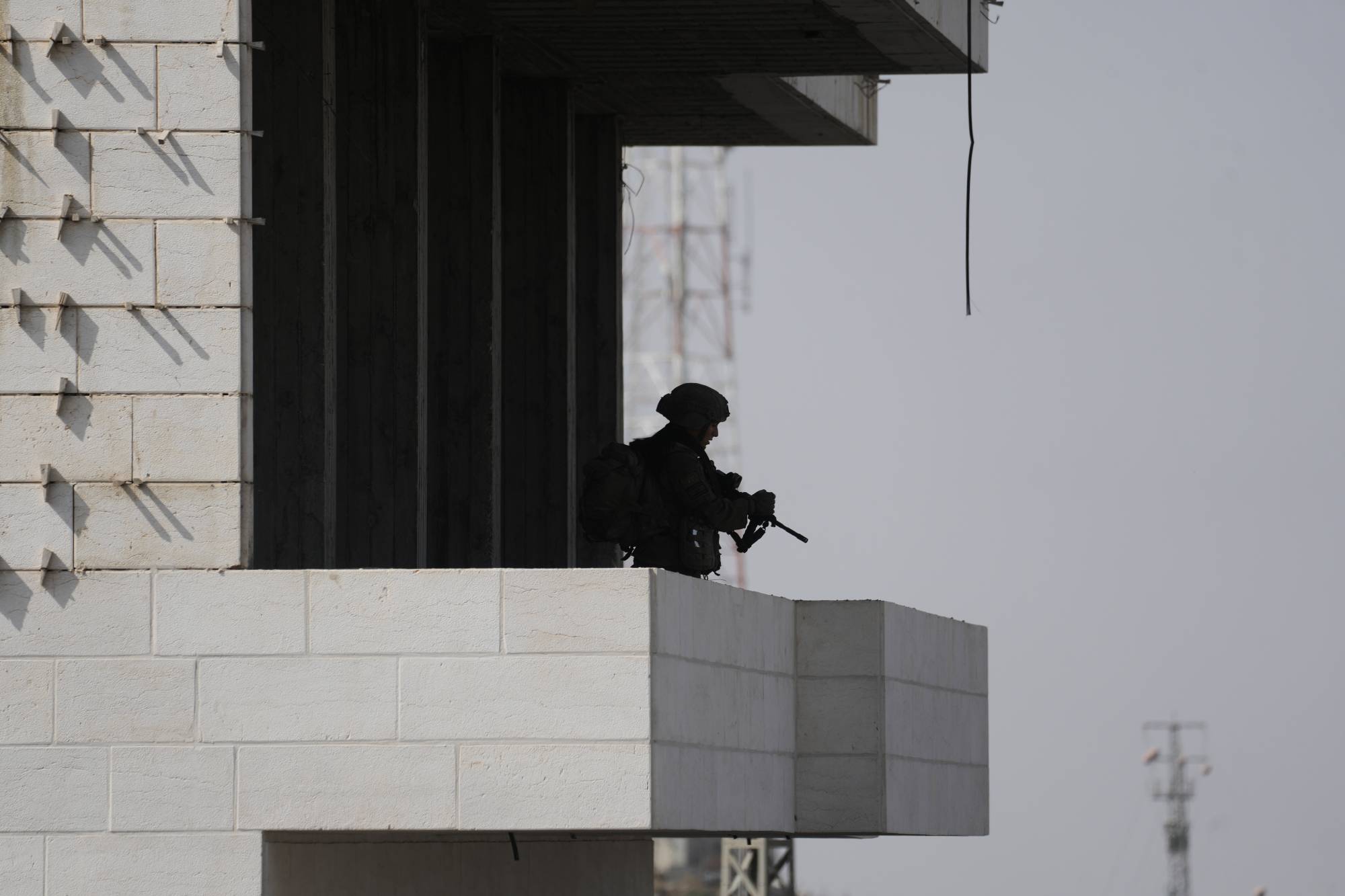
Israeli troops conduct a military raid in the village of Al-Yamoun, west of Jenin, West Bank, 17 February 2026. (EPA)
TT

Palestinian Child Dies After Stepping on Mine in West Bank

Israeli troops conduct a military raid in the village of Al-Yamoun, west of Jenin, West Bank, 17 February 2026. (EPA)

A Palestinian child died after stepping on a mine near an Israeli military camp in the occupied West Bank on Tuesday, the Palestinian Red Crescent said, with an Israeli defense ministry source confirming the death.

"Our crews received the body of a 13-year-old child who was killed after a mine exploded in one of the old camps in Jiftlik in the northern Jordan Valley," the Red Crescent said in a statement.

A source at COGAT, the Israeli defense ministry's agency in charge of civilian matters in the Palestinian territories, confirmed the death to AFP and identified the boy as Mohammed Abu Dalah, from the village of Jiftlik.

Israel's military had previously said in a statement that three Palestinians were injured "as a result of playing with unexploded ordnance", without specifying their ages.

It added that the area of the incident, Tirzah, is "a military camp in the area of the Jordan Valley", near Jiftlik and close to the Jordanian border.

"This area is a live-fire zone and entry into it is prohibited," the military said.

Jiftlik village council head Ahmad Ghawanmeh told AFP that three children, the oldest of whom was 16, were collecting herbs near the military base when they detonated a mine.

Jiftlik as well as the nearby Tirzah base are located in the Palestinian territory's Area C, which falls under direct Israeli control.

Israel has occupied the West Bank since 1967.

Much of the area near the border with Jordan -- which Israel signed a peace deal with in 1994 -- remains mined.

In January, Israel's defense ministry said it had begun demining the border area as part of construction works for a new barrier it says aims to stem weapons smuggling.