

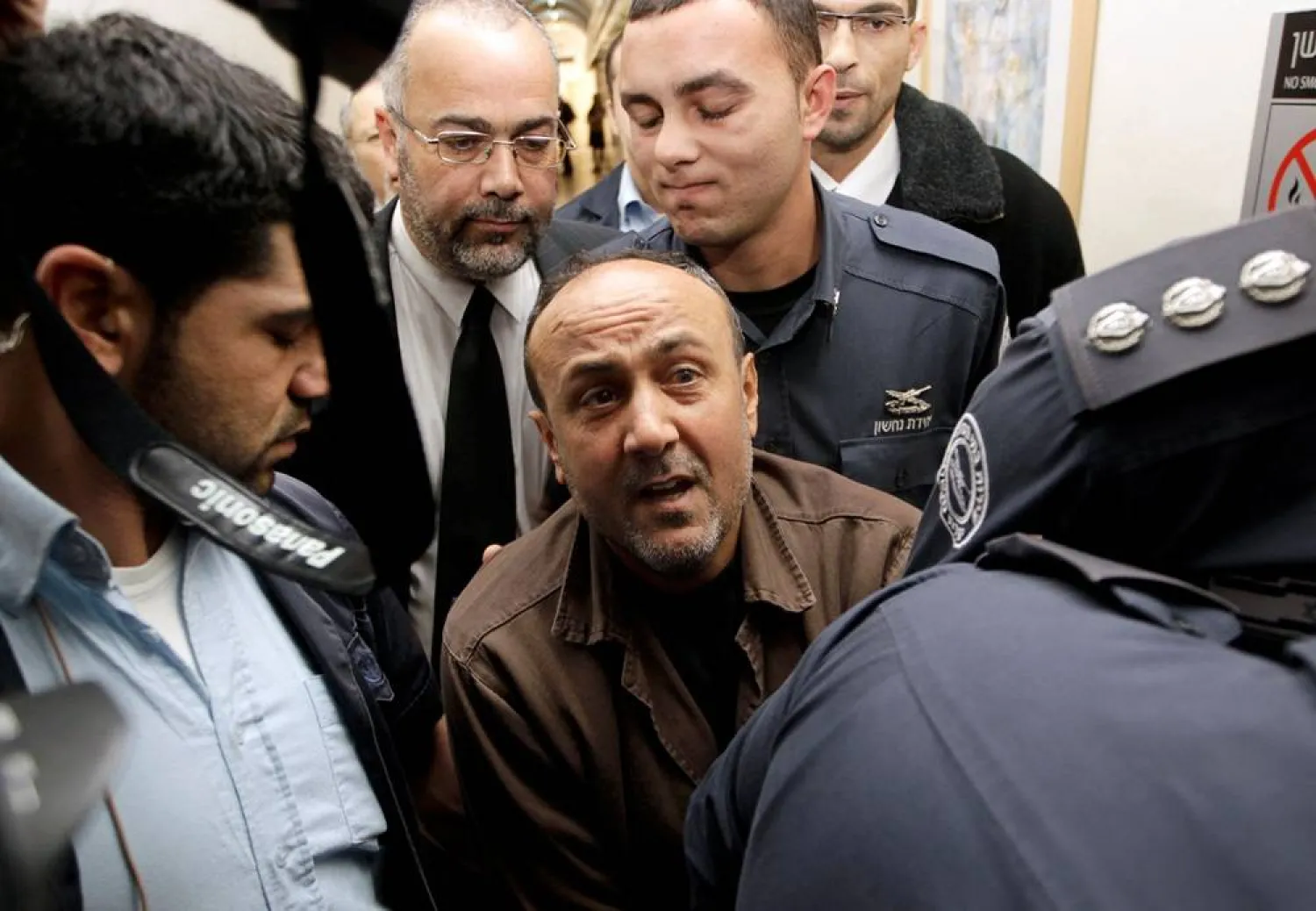

Jailed Palestinian Leader Barghouti Can Unify Palestinians Says Son

Jailed Fatah leader Marwan Barghouti (C) is accompanied by Israeli prison guards after a deliberation at Jerusalem Magistrate's court January 25, 2012. (Reuters)
TT

Jailed Palestinian Leader Barghouti Can Unify Palestinians Says Son

Jailed Fatah leader Marwan Barghouti (C) is accompanied by Israeli prison guards after a deliberation at Jerusalem Magistrate's court January 25, 2012. (Reuters)

Jailed Palestinian leader Marwan Barghouti's son urged US President Donald Trump to "seize the opportunity" created by the Gaza truce to secure his father's release and revive the two-state solution to the Middle East conflict.

Sometimes dubbed the "Mandela of Palestine" by his supporters, Marwan Barghouti, 66, was one of the leaders of the second intifada, the Palestinian uprising in the early 2000s, and is often cited as a possible successor to Palestinian President Mahmoud Abbas.

In June 2004, an Israeli court sentenced him to five life sentences after finding him guilty of involvement in four anti-Israeli attacks that killed five people.

But the heavy sentences have not diminished his popularity among Palestinians.

"He's capable and has the track record to unify the Palestinian people," Arab Barghouti told AFP in an interview on Sunday in English in the Israeli-occupied West Bank city of Ramallah.

"Someone like him represents a great opportunity for the international community to prove that they are serious about supporting the two-state solution."

Arab Barghouti's comments come after several countries -- including France, Britain and Canada -- formally recognized a Palestinian state last month.

He is the second member of the family to appeal to the US president to secure his father's release. Earlier this month, Marwan Barghouti's wife Fadwa also urged Trump to intervene.

Trump said in an interview with US magazine Time on October 15 that he would be "making a decision" on the matter, without specifying a timeline.

"I really hope he can do that, pressure the Israelis into releasing my father, because he is a partner for peace," Arab Barghouti said, adding that his family "really welcome" Trump's comment.

Though the two have not been allowed to speak in three years, Arab Barghouti said his father represents Palestinian unity and the best chance for a two-state solution for Israelis and Palestinians.

A longtime member of Abbas' Fatah party, Marwan Barghouti has consistently been re-elected to the party's central committee, including twice while in jail.

With his likeness painted on many walls in the occupied West Bank and, until recently, in Gaza, Marwan Barghouti is considered one of the few figures who could be accepted as a leader by all Palestinian political factions, including Hamas.

The movement, which violently pushed Fatah out of the Gaza Strip after winning the elections there in 2006, has nevertheless repeatedly called for Marwan Barghouti's release, including during ceasefire negotiations in Gaza.

According to a poll conducted last May by the Palestinian Center for Policy and Survey Research (PCPSR), an independent institute in Ramallah, Marwan Barghouti would win if new Palestinian presidential elections were held, twenty years after Abbas came to power.

Marwan Barghouti continues to carry out his political responsibilities through his lawyer, whom he has seen five or six times over the past two years, which he has largely spent in solitary confinement, Arab Barghouti said.

"We have corruption issues that we need to address as Palestinians, and we need to be brave enough to look in the mirror and to take responsibility for our mistakes," Arab Barghouti said, speaking to AFP at a campaign office and calling for his father's release.

But with the war in Gaza ending, Western countries including the US "need to seize the opportunity of having a Palestinian leader who is well-respected and trusted and has the same vision that they have".

Israel has so far refused to release Marwan Barghouti including in any prisoner exchanges carried out since the Gaza war broke out after Hamas' unprecedented October 7, 2023 attack on Israel.

"The last few weeks have been very tough on us as a family because it's been a roller coaster" of emotions, Arab Barghouti said.

He added that released prisoners reported his father had been beaten during a prison transfer in September, sustaining severe injuries.

"Four of his ribs got broken, he got severe injuries in his head, and he lost consciousness," said Arab Barghouti.

In a video he shared on social media in August, Israel's far-right National Security Minister Itamar Ben-Gvir was seen threatening a physically weak Marwan Barghouti in jail.

Asked whether his father might want to rest should he be released, Arab Barghouti said he did not foresee that happening.

"Knowing my father, I know that he will be playing an active role in stopping the suffering, the rebuilding of Gaza, helping the Palestinian people overall, because that's been his life mission," he said.



Hezbollah Official Says Lebanon-Israel Talks 'Do Not Concern Us'

A Hezbollah flag is displayed from a car window, next to a dog, as displaced people make their way to return to their homes after a 10-day ceasefire between Lebanon and Israel went into effect, in Sidon, Lebanon, April 18, 2026. REUTERS/Aziz Taher
TT

Hezbollah Official Says Lebanon-Israel Talks 'Do Not Concern Us'

A Hezbollah flag is displayed from a car window, next to a dog, as displaced people make their way to return to their homes after a 10-day ceasefire between Lebanon and Israel went into effect, in Sidon, Lebanon, April 18, 2026. REUTERS/Aziz Taher

Senior Hezbollah official Mahmud Qamati said on Saturday that his group was not concerned by Lebanon's planned direct talks with Israel, labelling them a failure, Reuters reported.

In a press conference in Beirut's southern suburbs, Qamati said his group was "not concerned with the negotiations being conducted by the state", saying they were "a failure, weak, defeated... and submissive negotiations".

"The resistance is the one that imposes. We are the land... and we are the ones who draw up the decisions, not those who have an official status," he said, adding that while his group did not mind Beirut "coordinating with us... not in this way that leads to surrender".


Abdelatty: Egypt Working with Pakistan on Lasting US-Iran Peace Plan

This handout photograph taken and released by Turkish Foreign Ministry on April 17, 2026, shows Türkiye's Foreign Minister Hakan Fidan (2nd R), Saudi Arabia's Foreign Minister Faisal bin Farhan Al-Saud (R), Egyptian counterpart Badr Abdelatty (L) and Pakistan's Foreign Minister Ishaq Dar (2nd L) poses family photo during the 5th edition of the Antalya Diplomacy Forum (ADF2026) in Antalya. (Photo by Turkish Foreign Ministery Press Service / TURKISH FOREIGN MINISTRY / AFP)
TT

Abdelatty: Egypt Working with Pakistan on Lasting US-Iran Peace Plan

This handout photograph taken and released by Turkish Foreign Ministry on April 17, 2026, shows Türkiye's Foreign Minister Hakan Fidan (2nd R), Saudi Arabia's Foreign Minister Faisal bin Farhan Al-Saud (R), Egyptian counterpart Badr Abdelatty (L) and Pakistan's Foreign Minister Ishaq Dar (2nd L) poses family photo during the 5th edition of the Antalya Diplomacy Forum (ADF2026) in Antalya. (Photo by Turkish Foreign Ministery Press Service / TURKISH FOREIGN MINISTRY / AFP)

Egypt is working closely with Pakistan on a framework aimed at securing a lasting peace between the US and Iran, ⁠Foreign Minister Badr ⁠Abdelatty said on Saturday.

He said Egypt, Türkiye, Pakistan and ⁠Saudi Arabia were coordinating a broader regional effort focused on preventing renewed escalation and laying the groundwork for a post-war security arrangement, stressing ⁠the ⁠importance of protecting Gulf states and stabilizing energy markets, supply chains and food security.

Abdelatty’s statement came as Iran has swiftly reversed course on reopening the Strait of Hormuz, reimposing restrictions on the critical waterway on Saturday after US President Donald Trump said that even after Tehran announced the strait's reopening on Friday, the American blockade “will remain in full force” until the country reaches a deal with the US, including on its nuclear program.

The conflict over the chokepoint threatened to deepen the energy crisis roiling the global economy after oil prices began to fall again on Friday on hopes the US and Iran were drawing closer to an agreement.


Yemen: Houthi Infighting Exposes Deepening Fractures

A gathering of Yemen’s Qaifa tribes rejecting Houthi death sentences against 11 of their members (X)
TT

Yemen: Houthi Infighting Exposes Deepening Fractures

A gathering of Yemen’s Qaifa tribes rejecting Houthi death sentences against 11 of their members (X)

Rising violence within Yemen’s Houthi movement is highlighting deep internal divisions, as competition over influence and resources intensifies amid growing isolation and public discontent, analysts and local sources say.

Recent incidents point to a weakness in managing internal disputes, with clashes increasingly erupting among the group’s own commanders. The absence of stable mechanisms to regulate rivalries, alongside declining trust in Houthi-run institutions, has fueled tensions.

One of the most serious episodes occurred last week in Jabal Ras district, south of Hodeidah province, where a local security headquarters turned into a battleground. Local sources said a dispute between Mohammed Abbas al-Qahif, the Houthi-appointed security chief, and field commander Abu Bashar Habib Mutlaq escalated into a gunfight inside the compound. Machine guns were used in a densely populated area, wounding fighters on both sides and critically injuring a civilian as the clashes spread outside.

The incident is part of a broader pattern. In recent weeks, several Houthi security and field leaders have been killed in the provinces of al-Jawf, al-Mahwit, Sanaa and al-Bayda.

Yemeni political researcher Salah Ali Salah said such conflicts “have become more frequent and visible,” reflecting the accumulation of competing power networks formed during years of war. These networks have reshaped internal hierarchies and weakened tribal and social actors that once supported or benefited from the group.

He added that tensions are increasingly shifting from the periphery into the core of the movement, with disputes among supervisors and commanders driven by competition over authority, resources and influence. These conflicts, he said, often require direct intervention from senior leadership to contain them.

Violence linked to personal disputes and widespread weapon ownership has also surged. In one case in Sanaa, tribal figure Abdulrazzaq al-Athri was killed by his brother Mohammed, described as a Houthi-affiliated gunman, following a land dispute in Arhab district.

In al-Bayda’s Radaa district, another tribal leader, Mohammed al-Rubaie, was killed in an ambush by unidentified gunmen, while an elderly man from Ibb province was shot dead in a separate incident. The district has become a hotspot for both lawlessness and confrontations between residents and Houthi forces.

Tensions have further escalated after a Houthi court sentenced 11 members of the Qaifa tribe to death over a previous tribal dispute with Sanhan tribes. Qaifa leaders say the ruling was issued without due legal process and accuse Houthi figure Yahya al-Razami of bias.

Analyst Bassem Mansour linked the growing chaos to the group’s isolation and leadership constraints. Senior figures, he said, are preoccupied with military and regional developments and often operate in secrecy for fear of Israeli targeting, leaving field commanders to act impulsively in the face of public resentment.

Residents report worsening living conditions and deteriorating services, fueling frustration that increasingly manifests in violent personal disputes. A Sanaa-based researcher, speaking anonymously for safety reasons, said public anger at Houthi policies is rising daily.

Security institutions, once tools of control, are now seen as arenas for settling scores, while judicial bodies have lost credibility due to perceived corruption and inefficiency. The proliferation of weapons have further undermined order.

As the situation persists, civilians remain the most vulnerable, caught between internal Houthi rivalries and unchecked violence, with little prospect of restored stability.