

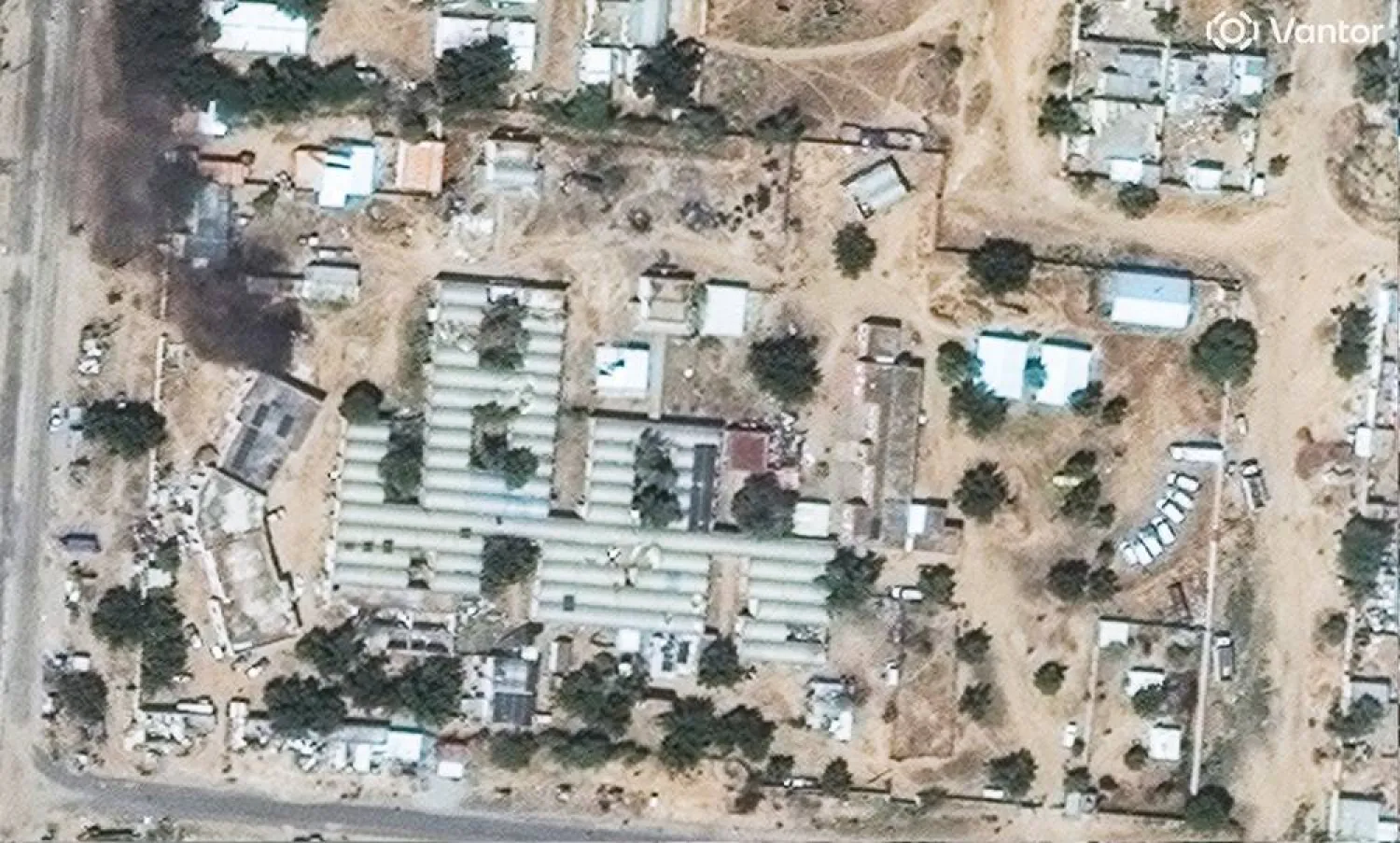

Satellite Images Appear to Show Attempts to Dispose of Bodies After RSF Seized Sudan’s el-Fasher

 This satellite image from Vantor shows a smoke from a fire at the Saudi hospital in el-Fasher, Sudan, Thursday, Nov. 6, 2025. (©2025 Vantor via AP)
This satellite image from Vantor shows a smoke from a fire at the Saudi hospital in el-Fasher, Sudan, Thursday, Nov. 6, 2025. (©2025 Vantor via AP)
TT

Satellite Images Appear to Show Attempts to Dispose of Bodies After RSF Seized Sudan’s el-Fasher

 This satellite image from Vantor shows a smoke from a fire at the Saudi hospital in el-Fasher, Sudan, Thursday, Nov. 6, 2025. (©2025 Vantor via AP)
This satellite image from Vantor shows a smoke from a fire at the Saudi hospital in el-Fasher, Sudan, Thursday, Nov. 6, 2025. (©2025 Vantor via AP)

New satellite images analyzed Friday appear to show further efforts by the paramilitary Rapid Support Forces to dispose of corpses after they seized and rampaged through the city of el-Fasher in Sudan’s Darfur region.

Images by the Colorado-based firm Vantor show a fire at the Saudi hospital in el-Fasher on Thursday near a collection of white objects seen days earlier in other Vantor photos.

The Yale School of Public Health’s Humanitarian Research Lab described the images as showing the “burning of objects that may be consistent with bodies.”

“The practice of burning bodies is not consistent with Islamic burial practices,” the Yale lab said in its report. “The apparent immolation of objects that may be consistent with human remains complicates any future effort to count the number of people killed since the fall of el-Fasher and to identify and return the remains to family members.”

The Associated Press separately accessed the Vantor images and identified objects corresponding to the Yale lab’s report, including the fire and the white objects. Such objects in other imagery from el-Fasher appear to correspond to dead bodies, showing the scale of the killings in the city.

Earlier satellite images of el-Fasher appear to show mass graves being dug and later covered at two sites in the city, one at a mosque just north of the Saudi hospital where some 460 people reportedly had been killed and another by a former children’s hospital that the RSF had been using as a prison.

The RSF has denied killing anyone at the Saudi hospital.

However, testimonies from those fleeing el-Fasher, online videos and satellite images offer an apocalyptic vision of the attack.

Another satellite image appeared to show the RSF likely blocking an exit to el-Fasher to the west. A new berm had been added to the site, the Yale lab said.

Drones reportedly intercepted

Meanwhile, the Sudanese army intercepted drones fired overnight by its rival paramilitary group on two cities in Sudan's northeast, a military official said Friday.

The army official, who spoke on condition of anonymity to freely discuss the matter, said 15 drones targeted Atbara, a city north of the capital, in River Nile province. He confirmed that strikes caused no casualties. Local media reports said residents heard explosions.

The official added that ground defenses intercepted a smaller-scale drone attack that also targeted Omdruman, the sister city of the capital Khartoum.

The RSF drone strikes come a day after the group announced that it has agreed to a humanitarian truce proposed by a US-led mediator group known as the Quad.

A Sudanese military official told the AP on Thursday that the army welcomes the Quad’s proposal but will only agree to a truce when the RSF completely withdraws from civilian areas and give up weapons per previous peace proposals.

US-led plan for a truce

The war between the RSF and the military began in 2023, when tensions erupted between the two former allies that were meant to oversee a democratic transition after a 2019 uprising.

The fighting has killed at least 40,000 people, according to the WHO, and displaced 12 million. However, aid groups say the true death toll could be many times higher. Over 24 million people are also facing acute food insecurity, according to the World Food Program.

The US-led plan for a truce would start with a three-month humanitarian truce followed by a nine-month political process, said Massad Boulos, a US adviser for African affairs, earlier this week.

Also Friday, the UN’s top human rights body announced it will hold an emergency special session on Sudan on Nov. 14 over recent bloodshed and other violence against civilians in and around the Darfur city of el-Fasher.

The call for the special session by the Human Rights Council in Geneva was led by Britain, Germany, Ireland, the Netherlands and Norway, and has drawn support from two dozen council members in the 47-member-country rights body so far.

Limited aid delivery The RSF’s announcement that it agreed to the truce comes more than a week after the group seized el-Fasher which had been under siege for over 18 months. It was also the last Sudanese military stronghold in Sudan’s western Darfur region.

UNICEF said Thursday that more than 81,000 people have been displaced from el-Fasher since Oct. 26, with rising needs for shelter, food, water and medical care but limited aid delivery.

The UN children agency's report said it identified more than 850 children with acute malnutrition who are now receiving treatment. It added that violence, sexual assaults and looting of health facilities remain rampant across North Darfur, with women and children being the most vulnerable.



Syrian Government Announces Ceasefire with Kurdish-led SDF

Syrian President Ahmed al-Sharaa after signing an agreement at the presidential palace in Damascus on January 18, 2026. (EPA)
TT

Syrian Government Announces Ceasefire with Kurdish-led SDF

Syrian President Ahmed al-Sharaa after signing an agreement at the presidential palace in Damascus on January 18, 2026. (EPA)

The Syrian government Sunday announced a ceasefire with the Syrian Democratic Forces, taking almost full control of the country and dismantling the Kurdish-led forces that controlled the northeast for over a decade.

The announcement comes as tensions between government forces and the SDF boiled over earlier this month, eventually resulting in a major push by government forces toward the east. The SDF appeared to have largely retreated after initial clashes on a tense front line area in eastern Aleppo province.

Hours after the government announced the deal, SDF leader Mazloum Abdi confirmed it in a video statement, saying the group had accepted the agreement, which stipulates their withdrawal from Raqqa and Deir Ezzor provinces “to stop the bloodshed.”

“We will explain the terms of the agreement to our people in the coming days,” he said.

Syria’s Defense Ministry said it ordered the fighting to halt on the front lines after the agreement was announced.

Syria’s new leaders, since toppling Bashar al-Assad in December 2024, have struggled to assert their full authority over the war-torn country. An agreement was reached in March that would merge the SDF with Damascus, but it didn't gain traction as both sides accused each other of violating the deal.

Since the push, the government has largely asserted control of the Deir Ezzor and Raqqa provinces, critical areas under the SDF that include oil and gas fields, river dams along the Euphrates, and border crossings.

Syria’s state-run news agency SANA showed President Ahmed al-Sharaa signing and holding the agreement. Abdi, who was scheduled to meet with the president in Damascus was not seen, though his signature appeared on the document.

Sharaa told journalists that Abdi could not travel due to bad weather and will visit Damascus on Monday.

“It’s a victory for all Syrians of all backgrounds,” Sharaa told journalists in Damascus after signing the agreement. “Hopefully Syria will end its state of division and move to a state of unity and progress.”

US Envoy Tom Barrack met with Sharaa earlier Sunday as government forces were sweeping into the city of Raqqa and across Deir Ezzor. Abdi reportedly joined the meeting over the phone.

Barrack praised the agreement, saying it will lead to “renewed dialogue and cooperation toward a unified Syria,” ahead of working on the details of implementing the integration.

“This agreement and ceasefire represent a pivotal inflection point, where former adversaries embrace partnership over division,” said Barrack in a post on X.

The agreement includes dismantling the SDF and having its forces join Syria’s military and security forces, while senior military and civilian officials would be given high-ranking positions in state institutions.

The SDF would have to give up the Raqqa and Deir Ezzor provinces — both Arab-majority areas — to the Syrian military and government, as well as its border crossings and oil and gas fields.

Hassakah province, the heartland of the Kurdish population, is only expected to give its civilian administration back to Damascus, while the Kurdish-led agencies that handled prisons and sprawling camps with thousands of detained ISIS group fighters and families would be handed over to Damascus.

Agreement will be implemented gradually

There was no clear timeline on when and how the different elements of the agreement will take effect. Sharaa told journalists that it will be gradually implemented, beginning with the cessation of hostilities.

It appeared that tensions following clashes in Aleppo earlier this month had calmed after Abdi announced that his troops will withdraw east of the Euphrates River, and Sharaa issued a presidential decree that would strengthen Kurdish rights in the country.

Initially the withdrawal appeared to be going as planned, but then new clashes broke out and the Syrian military seized Tabqa, continuing into Raqqa province.

A senior Syrian government official who spoke on condition of anonymity because he was not authorized to speak publicly said government forces pushed eastward because the SDF despite saying they will withdraw east of the Euphrates by 7 a.m. did not do so.

Armed Arab clans in Raqqa and Deir Ezzor that largely do not support the SDF backed Damascus. By Sunday evening, the SDF lost control of large swaths of its territory and infrastructure, including dams and oil and gas fields.

The SDF took Raqqa from the ISIS group in 2017 as part of its military campaign to take down the group’s so-called "caliphate", which at its peak stretched across large parts of Syria and Iraq.

An Associated Press reporter in the area said that large military convoys swept into Raqqa city Sunday evening and were greeted by residents. It appeared that the SDF had withdrawn.

Raqqa celebrates

Crowds in Raqqa celebrated in the streets late into the evening, waving Syrian flags and setting off fireworks, while some fired into the air.

“Today, everyone is born anew,” said Yahya Al Ahmad, who was among the revelers.

A couple of thousand Kurdish families who lived in the areas captured by government forces fled to the SDF-controlled city of Qamishli amid the offensive. Many of them had previously been displaced from other areas multiple times during Syria’s 14-year civil war and were living in tents camps. A cultural center in the city was turned into a temporary shelter for them.

Residents of Qamishli expressed both hope and skepticism about the deal.

“The Kurds have become victims of international agreements and international deception,” said Goran Ibrahim, a doctor. But he said, “With regards to this agreement, the positive part is the end of the fighting in the region.”

Syria's ambassador to the UN, Ibrahim Olabi, told the AP, “Really this is now a moment to show that Syrians are able to put differences aside and move ahead...It’s a victory for Syria.”


Video Shows Fires in Palestinian Village in West Bank During Israeli Settler Attack

 People stand in an area with destroyed vehicles and a structure, which Palestinians say were burned by Israeli settlers on Saturday, in the Palestinian town of Mikhmas, near Ramallah in the Israeli-occupied West Bank, January 18, 2026. (Reuters)
People stand in an area with destroyed vehicles and a structure, which Palestinians say were burned by Israeli settlers on Saturday, in the Palestinian town of Mikhmas, near Ramallah in the Israeli-occupied West Bank, January 18, 2026. (Reuters)
TT

Video Shows Fires in Palestinian Village in West Bank During Israeli Settler Attack

 People stand in an area with destroyed vehicles and a structure, which Palestinians say were burned by Israeli settlers on Saturday, in the Palestinian town of Mikhmas, near Ramallah in the Israeli-occupied West Bank, January 18, 2026. (Reuters)
People stand in an area with destroyed vehicles and a structure, which Palestinians say were burned by Israeli settlers on Saturday, in the Palestinian town of Mikhmas, near Ramallah in the Israeli-occupied West Bank, January 18, 2026. (Reuters)

Israeli settlers rampaged through a Palestinian village in the West Bank, setting fire to a series of structures, according to security camera footage obtained by The Associated Press on Sunday, in an overnight onslaught that has become a common phenomenon in the occupied territory.

In the video, time-stamped at around 10 p.m. Saturday, several structures in the village go up in flames as the sound of gunfire, screaming and barking echoes in the background. At one point in the video, the fires grow so large that they illuminate the bands of settlers, dressed in black, pacing freely through the village.

Also Sunday, at least four more countries said they had been invited to join US President Donald Trump’s Board of Peace, the international body expected to oversee his Gaza ceasefire plan and perhaps other conflict resolutions.

Meanwhile, an Israeli Cabinet minister said that he'd ordered officials to disconnect the water and electricity for facilities of the UN Relief and Works Agency for Palestinian Refugees, or UNRWA. It's the latest action in Israel’s long-running campaign to shut down the agency. UNRWA fears the shutdown could hamper its work in east Jerusalem.

Settler attack video

The footage obtained by the AP showed the moment dozens of settlers descended on the small Bedouin hamlet of Khirbet al-Sidra, north of Jerusalem, attacking Palestinians and international activists and burning cars and homes, according to the Palestinian Authority's Jerusalem governate, which monitors Palestinian affairs in the area.

In a statement, it said that eight homes and at least two cars were burned in the attack.

Israel’s military said that soldiers dispatched to the village found an Israeli vehicle with clubs inside. It said that Palestinians, Israelis and foreign nationals were injured, and troops were searching the area to make arrests. As of Sunday afternoon, no arrests had been reported.

It marked the latest assault in the tense territory as settler violence spikes in recent months.

Around 500,000 Israelis have settled in the West Bank since Israel captured the territory, along with east Jerusalem and the Gaza Strip, in the 1967 Mideast war. Their presence is viewed by most of the international community as illegal and a major obstacle to peace.

The Palestinians seek all three areas for a future state. Israel has sought to play down the violence as the work of a small, radical minority. But Israel's far-right government, dominated by settlers and their supporters, has done little to stop the attacks.

Board of Peace invites

Jordan, Greece, Cyprus and Pakistan on Sunday announced that they had received invitations to Trump's Board of Peace. Albania, Egypt, Paraguay, Argentina and Türkiye have already said they were invited.

The board, made up of world leaders, was initially seen as a mechanism focused on ending the Israel-Hamas war in Gaza. It's now taking shape with ambitions to have a far broader mandate to address other global crises, potentially rivaling the United Nations.

The US hasn't yet announced the official list of members. In letters sent Friday to various world leaders inviting them to be “founding members” of the board, Trump says the body would “embark on a bold new approach to resolving global conflict.”

Israel moves against UNRWA

Israeli Energy Minister Eli Cohen said on X Sunday he'd issued formal notices to disconnect water and electricity from facilities belonging to UNRWA.

The UN agency said on X that the shutdown could take effect within two weeks. It comes after Israel's parliament in December passed a bill to cut the supply of electricity and water to the facilities.

The earlier ban already closed many of UNRWA’s services in east Jerusalem, though it continues to operate a vocational training center in east Jerusalem.

The agency provides aid and services, including health and education, to around 2.5 million Palestinian refugees in Gaza and the occupied West Bank and east Jerusalem, as well as 3 million more in Syria, Jordan and Lebanon.

Earlier last year, Israel banned the agency from operating on its territory. The ban followed months of attacks on the agency by Israel, which says it's deeply infiltrated by Hamas. UNRWA rejects that accusation.


Iraq Announces Complete Withdrawal of US-Led Coalition from Federal Territory

 US forces at the Taji camp, north of Baghdad. (AFP file)
US forces at the Taji camp, north of Baghdad. (AFP file)
TT

Iraq Announces Complete Withdrawal of US-Led Coalition from Federal Territory

 US forces at the Taji camp, north of Baghdad. (AFP file)
US forces at the Taji camp, north of Baghdad. (AFP file)

Iraq said on Sunday US-led coalition forces had finished withdrawing from bases within the country's federal territory, which excludes the autonomous northern Kurdistan region.

"We announce today... the completion of the evacuation of all military bases and leadership headquarters in the official federal areas of Iraq of advisers" of the US-led coalition, the military committee tasked with overseeing the end of the coalition's mission said.

With the withdrawal, "these sites come under the full control of Iraqi security forces", it said in the statement, adding that they would transition to "the stage of bilateral security relations with the United States".

The vast majority of coalition forces had withdrawn from Iraqi bases under a 2024 deal between Baghdad and Washington outlining the end of the mission in Iraq by the end of 2025 and by September 2026 in the Kurdistan region.

US and allied troops had been deployed to Iraq and Syria since 2014 to fight the ISIS group, which had seized large swathes of both countries.

The group was territorially defeated in Iraq in 2017 and in Syria in 2019, but continues to operate sleeper cells.

The vast majority of coalition troops withdrew from Iraq over previous stages, with only advisers remaining in the country.

The military committee on Sunday said Iraqi forces were now "fully capable of preventing the reappearance of ISIS in Iraq and its infiltration across borders".

"Coordination with the international coalition will continue with regards to completely eliminating ISIS's presence in Syria," it added.

It pointed to "the coalition's role in Iraq offering cross-border logistical support for operations in Syria, through their presence at an airbase in Erbil", the capital of Iraq's Kurdistan region.

In December, two US soldiers and a civilian interpreter were killed in Syria in an attack blamed on ISIS, sparking fears of a resurgence in the country.

The statement added that anti-ISIS operations would be coordinated with the coalition through the Ain al-Assad base in Anbar province in western Iraq.

ISIS attacks in Iraq have massively declined in recent years, but the group maintains a presence in the country's mountainous areas.

A UN Security Council report in August said: "In Iraq, the group has focused on rebuilding networks along the Syrian border and restoring capacity in the Badia region."