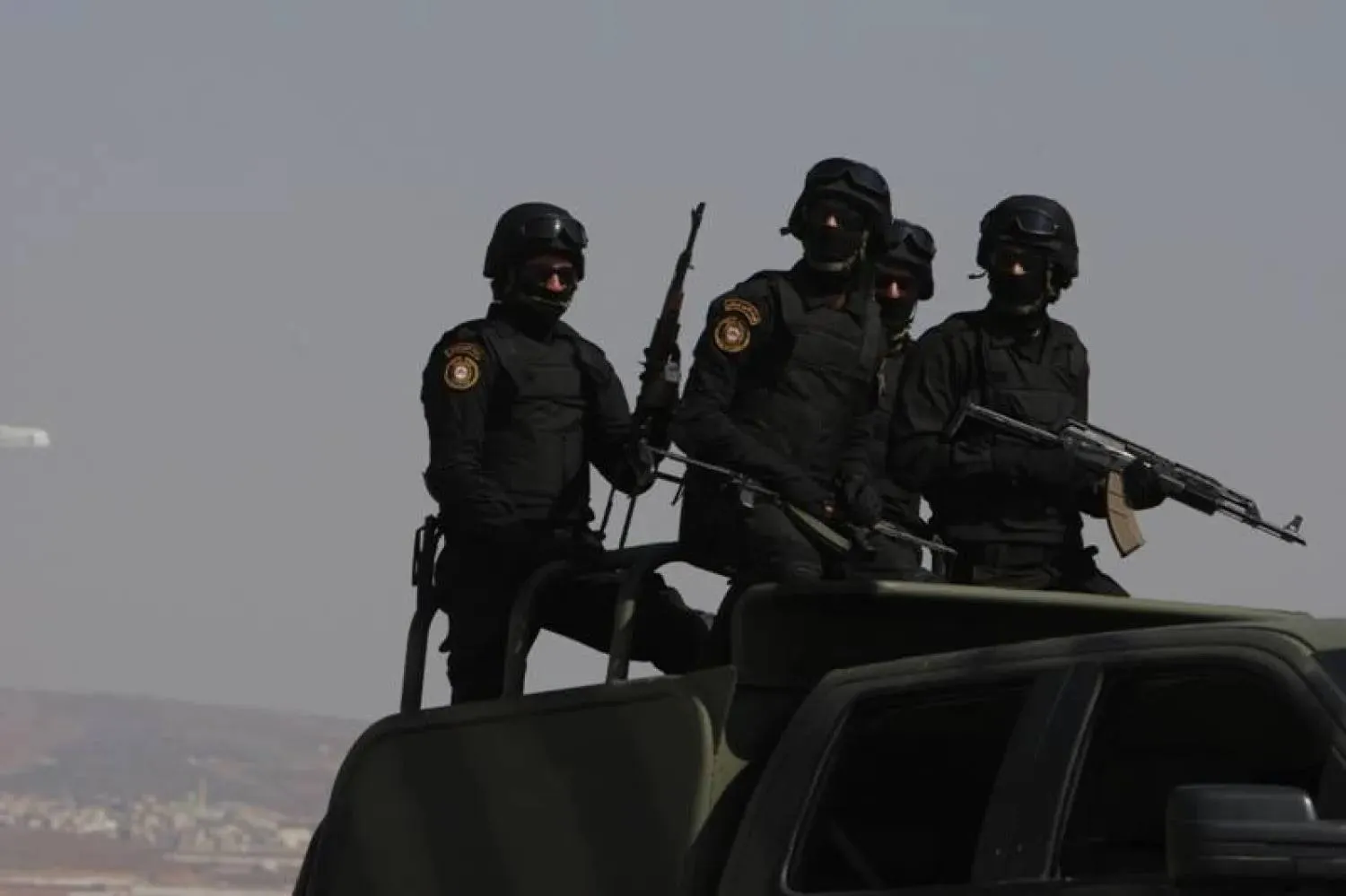

Palestinian security agencies have begun preparing for a possible return to Gaza, as officers undergo targeted training in Egypt and Jordan for what could become a post-war security mission in the territory.
Although these training programs have existed for years, officials say recent sessions are now designed with “the day after” scenario in mind.
The shift follows a UN Security Council resolution supporting a plan proposed by US President Donald Trump that secured a ceasefire last month after two years of fighting between Israel and Hamas.
The plan calls for an international stabilization force responsible for guarding borders with Israel and Egypt and removing weapons from “non-governmental armed groups” in Gaza.
Major General Anwar Rajab, spokesperson for the Palestinian Security Forces, told Asharq Al-Awsat that Palestinian forces are “ready to take control of Gaza immediately,” though political agreement is still pending.
He said only small groups have received mission-specific training so far, but “thousands more will undergo additional training in the coming weeks under the supervision of friendly Arab and European countries.” Still, he cautioned that “nothing is final yet,” and that uncertainty remains over the future of Gaza’s governance.
A European official told Agence France-Presse that the EU plans to train up to 3,000 police officers from Gaza, similar to its long-standing programs in the West Bank. The trainees will be chosen from officers not affiliated with Hamas.
Although around 7,000 police in Gaza remain on the Palestinian Authority payroll, many are retired or unfit for duty; roughly 3,000 could be retrained, with training expected to occur outside Gaza.
Rajab confirmed that while some officers have died, retired, or grown too old to serve, “our forces in Gaza remain operational and ready.” Gaza currently has about 13,000 security personnel, with another 36,000 serving in the West Bank.
The EU, the largest financial supporter of the Palestinian Authority, has funded police training in the West Bank since 2006. EU ministers will discuss the Gaza plan during a meeting in Brussels that coincides with an international donor conference attended by about 60 delegations, excluding Israel.
The UN resolution authorizes a temporary international force to work alongside Israel, Egypt and newly trained Palestinian units to secure border areas. Israeli media report the government is already preparing for the arrival of foreign troops.
Prime Minister Benjamin Netanyahu warned that Hamas would be disarmed “either the easy way, through international forces, or the hard way, by Israel.”
Palestinian officials reject that interpretation. A senior Palestinian Authority source told Asharq Al-Awsat that the international force should “secure borders and protect civilians, while assisting Palestinian forces, without deploying deep inside Gaza or interfering in internal affairs.”
He insisted that Gaza must remain under full Palestinian political and legal authority. He said: “Gaza is part of the Palestinian state, and our responsibility, not anyone else’s.”
He added that Hamas’ weapons should be handed over only to the Palestinian Authority. President Mahmoud Abbas has previously demanded Hamas surrender its arms, but the group has not agreed. Hamas says it might only consider disarmament within a comprehensive deal leading to full Palestinian statehood, complicating the mission for any foreign force.
Arab governments, according to diplomatic sources, do not want their troops drawn into fighting in Gaza or tasked with disarming Palestinian factions, especially a mission that Israel could not accomplish.
Rajab reaffirmed the Palestinian stance of “one state, one law, and one legitimate weapon,” and emphasized that any foreign presence must not replace Palestinian security forces. The only military unwelcome in Gaza, he said, is Israel: “We will not accept a single Israeli soldier there.”
Countries reportedly being considered for participation in the international force include Indonesia, Pakistan and Azerbaijan, though details remain unclear. Jordan has ruled out sending troops but, along with Egypt, has expressed readiness to train Palestinian forces to assume responsibility for internal security, with full Palestinian consent and without foreign control inside Gaza.