


Pope Leo XIV Sends Message of Support to Southern Lebanon as He Ends 1st Foreign Trip

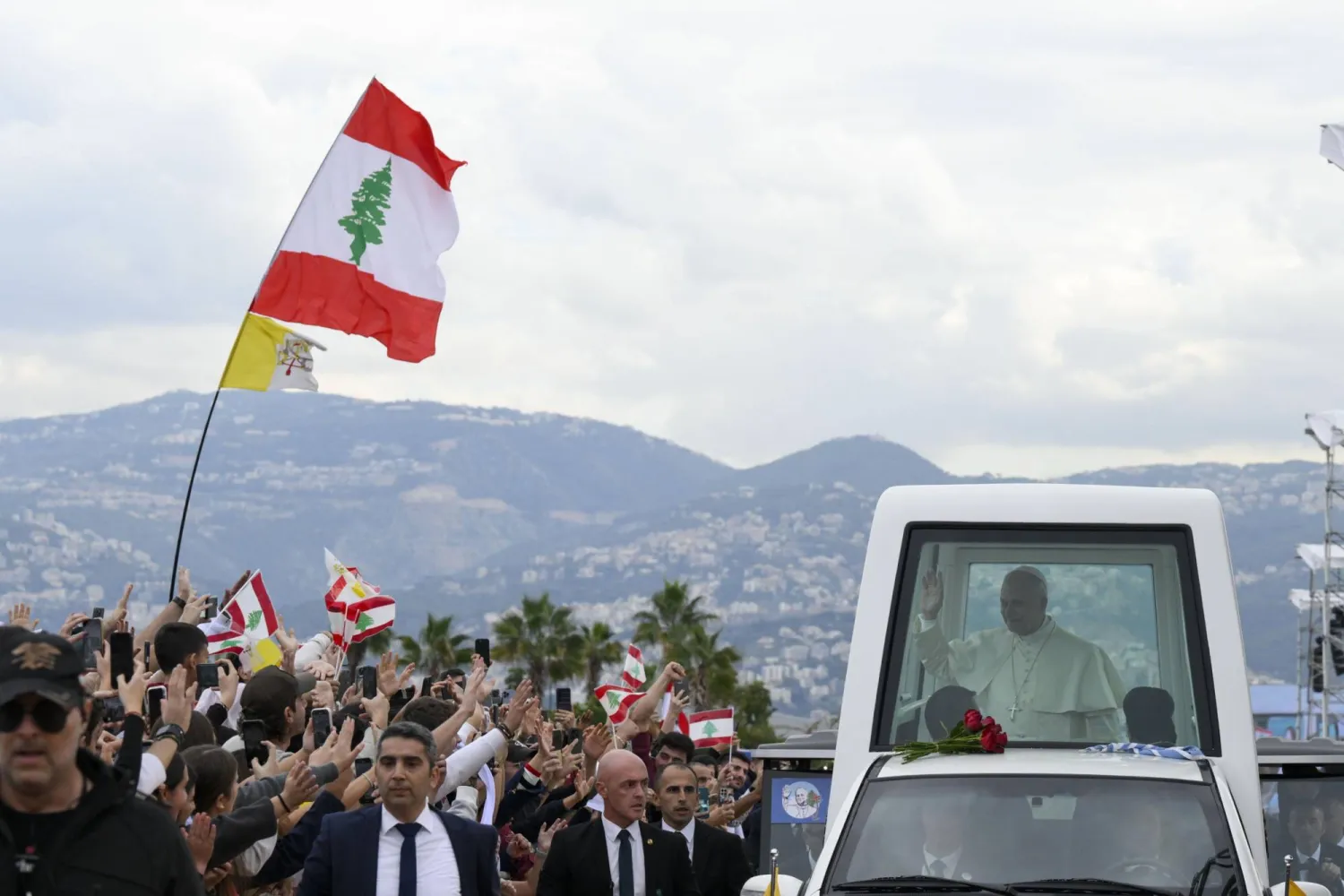
A handout picture provided by the Vatican Media shows Pope Leo XIV greeting the faithful on the day he celebrated a Holy Mass at the Beirut Waterfront, during his apostolic journey, in Beirut, Lebanon, 02 December 2025. EPA/VATICAN
TT

Pope Leo XIV Sends Message of Support to Southern Lebanon as He Ends 1st Foreign Trip

A handout picture provided by the Vatican Media shows Pope Leo XIV greeting the faithful on the day he celebrated a Holy Mass at the Beirut Waterfront, during his apostolic journey, in Beirut, Lebanon, 02 December 2025. EPA/VATICAN

Pope Leo XIV prayed Tuesday at the site of a deadly 2020 Beirut port explosion that has become a symbol of dysfunction and official impunity and called for justice to prevail, as he offered words of consolation to Lebanon’s people — including in the war-battered south — on the final day of his first overseas trip.

Relatives of some of the 218 people killed by the blast held up photos of their loved ones as Leo arrived at the scorched site. They stood side by side as Leo prayed silently first at a monument to the dead, then greeted each one, grasping their hands, The AP news reported.

The emotional encounter took place next to the shell of the last grain silo standing at the site destroyed by the Aug. 4, 2020, blast and the piles of burned cars torched in its wake. The explosion did billions of dollars in damage as hundreds of tons of ammonium nitrate detonated in a port warehouse.

Five years on, the families of those killed are still seeking justice. No official has been convicted in a judicial investigation that has been repeatedly obstructed, angering Lebanese for whom the blast was just the latest evidence of impunity after decades of corruption and financial crimes.

“The visit clearly sends the message that the explosion was a crime," said Cecile Roukoz, whose brother, Joseph Roukoz, was killed and who was on hand to meet the pope. "There should be a message, the country should end impunity and ensure justice is served.”

When he arrived in Lebanon on Sunday, Leo urged the country's political leaders to pursue the truth as a means of peace and reconciliation. In a homily Sunday after praying at the site, Leo referred explicitly to the blast and called for Lebanon to be a place of justice.

Pope calls for justice at Mass An estimated 150,000 worshippers packed the Beirut waterfront for Leo's final Mass, which he celebrated immediately after praying at the nearby blast site.

In his homily, Leo named the many problems the Lebanese people have faced, from economic crises to the blast and renewed fears of war. He said it’s natural to feel “paralyzed by powerlessness in the face of evil and oppressed by so many difficult situations.”

But he urged them not to be resigned, and to find ways to remain hopeful and grateful. He insisted, though, that justice was part of the equation.

“Let us cast off the armor of our ethnic and political divisions, open our religious confessions to mutual encounter and reawaken in our hearts the dream of a united Lebanon,” he said. “A Lebanon where peace and justice reign, where all recognize each other as brothers and sisters.”

“Lebanon, stand up! Be a home of justice and fraternity! Be a prophetic sign of peace for the whole of the Levant!”

An emotional visit to the hospital The American pope opened his final day in Lebanon with an emotional visit to the De La Croix hospital, which specializes in care for people with psychological problems. Awaiting him were some familiar-looking faces: young boys dressed up as Swiss Guards and cardinals, and even one dressed as the pope himself in all white.

The mother superior of the congregation that runs the hospital, Mother Marie Makhlouf, was overcome as she welcomed the pope, telling him that her hospital cares for the “forgotten souls, burdened by their loneliness.”

Leo said the facility stands as a reminder to all of humanity. “We cannot forget those who are most fragile. We cannot conceive of a society that races ahead at full speed clinging to the false myths of well-being, while at the same time ignoring so many situations of poverty and vulnerability,” he said.

“For Lebanon, (the visit) means a lot," said pilgrim Maggie Claudine, who was waiting for Leo at the hospital. "We hope that peace will prevail, and that is what we wish for. We want to live in comfort.”

Families of blast dead seek justice Leo has sought to bring a message of peace to Lebanon as it copes with the economic crises, the aftermath of last year's devastating war between Hezbollah and Israel and the fallout from the port blast.

Among those on hand to welcome Leo at the blast site was Lebanon Social Affairs Minister Haneen Sayed, whose mother was killed. Another was Mireille Khoury, whose 15-year-old son, Elias, was killed.

When Leo approached her, Khoury pointed to the building where they lived across the port, where Elias died as he was hanging out in his room.

Khoury said Lebanon cannot heal from its wounds without justice and accountability. She has been among the relatives who have called for finalizing the stalled investigation that implicated a long list of political, security and judicial officials. The probe has been obstructed by officials who have largely refused to cooperate.

“Justice is the basis of building any country,” she told The AP in an interview before the pope arrived in Lebanon. “Our children were killed in their homes. They were killed because someone kept (ammonium) nitrate in the main port of the city near a residential area.”

Khoury said the pope’s prayer and support would bring some relief, but said she would not give up on her pursuit for justice.

“I will not say that this anger will fully just disappear,” Khoury said. “But I think it will give some sort of relaxation of this anger that is in my heart until justice is served.”

The fate of the port’s massive grain silos, which absorbed much of the shock of the explosion, has also been a matter of debate.

The Lebanese government at one point planned to demolish the damaged silos but decided against it after families of the blast’s victims and survivors, who want them preserved, protested.

The port, meanwhile, is largely functional again but still hasn't been fully rebuilt.

Calls for peace in the south Pope Leo XIV referenced the ongoing conflict in southern Lebanon in his farewell speech at the Beirut airport and sent a message of support to people of the south.

Christians in the south had been disappointed that his trip did not include a visit to their areas, which were battered by last year’s war between Israel and Hezbollah and are still the target of regular airstrikes that Israel says aim to stop Hezbollah from rebuilding.

“I greet all the regions of Lebanon that I was unable to visit: Tripoli and the north, the Beqaa and the south of the country, which is currently experiencing a state of conflict and uncertainty,” Leo said. He also referred to the cities of Sidon and Tyre, which are mentioned in the New Testament, as “biblical places.”

“May the attacks and hostilities cease,” he said. “We must recognize that armed struggle brings no benefit. While weapons are lethal, negotiation, mediation and dialogue are constructive.”

Soon after the pope’s plane departed, an Israeli drone appeared in the sky over Beirut.

Lebanese President Joseph Aoun urged Leo to keep Lebanon in his prayers.

The Lebanese are “a faithful people who deserve life,” he said. “As we bid you farewell, we do not only part with an honored guest, but with a father who brought us comfort, and reminded us that the world has not forgotten Lebanon.”



UN Condemns Israel's Moves against Agency for Palestinian Refugees

UNRWA center targeted by Israeli shelling in northern Gaza (DPA)
TT

UN Condemns Israel's Moves against Agency for Palestinian Refugees

UNRWA center targeted by Israeli shelling in northern Gaza (DPA)

The United Nations warned Tuesday that recent actions by Israel against the UN agency for Palestinian refugees risked depriving millions of people of basic services such as education and healthcare.

Israel's parliament passed new legislation on Monday formally stripping the United Nations Relief and Works Agency (UNRWA) of diplomatic immunity, and barring Israeli companies from providing water or electricity to the agency's institutions, AFP reported.

According to UNRWA, the legislation also grants the Israeli government the authority to expropriate the agency's properties in East Jerusalem, including its headquarters and main vocational training center.

UNRWA chief Philippe Lazzarini condemned the legislation as "outrageous", decrying it on social media as "part of an ongoing, systematic campaign to discredit UNRWA and thereby obstruct the core role that the agency plays providing human-development assistance and services to Palestine refugees".

Filippo Grandi, the outgoing head of the UN refugee agency, UNHCR, and a former UNRWA chief, also criticised the move as "very unfortunate".

In an interview with AFP, he highlighted that UNRWA, unlike other UN agencies, provides basic public services such as education and healthcare to the millions of registered Palestinian refugees it serves across Gaza and the West Bank, as well as in Lebanon, Jordan and Syria.

"If you deprive those people of those services... then you had better find a substitute," he said, warning: "I think it would be very difficult."

"At the moment, there is a great risk that millions of people will be deprived of basic services if UNRWA is further deprived of space to work, and resources to work."

Israel has been ratcheting up pressure on UNRWA over the past two years.

It has accused the agency of providing cover for Hamas militants, claiming that some UNRWA employees took part in the militant group's October 7, 2023 assault on Israel, which sparked the war in Gaza.

A series of UN-linked internal and external investigations found some "neutrality-related issues" at UNRWA, but stressed Israel had not provided conclusive evidence for its headline allegation.

Grandi criticised the torrent of accusations that have swirled around the agency.

"UNRWA is a very indispensable organization in the Middle East," he said.

"Contrary to much of the frankly baseless rhetoric that we have heard in the past couple of years, UNRWA is a force for peace and stability," he added.

"In a region in which you need every bit of stability and efforts towards peace, it would be really irresponsible to let such an important organization decline further."


Syria Imposes Night Curfew on Port City of Latakia

People watch as Syrian Security forces are deployed after clashes erupted during a protest in the city of Latakia, Syria, 28 December 2025. EPA/AHMAD FALLAHA
TT

Syria Imposes Night Curfew on Port City of Latakia

People watch as Syrian Security forces are deployed after clashes erupted during a protest in the city of Latakia, Syria, 28 December 2025. EPA/AHMAD FALLAHA

Syrian authorities imposed an overnight curfew in the coastal city of Latakia on Tuesday.

Authorities announced a "curfew in Latakia city, effective from 5:00pm (1400 GMT) on Tuesday, December 30, 2025, until 6:00am (0300 GMT) on Wednesday, December 31, 2025".


Jailed Turkish Kurd Leader Calls on Government to Broker Deal for Syrian Kurds

(FILES) Supporters display a poster depicting jailed leader of the Kurdistan Workers' Party (PKK) Abdullah Ocalan, after he called on the Kurdistan Workers' Party (PKK) to disarm and dissolve itself in Diyarbakir, southeastern Türkiye, on February 27, 2025. (Photo by Yasin AKGUL / AFP)
TT

Jailed Turkish Kurd Leader Calls on Government to Broker Deal for Syrian Kurds

(FILES) Supporters display a poster depicting jailed leader of the Kurdistan Workers' Party (PKK) Abdullah Ocalan, after he called on the Kurdistan Workers' Party (PKK) to disarm and dissolve itself in Diyarbakir, southeastern Türkiye, on February 27, 2025. (Photo by Yasin AKGUL / AFP)

Jailed Turkish Kurd leader Abdullah Ocalan said Tuesday that it was "crucial" for Türkiye’s government to broker a peace deal between the Kurdish-led Syrian Democratic Forces (SDF) and the Damascus government.

Clashes between Syrian forces and the SDF have cast doubt over a deal to integrate the group's fighters into the army, which was due to take effect by the end of the year, reported AFP.

Ocalan, founder of the Kurdistan Workers' Party (PKK) group, called on Türkiye to help ensure implementation of the deal announced in March between the SDF and the Syrian government.

"It is essential for Türkiye to play a role of facilitator, constructively and aimed at dialogue," he said in a message released by Türkiye's pro-Kurdish DEM party.

"This is crucial for both regional peace and to strengthen its own internal peace," Ocalan, who has been jailed for 26 years, added.

"The fundamental demand made in the agreement signed on March 10 between the SDF and the government in Damascus is for a democratic political model permitting (Syria's) peoples to govern together," he added.

"This approach also includes the principle of democratic integration, negotiable with the central authorities. The implementation of the March 10 agreement will facilitate and accelerate that process."

The backbone of the US-backed SDF is the YPG, a Kurdish group seen by Türkiye as an extension of the PKK.

Türkiye and Syria both face long-running unrest in their Kurdish-majority regions, which span their shared border.

In Türkiye, the PKK agreed this year at Ocalan's urging to end its four-decade armed struggle.

In Syria, Sharaa has agreed to merge the Kurds' semi-autonomous administration into the central government, but deadly clashes and a series of differences have held up implementation of the deal.

The SDF is calling for a decentralized government, which Sharaa rejects.

Turkish Foreign Minister Hakan Fidan, whose country sees Kurdish fighters across the border as a threat, urged the SDF last week not to be an "obstacle" to stability.

Syrian Kurdish leader Mazloum Abdi said Thursday that "all efforts" were being made to prevent the collapse of talks.