


Al-Alimi Calls for Containing Escalation in Eastern Yemen, Praises Saudi Role

 
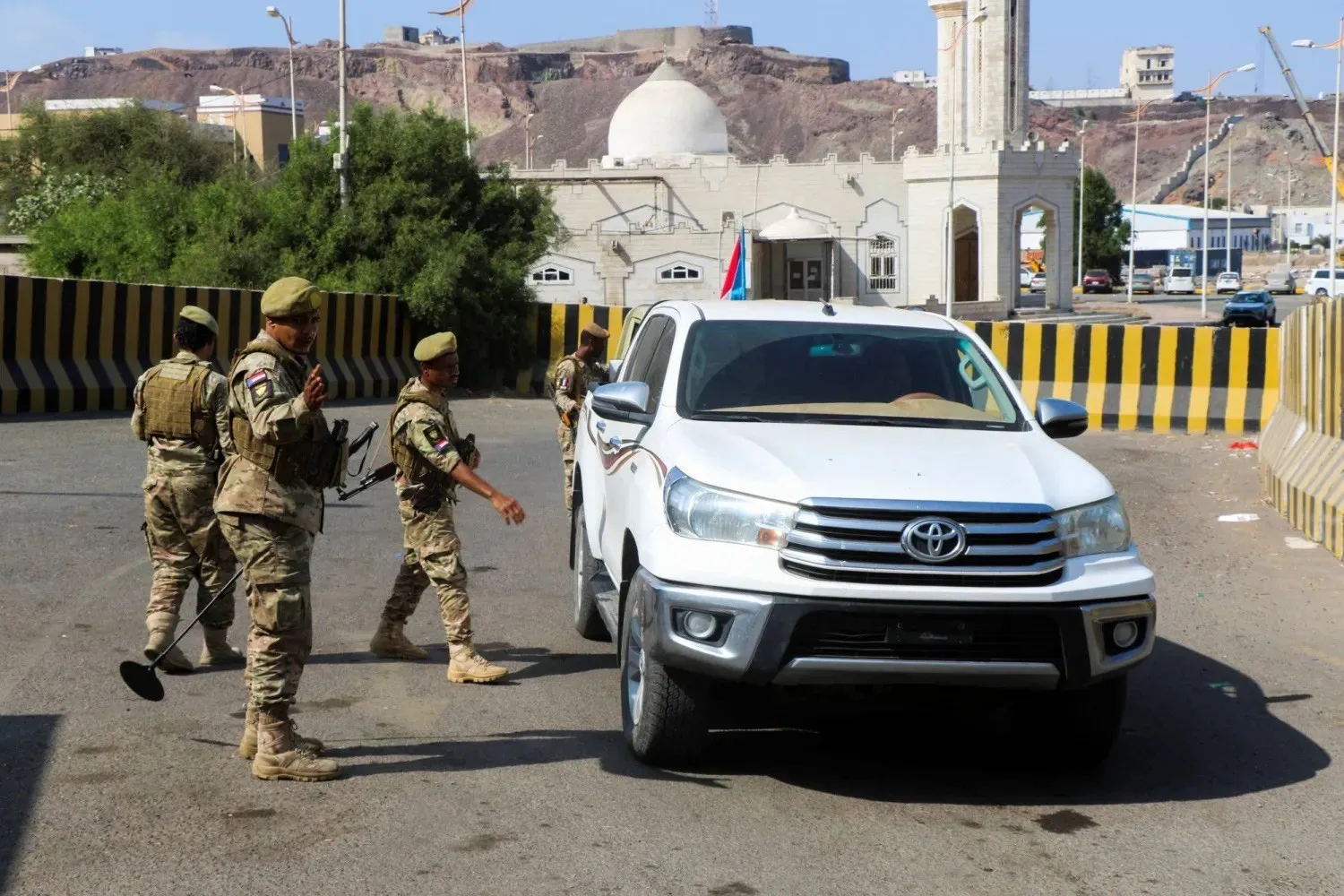
Caption: Soldiers loyal to Yemen’s Southern Transitional Council inspect a truck outside the presidential palace complex in Aden (Reuters)
  Caption: Soldiers loyal to Yemen’s Southern Transitional Council inspect a truck outside the presidential palace complex in Aden (Reuters)
TT

Al-Alimi Calls for Containing Escalation in Eastern Yemen, Praises Saudi Role

 
Caption: Soldiers loyal to Yemen’s Southern Transitional Council inspect a truck outside the presidential palace complex in Aden (Reuters)
  Caption: Soldiers loyal to Yemen’s Southern Transitional Council inspect a truck outside the presidential palace complex in Aden (Reuters)

Yemen’s Presidential Leadership Council Chairman Rashad al-Alimi on Thursday urged political, tribal and social forces in the eastern provinces of Hadramawt and Al-Mahra to close ranks behind state efforts and local authorities to contain the fallout from the recent security and military escalation.

While praising Saudi Arabia’s role in easing tensions, al-Alimi warned of the repercussions of continued unrest on Yemen’s economic and living conditions, noting early warning signs, including the International Monetary Fund’s announcement that it has suspended key activities in the country due to the deteriorating security environment.

A source in the presidential office said al-Alimi, during two phone calls with Hadramawt Governor Salem al-Khanbashi and Al-Mahra Governor Mohammed Ali Yasser, stressed the need for all forces brought in from outside the two provinces to withdraw, and for local authorities to be fully empowered to carry out their security and service responsibilities in line with the constitution and the law.

He also reiterated earlier directives to conduct a comprehensive investigation into all human rights violations linked to what he described as the Southern Transitional Council’s “unilateral measures,” including arbitrary arrests, enforced disappearances, and attacks on public and private property, emphasizing accountability and an end to impunity.

Al-Alimi cautioned against any further escalation that could lead to more bloodshed and deepen the economic and humanitarian crisis, stressing that the national priority must remain confronting the Iran-backed Houthi militia, which he described as the greatest threat to security and stability.

He commended Saudi efforts to de-escalate tensions and support stability in Hadramawt and Al-Mahra, affirming the state’s full backing for these initiatives and its commitment to strengthening the role of local authorities in safeguarding social peace and citizens’ interests.

According to the presidential source, al-Alimi underscored the need to restore conditions in the two provinces to their pre-escalation state, respect the frameworks governing the transitional period, and enable the government and local authorities to fulfill their constitutional duties.

He warned that the severe living conditions facing Yemenis “cannot withstand the opening of additional internal fronts,” calling on all parties to prioritize the public interest and preserve national gains, ensuring focus remains on the main battle against the Houthis and allied terrorist groups.

The appeal comes amid broader rejection of unilateral actions in the east. Parliament issued a statement condemning any military moves outside national consensus, describing recent developments as a “clear violation of constitutional legitimacy” and the powers of the Presidential Leadership Council.

Lt. Gen. Mohammed al-Qahtani, who headed a Saudi delegation that visited Hadramawt, stressed that Riyadh rejects “any attempts to impose a fait accompli by force” in the two provinces and supports restoring conditions to what they were prior to the escalation.

Al-Qahtani said Saudi Arabia, as leader of the Coalition to Support Legitimacy in Yemen, is working to resolve the crisis through a series of measures agreed upon with all parties, including the Southern Transitional Council.



Series of Israeli Strikes Hit Lebanon

A convoy of Lebanese army vehicles drives near the border with Israel in the village of Alma al-Shaab during a Lebanese army media tour in south Lebanon, Friday, Nov. 28, 2025. (AP Photo/Bilal Hussein)
TT

Series of Israeli Strikes Hit Lebanon

A convoy of Lebanese army vehicles drives near the border with Israel in the village of Alma al-Shaab during a Lebanese army media tour in south Lebanon, Friday, Nov. 28, 2025. (AP Photo/Bilal Hussein)

A series of Israeli strikes hit south and east Lebanon on Friday, state media reported, as Israel's army said it was targeting Hezbollah sites, the latest such raids despite a year-old ceasefire.

Lebanon's state-run National News Agency (NNA) reported strikes in around a dozen locations, including up to around 30 kilometers (20 miles) from the Israeli border, citing at times "heavy raids".

Israel has kept up strikes on Lebanon despite a November 2024 ceasefire that was supposed to end more than a year of hostilities with the Iran-backed militant group Hezbollah, and has also kept troops in five areas it deems strategic, reported AFP.

The Israeli military said in a statement that its forces "struck a training and qualification compound" used by Hezbollah's elite Radwan Force where operatives "underwent shooting exercises and additional training on the use of various types of weapons".

The army also "struck additional Hezbollah military infrastructure in several areas in southern Lebanon", it said.

According to the ceasefire, Hezbollah was required to pull its forces north of the Litani River, some 30 kilometers from the border with Israel, and have its military infrastructure there dismantled.

Under a government-approved plan, Lebanon's army is to dismantle Hezbollah's military infrastructure south of the Litani by the end of the year, before tackling the rest of the country.

The sites struck on Friday were generally north of the river.

Earlier this week, Israel launched a series of strikes on southern Lebanon, also saying it hit a Hezbollah training center and other targets.


Lavrov Offers Russian Mediation on Political Settlement in Sudan

An orphaned Sudanese child eats at a refugee camp in eastern Chad, November 22, 2025 (Reuters).
TT

Lavrov Offers Russian Mediation on Political Settlement in Sudan

An orphaned Sudanese child eats at a refugee camp in eastern Chad, November 22, 2025 (Reuters).

Russian Foreign Minister Sergei Lavrov has renewed Moscow’s offer to mediate efforts aimed at launching a political process to end the ongoing conflict in Sudan.

Lavrov said Russia is prepared, with the consent of the Sudanese government, to “facilitate the search for practical solutions,” calling on all parties to refrain from public condemnations and instead focus on advancing political dialogue.

He made the remarks during a meeting with a group of ambassadors convened to outline Russia’s positions on efforts to resolve the war in Ukraine, while also addressing a number of regional crises, including the situation in Sudan.

Lavrov stressed that Moscow is “ready to continue assisting in identifying practical steps to resolve Sudan’s internal crisis.”

Responding to a question on Sudan, he said Russia has consistently urged dialogue and negotiations between the warring parties, noting that several proposals had previously been put forward by countries seeking to help end the conflict.

Addressing the Sudanese representative attending the meeting, Lavrov said proposals had been presented to the Sudanese government to engage in dialogue with what it described as external actors. “Unfortunately, this effort did not succeed, as no genuine dialogue took place,” he said.

Despite this, Lavrov said specific proposals had been conveyed, adding that the priority now should be to move away from continued public blame and toward practical solutions.

“Russia is ready to facilitate this search for solutions and has the necessary capabilities,” he said, adding: “If your government agrees, we will seek to make use of this opportunity.”

Lavrov also urged Sudanese authorities to call on the Ukrainian government to halt the deployment of mercenaries to African countries. Moscow and Kyiv have repeatedly exchanged accusations over sending mercenaries to parts of Africa, while Western sources have alleged that Russia has provided weapons and expertise to Sudan’s Rapid Support Forces (RSF).

Russia has reiterated its offer of mediation on several occasions this year. In February, during talks with his Sudanese counterpart, Lavrov said Moscow was ready to cooperate with other external actors to help normalize the situation in Sudan, stressing that the resumption of bilateral cooperation depends entirely on security conditions.

The issue was also discussed on the sidelines of the Antalya Diplomacy Forum in mid-April, where Russia’s Foreign Ministry said both sides underscored the need for an immediate halt to the fighting between the Sudanese army and the RSF, and called for an inclusive national dialogue aimed at achieving lasting peace.

Separately, Russia’s embassy in Sudan said no Russian nationals were among the crew of a military Ilyushin Il-76 transport aircraft that crashed earlier this week near Port Sudan, killing all those on board.


UN Appeals for $2.5 Billion to Confront Humanitarian Crisis in Yemen

Displaced children gather in a camp in Sanaa. EPA
TT

UN Appeals for $2.5 Billion to Confront Humanitarian Crisis in Yemen

Displaced children gather in a camp in Sanaa. EPA

The United Nations has warned of an unprecedented rise in humanitarian needs in Yemen during the coming year, saying the country is heading towards one of the worst humanitarian crises in the world unless urgent funding for a response plan is provided.

Latest data showed that in 2026, 23.1 million people, nearly 65.4 percent of the population, will need lifesaving humanitarian assistance and protection services to meet their basic needs and safeguard their well-being.

So, the UN launched an urgent appeal to fund the 2026 Yemen Humanitarian Response Plan, requesting the international community to raise $2.5 billion to confront the humanitarian crisis that is escalating in complexity and severity.

The plan aims to provide support to more than 10.5 million people in desperate need, with a special focus on life-saving interventions and combating hunger and malnutrition in the most deprived areas.

Yet the plan did not clarify how programs will be implemented in areas under Houthi control, which are witnessing increasing restrictions after the group closed offices belonging to the United Nations and international organizations since last September, and arrested dozens of their staff, including 59 UN employees.

The UN said that a convergence of conflict, economic decline, and climate shocks, compounded by shrinking operational space in parts of the country and funding shortfalls, continues to exacerbate humanitarian needs.

Already, 18.1 million people face acute food insecurity, while 2.5 million children under five risk acute malnutrition, and 1.3 million pregnant and breastfeeding women are suffering from severe acute malnutrition.

Amid the massive collapse of basic systems, 8.41 million people lack access to healthcare, while 15 million suffer from water insecurity. With 17.4 million lacking adequate sanitation and hygiene, preventable waterborne diseases will surge, the UN warned.

Protection risks are escalating as resilience collapses, it said. Over 16 million people require protection assistance, of which 4.7 million are internally displaced.

Meanwhile, 6.2 million people need GBV services as women and girls, especially among displaced and marginalized communities, face escalating risks of gender-based violence.

About 2.6 million children remain out of class, while teachers continue to work without pay, while floods, weather events and droughts affected 1.5 million people in 2025.

The UN on Tuesday condemned a referral by the Houthis of some of the dozens of UN staff they have detained to a special criminal court.

UN Secretary-General Antonio Guterres said the Houthis have arbitrarily detained 59 Yemeni UN personnel, who have been held “incommunicado - some for years - without any due process, in violation of international law,” according to his spokesperson Stephane Dujarric.

“We call on the de facto authorities to rescind the referral and work in good faith toward the immediate release of all detained personnel,” Dujarric said.

“The United Nations remains committed to supporting the people of Yemen and delivering principled humanitarian assistance,” he added.