


Lebanese PM to Asharq Al-Awsat: 2nd Phase of Disarmament to Begin Soon Covering Regions between Litani, Awali

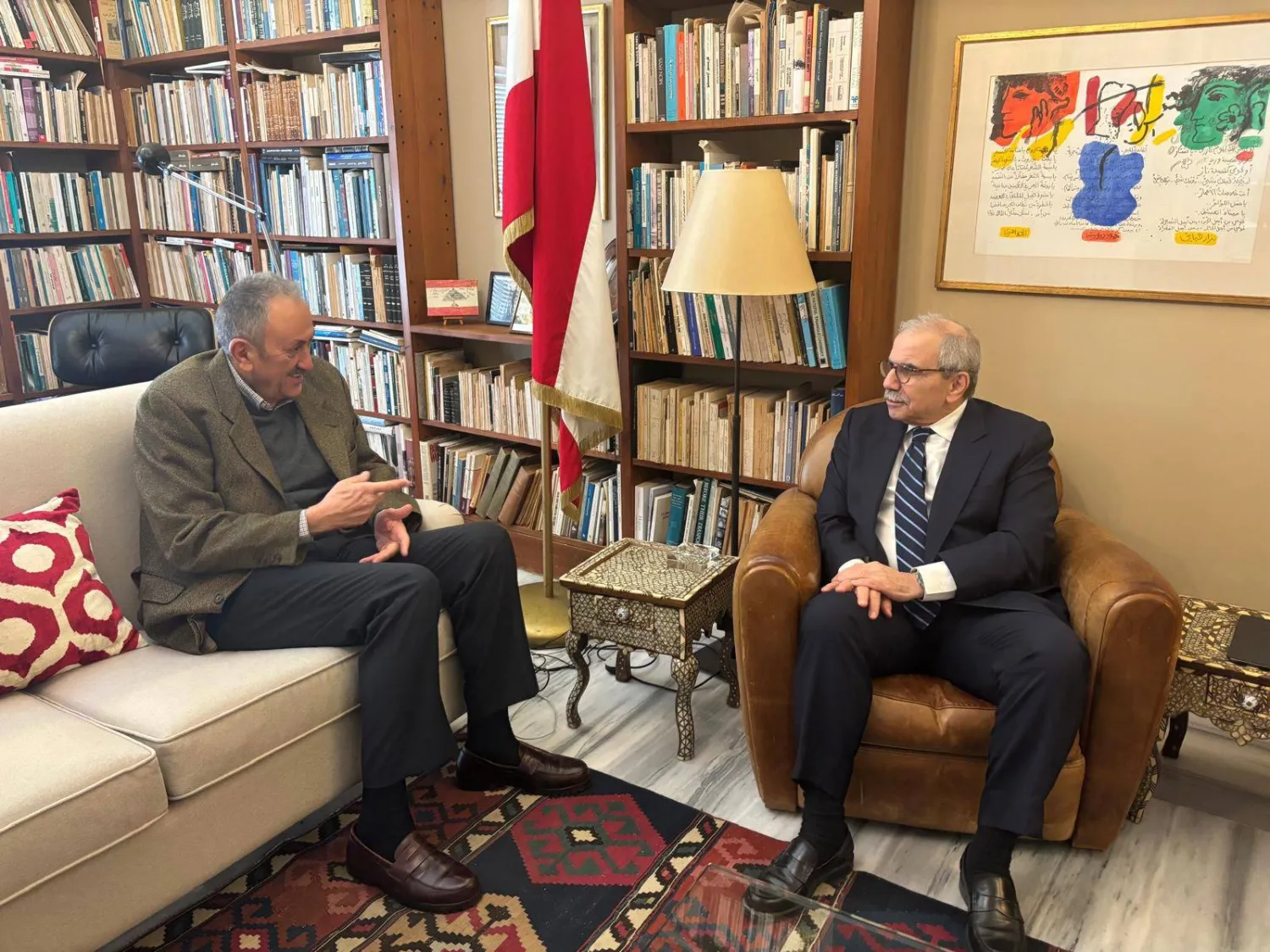
Prime Minister Nawaf Salam and ambassador Simon Karam meet on Saturday. (PM's office)
TT

Lebanese PM to Asharq Al-Awsat: 2nd Phase of Disarmament to Begin Soon Covering Regions between Litani, Awali

Prime Minister Nawaf Salam and ambassador Simon Karam meet on Saturday. (PM's office)

Lebanon would have completed the first phase of the army’s plan to impose state monopoly over arms, or the disarmament of Hezbollah, by the end of the year.

Prime Minister Nawaf Salam’s office confirmed on Saturday that the first phase was close to completion.

“The first phase of the weapons consolidation plan related to the area south of the Litani River is only days away from completion,” it said.

“The state is ready to move on to the second ‌phase - namely (confiscating weapons) north of the ‍Litani River - based on the ‍plan prepared by the Lebanese army pursuant to ‍a mandate from the government,” Salam added.

The cabinet will meet at the beginning of the new year after the first phase is completed.

Salam, meanwhile, told Asharq Al-Awsat that the second phase of the disarmament will cover the areas between the Litani and Awali Rivers to its north.

The third phase will cover Beirut and Mount Lebanon and the fourth covers the Bekaa followed by remaining regions.

Lebanese sources said the army has completed most of its report on its disarmament efforts south of the Litani. It has completed the confiscation and destruction of thousands of tons of ammunition and military gear. It has discovered around a hundred military tunnels in the region.

As it stands, the army is unlikely to ask for an extension of the deadline to complete the first phase by the end of the year. It may ask for a “technical” extension for a few weeks if necessary.

Salam refused to go into the details of the government’s next step after it receives the army’s detailed report on the disarmament south of the Litani.

“The military has succeeded in imposing complete state authority over the regions from south of the Litani to the southern border, except for the areas occupied by Israel and from where it should withdraw without delay,” the PM told Asharq Al-Awsat.

He confirmed that the government will convene at the beginning of the year to assess the first phase of the disarmament, stressing that Israel must take reciprocal steps, such as ceasing its violations of the ceasefire.

This will not prevent Lebanon from moving on to the second phase of implementing state monopoly over arms, he revealed.

Progress hinges of Hezbollah’s cooperation with Lebanon’s efforts to limit possession of weapons to the state and move towards activating state institutions in the South and kick off the reconstruction process with the help of Lebanon’s friends, he added.

“Imposing state monopoly over weapons is a Lebanese need before it is an international one,” he declared.

Everyone should be concerned with facilitating the process to end the cycle of violence, he urged.

Salam met on Saturday with Simon Karam, Lebanon's top civilian negotiator on the Mechanism committee overseeing the Hezbollah-Israel truce.

Karam briefed Salam on the latest meeting of the Mechanism.

Hezbollah continues to resist calls to disarm, saying the ceasefire with Israel does not cover areas north of the Litani. Party officials continue to tie disarmament to Israel’s withdrawal from regions it occupies in the South.



Armed Groups Opposed to Hamas in Gaza Seen with New Weapons

Armed Hamas members are seen in Gaza. (Reuters file)
TT

Armed Groups Opposed to Hamas in Gaza Seen with New Weapons

Armed Hamas members are seen in Gaza. (Reuters file)

Images circulated on social media of armed groups opposed to Hamas in Gaza brandishing new weapons.

The factions have been presenting themselves as replacements to Hamas in ruling the enclave and have been developing new means to oust the movement.

The factions are active in areas in Gaza that are controlled by Israel and have acknowledged working with Israel.

Debate on social media revolved around whether the groups had acquired the new weapons from Israel or if they were seized by Israeli forces from Hamas and handed over to them. Speculation also centered on whether the groups had seized the weapons from Hamas tunnels.

One video on social media showed Ghassan al-Dahini, who took over the Popular Forces after the killing of Yasser Abu Shabab weeks ago, as he brandished a Tandem modern RPG that Hamas had often used in recent years and during the Gaza war.

Dahini was seen with several other gunmen as he inspected a box of new weapons.

Dahini’s group is deployed mainly in Rafah in southern Gaza.

Another video showed members of the so-called “Popular Army”, led by Ashraf al-Mansi, brandishing RPGs. The Popular Army is deployed in Jabaliya and Beit Lahia in northern Gaza.

None of the groups opposed to Hamas have denied that they receive support from Israel. Prime Minister Benjamin Netanyahu acknowledged in June that his government was backing these factions.

Shawqi Abu Nasira, a former Palestinian security officer and now leader of one of these factions deployed east of Khan Younis, recently told Israeli television that Tel Aviv had supplied his group and others with weapons, funds and food.

He said “great security coordination” was underway between them.


Two Warnings, Arab and Western, ‘Tip the Balance’ in Iraq

Members of the Popular Mobilization Forces during the funeral of comrades killed in a US strike (AFP). 
TT

Two Warnings, Arab and Western, ‘Tip the Balance’ in Iraq

Members of the Popular Mobilization Forces during the funeral of comrades killed in a US strike (AFP). 

In an unusual development, informed sources told Asharq Al-Awsat that the Iraqi government and influential political actors received two extraordinary warning messages over the past two weeks — one from an Arab country and another from a Western intelligence service — containing what were described as “serious” indications of impending, wide-ranging military strikes inside Iraq.

An Iraqi official confirmed that a “friendly state” had briefed Baghdad on the substance of the threat, prompting Shiite factions to move swiftly toward concessions.

According to the sources, potential targets could have included government institutions linked to Shiite factions and the Popular Mobilization Forces (PMF), powerful financial and military figures, sites and depots for drones and missiles, and training camps.

The two warnings are widely believed to have accelerated a recent wave of political statements by factions calling to “confine weapons to the state,” while simultaneously requesting time and freedom of action, within what they termed a “national framework”, to dismantle their military capabilities. This position remains a point of contention among leaders of the Coordination Framework.

A Message from a “Friendly State”

The threat level first rose with a message from an Arab country that maintains good relations with both Washington and Tehran. The message warned that Baghdad was perilously close to a swift military strike, likened to the targeting of Hamas’ political office in Doha in September 2025.

The message, delivered to Iraqi officials and politicians, stressed that the threat was “extremely serious” and that Israelis were now speaking openly of having received a green light from the United States to act unilaterally in the Iraqi theater.

Iraq has been among the arenas Israel has contemplated striking since the Oct. 7, 2023 attacks. Iraqi politicians told Asharq Al-Awsat in recent months that Washington had restrained Israel from operating in Iraq, while pressing Baghdad to remove the risks posed by weapons outside state control.

A Western diplomat said US officials felt Iraqi leaders did not fully grasp the gravity of the situation and had grown frustrated with what they saw as a weak response.

An Iraqi government official acknowledged receiving multiple warnings about armed groups from friendly states and Western embassies in Baghdad.

“A Massive File”

Days after the Arab message, Iraqi officials received what sources described as a “massive file” from a Western intelligence service. The file included Israeli-prepared lists packed with detailed information on Iraqi armed factions.

The breadth, precision, and depth of the intelligence stunned Iraqi officials. One told Asharq Al-Awsat that the timing of revealing the extent of Israel’s knowledge was critical. The lists reportedly detailed faction leaders, covert operatives within their inner circles, financiers and business figures tied to the groups, and government institutions serving as fronts for factional influence.

The Western service warned that Israel was on the verge of a broad operation now that the factions’ operational and financial capabilities and the deep networks underpinning their military structures had been exposed. After reviewing parts of the file, Shiite politicians reportedly recalled the pager explosions in Lebanon as a cautionary precedent.

“What Now?”

A senior Shiite leader within the Coordination Framework revealed that the two messages “changed the equation,” pushing party leaders to accelerate steps related to factional arms. Many are now grappling with a single question: what to do next? Disagreements persist over the method and the trusted authority to oversee a transitional phase of weapons consolidation.

The leader noted the first phase would involve handing over ballistic missiles and drones and dismantling and surrendering strategic camps north and south of Baghdad. A second phase, he claimed, would include removing faction-affiliated officials from the PMF, pending the US response.

An official in the State of Law Coalition said an agreement to remove heavy weapons had already existed within the Coordination Framework, even before US pressure intensified. Current disputes center on which state body would take custody of the weapons, amid US distrust of security institutions seen as influenced by factions.

Complicating matters, factions fear implementing disarmament amid fraught negotiations to form a new government. Caretaker Prime Minister Mohammad Shia al-Sudani is seeking a second term after winning the largest bloc within the Coordination Framework, a bid opposed by his rival Nouri al-Maliki, who favors a compromise candidate.

US Pressure

The Western intelligence message coincided with the arrival in Iraq of Senior Defense Official Colonel Stephanie Bagley. US defense funding will hinge on three conditions set out in the 2025 National Defense Authorization Act, passed on Dec. 11, 2025.

The law conditions assistance on Iraq’s ability to publicly and verifiably reduce the operational capacity of Iran-aligned armed groups not integrated into the security forces through disarmament, demobilization, and reintegration. It also requires strengthening the Iraqi prime minister’s authority as commander-in-chief and investigating and prosecuting militia members or security personnel operating outside the official chain of command if involved in attacks or destabilizing acts.

Western diplomatic sources said Bagley is expected to seek a clear, enforceable timeline from Iraqi officials. She met twice in one week with Army Chief of Staff Lt. Gen. Abdul Amir Yarallah in October 2025.

A former Iraqi official noted that Washington has repeatedly pressed Baghdad for a timeline to dismantle militia influence, especially ahead of 2026, when the US-led coalition is set to complete its mission. A US State Department spokesperson reaffirmed that Washington will continue to press for the disarmament of Iran-backed militias that undermine Iraq’s sovereignty and threaten Iraqis and Americans alike.


US, Qatar, Egypt, Türkiye, Urge Restraint in Gaza

Members of the Palestinian Civil Defense remove the rubble of a destroyed home as they search for the bodies of Palestinians killed during the conflict in Khan Younis, southern Gaza Strip, 20 December 2025. (EPA)
TT

US, Qatar, Egypt, Türkiye, Urge Restraint in Gaza

Members of the Palestinian Civil Defense remove the rubble of a destroyed home as they search for the bodies of Palestinians killed during the conflict in Khan Younis, southern Gaza Strip, 20 December 2025. (EPA)

The United States was joined Saturday by Qatar, Egypt and Türkiye in urging parties in the Gaza ceasefire to uphold their obligations and exercise restraint, the chief US envoy said after talks in Miami.

Top officials from each nation met with Steve Witkoff, President Donald Trump's special envoy, to review the first stage of the ceasefire that came into effect on October 10.

"We reaffirm our full commitment to the entirety of the President’s 20-point peace plan and call on all parties to uphold their obligations, exercise restraint, and cooperate with monitoring arrangements," said a statement posted by Witkoff on X.

Their meeting came amid continuing strains on the agreement.

Gaza's civil defense said six people were killed Friday in Israeli shelling of a shelter. That brought to 400 the number of Palestinians killed by Israeli fire since the deal took effect.

Israel has also repeatedly accused Hamas of violating the truce, with the military reporting of its three soldiers killed in the territory since October.

Saturday's statement cited progress yielded in the first stage of the peace agreement, including expanded humanitarian assistance, return of hostage bodies, partial force withdrawals and a reduction in hostilities.

It called for "the near-term establishment and operationalization" of a transitional administration which is due to happen in the second phase of the agreement, and said consultations would continue in the coming weeks over its implementation.

Under the deal's terms, Israel is supposed to withdraw from its positions in Gaza, an interim authority is to govern the Palestinian territory instead of Hamas, and an international stabilization force is to be deployed.

On Friday, US Secretary of State Marco Rubio expressed hope that countries would contribute troops for the stabilization force, but also urged the disarmament of Hamas, warning the process would unravel unless that happened.