


Defense Cooperation Between Egypt and Türkiye: Increasing Influence by Shifting Regional Power Balances

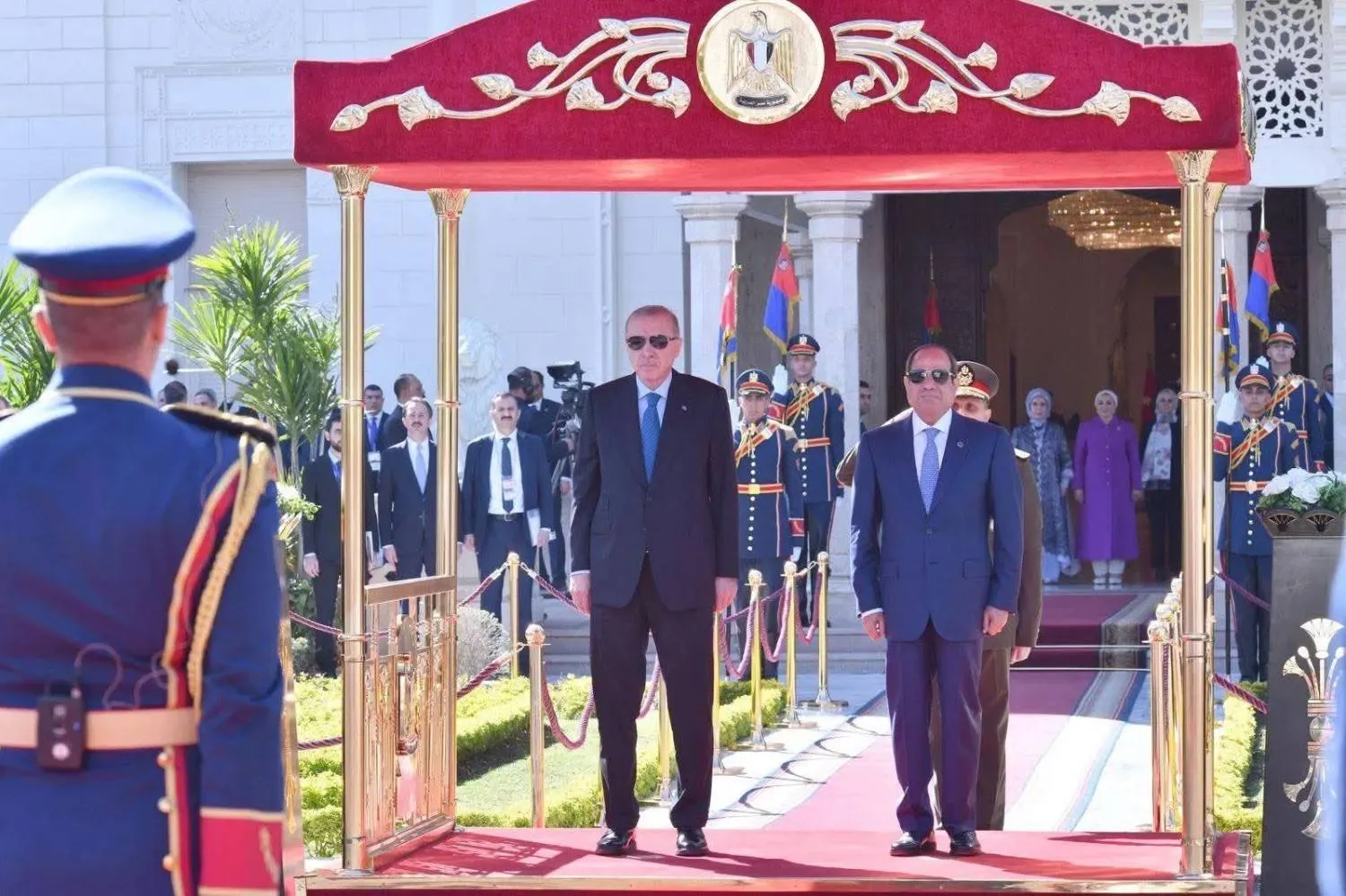
Egyptian President Abdel Fattah el-Sisi receives Turkish President Recep Tayyip Erdogan in Cairo on Wednesday (Egyptian Presidency).
TT

Defense Cooperation Between Egypt and Türkiye: Increasing Influence by Shifting Regional Power Balances

Egyptian President Abdel Fattah el-Sisi receives Turkish President Recep Tayyip Erdogan in Cairo on Wednesday (Egyptian Presidency).

Cairo and Ankara are moving to deepen military and defense cooperation, a key focus of Turkish President Recep Tayyip Erdogan’s visit to Egypt on Wednesday.

Analysts told Asharq Al-Awsat that the growing partnership aims to restore Egyptian-Turkish influence by reshaping regional power balances, particularly amid concerns over expanding Israeli influence, which they say increasingly threatens the interests of both countries.

The latest step was a military cooperation agreement signed in Cairo in the presence of Egyptian President Abdel Fattah el-Sisi and Erdogan. The deal was signed by Egypt’s Minister of Defense, Lieutenant General Abdel Mageed Saqr, and Türkiye’s Minister of National Defense, Yasar Guler.

Military ties between Egypt and Türkiye have expanded steadily since 2023, following the full restoration of diplomatic relations and reciprocal presidential visits. This rapprochement has extended into the defense industry, with the two countries recently resuming joint military exercises under the name “Sea of Friendship.”

They have also agreed to cooperate on the joint production of unmanned aerial vehicles, while Cairo has joined Türkiye’s fifth-generation stealth fighter jet program, KAAN.

Bashir Abdel Fattah, an Egyptian academic specializing in international relations, said defense cooperation between the two countries covers several areas. The first involves regular joint exercises aimed at enhancing combat readiness and exchanging military expertise.

The second centers on joint defense manufacturing, including advanced systems such as air defense, missiles, ammunition, drones, and potentially fighter aircraft.

A third dimension, he added, lies in security and intelligence cooperation, particularly through information sharing in counterterrorism efforts, combating piracy in the Mediterranean, and coordination on regional issues such as Libya and Sudan.

Egyptian national security expert Major General Mohamed Abdel Wahid said both countries are keen to strengthen ties because they face similar challenges, including shifting regional power balances and the emergence of new actors.

He argued that these changes have made it necessary for Egypt and Türkiye to reassert their influence, especially in response to Israel’s growing role, prompting a focus on building joint defense capabilities.

Abdel Wahid noted that Türkiye has shown flexibility in transferring technology, without putting strict political conditions often imposed by Western countries or the European Union.

He added that a Turkish company has already been established in Cairo and will cooperate with Egypt’s Arab Organization for Industrialization.

At the Egypt Defense Expo (EDEX 2025) in Cairo, Bayraktar drones were displayed bearing the Egyptian flag.

Egypt and Türkiye also signed an agreement last August to jointly produce vertical takeoff and landing drones, while production of unmanned ground vehicles has begun through a partnership between the Turkish company Havelsan and Egypt’s Kader Factory.

Türkiye’s defense electronics firm Aselsan recently announced the opening of a regional office in Egypt, describing the move as a “new chapter” in expanding cooperation and providing direct, on-the-ground support to Egyptian partners.


Iraqi Government Seeks to Keep Country Out of Iran War Fallout

Al-Sudani chairs a meeting of the National Security Council (Prime Minister’s Office Media).
TT

Iraqi Government Seeks to Keep Country Out of Iran War Fallout

Al-Sudani chairs a meeting of the National Security Council (Prime Minister’s Office Media).

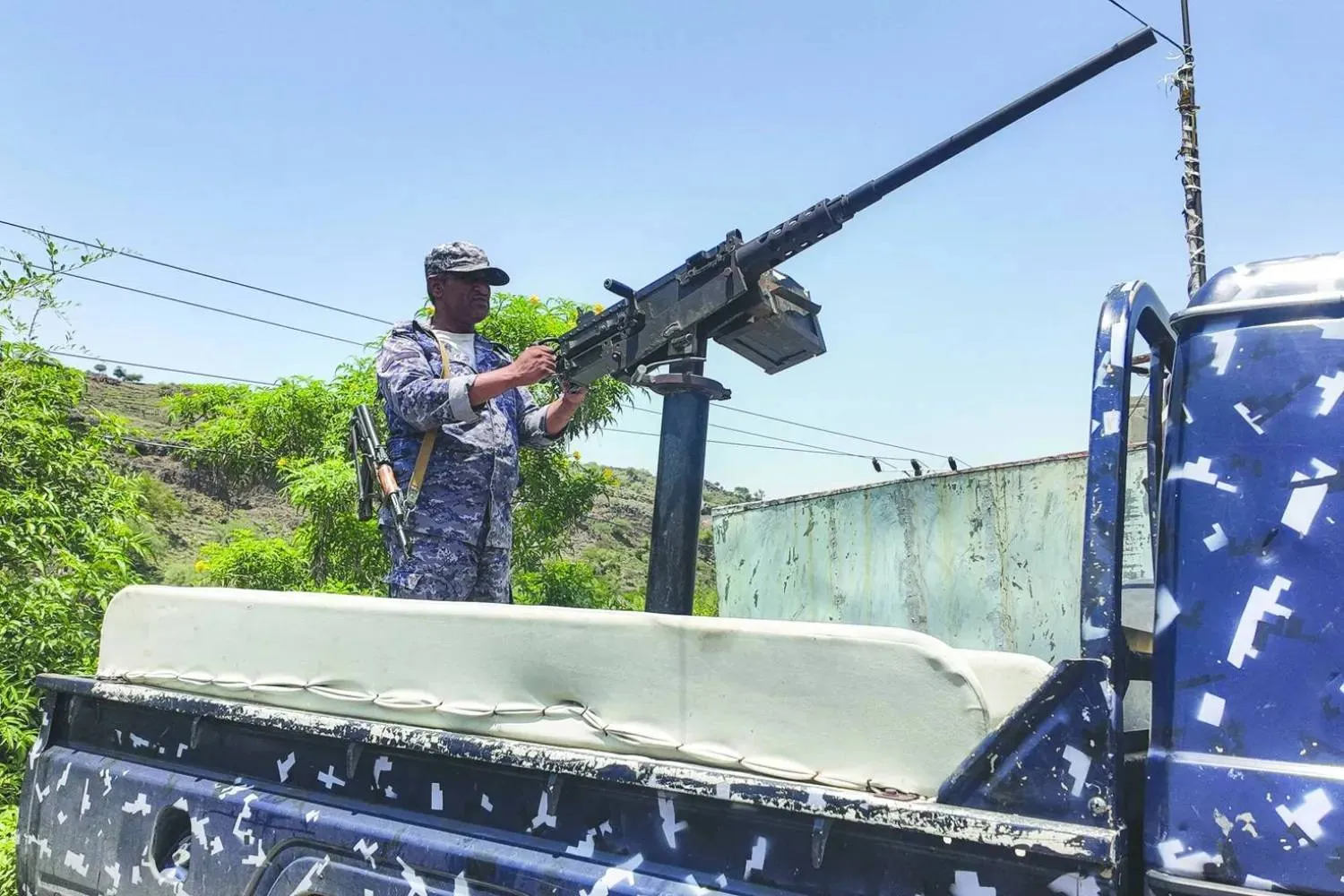
The government of outgoing Prime Minister Mohammed Shia Al-Sudani is working to distance Iraq from the escalating US-Israel war on Iran.

Tehran has responded to the military operation launched by the US and Israel with missile strikes on Gulf states and other locations, including Iraq, saying it is targeting American bases and interests.

Although Iraq has not been directly drawn into the conflict - unlike during the Iran-Iraq War (1980–1988), the 1990–1991 Gulf War, or the 2003 US-led invasion that toppled Saddam Hussein - fear is mounting as the country risks being caught between Iran and its local allies and the broader confrontation involving Washington and Tel Aviv.

There are also concerns that any disruption to Gulf shipping lanes could significantly curtail Iraq’s oil revenues.

Al-Sudani, who also serves as commander in chief of the armed forces, chaired on Monday an emergency meeting of the Ministerial Council for National Security, according to a statement from his office.

The premier instructed security agencies to prevent any actions that could undermine stability and to ensure that Iraq is not dragged into the conflict. Still, some observers say the government has been unable to stop missile attacks on Iraqi territory.

The government reiterated its commitment to protecting diplomatic missions and critical infrastructure, while affirming that freedom of expression and peaceful assembly remain constitutionally protected rights.

The statement stressed that security forces will continue safeguarding citizens, diplomatic facilities and public and private property, in line with national laws and international obligations.

The remarks appeared to reference attempts Sunday evening by groups linked to Iran-aligned armed factions to approach the US Embassy in Baghdad’s fortified Green Zone. Security forces stopped them from reaching the compound.

The council added that Iraq remains committed to preventing escalation and ensuring its territory is not used for external or internal conflicts, underscoring that decisions on national security and military action lie solely with the state and its constitutional institutions.

The council also reviewed the potential economic fallout of a prolonged and expanding conflict, particularly the risks associated with a possible closure of the Strait of Hormuz. The bulk of Iraq’s oil exports pass through the Gulf en route to the strategic waterway.

Given the country’s heavy dependence on oil income, any sustained disruption to maritime traffic would pose a serious threat to Iraq’s already fragile economy.


Lebanon Sucked Deeper into War as Hezbollah, Israel Trade Blows

Displaced residents from the southern suburbs sit along Corniche Al Manara in Beirut, Lebanon, 02 March 2026, after fleeing their homes following Israeli strikes. EPA/WAEL HAMZEH
TT

Lebanon Sucked Deeper into War as Hezbollah, Israel Trade Blows

Displaced residents from the southern suburbs sit along Corniche Al Manara in Beirut, Lebanon, 02 March 2026, after fleeing their homes following Israeli strikes. EPA/WAEL HAMZEH

Lebanon was pulled deeper into the war in the Middle East on Tuesday as the Iran-backed Lebanese group Hezbollah launched missiles at Israel for a second consecutive day and Israel sent troops into the south and carried out waves of airstrikes. 

The theater of numerous conflicts between Israel and Hezbollah, Lebanon was drawn into the spillover from the war between the United States, Israel and Iran on Monday, when the group opened fire with drones and missiles. 

With dozens of people killed in retaliatory Israeli strikes, Hezbollah's move to enter the conflict has sharpened long-standing divisions in Lebanon over its status as an armed group - the only Lebanese faction to keep its weapons after the 1975-90 civil war. 

THOUSANDS FLEE FROM BORDER AREA 

The government on Monday took the unprecedented step of outlawing Hezbollah's military activities. The pro-Hezbollah al-Akhbar newspaper condemned this as a "capitulation to dictates, which could even lead to the outbreak of civil war". 

Israeli strikes sent thick plumes of smoke billowing over Beirut’s Hezbollah-controlled southern suburbs and across hilltops in southern ‌Lebanon. 

Israeli Defense Minister ‌Israel Katz said in a statement he had authorized the military to advance and take control ‌of additional ⁠positions in Lebanon, ⁠where Israeli troops have held several hilltops since a war with Hezbollah in 2024. 

Many thousands of Lebanese have fled homes in areas that bore the brunt of that war. The Israeli military has ordered residents of dozens of south Lebanon villages to evacuate. 

"This displacement is harder than the last one," said Nuzha Salame, a woman sheltering in the city of Sidon after fleeing her village. "Now we're in hardship and deprivation, and we're still out in the streets." 

The United Nations said that, by Monday, at least 30,000 people, including 9,000 children, had sought protection in shelters, while many more were expected to join them. 

Israeli Prime Minister Benjamin Netanyahu said Israel would increase its strikes in Lebanon in response to Hezbollah's attacks, and said the group was ⁠dragging the Lebanese people "into a war that is not theirs". 

ISRAELI INCURSIONS 

The Lebanese health ministry said Israeli ‌strikes had killed at least 40 people and wounded 246 since the start of ‌the escalation. It said an incorrect death toll of 52 was issued on Monday. 

There have been no reported deaths in Israel as a result of Hezbollah's attacks. 

The ‌Israeli military said it had deployed additional forces to southern Lebanon overnight, saying this was to take up defensive positions to guard ‌against any potential Hezbollah attack. 

UNIFIL, the UN peacekeeping force in southern Lebanon, said Israeli soldiers crossed the border in four areas before returning south of the frontier, and that dozens of rockets and missiles had been fired into Israel over the past two days. 

Witnesses said the Lebanese army had pulled out of at least seven forward-operating positions along the border. 

Israel had been carrying out near daily strikes targeting Hezbollah since the ceasefire in 2024. Hezbollah's attack on Monday was its ‌first since that conflict. 

Hezbollah announced at least four separate attacks on Tuesday using attack drones and missiles and saying these had targeted military facilities in northern Israel. It also claimed to have shot ⁠down an Israeli drone in ⁠the south. 

The south has long been a key Hezbollah stronghold, where it has drawn political support and deployed weaponry ahead of the 2024 conflict. The Lebanese army has moved into the area and seized its weapons caches since that conflict, from which Hezbollah emerged greatly weakened. 

ROCKET HITS HOUSE IN ISRAEL 

A missile from Lebanon hit a house in northern Israel, Israeli media reported. Israel's ambulance service said a man was treated for glass shrapnel injuries. 

Overnight, an Israeli airstrike hit the headquarters of Hezbollah's al-Manar TV in Beirut. Footage shot overnight by a Reuters camera overlooking Beirut's southern suburbs showed explosions and outgoing projectiles. 

The Israeli military reported more airstrikes in Beirut on Tuesday, saying it had hit "command centers, weapons storage facilities, and satellite communication components belonging to Hezbollah’s intelligence headquarters in Beirut". 

"These assets were operating under civilian cover," it said. 

The Israeli military said it had taken steps to mitigate civilian harm, including the use of advanced warnings. 

After its attack on Monday, Hezbollah said it acted to avenge the killing of Iran's supreme leader and also in defense of Lebanon. On Tuesday, the group noted continuous Israeli attacks since 2024, and said that its actions were "a reaction to aggression, for national reasons first and foremost". 

Hezbollah leader Naim Qassem has given no statements or speeches during the latest escalation. 


Lebanese President Says Ban on Hezbollah’s Military Activity ‘Irreversible’

President Aoun meets with members of the Quintet at the presidential palace on Tuesday. (Lebanese Presidency)
TT

Lebanese President Says Ban on Hezbollah’s Military Activity ‘Irreversible’

President Aoun meets with members of the Quintet at the presidential palace on Tuesday. (Lebanese Presidency)

Lebanon's President Joseph Aoun said Tuesday that the decision to ban Hezbollah's military activities is "irreversible", as the Iran-backed movement claimed responsibility for new attacks targeting Israeli positions.

Speaking to members of the Quintet -- a committee made up of the French, US, Qatari, Saudi Arabian, and Egyptian ambassadors -- the president called the decision "final," after a Hezbollah statement on Monday night lambasted the state's "impotence in the face of the brutal Zionist enemy".

Aoun urged the Quintet members to "pressure Israel to stop its aggressions against Lebanon" as Israel continued launching intense strikes and authorized its troops to "take control of additional strategic positions in Lebanon".
