


Failed Israeli Commando Operation to Find Airman Remains Kills 41 in Lebanon

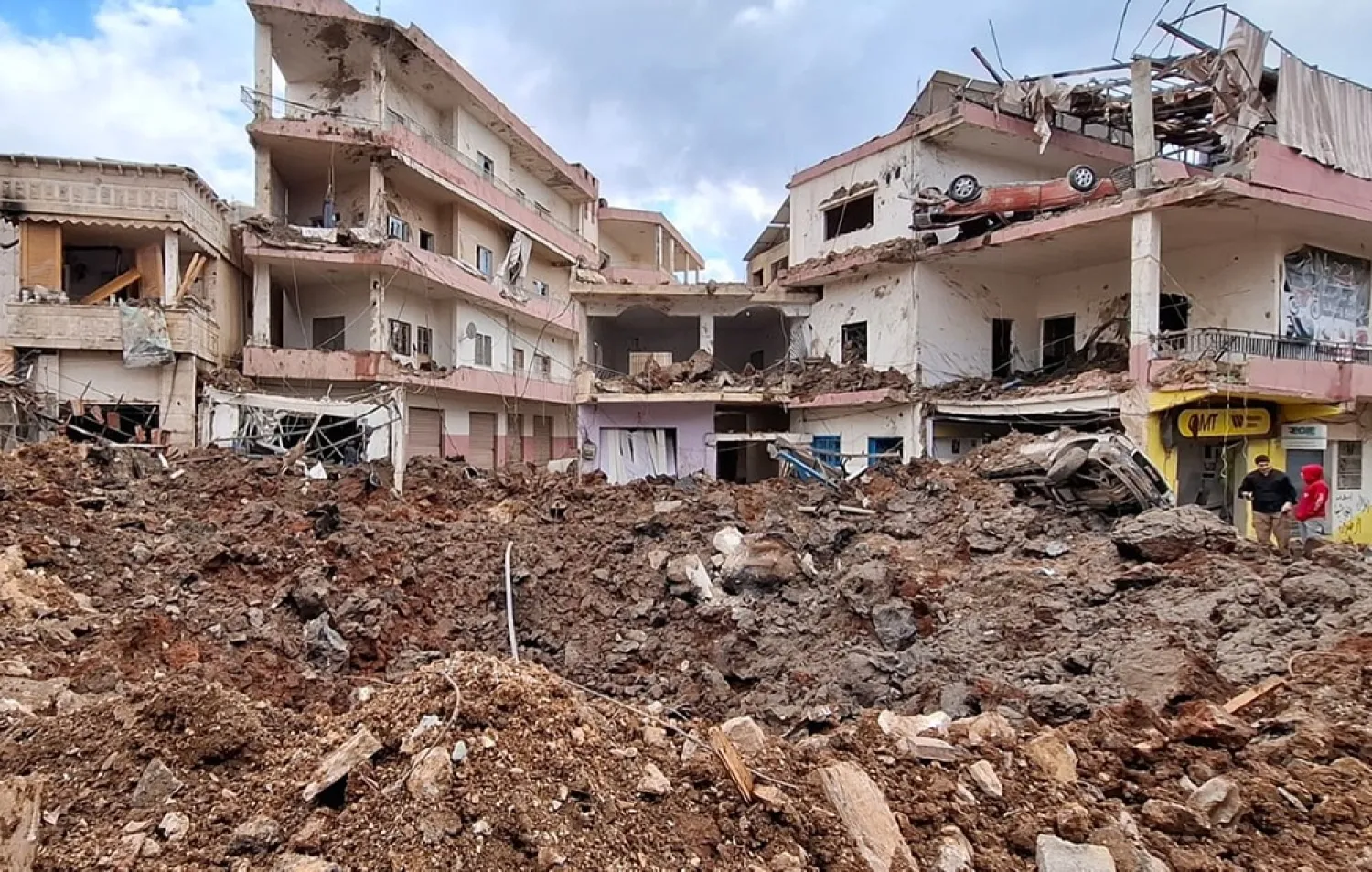
People check the damage left by Israeli airstrikes, Saturday, March 7, 2026, in the village of Nabi Sheet, eastern Lebanon late Friday, where Israeli forces landed overnight and dug a grave in a cemetery searching for Israeli co-pilot Ron Arad who was captured and then went missing after his fighter jet crashed over south Lebanon in 1986. (AP)
TT

Failed Israeli Commando Operation to Find Airman Remains Kills 41 in Lebanon

People check the damage left by Israeli airstrikes, Saturday, March 7, 2026, in the village of Nabi Sheet, eastern Lebanon late Friday, where Israeli forces landed overnight and dug a grave in a cemetery searching for Israeli co-pilot Ron Arad who was captured and then went missing after his fighter jet crashed over south Lebanon in 1986. (AP)

An Israeli special forces operation that failed to find the remains of airman Ron Arad, captured in Lebanon in 1986, killed 41 people and wounded 40 in eastern Lebanon. 

Gutted buildings, torn-off roofs, munitions scattered on the ground surrounded a large crater in Nabi Sheet, the town that witnessed the operation which involved air strikes and clashes. 

"The sounds of the explosions were like something out of a movie," Nabi Sheet resident Mohammed Mussa, 55, told AFP during a media tour organized by the Iran-backed group Hezbollah. 

"We later understood that there was a commando operation underway." 

The operation was met with "resistance" he said, referring to Hezbollah fighters in the area, adding that it had "escalated into clashes and attacks against the Israelis". 

The explosions were powerful enough to send a car onto a building's second floor. 

Another damaged home showed the shredded remains of posters of Hezbollah leaders. 

The strikes on Nabi Sheet and its surroundings killed 41 people and wounded 40, Lebanon's health ministry said. 

The Israeli military had issued evacuation warnings for the area at noon on Friday. 

"With this warning, we prepared and evacuated the children from the town to protect them," Nabi Sheet mayor Hani Moussawi said. 

Israel's military said Saturday it had carried out an operation overnight in Lebanon to find Arad's remains but had failed to uncover any trace of the navigator missing since 1986. 

"No findings related to him were located... No military injuries were reported," the army said. 

Lebanese military chief Rudolphe Haykal said the Israeli soldiers wore military uniforms similar to those of the Lebanese army and used military vehicles and ambulances similar to those of the Hezbollah-linked Islamic Health Authority. 

Haykal added that Israeli attacks targeting Lebanon were hindering the implementation of the army's plan to disarm Hezbollah. 

- 'Infiltration' - 

Hezbollah said earlier Saturday it had confronted Israeli troops that infiltrated an east Lebanon town overnight by helicopter. 

The group said its fighters had "observed the infiltration of four Israeli enemy army helicopters from the Syrian direction". 

After landing and disembarking, the advancing troops "were engaged" by Hezbollah fighters as they reached a cemetery in Nabi Sheet, it added. 

"The clash escalated after the enemy force was exposed," Hezbollah said, adding that Israeli troops launched strikes before evacuating. 

An AFP correspondent in eastern Lebanon, where Hezbollah holds sway, heard warplanes and intense gunfire throughout the night. 

Lebanon's military said it witnessed a commando operation by Israeli forces, adding that "three soldiers and a number of civilians were killed as a result of the violent enemy shelling" that accompanied the attack. 

Arad has been missing since he was captured after he ejected from his combat jet over Lebanon in 1986 as the aircraft went down. 

He is presumed dead, though his remains have never been returned. 

The Israeli army said it "will continue to operate relentlessly, day and night, out of a deep commitment to bringing all of Israel's sons, the fallen and the missing, back home". 

Arad's wife Tami thanked the military but said the lives of soldiers should not be put "at risk" in the hunt for traces of her husband, Israeli media reported. 

- 'Resist' - 

In the town's cemetery, an AFP journalist saw a hole that looked like a dug-up grave, surrounded by other tombstones. 

Earlier on Saturday, a Hezbollah official in the Bekaa region, where Nabi Sheet is located, told AFP that the cemetery the Israelis raided belonged to the Shukr family. 

Last month, Lebanese authorities charged four people with kidnapping Ahmed Shukr -- whose brother Hassan is suspected of involvement in Arad's capture -- on behalf of Israel's Mossad intelligence agency. 

As the Israelis withdrew after the failed operation, mayor Moussawi said "the bombing became indiscriminate and very heavy, resulting in destruction in dozens of locations". 

"It cost a great deal: infrastructure, destruction and the blood of our sons," he added, insisting however that "as long as Israel exists, we will continue to resist it". 

Israel has launched numerous strikes and sent ground troops into Lebanon since Hezbollah fired missiles at Israel to avenge the killing of Iranian supreme leader Ali Khamenei. 

Lebanon's health ministry on Saturday said Israeli attacks on the country had killed nearly 300 people since Monday. 


After Three Years of War, Sudan in Shambles as Donors Gather in Berlin

 A Sudanese man pulls a donkey cart filled with water for sale in Port Sudan on April 14, 2026. (AFP)
A Sudanese man pulls a donkey cart filled with water for sale in Port Sudan on April 14, 2026. (AFP)
TT

After Three Years of War, Sudan in Shambles as Donors Gather in Berlin

 A Sudanese man pulls a donkey cart filled with water for sale in Port Sudan on April 14, 2026. (AFP)
A Sudanese man pulls a donkey cart filled with water for sale in Port Sudan on April 14, 2026. (AFP)

The vast majority of Sudanese people have been plunged into poverty, with 11 million uprooted from their homes and nearly twice as many facing hunger as the war between the army and its paramilitary foes enters its fourth year.

On the third anniversary of the start of the grinding conflict on Wednesday, donors will gather in Berlin for an international conference aimed at reviving faltering peace talks and mobilizing aid for one of the world's worst humanitarian crises.

"People are exhausted," said Amgad Ahmed, 42, who has lived in Omdurman, Khartoum's twin city, throughout the conflict.

"Three years of war have worn people down. We have lost work, savings and any sense of stability," he told AFP.

The meeting in Berlin brings together governments, aid agencies and civil society groups, but excludes both the Sudanese army and the paramilitary Rapid Support Forces (RSF) -- the two sides fighting the conflict.

It follows similar conferences hosted by London and Paris over the past two years that failed to produce a diplomatic breakthrough.

The war between Sudan's army and the RSF has killed tens of thousands of people, sparking what German Chancellor Friedrich Merz called "the greatest humanitarian crisis of our time, which is not very often in the public eye".

Nearly 700 civilians have been killed in drone strikes since January, as attacks have escalated on both sides, particularly in the southern Kordofan region and Blue Nile State, according to the United Nations.

A semblance of normality, however, has taken root in the capital Khartoum since the army re-established control there last year.

In parts of the city, reconstruction has begun. Markets have reopened, traffic has returned to streets that were once largely empty, and national secondary school exams were held this week after nearly two years of widespread school closures.

According to the UN, around 1.7 million people have returned to the capital.

But danger still lurks among the soot-stained buildings, with authorities slowly working to clear tens of thousands of unexploded bombs left behind by the fighting.

- 'Heartbreaking' -

Al-Basheer Babker al-Basheer, 41, who visited Khartoum twice this year after three years away, said the city would need years to recover.

"I was happy to come back," he told AFP. "But when I went into the city center, it was heartbreaking."

"The road to the university where I studied is no longer the same. The walls are black," he said. "They are not the same places we used to go to."

Quad-led talks stalled after army chief Abdel Fattah al-Burhan accused the group in November of bias over Abu Dhabi's membership.

German Foreign Ministry spokeswoman Kathrin Deschauer said the Berlin conference would discuss how to "exert influence on the key actors".

"There are many external actors involved in this war," said Luca Renda, the UN Development Program's representative in Sudan.

"And as long as this continues, unfortunately, the chances of peace are very slim."

Beyond widespread infrastructure destruction, the war has pushed Sudan deeper into hunger and poverty, with humanitarian funding at just 16 percent of what is needed, Renda said.

Famine was declared last year in North Darfur capital el-Fashir and Kadugli, the capital of South Kordofan, with 20 additional areas at risk, the UN said.

African Union Commission Chairman Mahamoud Ali Youssouf, in Berlin for the meeting, voiced hope for a cessation of hostilities but acknowledged "we are not there yet".

"When the whole world is focusing on Iran and Ukraine and other crises, I think it is very much appreciated that Germany puts this agenda on the table so that we do not lose sight about the suffering of the people of the Sudan."


Canada, UK, Australia and Japan Call for ‘Urgent End to Hostilities in Lebanon’

 Israeli military armored vehicles operate in Lebanon, near the Israel-Lebanon border, as seen from the Israeli side of the border in northern Israel, April 14, 2026. (Reuters)
Israeli military armored vehicles operate in Lebanon, near the Israel-Lebanon border, as seen from the Israeli side of the border in northern Israel, April 14, 2026. (Reuters)
TT

Canada, UK, Australia and Japan Call for ‘Urgent End to Hostilities in Lebanon’

 Israeli military armored vehicles operate in Lebanon, near the Israel-Lebanon border, as seen from the Israeli side of the border in northern Israel, April 14, 2026. (Reuters)
Israeli military armored vehicles operate in Lebanon, near the Israel-Lebanon border, as seen from the Israeli side of the border in northern Israel, April 14, 2026. (Reuters)

Canada, the UK, Australia, Japan and six other countries condemned the killings of UN peacekeepers in Lebanon on Tuesday while calling "for an urgent end to hostilities" in the country where Israeli attacks have killed over 2,000 people since March.

"Australia, Brazil, Canada, Colombia, Indonesia, Japan, Jordan, Sierra Leone, Switzerland and the United Kingdom remain deeply concerned by the worsening humanitarian situation and displacement crisis in Lebanon," the countries said in a joint statement without directly mentioning US ally Israel or Iran-backed Hezbollah.

The statement ‌comes after ‌the deaths of three Indonesian peacekeepers last month. ‌The ⁠UN has said ⁠preliminary findings from its probe showed one was killed by an Israeli tank projectile and two by an improvised explosive device most likely placed by Hezbollah.

Israel intensified air attacks on Lebanon after Hezbollah fired missiles at Israel on March 2, three days into the US.-Israeli war on Iran.

Israel has since widened a ground invasion into Lebanon's south, ordering hundreds ⁠of thousands of Lebanese to flee villages. The Israeli ‌offensive has killed more than ‌2,000 people and forced 1.2 million from their homes, according to Lebanese authorities.

Hezbollah missile ‌fire has mainly targeted towns near Israel's northern border but has ‌also been aimed at major cities. Two Israelis and 13 soldiers have been killed since March 2, Israel says.

"We condemn in the strongest terms actions that have killed UN peacekeepers and significantly increased the risks faced by humanitarian ‌personnel in southern Lebanon," the 10 countries said in the joint statement, which only noted Israel ⁠in the context of ⁠the ceasefire in the US and Israel's war against Iran.

"We welcome the ceasefire agreed between the United States, Israel and Iran. We call for an urgent end to hostilities in Lebanon."

The US and Israel attacked Iran on February 28. Iran responded with strikes on Israel and Gulf states with US bases. US-Israeli strikes on Iran have killed thousands and displaced millions. A fragile two-week ceasefire between the US and Iran still has a week to run.

Iran says Israel's war in Lebanon must be included in any agreement to end the wider conflict. Israel has ruled out discussing a ceasefire in Lebanon and demanded that Beirut disarm Hezbollah.


Lebanon and Israel Hold First Direct Diplomatic Talks in Decades in Washington

US Secretary of State Marco Rubio (C) speaks during a meeting with Lebanon's Ambassador to the US Nada Hamadeh Moawad (2R) and Israeli Ambassador to the US Yechiel Leiter (2L) at the State Department in Washington, DC, on April 14, 2026. (AFP)
TT

Lebanon and Israel Hold First Direct Diplomatic Talks in Decades in Washington

US Secretary of State Marco Rubio (C) speaks during a meeting with Lebanon's Ambassador to the US Nada Hamadeh Moawad (2R) and Israeli Ambassador to the US Yechiel Leiter (2L) at the State Department in Washington, DC, on April 14, 2026. (AFP)

Lebanon and Israel held their first direct diplomatic talks in decades on Tuesday in Washington following more than a month of war between Israel and the Iran-backed Hezbollah group, with US Secretary of State Marco Rubio calling it a "historic opportunity" but making clear that no breakthrough agreement would happen right away.

In a statement after the two-hour session ended, the State Department praised the two sides for what it called "productive discussions on steps toward launching direct negotiations between Israel and Lebanon." Hezbollah opposed the direct talks and was not represented, appearing to step up its fire on northern Israel as the discussions began.

"The United States affirmed that any agreement to cease hostilities must be reached between the two governments, brokered by the United States, and not through any separate track," the State Department said.

Israeli Ambassador to the US Yechiel Leiter hailed what he called a convergence of opinion about removing Hezbollah’s influence from Lebanon, saying he was encouraged by a "wonderful exchange."

"The Lebanese government made it very clear that they will no longer be occupied by Hezbollah," he said. "Iran has been weakened. Hezbollah is dramatically weakened. This is an opportunity."

Lebanese Ambassador to the US Nada Hamadeh Moawad "reaffirmed the urgent need" for an end to the Israel-Hezbollah conflict, "underscoring the principles of territorial integrity and full state sovereignty."

She also called for a ceasefire, the return of displaced people to their homes, and "concrete measures to address and alleviate the severe humanitarian crisis" resulting from the conflict.

Despite Hezbollah’s outright rejection, the talks are a major step for two countries with no diplomatic relations that have been officially at war since Israel’s inception in 1948. The latest round of fighting was sparked by Hezbollah firing rockets into northern Israel on March 2, days after the United States and Israel attacked Iran, Hezbollah’s key ally and patron.

Hezbollah pushes back

As the talks began, Rubio said the Trump administration was "very happy" to facilitate but noted that "we understand we’re working against decades of history and complexities" that will not be quickly resolved.

"But we can begin to move forward with a framework where something can happen — something very positive, something very permanent — so that the people of Lebanon can have the kind of future they deserve, and so that the people of Israel can live without fear," Rubio said.

The Lebanese government hopes the talks will help pave the way to an end to the war. While Iran has set ending the wars in Lebanon and the region as a condition for talks with the US, Lebanon insists on representing itself.

Hezbollah and other critics say Lebanon’s government lacks leverage and that it should back Iran’s position. Wafiq Safa, a high-ranking member of the group’s political council, told The Associated Press that the group will not abide by any agreements made during the talks.

On the day of the discussions, incoming fire triggered nonstop drone and rocket alert sirens in Israeli communities near the Lebanese border. Hezbollah, so far on Tuesday, has claimed 24 attacks on northern Israel and on Israeli troops in southern Lebanon.

At least 2,124 people have been killed in Israeli strikes in Lebanon, the Health Ministry said, including hundreds of women and children. More than 1 million people are displaced. The deadliest day of the war took place last week, when Israel launched 100 airstrikes across Lebanon in 10 minutes, including in the heart of the capital, killing over 350 people.

The Israeli military has invaded southern Lebanon, a move some Israeli officials have said aims to create a "security zone" from the border to the Litani River, some 30 kilometers (20 miles) to the north.

Israel’s defense minister says hundreds of thousands of people uprooted from southern Lebanon will not be allowed to return home until the area is demilitarized and Israel believes its northern communities are safe. Hezbollah, though weakened in its last war with Israel that ended in November 2024, still fires drones, rockets and artillery daily into northern Israel and on ground troops inside Lebanon.

Hezbollah enjoys wide influence in Beirut’s southern suburbs, as well as large swaths of the country’s southern and eastern provinces. Hezbollah-allied politicians hold two Cabinet minister positions, though the group’s ties have soured with Lebanon’s top political authorities, who have been critical of Hezbollah’s decision to enter the war last month and who have since criminalized the group’s military activities in the country.

First Israel-Lebanon talks in more than 30 years

The talks are the first between Israel and Lebanon since 1993. Both countries have relied on indirect communication, often brokered by the United States or UNIFIL, the United Nations peacekeeping mission in southern Lebanon.

Lebanon’s top political authorities, critical of Hezbollah’s decision to fire rockets toward Israel on March 2 in solidarity with Iran, quickly proposed direct talks in a bid to stop the escalation, hoping that Israel would not launch its ground invasion.

Israel did not respond positively until last week, after its deadly bombardment hit several crowded commercial and residential areas in Beirut, sparking an international outcry and triggering threats by Iran that it would end the ceasefire with the United States and Israel.

Lebanese officials have pushed for a truce, which Israel has ruled out. Israel has, however, halted strikes on Lebanon's capital following the bombardment.

"Israel’s destruction of Lebanese territories is not the solution, nor will it yield any results," Lebanese President Joseph Aoun said Monday. He came to power vowing to disarm non-state groups, including Hezbollah. "Diplomatic solutions have consistently proven to be the most effective means of resolving armed conflicts globally."

Foreign Minister Gideon Saar on Tuesday denied having disputes with Lebanon and said: "The problem is Hezbollah."

Hezbollah wants a return to the 2024 agreement under which talks were conducted indirectly with the US, France and UNIFIL as mediators.
