

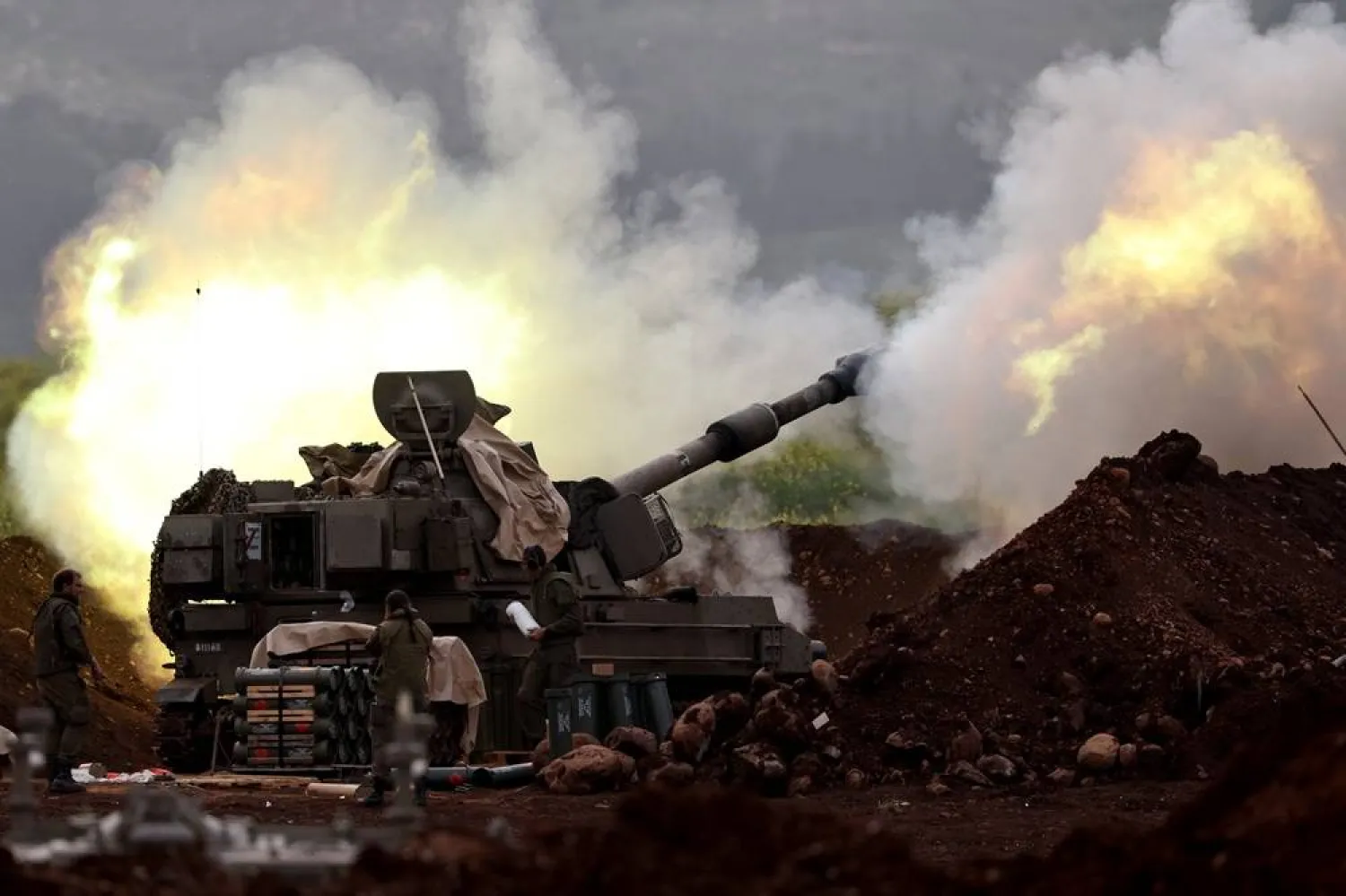

Lebanon, Israel Near First Round of Negotiations

An Israeli artillery unit deployed at an undisclosed location at the Israeli border with Lebanon shells targets in Lebanon, 14 March 2026. (EPA)
TT

Lebanon, Israel Near First Round of Negotiations

An Israeli artillery unit deployed at an undisclosed location at the Israeli border with Lebanon shells targets in Lebanon, 14 March 2026. (EPA)

Lebanon and Israel have taken a step forward towards holding a first meeting to negotiate an end to the war on Lebanon.

An agreement has yet to be reached on the necessary arrangements, even as United Nations Secretary-General Antonio Guterres said from Beirut on Saturday that the “diplomatic avenues” were available to end the war.

Ministerial sources told Asharq Al-Awsat that an agreement has been reached to hold a meeting between Lebanon and Israel, but the location and date have not been set.

France and Cyprus have both offered to host the talks.

The sources revealed that parliament Speaker Nabih Berri has not yet decided whether to send a Shiite representative to the meeting or not.

The negotiations team does not yet have a Shiite representative.

In remarks to Asharq Al-Awsat, Berri tied his agreement to negotiations and President Joseph Aoun’s initiative to end the war with two conditions: the ceasefire and the return of the displaced.

He refused to go into further details “ahead of time”.

Berri refuses to take part in direct negotiations between Lebanon and Israel and has demanded a ceasefire be implemented before taking any other step to resolve the conflict.

Sources have quoted him as saying that he is still committed to the Mechanism committee and UN Security Council resolution 1701 to end the war.

‘Only diplomacy’

Guterres urged on Saturday the international community to support Lebanon.

Lebanon was dragged into the Middle East war last week when Hezbollah attacked Israel in response to the killing of Iranian supreme leader Ali Khamenei in US-Israeli strikes, and the Tehran-backed group's leader has said the fighters were ready for a long confrontation with Israel.

On Saturday, Israel kept up strikes on Lebanon as Hezbollah claimed attacks against northern Israel and Beirut said the death toll in the country since March 2 had climbed to 826, including 106 children.

US news site Axios reported on Saturday that Israel was planning a major ground invasion of Lebanon "aiming to seize the entire area south of the Litani River", citing US and Israeli officials.

The area, covering hundreds of square miles, is already subject to Israeli evacuation warnings.

Israel has already sent some ground forces into Lebanon and late on Saturday Hezbollah said it was engaged in ongoing "direct clashes" with Israeli forces in Khiam.

Guterres, however, insisted "there is no military solution, only diplomacy" and dialogue.

The UN chief arrived in Beirut on Friday for what he called a solidarity visit and launched a $325 million humanitarian appeal to support Lebanon as it responds to the displacement of hundreds of thousands of people amid sweeping Israeli army evacuation orders.

Guterres urged the international community to "step up your engagement, empower the Lebanese state" and support the army, which has committed to disarming Hezbollah.

Turkish Foreign Minister Hakan Fidan said on Saturday that Ankara feared Israel could commit "genocide" in Lebanon and called for the international community to intervene.

Turkey has been fiercely critical of Israel since the start of the Gaza war.

Paramedics

The health ministry said 31 paramedics had been killed this month, after the bodies of additional health workers were found following an overnight strike that authorities said hit a healthcare center in Burj Qalawiya in the country's south, killing doctors, paramedics and nurses.

The Hezbollah-affiliated Islamic Health Committee said the center was one of its facilities, pledging such attacks would not deter it from "performing our humanitarian duty".

The Israeli military accused Hezbollah of using ambulances militarily, and its spokesman Avichay Adraee warned that Israel would act "in accordance with international law against any military activity" by any Hezbollah use of medical facilities or ambulances.

Lebanon's health ministry accused Israel of repeatedly "targeting ambulance crews while they were performing rescue duties".

The Israeli army said that it had struck Hezbollah operatives on Friday "who were bringing rockets into a weapons depot" in Majedel, near Burj Qalawiya.

It also said it had struck "approximately 110 Hezbollah command centers" since the regional conflict broke out.

On Saturday, a strike hit an apartment building in a northern Beirut suburb that had been targeted a day earlier.

An AFP correspondent in the Nabaa-Burj Hammoud area saw rescue workers at the scene and damage including a hole in a building, outside Hezbollah's strongholds in the capital's southern suburbs.

The health ministry said the strike killed one person in Burj Hammoud, a densely populated, mixed area known for its large Armenian-Lebanese community.

'No safety'

Levon Ghazalian, 42, who lives in the building next door, said "it's the first time this happens" in the area, which was spared in the previous conflict between Israel and Hezbollah in 2024.

"All the neighbors are afraid," he told AFP.

Hanadi Hachem, 50, who was in her pyjamas, said "there's no safety anymore... you never know where a strike will come from".

She said she and some family members were sleeping in their car out of fear.

French President Emmanuel Macron said the Lebanese government was ready to engage in "direct talks" with Israel and offered to host negotiations in Paris, warning that "everything must be done to prevent Lebanon from descending into chaos".

The French foreign ministry later denied there was a French plan to end the war, saying it had only offered to facilitate talks, after Axios reported that Paris had drawn up a proposal involving Lebanon formally recognizing Israel.




Will Lebanon Be the Biggest Loser After the Ceasefire?

Smoke rises after an Iranian missile is intercepted over the Sahel Alma area in Mount Lebanon. (Reuters)
TT

Will Lebanon Be the Biggest Loser After the Ceasefire?

Smoke rises after an Iranian missile is intercepted over the Sahel Alma area in Mount Lebanon. (Reuters)

Political sources in Beirut warned Lebanon could emerge as the biggest loser when the current regional war ends, outlining their concerns to Asharq Al-Awsat.

Lebanon is heading toward a severe internal crisis, the sharpest in its modern history with the dispute centering on Hezbollah’s weapons.

The majority of Shiites in the country insists on keeping them, while most other segments say Lebanon’s survival depends on implementing government decisions to limit arms to the state, in line with Lebanese, Arab, and international positions.

The sources noted that Hezbollah has again entered a regional war it cannot influence, risking burdens Lebanon cannot bear.

Hefty price

The war is proving costly for those involved and for countries hit by its spillover.

A ceasefire would likely show Iran suffered heavy damage to its defense, industrial sectors, and infrastructure, potentially setting it back decades. But its size, energy resources, and experience with economic hardship may help it manage the aftermath, unless losses destabilize the system.

Iranian missiles are expected to have caused damage to Israeli institutions and infrastructure, despite a high interception rate. The cost of interception is steep, but Israel appears ready to absorb it, calling the conflict an existential war and relying on strong US support.

Lebanon will struggle the most. Its economy is already near collapse. The country faces a catastrophic situation, with about one million displaced and heavy destruction along the border with Israel.

Israel has said it intends to establish a “buffer zone” inside Lebanese territory, signaling a return of occupation to parts of the country “pending guarantees for the safety of Galilee residents.”

The most dangerous scenario is that Israel’s campaign on the Lebanese front continues even if a ceasefire is reached between the US and Israel on one side and Iran on the other.

The fallout is worsened by a deepening rift among Lebanon’s components, raising the risk of internal conflict.

The role of parliament Speaker Nabih Berri appears diminished as the conflict widens. The current crisis over the expulsion of the Iranian ambassador reflects a deeper divide between the Shiite camp and others over weapons, the war, and Lebanon’s regional role.

Hezbollah described the expulsion as a “sin”, demanding that the government reverse it.

‘Impossible to coexist’

Voices are rising in Lebanon, warning that it was “impossible to coexist” between a “quasi-state” and a “Hezbollah’s statelet.”

Countries that once backed Lebanon’s reconstruction, especially in the Gulf, are now focused on their own losses from Iranian attacks. They have also made clear that they will not help unless the Lebanese state takes full control over decisions of war and peace.

The sources reiterated their warning that Lebanon risks being the biggest loser, especially if Israel expands its ground offensive and internal divisions deepen to the point of questioning the country’s very formula of coexistence.


Netanyahu Says Israel Is Expanding ‘Buffer Zone’ in Lebanon

Smoke billows from an Israeli strike on Marjeyoun in southern Lebanon on Wednesday. (AFP)
TT

Netanyahu Says Israel Is Expanding ‘Buffer Zone’ in Lebanon

Smoke billows from an Israeli strike on Marjeyoun in southern Lebanon on Wednesday. (AFP)

Israeli Prime Minister Benjamin Netanyahu said on Wednesday that his country's forces were expanding a "buffer zone" in southern Lebanon as the military pressed ahead with its campaign against Hezbollah.

"We have created a genuine security zone preventing any infiltration toward the Galilee and the northern border," Netanyahu said in a video statement.

"We are expanding this zone to push the threat from anti-tank missiles further away and to establish a broader buffer zone."

Netanyahu said that dismantling Hezbollah "remains central" to Israel's objectives in Lebanon.

"It is connected to the broader confrontation with Iran," he said.

"We are determined to profoundly transform the situation in Lebanon," he added.

Lebanon was pulled into the Middle East war when Iran-backed Hezbollah began firing rockets into Israel on March 2 to avenge the killing of Iran's supreme leader Ali Khamenei.


Strike on Western Iraq Kills Seven Security Personnel

Members of Iraq's PMF carry the coffin of the PMF operations commander for Al-Anbar, Saad Dawai alongside others during a mass funeral in Baghdad on March 24, 2026. (AFP)
TT

Strike on Western Iraq Kills Seven Security Personnel

Members of Iraq's PMF carry the coffin of the PMF operations commander for Al-Anbar, Saad Dawai alongside others during a mass funeral in Baghdad on March 24, 2026. (AFP)

A strike on a base in western Iraq killed seven security personnel, the defense ministry said Wednesday, a day after an attack on the same base targeted the Popular Mobilization Forces.

"This resulted in the death of seven of our heroic fighters and the injury of 13 others," the ministry said of the strike in Anbar province, saying it specifically targeted the base's military healthcare clinic.

Rescue operations were ongoing, it added.

The base hosts Iraqi police, soldiers from the regular army and PMF, a security official told AFP.

It was hit by a deadly strike on Tuesday that the former paramilitaries blamed on the United States.

Iraq said late on Tuesday it would summon the US charge d'affaires and the Iranian ambassador after deadly strikes blamed on their countries, as Iraqi authorities granted the targeted groups the "right to respond".

Iraq has been pulled into the war sparked by US and Israeli strikes on Iran on February 28, and which has since engulfed much of the region.

Iraq has long been a proxy battleground for the United States and Iran, and has struggled to balance diplomatic ties with both countries.

Since the war began, pro-Iran armed groups have claimed responsibility for attacks on US interests in Iraq and across the region, while strikes have also targeted these groups, including state-linked positions.

In the statement from the prime minister's office, however, Iraq granted former paramilitaries within the official armed forces the right to "respond to military attacks" by drones and aircraft that targeted their headquarters.