


Israeli Minister Calls for Annexation of Southern Lebanon

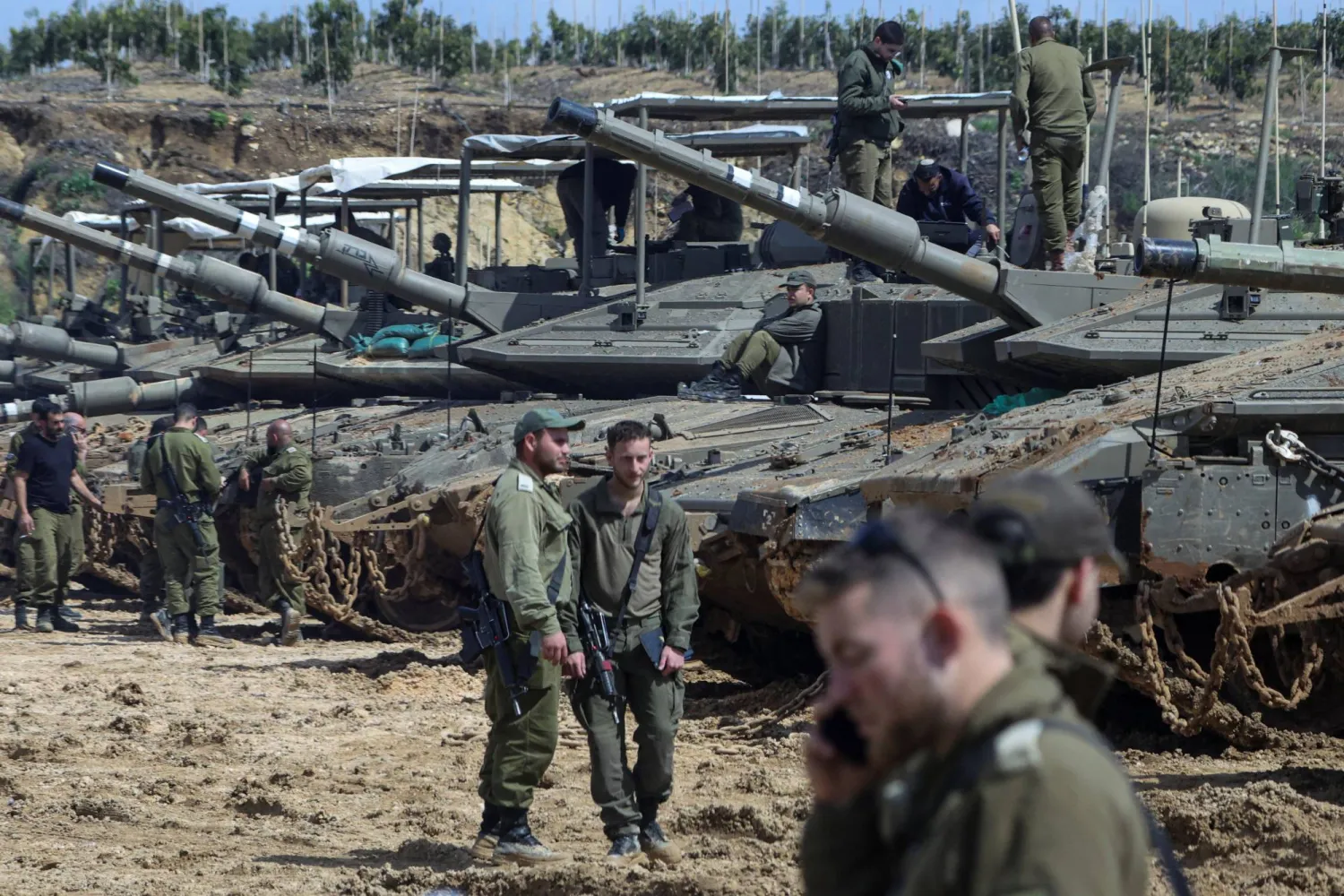
Israeli soldiers stand next to tanks near the Israeli side of the border with Lebanon, March 23, 2026. REUTERS/Tyrone Siu
TT

Israeli Minister Calls for Annexation of Southern Lebanon

Israeli soldiers stand next to tanks near the Israeli side of the border with Lebanon, March 23, 2026. REUTERS/Tyrone Siu

Israel should extend its border with Lebanon up to the Litani River deep inside the country's south, Israel's finance minister said on Monday as Israeli troops bombed bridges and destroyed homes in the area in an escalating military assault.

The comments by Finance Minister Bezalel Smotrich were the most explicit yet by a senior Israeli official on seizing Lebanese territory in a fight Israel says targets Iran-backed Hezbollah militants.

Lebanon was pulled into the regional war on March 2 when Hezbollah fired missiles into Israel. Since then, Israel has ordered all residents to leave the area south of the Litani River as it pummels the area with air strikes, viewing it as a Hezbollah stronghold.

Lebanese authorities say the Israeli air and ground assault has killed more than 1,000 people, and more than a million have been driven from their homes with Israel having ordered residents to flee swathes of the country.

'THE NEW ISRAELI BORDER MUST BE THE LITANI'

Smotrich told an Israeli radio program that the military campaign in Lebanon "needs to end with a different reality entirely, both with the Hezbollah decision but also with the change of Israel's borders."

"I say here definitively...in every room and in every discussion, too: the new Israeli border must be the Litani," Smotrich said.

Smotrich, leader of a small far-right party in Prime Minister Benjamin Netanyahu's cabinet, often makes comments that go beyond official Israeli policy.

Netanyahu's office did not immediately respond to a request for comment on the remarks. Defenسe Minister Israel Katz hinted earlier this month at plans to capture land, saying Lebanon could face "loss of territory" if it did not disarm Hezbollah.

Smotrich's remarks were deeply resonant in Lebanon, which is trying to emerge from a decades-old cycle of invasions and occupations by its neighbor. Israeli forces have launched repeated assaults on Lebanon since 1978 and occupied the south from 1982-2000.

A Lebanese official told Reuters that Beirut was still counting on foreign powers to put enough pressure on Israel to put an end to the war, through an offer from President Joseph Aoun to hold direct talks.

Smotrich also called for Israel to annex territory it now controls in the Gaza Strip, up to an armistice line with Hamas. A ceasefire signed in October left Israel in control of 53% of Gaza, where it has ordered residents out and bulldozed buildings.

The Israeli military says its troops in Lebanon are carrying out ground maneuvers and targeted raids on Hezbollah militants and weapons stores, aimed at protecting residents in northern Israel from Hezbollah fire.

The Lebanese government has outlawed Hezbollah military activity and said it wants to engage in direct talks with Israel.

ROUTES TO NORTH BEING CUT OFF

Over the weekend, Israel struck a main bridge linking south Lebanon with the rest of the country after ordering its military to destroy all crossings over the Litani River and to step up the demolition of homes near the southern border.

International law generally prohibits militaries from attacking civilian infrastructure, and the United Nations human rights chief has criticized Israel's actions in Lebanon, particularly its use of widespread evacuation orders.

Israeli strikes hit two more crossings on the Litani River on Monday -- a road running near a main bridge hit on Sunday and another small bridge on another section of the river.

Hanna Amil, the mayor of Christian border town Rmeish whose residents have refused to leave their homes, told Reuters that it was getting increasingly difficult to move around.

"Once or twice a week, a convoy from the Lebanese army accompanies us as we try to get basic goods from nearby areas," he said.

"Already, we have no state electricity, no water and we have diesel shortages. If all the routes to the north get cut off, who knows what the future could hold for us," Amil said.



Will Lebanon Be the Biggest Loser After the Ceasefire?

Smoke rises after an Iranian missile is intercepted over the Sahel Alma area in Mount Lebanon. (Reuters)
TT

Will Lebanon Be the Biggest Loser After the Ceasefire?

Smoke rises after an Iranian missile is intercepted over the Sahel Alma area in Mount Lebanon. (Reuters)

Political sources in Beirut warned Lebanon could emerge as the biggest loser when the current regional war ends, outlining their concerns to Asharq Al-Awsat.

Lebanon is heading toward a severe internal crisis, the sharpest in its modern history with the dispute centering on Hezbollah’s weapons.

The majority of Shiites in the country insists on keeping them, while most other segments say Lebanon’s survival depends on implementing government decisions to limit arms to the state, in line with Lebanese, Arab, and international positions.

The sources noted that Hezbollah has again entered a regional war it cannot influence, risking burdens Lebanon cannot bear.

Hefty price

The war is proving costly for those involved and for countries hit by its spillover.

A ceasefire would likely show Iran suffered heavy damage to its defense, industrial sectors, and infrastructure, potentially setting it back decades. But its size, energy resources, and experience with economic hardship may help it manage the aftermath, unless losses destabilize the system.

Iranian missiles are expected to have caused damage to Israeli institutions and infrastructure, despite a high interception rate. The cost of interception is steep, but Israel appears ready to absorb it, calling the conflict an existential war and relying on strong US support.

Lebanon will struggle the most. Its economy is already near collapse. The country faces a catastrophic situation, with about one million displaced and heavy destruction along the border with Israel.

Israel has said it intends to establish a “buffer zone” inside Lebanese territory, signaling a return of occupation to parts of the country “pending guarantees for the safety of Galilee residents.”

The most dangerous scenario is that Israel’s campaign on the Lebanese front continues even if a ceasefire is reached between the US and Israel on one side and Iran on the other.

The fallout is worsened by a deepening rift among Lebanon’s components, raising the risk of internal conflict.

The role of parliament Speaker Nabih Berri appears diminished as the conflict widens. The current crisis over the expulsion of the Iranian ambassador reflects a deeper divide between the Shiite camp and others over weapons, the war, and Lebanon’s regional role.

Hezbollah described the expulsion as a “sin”, demanding that the government reverse it.

‘Impossible to coexist’

Voices are rising in Lebanon, warning that it was “impossible to coexist” between a “quasi-state” and a “Hezbollah’s statelet.”

Countries that once backed Lebanon’s reconstruction, especially in the Gulf, are now focused on their own losses from Iranian attacks. They have also made clear that they will not help unless the Lebanese state takes full control over decisions of war and peace.

The sources reiterated their warning that Lebanon risks being the biggest loser, especially if Israel expands its ground offensive and internal divisions deepen to the point of questioning the country’s very formula of coexistence.


Netanyahu Says Israel Is Expanding ‘Buffer Zone’ in Lebanon

Smoke billows from an Israeli strike on Marjeyoun in southern Lebanon on Wednesday. (AFP)
TT

Netanyahu Says Israel Is Expanding ‘Buffer Zone’ in Lebanon

Smoke billows from an Israeli strike on Marjeyoun in southern Lebanon on Wednesday. (AFP)

Israeli Prime Minister Benjamin Netanyahu said on Wednesday that his country's forces were expanding a "buffer zone" in southern Lebanon as the military pressed ahead with its campaign against Hezbollah.

"We have created a genuine security zone preventing any infiltration toward the Galilee and the northern border," Netanyahu said in a video statement.

"We are expanding this zone to push the threat from anti-tank missiles further away and to establish a broader buffer zone."

Netanyahu said that dismantling Hezbollah "remains central" to Israel's objectives in Lebanon.

"It is connected to the broader confrontation with Iran," he said.

"We are determined to profoundly transform the situation in Lebanon," he added.

Lebanon was pulled into the Middle East war when Iran-backed Hezbollah began firing rockets into Israel on March 2 to avenge the killing of Iran's supreme leader Ali Khamenei.


Strike on Western Iraq Kills Seven Security Personnel

Members of Iraq's PMF carry the coffin of the PMF operations commander for Al-Anbar, Saad Dawai alongside others during a mass funeral in Baghdad on March 24, 2026. (AFP)
TT

Strike on Western Iraq Kills Seven Security Personnel

Members of Iraq's PMF carry the coffin of the PMF operations commander for Al-Anbar, Saad Dawai alongside others during a mass funeral in Baghdad on March 24, 2026. (AFP)

A strike on a base in western Iraq killed seven security personnel, the defense ministry said Wednesday, a day after an attack on the same base targeted the Popular Mobilization Forces.

"This resulted in the death of seven of our heroic fighters and the injury of 13 others," the ministry said of the strike in Anbar province, saying it specifically targeted the base's military healthcare clinic.

Rescue operations were ongoing, it added.

The base hosts Iraqi police, soldiers from the regular army and PMF, a security official told AFP.

It was hit by a deadly strike on Tuesday that the former paramilitaries blamed on the United States.

Iraq said late on Tuesday it would summon the US charge d'affaires and the Iranian ambassador after deadly strikes blamed on their countries, as Iraqi authorities granted the targeted groups the "right to respond".

Iraq has been pulled into the war sparked by US and Israeli strikes on Iran on February 28, and which has since engulfed much of the region.

Iraq has long been a proxy battleground for the United States and Iran, and has struggled to balance diplomatic ties with both countries.

Since the war began, pro-Iran armed groups have claimed responsibility for attacks on US interests in Iraq and across the region, while strikes have also targeted these groups, including state-linked positions.

In the statement from the prime minister's office, however, Iraq granted former paramilitaries within the official armed forces the right to "respond to military attacks" by drones and aircraft that targeted their headquarters.