



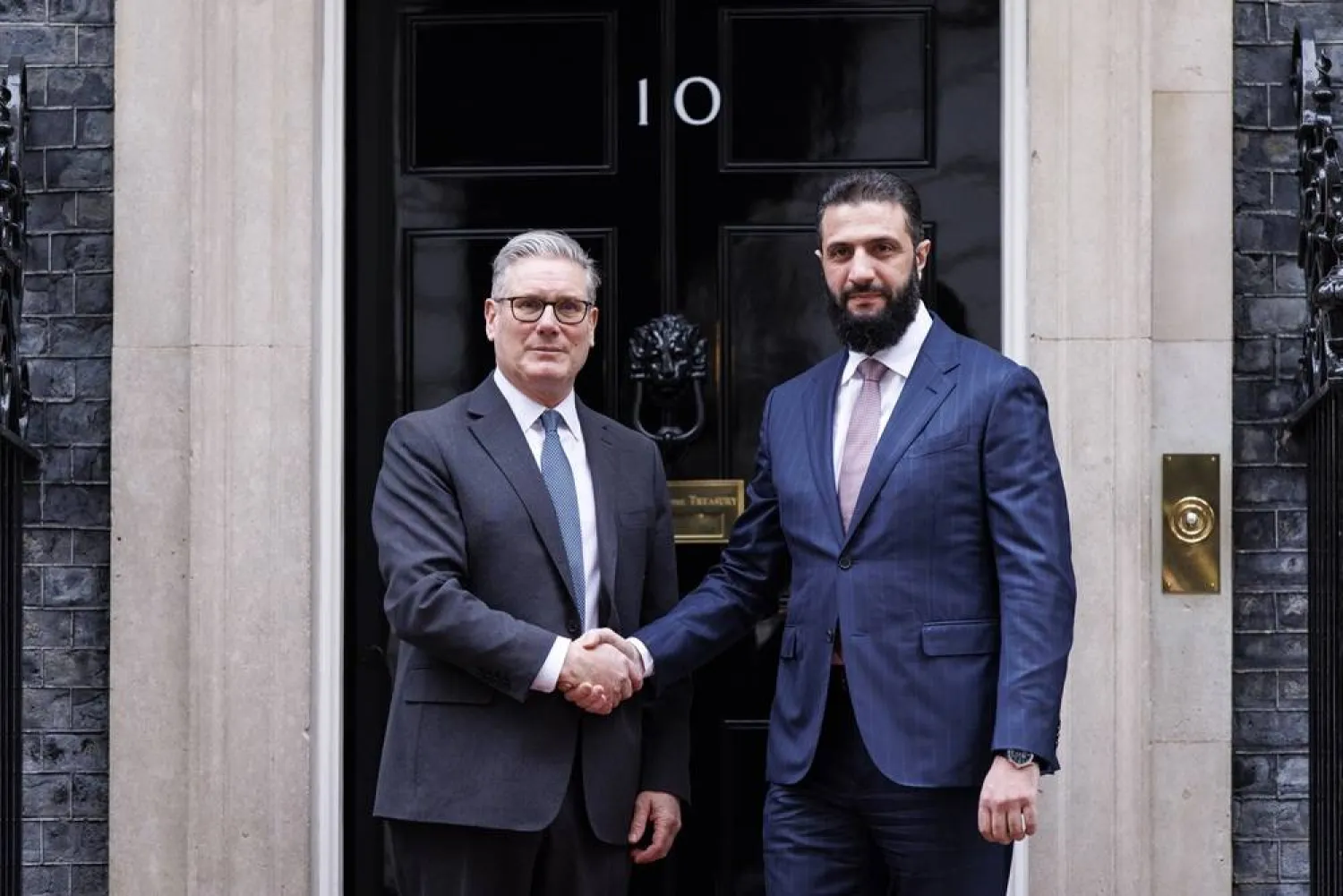

Syrian President Ahmed al-Sharaa said on Tuesday that his country will stay out of the US-Israeli war against Iran unless Syria is subject to aggression and has no diplomatic solutions.
"Unless Syria is targeted by any party, Syria will remain outside any conflict," the Syrian president said at an event hosted by think tank Chatham House in London during his first official visit to the UK.
"We do not want Syria to be an arena of war. But unfortunately, today, things are not governed by wise minds. The situation is volatile and random," the president said.
The month-long conflict has spread across the region, killing thousands, disrupting energy supplies, and threatening to send the global economy into a tailspin.
"We want Syria to have ideal relationships with the entire region, with Lebanon, Iraq, Türkiye, Saudi Arabia, and world powers like the UK, France, Germany and the US. I think that Syria is qualified to start a strategic relationship network," he said, responding to a question on whether Syria would stay neutral while the conflict goes on.
Syria has been keen to stay on the sidelines of the regional conflict that has pulled in neighboring countries, including Lebanon, where armed group Hezbollah is locked in fighting with Israeli ground troops, and Iraq, where Iran-aligned factions have launched drone and rocket attacks.
Syria sent thousands of troops to its western border with Lebanon and its eastern border with Iraq earlier this month.
Syria's defense ministry said the deployment was part of efforts to "protect and control the borders amid the escalating regional conflict".
"We had enough war. We paid a large bill. We are not ready for another war experience," Syria's president said.
Sharaa meets Starmer, King Charles
King Charles III hosted Sharaa at Buckingham Palace on Tuesday.
Sharaa was making his first visit to Britain since ousting long-time iron-fisted former president Bashar al-Assad in 2024.
Earlier Tuesday, Sharaa discussed the war with Iran in talks with Prime Minister Keir Starmer at Downing Street.
The leaders "discussed the need for a viable plan to reopen the Strait of Hormuz, in the face of the severe economic impact of prolonged closure, and agreed to work with others to restore freedom of navigation," a Downing Street spokesperson said.
Since Sharaa has been in power, sectarian tensions have continued to cause repeated bloodshed in Syria, while the ISIS group remains at large.
Starmer said he welcomed the Syrian government's "action" against ISIS and noted progress on counter-terrorism, the spokesperson said.
The British prime minister urged "closer work together on returns (of illegal migrants), on border security, and on tackling people smuggling networks".
Between 2011 and 2021, nearly 31,000 Syrians were granted asylum in Britain after the civil war there sparked a refugee crisis, according to government statistics.
The president's visit came after London announced the resumption of diplomatic relations with Syria in July 2025.
It followed a visit by then foreign minister David Lammy to Damascus, the first visit to Syria by a British minister in 14 years.
The British government said at the time that its engagement with Damascus was aimed at supporting the country's political transition and assisting economic recovery as well as reducing illegal migration, and addressing the issue of chemical weapons.
Sharaa met German Chancellor Friedrich Merz in Berlin on Monday, as he seeks to keep Syria insulated from the repercussions of the current Middle East war.
Europe's top economy is home to the largest Syrian diaspora in the European Union at more than a million, many of whom arrived during the peak of the migrant influx in 2015-2016.
Merz, who has made a tougher immigration policy a priority since taking office last year, said he and Sharaa had agreed eight out of 10 Syrians in Germany should go back "over the next three years".


