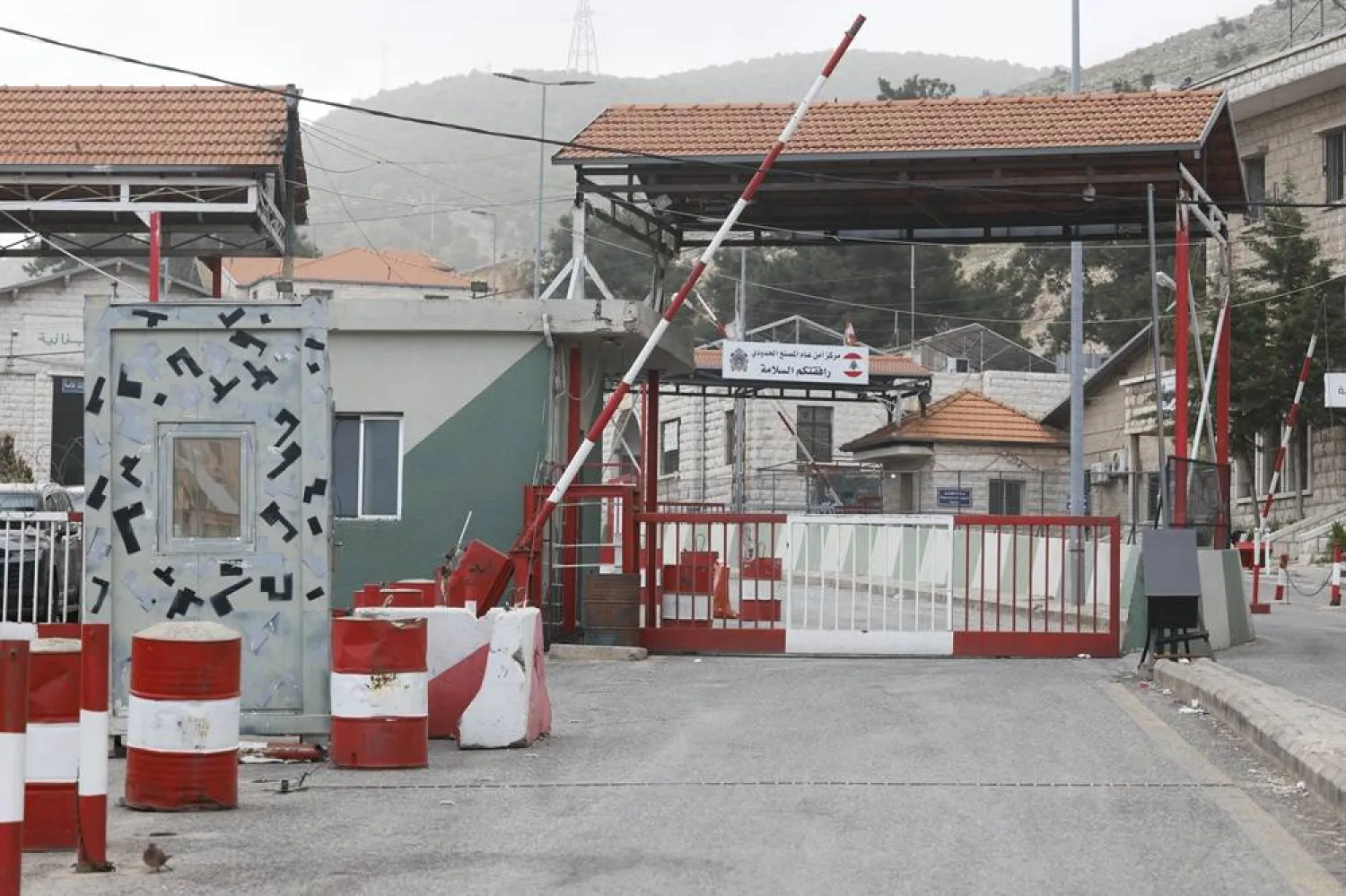

Israel has partially severed Beirut from Damascus after shutting the main border crossings between the two countries, following a warning that it would strike the Masnaa crossing.
The move has disrupted trade and travel, funneling movement through a single crossing in Lebanon’s far northeast, far from both capitals.
Syrian and Lebanese diplomatic contacts helped avert an Israeli strike on Masnaa, but failed to reopen it. The crossing remains fully closed. Major General Hassan Choucair, head of Lebanon’s General Security, said protecting personnel and equipment at the crossing was the top priority.
He stressed the crossing was legal and could not be used for arms smuggling, noting all trucks and vehicles undergo strict inspections, and dismissed reports of smuggling as false.
Security measures
A Lebanese security source flatly rejected Israeli claims that the crossings are used to smuggle weapons, saying traffic in both directions is subject to strict inspections by Lebanese and Syrian authorities, making any such operations impossible.
The source told Asharq Al-Awsat the allegations were baseless and carried political and security motives beyond counter-smuggling.
The Israeli escalation over the crossings forms part of broader pressure linked to the war on Lebanon, the source said, and may pave the way for a land blockade along the Lebanese-Syrian border to redraw the rules of engagement with Hezbollah.
The source warned the developments could signal a new security reality on the border ahead of any future confrontation.
Undeclared blockade
Border crossings are no longer mere transit points; they have become a focal point where economic strain meets security and political tensions. With movement paralyzed, losses mounting, and tensions rising, Lebanon appears to be entering a phase of compounded pressure, widely seen as an undeclared blockade.
MP Sajih Attieh, head of parliament’s public works committee, said conditions at the crossings are steadily deteriorating. Of five crossings with Syria, only one remains effectively open, Jousieh in the Qaa area.
He told Asharq Al-Awsat that three crossings in Akkar, Aboudieh, Arida, and Al-Buqiaa remain shut, while efforts to reopen Aboudieh are being hindered by Syrian hesitation due to limited security capacity.
Masnaa, the main artery between Lebanon and Syria in the Bekaa Valley, has been paralyzed since Sunday night after the Israeli warning. Activity has shifted to Jousieh, where trucks loaded with goods are backed up on both sides, along with civilian traffic.
Attieh said the closures have nearly halted land transit and cross-border trade, hitting key facilities, notably the port of Tripoli, which is losing about $100,000 a day due to the suspension of overland transit goods.
State revenues fall
The closures have also choked Lebanese exports, especially fruit, vegetables and local industries, which have lost their main overland route to Arab markets, adding pressure on productive sectors.
Attieh said the impact extends beyond exports. Maritime imports have dropped by up to 70%, affected by the closure of the Strait of Hormuz, triggering a sharp fall in state revenues.
Monthly revenues from customs, imports and value-added tax have fallen from about $450 million to roughly $125 million, he said, adding that the government has frozen implementation of the 2026 budget.
Public spending had been set based on revenues nearing $6 billion, making the freeze unavoidable amid a roughly 70% drop in imports, he said, warning that the risk of a deeper economic crisis will become clearer once the war ends.