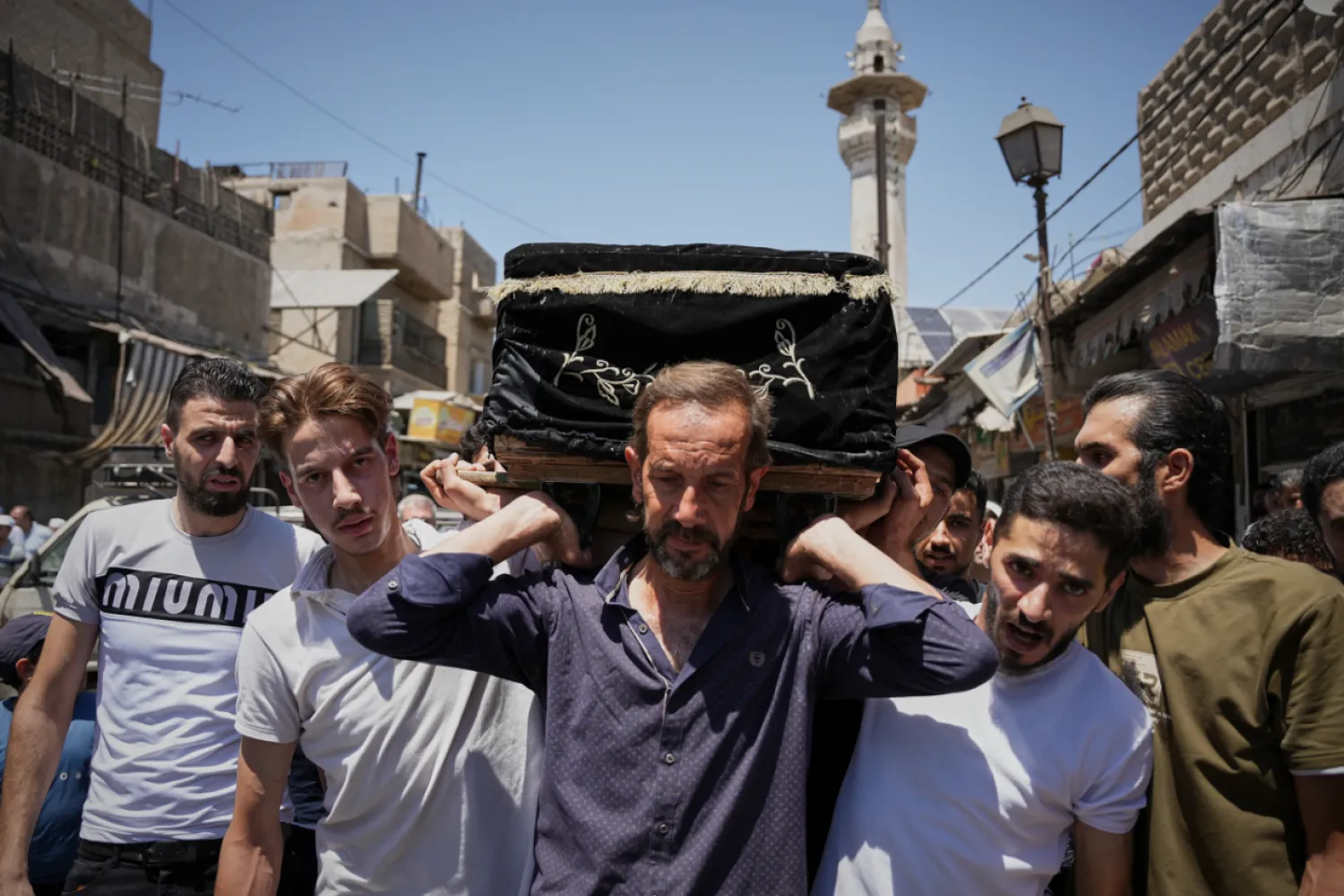
Mourners in Damascus Bury Cafe Blast Victims as Officials Promise Justice

Mourners carry the coffin of Fathi Muhammad Saeed Qabbani, who was killed Tuesday when an explosive device detonated in a cafe near Damascus' main courthouse complex, during his funeral in the Al-Midan neighborhood of Damascus, Syria, Friday, July 3, 2026. (AP Photo/Omar Albam)
TT

Mourners in Damascus Bury Cafe Blast Victims as Officials Promise Justice

Mourners carry the coffin of Fathi Muhammad Saeed Qabbani, who was killed Tuesday when an explosive device detonated in a cafe near Damascus' main courthouse complex, during his funeral in the Al-Midan neighborhood of Damascus, Syria, Friday, July 3, 2026. (AP Photo/Omar Albam)

Mourners filed through Damascus on Friday, a day after an explosive device set off in a cafe in the Syrian capital killed 10 people.

The funeral procession in the normally bustling Midan neighborhood carried the coffins of three of the victims. Another 21 were wounded in the explosion at a popular cafe near the capital's main judicial complex, which was often frequented by lawyers.

Syria's Health Ministry raised the death toll Friday from nine to 10. Officials have promised to arrest those behind the attack, but no updates were announced in the investigation. No group has claimed responsibility for the attack.

Bahaa Qabbani said his brother, Fathi Qabbani, a married father of one son, worked at a shop near the site of the explosion and was passing by the cafe at the moment of the blast. He was killed, The AP news reported.

Qabbani called the perpetrators of the attack “a group of terrorists who are against the homeland,” and called on security forces to “take hold of the country with an iron fist."

Although there is so far no indication who carried out the attack, many were quick to blame loyalists of former President Bashar Assad, who was ousted in an insurgent offensive in December 2024. During the funeral procession, some mourners chanted, “The people want remnants of the former regime to be executed.”

Also Friday, Syria's state-run news agency SANA reported that three members of security forces were wounded in an attack on a checkpoint at the entrance to the Damascus suburb of Jaramana. It said that a man on a motorcycle threw two hand grenades at the checkpoint guards and tried to throw a third one, but it exploded in his hand, killing him.

Another person was arrested in connection with the attack, SANA reported.

Since overthrowing the Assad dynasty, Syria’s new rulers have struggled to exert control across the country and to check extremist groups.

Deadly attacks blamed on the ISIS group have targeted religious minorities, including a suicide attack on a church in a Damascus suburb and a bomb set off in a mosque in a predominantly Alawite area in the city of Homs.


Former Syrian Colonel Unfit for Trial in Landmark UK Crimes Against Humanity Murder Case

Prosecutors said al-Salem was part of a Syrian Air Force Intelligence group that suppressed demonstrations in the Damascus suburb of Jobar when the government carried out a bloody crackdown during the 2011 uprising against former President Bashar al-Assad’s authoritarian leadership. (AFP)
TT

Former Syrian Colonel Unfit for Trial in Landmark UK Crimes Against Humanity Murder Case

Prosecutors said al-Salem was part of a Syrian Air Force Intelligence group that suppressed demonstrations in the Damascus suburb of Jobar when the government carried out a bloody crackdown during the 2011 uprising against former President Bashar al-Assad’s authoritarian leadership. (AFP)

A former Syrian air force colonel is unfit to stand trial in a landmark British case charging him with three counts of murder as crimes against humanity for attacks on civilians in 2011, a judge said Friday.

Not guilty pleas were entered on behalf of Salem al-Salem, 58, in the Central Criminal Court after prosecutors accepted medical findings that his rare neurological condition was too advanced for him to enter a plea or face trial.

Justice Bobbie Cheema-Grubb said al-Salem will face a trial of facts next year on murder and torture allegations but he won't be required to appear in court. The trial will determine whether he committed the acts but cannot result in a conviction because of his condition.

Al-Salem is the first person in the UK charged with murder as a crime against humanity under the International Criminal Court Act of 2001. UK law allows British prosecutors to bring charges for some international offenses, including crimes against humanity and torture, regardless of where they were committed.

Prosecutors said al-Salem was part of a Syrian Air Force Intelligence group that suppressed demonstrations in the Damascus suburb of Jobar when the government carried out a bloody crackdown during the 2011 uprising against former President Bashar al-Assad’s authoritarian leadership.

Al-Salem “was tasked with quelling civilian protests against the regime and the defendant ordered officers under his command to shoot protesters and he himself shot protesters,” prosecutor Emilie Pottle said at a previous hearing. “The murders were part of a widespread and systemic attack against the civilian population.”

Al-Salem, who appeared by a video link with an oxygen mask over his face, has a progressive and fatal motor neuron disease that has left him paralyzed in all four limbs with cognitive impairment and limited ability to communicate, prosecutor Tom Little said.

“The motor neuron disease is now advanced. In addition, there is associated depression, apathy and cognitive impairment as well as severely restricted speech,” Little said in reading out one doctor's report. “The defendant is monosyllabic and only really understandable to close family.”

He is charged with murder in the deaths of Omar Al-Homsi, Nizar Fayoumi-AlKhatib and Talhat Dalal in April and July 2011. He faces a count of conduct ancillary to murder in the death of Mohammed Salim Zahrak Balik.

Al-Salem is also charged with torturing three other people as part of his official duties. Prosecutors said he was present and participated in interrogations when detainees were beaten, shocked and hung by handcuffs from a ceiling.


Israel Military Says Struck Hezbollah Positions in South Lebanon

Relatives of missing victims weep, as they gather at the site of destroyed buildings that were hit in an Israeli airstrike in Qannarit village, southern Lebanon, Saturday, June 20, 2026. (AP Photo/Mohammed Zaatari)
TT

Israel Military Says Struck Hezbollah Positions in South Lebanon

Relatives of missing victims weep, as they gather at the site of destroyed buildings that were hit in an Israeli airstrike in Qannarit village, southern Lebanon, Saturday, June 20, 2026. (AP Photo/Mohammed Zaatari)

Israel's military said Friday it had struck several Hezbollah sites in southern Lebanon a day earlier in response to attacks on its troops in the area.

Israel and Lebanon signed a US-sponsored framework agreement last week to pave the way for peace between the two countries and disarm Iran-backed militant group Hezbollah.

Israeli officials have repeatedly ruled out withdrawing troops from southern Lebanon, maintaining that any withdrawal would happen only after Hezbollah has been disarmed across Lebanon.

"The -army- struck approximately 10 Hezbollah infrastructure sites and a truck used to transfer weapons in southern Lebanon," the military said in a statement.

The sites were in the areas of the south Lebanon towns of Bint Jbeil, Beit Yahoun, Kounine, and Baraachit, and "were used by Hezbollah to advance attacks against -Israeli- soldiers operating in the Security Zone," the army said, AFP reported.

The military said the strikes on the infrastructure sites were carried out following attacks on its soldiers inside the Israeli-declared "security zone", which stretches about 10 kilometres (six miles) deep inside Lebanese territory along the border.

The military said the strike on the truck carrying weapons near the area was carried out to remove a threat to the soldiers.

The Lebanese state-run news agency reported three Israeli strikes Thursday night, near the town of Baraachit in the Bint Jbeil area, and in Nabatiyeh Al-Fawqa.

The agency also reported two injuries in a strike on the town of Seddiqine near Tyre.

Netanyahu visited troops in southern Lebanon on Tuesday, vowing that his country's forces would stay in the area as long as Iran-backed Hezbollah remained a threat.

The deal between Israel and Lebanon makes any Israeli withdrawal from occupied Lebanese land conditional on Beirut disarming Hezbollah, starting with "pilot zones" that the Lebanese military will take over.

Hezbollah drew Lebanon into the Middle East war on March 2 with rocket fire at Israel, triggering Israeli airstrikes and a ground invasion.

Israeli attacks since the start of the war have killed about 4,300 people, according to Lebanese official figures.

In the same period, the Israeli military has reported 38 soldiers and one civilian contractor killed.


Al-Zouba Leads Yemeni Efforts to Link Relief With Sustainable Development

Yemeni Planning and International Cooperation Minister Afrah al-Zouba meets representatives of international organizations partnering with Yemen to discuss strengthening development cooperation (Saba).
TT

Al-Zouba Leads Yemeni Efforts to Link Relief With Sustainable Development

Yemeni Planning and International Cooperation Minister Afrah al-Zouba meets representatives of international organizations partnering with Yemen to discuss strengthening development cooperation (Saba).

The Yemeni government has intensified its diplomatic and development efforts in Germany through a series of meetings held by Minister of Planning and International Cooperation Afrah al-Zouba with international organizations, partner organizations, and the World Food Programme (WFP), aimed at strengthening cooperation and mobilizing support for Yemen's economic recovery and sustainable development.

The meetings took place on the sidelines of the Hamburg Sustainability Conference 2026, where al-Zouba met representatives of Vision Hope, CARE, Save the Children, and Oxfam to discuss ways to improve the implementation of humanitarian and development projects and overcome challenges facing various sectors, with the goal of improving project implementation and maximizing their impact on target communities.

During the meetings, al-Zouba stressed the importance of the strategic partnership between the Yemeni government and international organizations, praising their role in implementing humanitarian and development programs. She also highlighted the need to transfer successful experiences, strengthen knowledge exchange, and promote best practices.

The minister underscored the importance of conducting comprehensive and realistic assessments to measure the development impact of completed projects and incorporating lessons learned into the design of future programs and projects to enhance performance and achieve more sustainable development outcomes.

According to state media, representatives of the international organizations reaffirmed their commitment to continuing support for Yemen's development efforts and expressed appreciation for the Planning Ministry's efforts to strengthen dialogue and coordination aimed at improving project efficiency and achieving sustainable development impact.

Yemeni Minister of Planning and International Cooperation Afrah al-Zouba (Saba)

Supporting Reforms and Peace

In the German capital, Berlin, the Yemeni minister met officials from the Friedrich Ebert Foundation to discuss expanding cooperation in the areas of social and economic policy, supporting peacebuilding efforts, and improving aid effectiveness in line with the Yemeni government's priorities and its reform and recovery plans.

The discussions also covered social protection, economic reforms, community dialogue, as well as support for applied research and evidence-based policymaking to improve public policy and strengthen coordination among partners.

Both sides reaffirmed their commitment to continued coordination and expanding areas of joint cooperation in support of the government's efforts to achieve sustainable development and strengthen economic recovery.

Al-Zouba also expressed the government's appreciation for the foundation's continued presence in Yemen and its decision to continue operating from the interim capital, Aden, describing the move as a reflection of its commitment to supporting national institutions and strengthening cooperation with the government.

Yemeni Planning Minister Afrah al-Zouba Meets Officials of Germany's Friedrich Ebert Foundation (Saba)

Food Security Tops Agenda

In a separate meeting, al-Zouba met with World Food Programme (WFP) Acting Executive Director Carl Skau to discuss ways to improve food access for the most vulnerable groups, particularly children and mothers, while reducing costs through innovative mechanisms that make use of local markets and support producers, farmers, and fishermen.

The minister stressed the importance of integrating these efforts with national social safety nets and school feeding programs, while highlighting success stories that demonstrate the impact of the partnership between the government and the WFP. She emphasized the need to shift from humanitarian response toward building resilience, promoting development, and breaking cycles of dependency.

Al-Zouba also called for stronger international advocacy efforts to mobilize funding for Yemen amid declining humanitarian assistance and urged that the challenges facing fragile states be placed on the G20 agenda. She noted that Yemen continues to bear the consequences of external crises, including the impacts of climate change.

According to state media, the UN official reaffirmed the WFP's commitment to continuing its support for Yemen and stressed the importance of encouraging donors to focus on the country's needs. He also expressed support for strengthening national capacities and investing in resilience and development.

The meetings came days after the minister announced that the International Development Association (IDA), part of the World Bank Group, had approved a $101.8 million Cash for Nutrition and Livelihoods Project for Yemen.

The project targets households with pregnant and breastfeeding women, as well as mothers of children under the age of two, in governorates most affected by malnutrition. It will provide targeted cash transfers, nutrition awareness programs, early screening for malnutrition, and components aimed at supporting livelihoods, strengthening institutional capacity, and enhancing social protection systems and digital payment systems.

Al-Zouba said the project's approval reflects the strength of the partnership between the Yemeni government and the World Bank and supports the priorities of the 2026-2030 Country Partnership Framework, which aims to strengthen food security, improve livelihoods, and gradually transition from humanitarian response toward building the capacity of national institutions.