
Macron Says Syria Must Not Be Destabilized After Bombs Wound 18

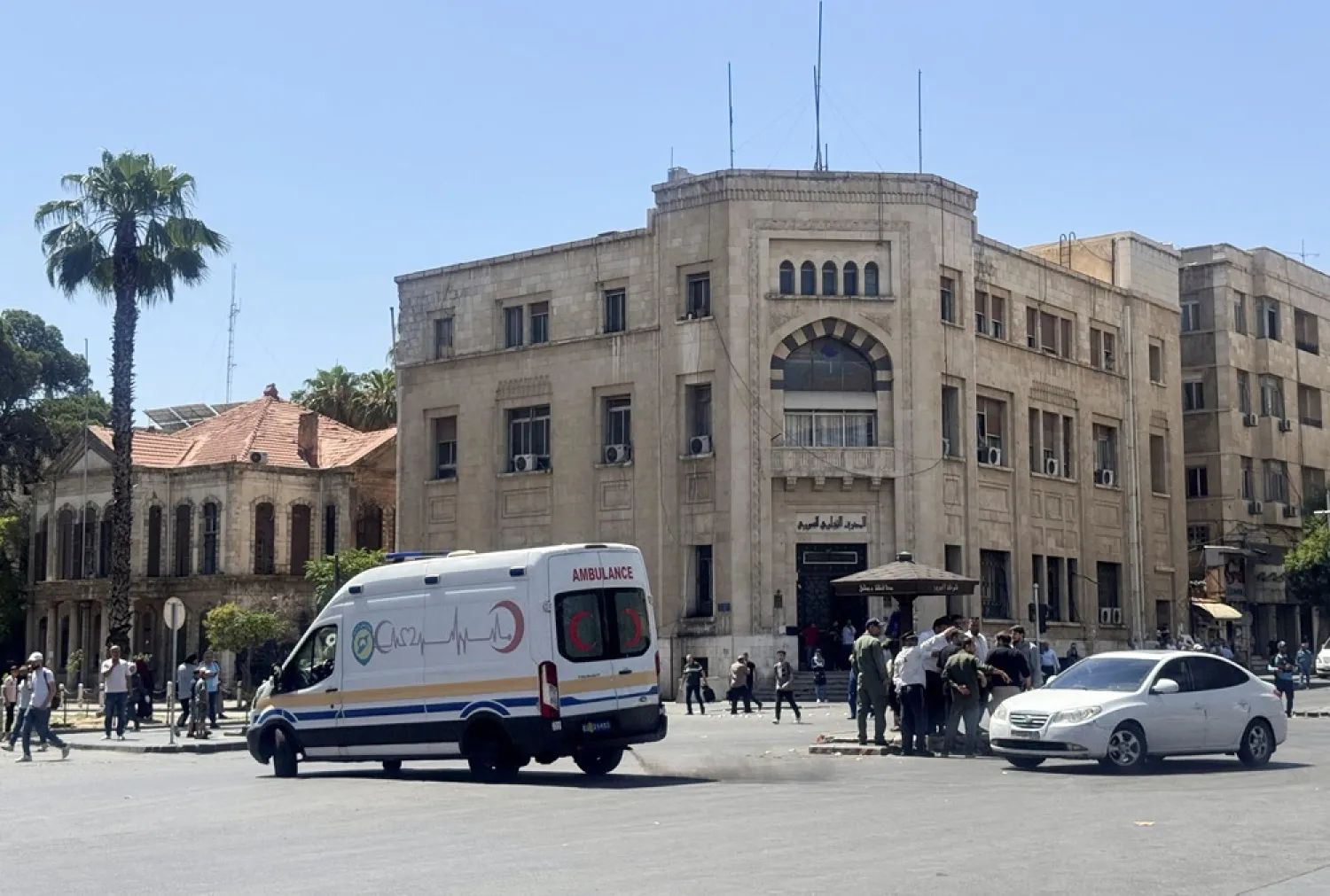
An ambulance drives past the site where explosive devices blew up near a hotel where French President Emmanuel Macron was meant to be staying, in Damascus, Syria, July 7, 2026. (Reuters)
TT

Macron Says Syria Must Not Be Destabilized After Bombs Wound 18

An ambulance drives past the site where explosive devices blew up near a hotel where French President Emmanuel Macron was meant to be staying, in Damascus, Syria, July 7, 2026. (Reuters)

French President Emmanuel Macron warned on Tuesday that Syria must not be destabilized after twin bomb attacks near the Damascus hotel where he spent the night, during a landmark state visit to a country emerging from years of civil war. 

The attacks cast a shadow over the first trip of a European Union head of state since Bashar al-Assad was toppled in late 2024, as President Ahmed al-Sharaa tries to rebuild the country's image after more than a decade of conflict. 

The two leaders vowed to step up economic and diplomatic ties with new ambassadors to be installed in each country. 

In a joint press conference with his Syrian counterpart, Macron said we must "not let ourselves be destabilized" by such attacks, before which he had already left for the presidential palace in the heart of the Syrian capital, and reiterated Paris' support for the country. 

Sharaa saluted Macron's "courage" for carrying on with his visit despite the bombings. 

An AFP team saw Macron arrive for a meeting with Sharaa, while other journalists heard at least one blast echo through Damascus before seeing a plume of smoke rising near the hotel, where security forces closed a road and ambulances rushed to the scene. 

Syria's interior ministry said one bomb had been placed inside a car parked on the side of a road, while the second was planted in a garbage container. 

It said they exploded "while preparations were underway" to dismantle them. 

Syria state media said the blasts wounded 18 people, including four police officers. 

An AFP photographer near Syria's tourism ministry, opposite the hotel, saw windows damaged by one of the explosions, amid a heavy security presence. 

- Economic forum - 

France's Elysee Palace said Macron would continue his trip until his expected departure on Tuesday evening, when he travels to Ankara for a NATO summit and holds talks there the following day with Türkiye's president. 

The explosions are the second in the Syrian capital since Thursday, when 10 people were killed in a bombing in a Damascus cafe. 

The French president had postponed announcing the date of his visit until his plane landed on Monday, for security reasons. 

Syrian Foreign Minister Asaad al-Shaibani said that Macron's visit marked a "pivotal point" in the two countries' relations, vowing to continue to "confront terrorism in all its forms". 

Sharaa also announced "our agreement to begin the process of exchanging resident ambassadors between Damascus and Paris as soon as possible, signaling the return of diplomatic relations to their normal state". 

The blasts came moments before Syrian state television announced Macron's arrival at the palace. 

The visit included an economic forum during which the two sides signed 15 bilateral agreements in several sectors, including civil aviation, health, banking, water infrastructure and roads, although French investors remain cautious about the situation. 

"After the Strait of Hormuz crisis, the world realizes the value of a safe and stable corridor," Sharaa said at the forum. 

"Here the importance is highlighted of the geography of Syria, which today has regained its vital role as an indispensable link in the global corridors market." 

Macron was accompanied by several economic players including Rodolphe Saade, chief executive of maritime transport giant CMA CGM, and TotalEnergies head Patrick Pouyanne. 

Before the Damascus blasts, Pouyanne said that "the security situation still doesn't allow us to operate, but I think it is a positive initiative to come here, to Damascus". 

- Civil society - 

Before arriving at the presidential palace, Macron held a meeting Tuesday morning with civil society representatives at the Four Seasons Hotel. 

The French leader had said on X that "nothing can smother the aspiration of Syrian women and men to live in a fully sovereign, safe, pluralistic and united Syria". 

The last French president to visit Syria was Nicolas Sarkozy in 2009, before Assad brutally crushed pro-democracy protests in 2011, sparking a conflict that killed more than half a million people and devastated the country's infrastructure and industry. 

In May 2025, Macron hosted Sharaa in France on his first official visit to a European country, a move that preceded the Syrian leader's trip to Washington last year to meet US President Donald Trump. 


Israel Allocates $434 Million for 34 New West Bank Settlements

Israeli Finance Minister Bezalel Smotrich speaks at a press conference regarding settlements expansion for the long-frozen E1 settlement, that would split East Jerusalem from the occupied West Bank, near the Israeli settlement of Maale Adumim in the Israeli-occupied West Bank, August 14, 2025. (Reuters)
TT

Israel Allocates $434 Million for 34 New West Bank Settlements

Israeli Finance Minister Bezalel Smotrich speaks at a press conference regarding settlements expansion for the long-frozen E1 settlement, that would split East Jerusalem from the occupied West Bank, near the Israeli settlement of Maale Adumim in the Israeli-occupied West Bank, August 14, 2025. (Reuters)

Israel's security cabinet approved ‌a budget of 1.3 billion shekels ($434 million) for establishing 34 new settlements in the occupied West Bank, right-wing Finance Minister Bezalel Smotrich said on Tuesday, adding to tensions over territory widely viewed as central to a potential Palestinian state.

UN bodies, Palestinians and most countries view the settlements as illegal under international conventions - a stance disputed by Israel - and a primary obstacle to peace.

Smotrich, who has long opposed Palestinian ‌statehood, is head of ‌the Religious Zionism party that ‌draws ⁠much of its support ⁠from settlements and is running in the upcoming legislative election on October 27.

The planned settlements would bring the total established under his four-year tenure to 103.

Smotrich said another 1.075 billion shekels would be approved to pave roads to the new settlements.

Last ⁠month, government ministers referred the settlement ‌funding plan to the security ‌cabinet.

Smotrich called the cabinet's decision historic and a "day of ‌celebration for Israel and settlements", thanking Prime Minister Benjamin ‌Netanyahu for his support.

Opinion polls point to Netanyahu losing in the October election.

"We are strengthening the security of the State of Israel, killing the idea of establishing ‌a terrorist state in the heart of the country, and strengthening our hold ⁠on ⁠the homeland in Judea and Samaria," Smotrich said in a statement, using the biblical term for the West Bank.

There has been a rise in settler violence in recent months against Palestinians and their property. About 700,000 Israeli settlers live among 2.7 million Palestinians in the West Bank and East Jerusalem.

Israel has not extended sovereignty to the occupied West Bank, while refuting international objections to the settlements and arguing that it is a disputed territory where Jews have lived for thousands of years.


Sudan Risks Deeper Hunger Crisis Due to War, Aid Cuts and Hormuz Disruption, Says WFP

A Sudanese woman peels beans inside a shelter in the al-Rahmaniya camp for displaced people near the city of al-Obeid in the southern Kordofan region on July 9, 2026. (AFP)
TT

Sudan Risks Deeper Hunger Crisis Due to War, Aid Cuts and Hormuz Disruption, Says WFP

A Sudanese woman peels beans inside a shelter in the al-Rahmaniya camp for displaced people near the city of al-Obeid in the southern Kordofan region on July 9, 2026. (AFP)

Sudan risks sliding backwards into deeper hunger as conflict, aid funding cuts and rising agricultural costs driven by disruption linked to the Iran war threaten to reverse gains made after famine took hold in parts of the country, a senior World Food Program official said on Tuesday.

The war between Sudan's army and the paramilitary Rapid Support Forces, now in its fourth year, has displaced millions and devastated much of the country.

Aid ‌agencies have ‌repeatedly warned of worsening food insecurity and limited humanitarian access.

Sudan remains ‌the ⁠world's largest humanitarian ⁠crisis, with around 5 million people facing emergency or catastrophic levels of hunger, even after an intensive aid response helped reduce the number of people in famine-like conditions, Carl Skau, the WFP's acting executive director, told Reuters.

"It's a massive crisis, both in terms of numbers, but also the gravity," he said, adding that more than 100,000 people were still facing famine-like conditions, placing them in the highest level of the ⁠UN-backed IPC hunger classification.

"With these kinds of numbers in ‌IPC (Phase) 5 starvation it is extremely, extremely serious," ‌he said.

Across Sudan, nearly 19.5 million people face high levels of acute food insecurity, according ‌to the IPC.

Skau said recent fighting around al-Obeid in North Kordofan ‌had raised fears the city could suffer a fate similar to el-Fashir in Darfur, where conflict and siege conditions have trapped civilians and hindered aid deliveries.

In recent days, however, violence has eased somewhat, raising hopes aid deliveries can be expanded from 100,000 to 250,000 people around ‌al-Obeid.

The WFP is also increasingly concerned about renewed fighting over the past week in Darfur, which has forced the ⁠closure of the Tine ⁠border crossing, a route from Chad into Darfur.

Throughout the country WFP has reduced the number of people it assists from 5 million a year ago to about 3.5 million and reduced rations in many areas, including in Tawila in Darfur, as it faces a $646 million funding gap after cuts from major donors, including the United States, European countries and Britain.

"We're not heading in the right direction here," Skau said. "If anything, we are falling backwards."

Skau also warned that soaring diesel prices and fertilizer shortages linked to the closure of the Strait of Hormuz could further undermine Sudan's food security during the current planting season.

Sudan relies heavily on fertilizer imports from Gulf countries, while much of its agriculture depends on irrigation pumps, which may be too expensive for farmers to run.


Israel Says Ready to Move on Pilot Zones amid New Lebanon Talks

A motorcade delegation arrives on the first day of talks between the Lebanese and Israeli delegations in Rome © Andreas SOLARO / AFP
TT

Israel Says Ready to Move on Pilot Zones amid New Lebanon Talks

A motorcade delegation arrives on the first day of talks between the Lebanese and Israeli delegations in Rome © Andreas SOLARO / AFP

Israel said it was ready to move forward with plans to withdraw troops from two areas of south Lebanon, as the two countries held a new round of talks in Rome on Tuesday.

US-brokered negotiations were taking place in the Italian capital over a framework agreement sealed last month after five rounds of talks in Washington, with Lebanese negotiators hoping for progress on an Israeli withdrawal.

The framework deal emerged after war broke out between Israel and Iran-backed militant group Hezbollah on March 2 against the backdrop of the wider Middle East war.

It calls for an end to the war in Lebanon, disarmament of the Lebanese movement, the deployment of Lebanese troops in the south and for Israeli forces to steadily withdraw from the country in two "pilot zones".

Israeli Foreign Minister Gideon Saar said Tuesday that his country was "ready to move forward implementing these two pilot zones".

"I hope and tend to believe that this round of discussions in Rome will promote it."

The Lebanese presidency had announced on Monday that its delegation to Rome had been instructed "to demand the immediate start of Israeli forces' withdrawal from the two pilot zones before any further discussion".

AFP journalists saw delegation vehicles entering the US embassy compound in the heart of Rome under tight security on Tuesday morning ahead of the talks, while the embassy declined to comment when asked.

According to a Lebanese diplomatic source familiar with the content of the talks, "the Lebanese army is ready to gradually take control of the localities from which the Israeli army would withdraw".

But Hezbollah rejects the agreement outright despite Lebanese government pressure, lowering expectations of success in the negotiations.

Orna Mizrahi of the Institute for National Security Studies (INSS) in Tel Aviv said Israel was "willing to withdraw gradually", but on the condition that "that there will be no presence of Hezbollah in the areas that Israel is withdrawing from".

She added that Israel also seeks to ensure "that the Lebanese army will have the ability... to keep it as a neutralized zone and a neutralized place that Hezbollah cannot come in again."

A US military delegation began discussions with the Lebanese army in Beirut on Saturday on the process for Israeli withdrawal from one of these "pilot zones".

- Limited prospects -

The framework agreement was concluded after a fragile ceasefire came into effect last month in the war between Hezbollah and Israel.

The Israeli army has nonetheless continued limited strikes in the south and has been carrying out demolitions in villages it occupies, according to official Lebanese media.

Lebanon's state-run National News Agency reported a strike on the southern town of Nabatieh al-Fawqa on Tuesday.

Israel's strikes and ground invasion have killed more than 4,300 people since the war started in early March, according to Lebanese authorities.

"The chances of a breakthrough in Rome are quite limited," Karim Bitar, a lecturer at Sciences Po Paris, told AFP.

"What we might see instead is a kind of opportunity to show that the process is still in place... that there are negotiations continuing despite the opposition and the obstacles that are beginning to emerge."

Tehran had demanded the ceasefire in Lebanon in order to conclude a memorandum of understanding with Washington on June 17.

But the region has seen a renewed escalation in recent days, with the US carrying out a third consecutive night of strikes against Iran ahead of the planned reimposition on Tuesday of its naval blockade on Iranian ports with ongoing attacks.

Iran wants to establish a link between negotiations over the regional war and Lebanon, "but we have the wish to disconnect it," said Mizrahi.

Tehran's priorities remain the Strait of Hormuz and the nuclear file, she added.

"The Iranians are using Lebanon as an excuse. They will always use it as an excuse," she said.

Hezbollah drew Lebanon into the regional war on March 2 by launching missiles at Israel in support of Iran.

Bitar, for his part, said that the risk of major fighting returning to Lebanon as a result of the regional escalation "is, of course, not negligible".

"But I think that Iran today will think twice before asking Hezbollah to launch new strikes against Israel," he said.

Tehran "wants to maintain Hezbollah as a long-term deterrent tool and does not want to use it immediately to open a new front," he said.