


Israel Is Building a Miles-Long Earthen Barrier Inside Gaza, Entrenching Its Division

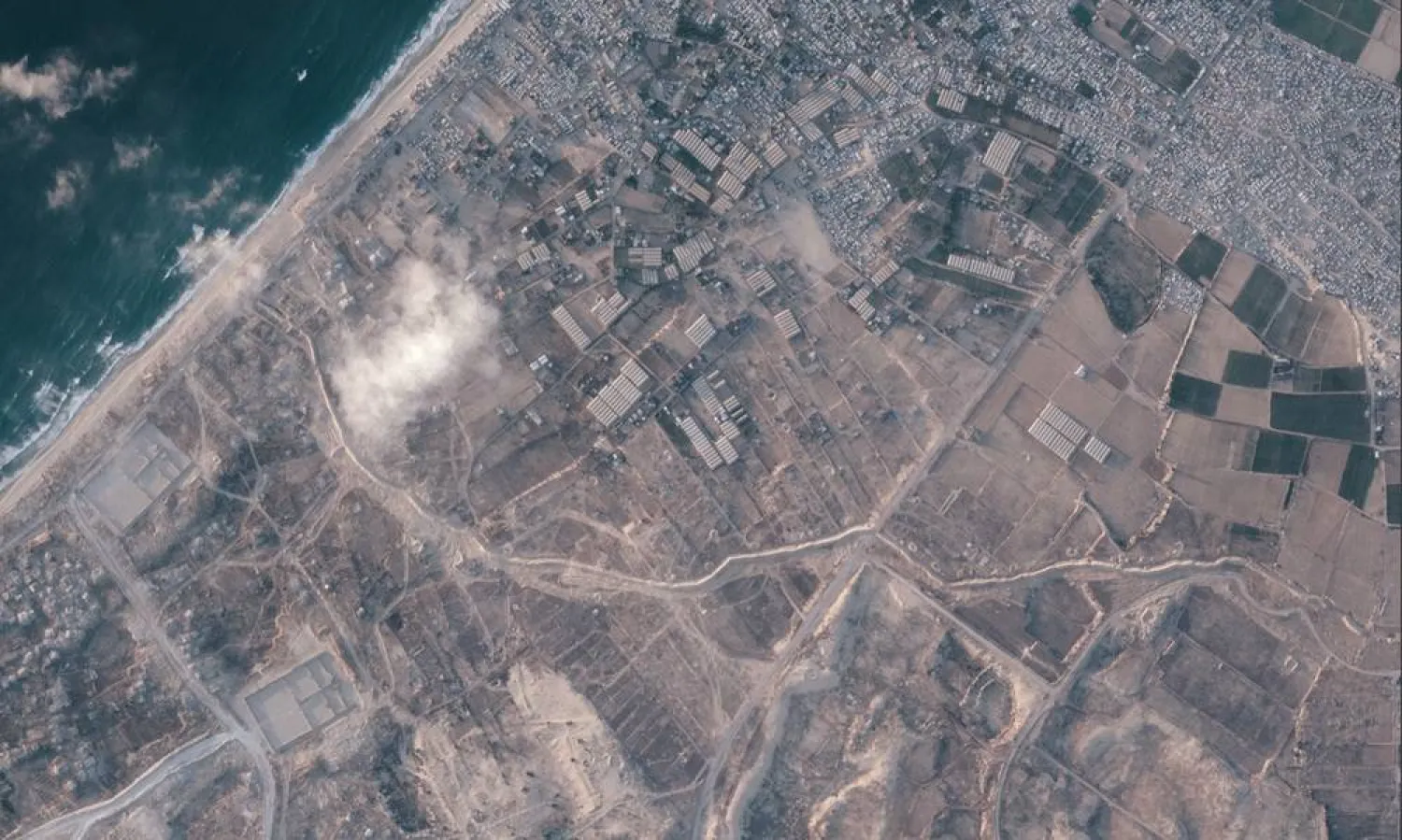
A satellite image from Planet Labs PBC shows a section of an earthen barrier, cutting horizontally across the middle of the image, being built by the Israeli military in the southern Gaza Strip, July 15, 2026. On one side are two military bases, and on the other the Palestinian tent city of Muwasi. (Planet Labs PBC via AP)
TT

Israel Is Building a Miles-Long Earthen Barrier Inside Gaza, Entrenching Its Division

A satellite image from Planet Labs PBC shows a section of an earthen barrier, cutting horizontally across the middle of the image, being built by the Israeli military in the southern Gaza Strip, July 15, 2026. On one side are two military bases, and on the other the Palestinian tent city of Muwasi. (Planet Labs PBC via AP)

The Israeli military is quietly but quickly building a giant earthen barrier separating the over 50% of the Gaza Strip it controls from the rest of the territory, according to satellite imagery, further entrenching the division of the tiny Palestinian enclave.

More than 23 kilometers (14 miles) have been constructed in recent months, running through Palestinian communities demolished by the military. That is equivalent to more than half the length of the coastal strip, which is some 40 kilometers (25 miles) long and 11 kilometers (7 miles) wide, and home to over 2 million Palestinians.

When presented with the satellite images, Israel’s military confirmed to The Associated Press it has built a physical barrier in the area of the so-called yellow line, the boundary to which Israeli troops withdrew under the October ceasefire deal with Hamas. The line was envisioned in the US-backed agreement as a temporary division of the territory pending a fuller Israeli withdrawal.

But as the truce stagnates, it appears Israel is digging in, heightening Palestinian fears that the line is morphing into a border. Neither the US Central Command, which is tasked with monitoring the ceasefire, nor the Board of Peace, the body led by US President Donald Trump meant to eventually oversee Gaza, would comment on the barrier.

Along with the barrier, the military told AP it has developed a “security zone” around the line, equipped with intelligence and technological assets. It declined to give details on the route of the barrier when asked how far it would be extended. It said the barrier aimed to prevent infiltration and protect Israeli troops and Israeli communities near Gaza.
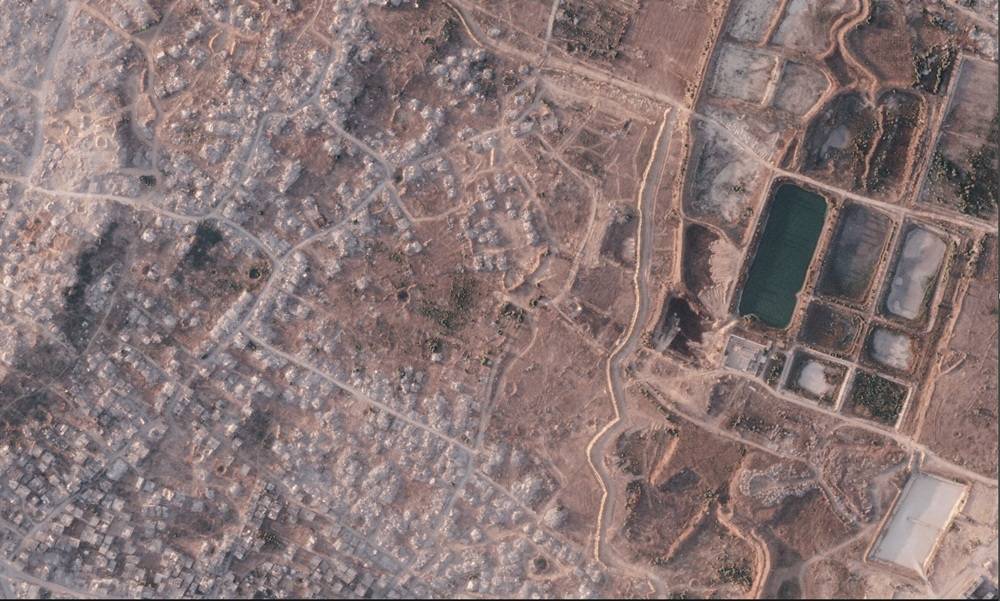
This satellite image from Planet Labs PBC shows a section of an earthen barrier being built by the Israeli military in the northern Gaza Strip, July 8, 2026. To the left is the demolished town of Beit Lahia, and at right a defunct sewage treatment plant. (Planet Labs PBC via AP)

Construction of the barrier is proceeding rapidly

Since the ceasefire deal took hold, Palestinians in Gaza have feared Israel would not return the area of Gaza it controls. But few appear to be aware of the berms now being built around them because of the danger of even approaching that area.

A portion of the berm network in southern Gaza was extended by more than 2 kilometers (1.2 miles) in two weeks this month, according to the satellite images provided by Planet Labs PBC.

The berm was about 500 meters (0.3 miles) long on July 1. By July 15, it was about 2.4 kilometers (1.5 miles), splicing the Israel-controlled ruins of the city of Rafah from Muwasi, site of some of the largest Palestinian tent camps.

If construction continues in its current direction, it will join up with the longest stretch of the barrier, which runs nearly unbroken for around 17 kilometers (10 miles) from the southern city of Khan Younis to near Gaza City, in the north.

Construction began on that stretch in February, and it appears work to extend it further south is continuing, according to the satellite images. More than a kilometer (0.6 miles) was added between June 21 and July 7, running close to an Israeli military base built on the ruins of the town of Bani Suheila, near Khan Younis.

In the far north of Gaza, several unconnected stretches of berms run just outside the largely leveled town of Beit Lahia.

The height of the berms in each place remains unclear. In some places, the barriers appear to run outside the yellow line.

Israel has mostly destroyed and depopulated the half of Gaza it controls

Gaza’s population has been crowded into the coastal area west of the yellow line, most living in squalid tent camps and dependent on aid.

On the other side of the line, satellite imagery shows that Israeli forces have leveled the vast majority of buildings using bulldozers and explosives, virtually erasing several towns and Rafah, once home to more than a quarter million people.

They have carved new road networks and erected new bases on the ruins of Palestinian towns. Agricultural land has also been destroyed. The Israeli military says it is demolishing infrastructure used by Hamas.

The yellow line was never precisely defined, whether in the ceasefire deal or by Israeli or US officials, and it has been inconsistently marked on the ground. The military told AP it is working to clearly mark the route of the yellow line to “reduce friction and prevent harm to uninvolved individuals.”

Israeli forces have killed Palestinians who came close to the line or crossed it. The Israeli military says it fires on those believed to be militants threatening its troops. But those killed have included children and other civilians seemingly unaware of the line. Some soldiers have said they don’t always know who they are firing on and have orders to kill anyone crossing the boundary.
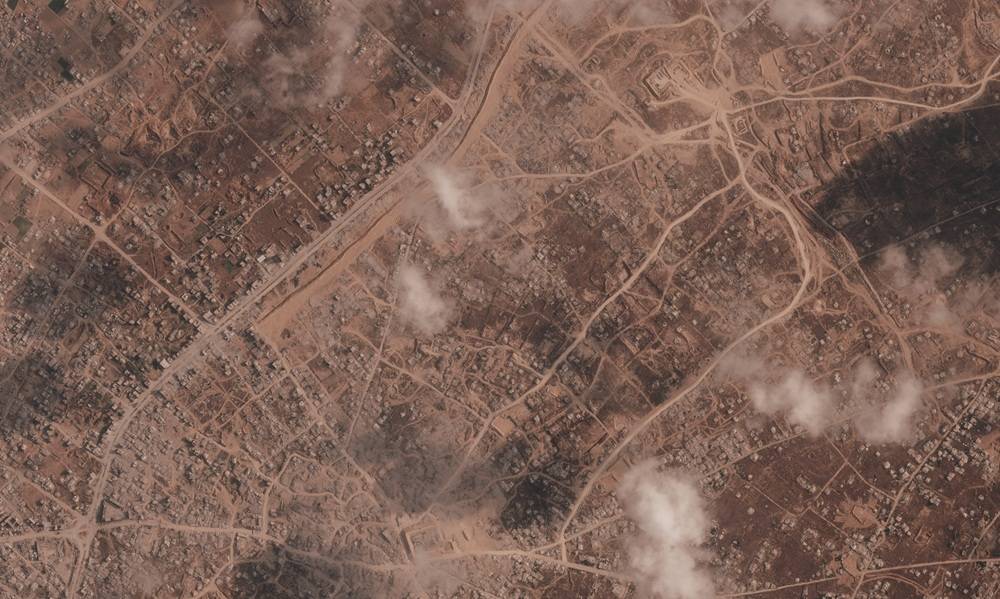
A satellite image from Planet Labs PBC shows a section of an earthen barrier being built by the Israeli military, seen starting at top center of image and moving down at an angle to the left, near the city of Khan Younis in the southern Gaza Strip, July 7, 2026. Two Israeli military bases are visible in the demolished town of Bani Suheila. (Planet Labs PBC via AP)

Israeli strikes have killed hundreds of Palestinians since the ceasefire

Israeli forces have killed more than 1,100 Palestinians since the ceasefire began, most in airstrikes and drone strikes around Gaza. The Israeli military says it is targeting fighters. Militant attacks have killed five Israeli soldiers in the same period.

Under the ceasefire deal, Israel is eventually supposed to withdraw its troops further to the very edges of Gaza, to be replaced by an international security force. But implementation of the deal has been stalled for months.

A former UN diplomat now in charge of coordinating the ceasefire has blamed Hamas’ failure to disarm. Sporadic talks to reach a formula for decommissioning its weapons appear to have made little progress, and Hamas accuses Israel in turn of violating the ceasefire.

The war began after Hamas-led fighters attacked Israeli communities on Oct. 7, 2023, killing around 1,200 people, mostly civilians, and taking 251 others hostage. Israel responded with a punishing military offensive that has killed more than 73,000 people, according to the Gaza Health Ministry.

The ministry, which was part of the recently dissolved Hamas-run government, maintains detailed records viewed as generally reliable by UN agencies and international organizations. It does not distinguish between civilians and fighters but says women and children make up around half of all fatalities.

China, Jordan Call for Maintaining US-Iran Ceasefire

China's President Xi Jinping, right, and King Abdullah II of Jordan shake hands after a signing ceremony at the Great Hall of the People in Beijing, Monday, Aug. 24, 2026. (Andres Martinez Casares/Pool Photo via AP)
TT

China, Jordan Call for Maintaining US-Iran Ceasefire

China's President Xi Jinping, right, and King Abdullah II of Jordan shake hands after a signing ceremony at the Great Hall of the People in Beijing, Monday, Aug. 24, 2026. (Andres Martinez Casares/Pool Photo via AP)

China and Jordan on Monday said the ceasefire between the US and Iran should be maintained, and that the normal passage through the Strait of ⁠Hormuz should be restored, ⁠the two countries said in a jointed statement, according to China's Xinhua ⁠news agency.

Chinese President Xi Jinping met with Jordan's King Abdullah in Beijing on Monday.

China and Jordan said "a comprehensive solution capable of eliminating the root causes" of regional tensions should be reached through dialogue and negotiations.

The two ⁠also expressed "deep ⁠concern over Israel's dangerous escalatory actions in the West Bank and East Jerusalem."

China's President Xi Jinping, left, and King Abdullah II of Jordan review the honor guard during a welcoming ceremony at the Great Hall of the People in Beijing, Monday, Aug. 24, 2026. (Andres Martinez Casares/Pool Photo via AP)

Xi told King Abdullah that China values Jordan's "unique and important role in the region,” which was thrown into crisis after the United States and Israel launched strikes against Iran on February 28.

"China has always advocated for a comprehensive ceasefire (and) resolving disputes through political and diplomatic means," Xi said, according to a Chinese foreign ministry statement.

"(China) believes the sovereignty and security of regional countries including Jordan should be respected," Xi said.

The Chinese president also urged on Monday a "comprehensive, just and lasting solution to the Palestinian issue,” the foreign ministry statement said.

China supports "promoting the resumption of Israeli-Palestinian peace talks anchored on the correct direction of the 'two-state solution'," Xi said.

The two sides also signed several agreements on diplomacy, trade and supply chains, China's foreign ministry said.


Iraq Pushes Back Deadline for Factions to Disarm

This handout photograph taken and released by the Iraq's Prime Minister Media Office on August 19, 2026 shows Iran's Parliament Speaker Mohammad Bagher Ghalibaf (R) shaking hands with Iraq's Prime Minister Ali al-Zaidi before their meeting in Baghdad. (Iraq's Prime Minister Media Office / AFP)
TT

Iraq Pushes Back Deadline for Factions to Disarm

This handout photograph taken and released by the Iraq's Prime Minister Media Office on August 19, 2026 shows Iran's Parliament Speaker Mohammad Bagher Ghalibaf (R) shaking hands with Iraq's Prime Minister Ali al-Zaidi before their meeting in Baghdad. (Iraq's Prime Minister Media Office / AFP)

A senior Iraqi official pushed back a September 30 deadline for pro-Iran factions to hand over their weapons, without offering an explanation for the move or providing a new date.

Iraq has come under pressure from the United States to rein in armed factions, particularly those close to Iran.

The US and Iran have been at war since February 28, drawing in other countries in the region as well as non-state groups backed by the Islamic republic.

For several months, Iraq's government has stood by its deadline, but on Sunday, the security adviser to the prime minister, Qasim al-Araji, told state media the process would only begin at the end of next month.

"September 30 is the date for the international coalition to depart, not the deadline to hand over weapons," Araji told the Al Iraqiya broadcaster, referring to the coalition of US-led forces.

Government spokesman Haider al-Aboudi had made a similar announcement to local media on Friday, despite announcing in June that factions had until the end of September to disarm.

September 30, he said, was "the date for the international coalition to end its presence, not the deadline for armed factions... Perhaps people are confusing the two."

Since taking office in May, Prime Minister Ali al-Zaidi has pledged to ensure the armed factions that emerged in the years that followed the US-led invasion hand over their weapons to the state.

While some factions have in recent weeks said they would join state institutions, others, in particular those closer to Iran, are refusing.

"The situation is extremely complicated," a government official told AFP, requesting anonymity because he was not authorized to speak on the matter.

"The government is insisting on closing the weapons file; but faction leaders are determined to hold onto their weapons because they believe disarming would serve Israel and the United States."

The most powerful armed factions in Iraq include Kataib Hezbollah, a part of Iran's so-called "Axis of Resistance" against the US and Israel.

Another Iraqi source told AFP that Iran views its proxies in the region, "especially in Iraq, as a source of strength it refuses to give up".


Syria Sentences Assad-Era Top Muslim Cleric to Life Imprisonment

Ahmed Hassoun during proceedings before the Fourth Criminal Court in Damascus. (SANA file photo)
TT

Syria Sentences Assad-Era Top Muslim Cleric to Life Imprisonment

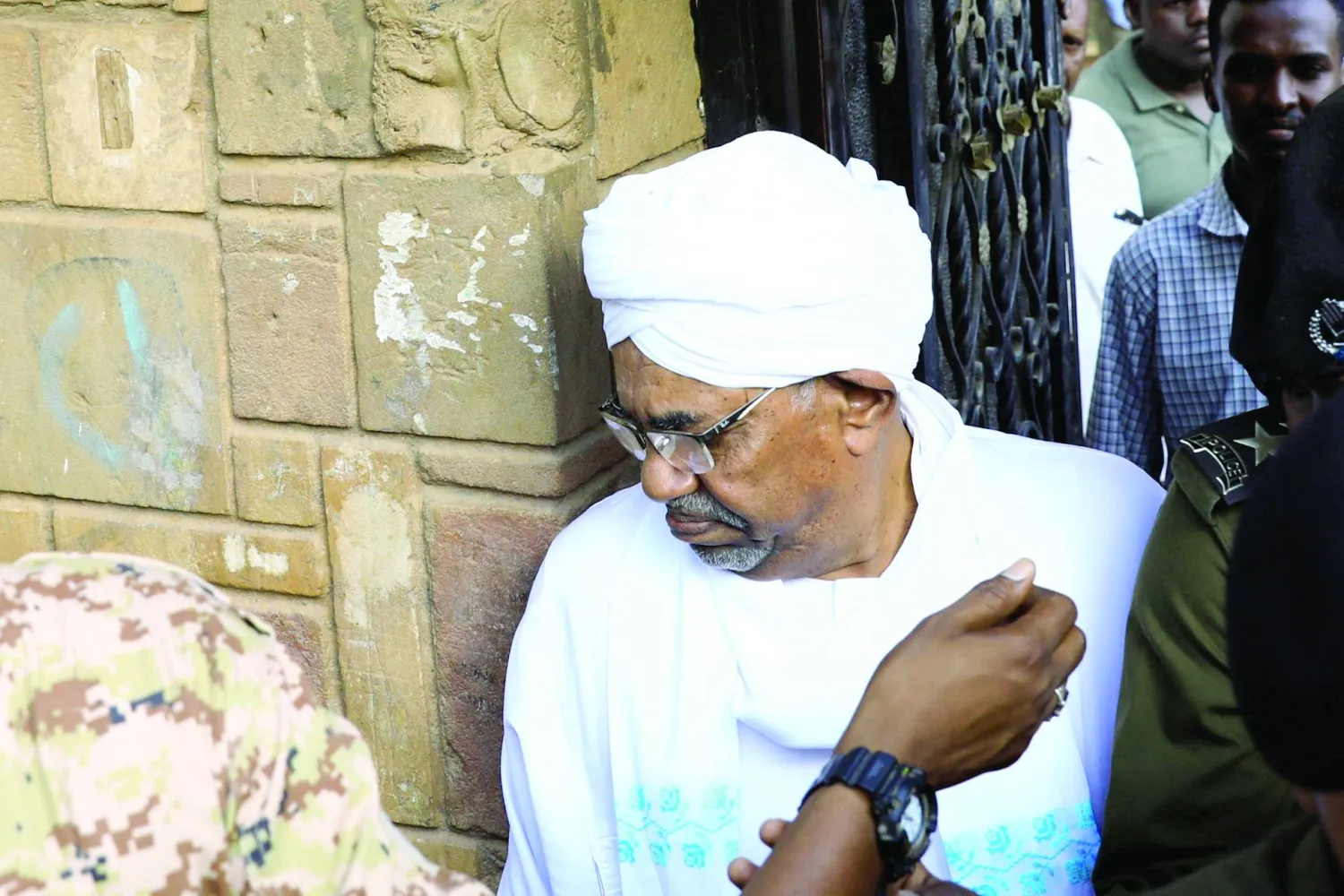
Ahmed Hassoun during proceedings before the Fourth Criminal Court in Damascus. (SANA file photo)

A Syrian court on Monday handed a life sentence to Ahmed Hassoun, the country's former grand mufti under ousted leader Bashar al-Assad, convicting him of crimes including inciting sectarian strife and exploiting his position. 

Hassoun, the 10th Assad-era figure to be sentenced under the new authorities, was Syria's top Muslim cleric for 16 years. 

He was known for his close ties to the former president and frequent appearances alongside him on religious occasions. 

Judge Fakhr al-Din al-Aryan said Hassoun, 77, was guilty of a raft of charges including "inciting civil war and sectarian strife", for which he was jailed for life. 

The cleric was also convicted of "incitement to intentional homicide", "principal complicity in intentional homicide", and "inciting sectarian and racial strife", for which he was handed additional terms ranging from three to 20 years. 

The court also decided to confiscate Hassoun's assets and hand them to the public treasury. 

His sentencing is the first against a religious figure since Syrian authorities began trying Assad-era officials in April. 

On August 11, Syria sentenced Bashar al-Assad, his brother Maher and five other security officials to death in absentia for atrocities committed during Syria's civil war, the first such ruling under the new authorities. 

The former president fled Syria as his government fell in December 2024 and is believed to be in Russia. 

Authorities have also handed death sentences to Atif Najib and Wassim al-Assad, cousins of the former ruler who were tried in person. 

Hassoun, a native of Aleppo whose late father was also an important religious figure, was arrested at Damascus airport in March last year as he tried to flee the country. 

Though he held the post of grand mufti for more than a decade, Hassoun lost the title in 2021 when Syria abolished the position. 

Syria began legal proceedings in April against Bashar al-Assad and other officials accused of atrocities during the civil war, which erupted in 2011 with brutal repression of pro-democracy protesters. 

More than half a million people were killed and millions displaced during the conflict, while tens of thousands disappeared.
