

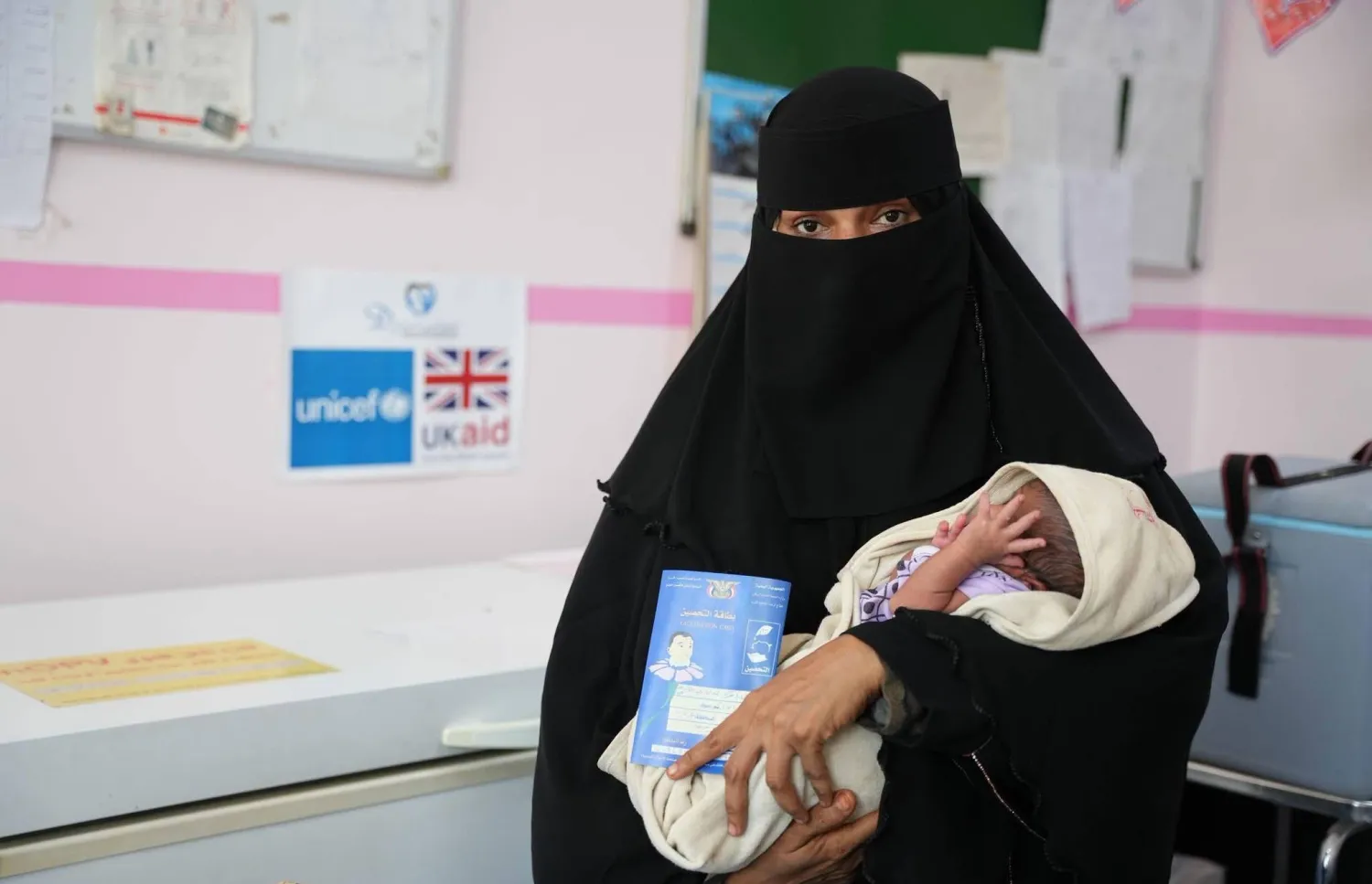

Yemen Urges International Action to Protect Children in Houthi-Controlled Areas

Restrictions on immunization programs have deprived nearly 5 million children of routine vaccinations. (Local media)
TT

Yemen Urges International Action to Protect Children in Houthi-Controlled Areas

Restrictions on immunization programs have deprived nearly 5 million children of routine vaccinations. (Local media)

Yemen’s legitimate government has warned of an impending public health crisis that could threaten millions of children in Houthi-controlled areas, urging the international community to act urgently to ensure the delivery of life-saving vaccines.

It said restrictions on immunization programs have deprived nearly 5 million children of routine vaccinations, raising fears of renewed outbreaks of previously contained childhood diseases, particularly polio, measles, and diphtheria.

The Ministry of Public Health and Population said the continued disruption of vaccination programs and interference in the work of humanitarian organizations were widening immunity gaps among children.

It warned that the consequences could extend beyond Yemen’s borders if restrictions on vaccine access persist.

The warning coincided with growing complaints from residents of the Houthi-held capital, Sanaa, and other areas under the group’s control over the disappearance of childhood vaccines from health centers after years of suspended door-to-door immunization campaigns.

Residents in Sanaa told Asharq Al-Awsat that vaccines are no longer available at maternal and child health clinics, fueling fears of a resurgence of epidemic diseases, particularly after polio cases were reported in those areas despite Yemen having been declared polio-free nearly three decades ago.

According to residents, the suspension of nationwide vaccination campaigns was preceded by Houthi media outlets and mosque sermons that cast doubt on vaccines and urged parents to refrain from immunizing their children, portraying the vaccines as part of a “Western conspiracy.” The vaccines later disappeared from public health facilities.

The Health Ministry stressed that immunization is a fundamental right of every child and one of the most effective public health interventions for reducing child mortality and preventing serious diseases.

Vaccines should not be politicized or used as a means of pressure, as children ultimately bear the greatest cost, it urged.

The ministry attributed the breakdown of immunization services in Houthi-held areas to continued restrictions affecting the national immunization program and its partners, including the suspension of vaccination campaigns, limits on the movement of health teams, interference in humanitarian operations, and the detention of UN and international aid personnel, forcing the scaling back or suspension of health and humanitarian activities.

Vaccines allocated for all Yemeni provinces, including those under Houthi control, remain available through international health partners under established global supply mechanisms, it assured. However, restrictions on their receipt, transportation, and distribution have prevented them from reaching the intended beneficiaries.

The ministry renewed its readiness, in coordination with the World Health Organization (WHO), the United Nations Children’s Fund (UNICEF), Gavi, the Vaccine Alliance, and other health partners, to provide vaccines to all children across Yemen without discrimination.

It called for guarantees that vaccines can be transported, stored, and distributed in line with international medical standards, preserving the cold chain and ensuring they are provided free of charge.

It also appealed to health workers in Sanaa and other Houthi-controlled governorates to cooperate with international organizations, facilitate the delivery of vaccines, medicines, and medical supplies, and remove obstacles hindering immunization and healthcare services.

The ministry further called for international organizations and health teams to be granted safe and unconditional access to health facilities and target communities, independent technical oversight of vaccination programs, full transparency over vaccine stocks and distribution, an independent technical inventory, and the release of detained UN and humanitarian personnel to allow health and relief operations to resume fully.

It warned that continued disruption of immunization services would widen immunity gaps and lead to renewed outbreaks of vaccine-preventable diseases, including polio, measles, diphtheria, whooping cough, and tetanus, posing a health threat that extends beyond Yemen.

Meanwhile, the government said it continues to strengthen immunization programs in areas under its control. Last month, it received a shipment of more than 2.8 million vaccine doses for children and mothers, including vaccines against polio, measles, rotavirus, and other preventable diseases.

UNICEF stressed that vaccination remains one of the most effective ways to save lives and protect communities, and that ensuring the continued availability of vaccines is essential to giving children the opportunity to grow up healthy.



Syria Parliament Votes to Abolish Assad-Era Terrorism Court, Nullify Rulings

Members of Syria's newly formed People's Assembly attend the body's inaugural session, the first parliament session since the end of the rule of ousted Syrian President Bashar al-Assad, in Damascus, Syria, July 12, 2026. (Reuters)
TT

Syria Parliament Votes to Abolish Assad-Era Terrorism Court, Nullify Rulings

Members of Syria's newly formed People's Assembly attend the body's inaugural session, the first parliament session since the end of the rule of ousted Syrian President Bashar al-Assad, in Damascus, Syria, July 12, 2026. (Reuters)

Syria's parliament voted on Wednesday ‌to abolish an Assad-era terrorism court and nullify the legal effects of its rulings, state-run Al-Ikhbariya TV reported, in one of the first significant legislative moves by the country's new assembly.

The Counter-Terrorism Court was established in 2012 as then-President Bashar al-Assad sought to suppress an uprising against his rule, and it was used to prosecute thousands of Syrians for terrorism-related offences.

The move formalizes the court's abolition after Syria's new authorities had already treated it as defunct. ‌In June 2025, President ‌Ahmad al-Sharaa issued a decree dismissing ‌67 ⁠judges who had served ⁠in what he described at the time as the "abolished Counter-Terrorism Court".

Syria's March 2025 constitutional declaration had also called for abolishing the effects of what it described as unjust rulings issued by the court, including returning confiscated property.

The United Nations Human Rights Committee said in 2024 that the ⁠2012 law establishing the court failed to ‌adequately provide key judicial guarantees ‌and raised concerns over arbitrary detention, torture or ill-treatment, and the ‌court's independence. It also noted that the court was ‌permitted to depart from ordinary procedures during prosecution and trial.

The UN's International, Impartial and Independent Mechanism said in a 2024 report that the Counter-Terrorism Court formed part of the judicial system through ‌which detainees held by Assad-era security agencies could be prosecuted. The report documented widespread and ⁠systematic torture ⁠and ill-treatment across the government's detention system.

Wednesday's vote came during the opening weeks of the first parliament formed since Assad was toppled in December 2024. The chamber convened for the first time in July.

The vote is among the assembly's first major legislative decisions after it spent its initial sessions establishing its internal rules and committees. It held a hearing this week with Education Minister Mohammad Abdul Rahman Tarkou over the state of the country's schools and is due to question the energy minister on Thursday over a sharp rise in fuel prices.


Egypt's Sisi Rejects Palestinian Displacement in Abbas Meeting

A handout photo made available by the Palestinian President Office (PPO) shows Palestinian President Mahmoud Abbas (L)  meeting with the Egyptian President Abdel Fattah al-Sisi  (R) in Cairo, Egypt, 08 January 2024.File / EPA
A handout photo made available by the Palestinian President Office (PPO) shows Palestinian President Mahmoud Abbas (L) meeting with the Egyptian President Abdel Fattah al-Sisi (R) in Cairo, Egypt, 08 January 2024.File / EPA
TT

Egypt's Sisi Rejects Palestinian Displacement in Abbas Meeting

A handout photo made available by the Palestinian President Office (PPO) shows Palestinian President Mahmoud Abbas (L)  meeting with the Egyptian President Abdel Fattah al-Sisi  (R) in Cairo, Egypt, 08 January 2024.File / EPA
A handout photo made available by the Palestinian President Office (PPO) shows Palestinian President Mahmoud Abbas (L) meeting with the Egyptian President Abdel Fattah al-Sisi (R) in Cairo, Egypt, 08 January 2024.File / EPA

Egyptian President Abdel Fattah al-Sisi rejected on Wednesday any plans for Palestinian displacement, hours after Israel's defense minister said the army would "finish the job" in Gaza and remove Palestinians.

During a visit by Palestinian president Mahmud Abbas, Sisi "reiterated Egypt's firm stance against the displacement of the Palestinian people or any attempt to annihilate the Palestinian cause".

Egypt shares the only land border with the Gaza Strip that is not controlled by Israel, and has since 2023 rejected plans to displace the territory's more than two million people into the Sinai peninsula.

Last year, Egyptian Foreign Minister Badr Abdelatty said Cairo had turned down multiple offers to forgive parts of its massive foreign debt bill in exchange for allowing mass displacement into its territory.

Israeli Defense Minister Israel Katz on Wednesday said it was only a matter of time before Israel resumes full-scale war in Gaza, "to finish the job so that we can also implement the migration plan".

He said earlier this month that Israel was ready to remove Palestinians from Gaza by sea and land but was waiting for the United States, which he said was discussing where the two million people would go.

US Ambassador Mike Huckabee has denied any plan to "displace people out of Gaza against their will".

Nearly all of Gaza's population has been internally displaced and most of the territory lies in rubble after three years of war that has killed more than 73,700 Palestinians.

The war began on October 7, 2023 after a Hamas-led attack on Israel that killed 1,221 people, according to an AFP tally based on Israeli official figures.


Aoun: Lebanon Wants Israel Security Deal, Hezbollah Disarmament Without Confrontation

Lebanese President Joseph Aoun speaks during an interview with AFP at the Presidential Palace in Baabda on September 15, 2026. (Photo by JOSEPH EID / AFP)
TT

Aoun: Lebanon Wants Israel Security Deal, Hezbollah Disarmament Without Confrontation

Lebanese President Joseph Aoun speaks during an interview with AFP at the Presidential Palace in Baabda on September 15, 2026. (Photo by JOSEPH EID / AFP)

Lebanese President Joseph Aoun told AFP in an exclusive interview he wants to reach a security agreement with Israel once it withdraws from the south, and is determined to disarm Hezbollah without resorting to confrontation.

Speaking ahead of his departure to France on Wednesday, Aoun said Lebanon wanted a new force, European or otherwise, to prevent a security vacuum after UN peacekeepers leave south Lebanon when their mandate expires at the end of the year.

He called on the United States, European Union and Arab countries to support Lebanon's military as it deploys across the south.

In Paris, Aoun will attend a meeting hosted by President Emmanuel Macron and attended by King Abdullah II of Jordan to build international support for Lebanese troops as they deploy across the country.

"What matters is that there is no vacuum," Aoun told AFP on Tuesday. He added that any new force for Lebanon's south, part of which is occupied by Israel, would be "temporary until the (Lebanese) army can deploy."

"Whatever the nature of this force, that poses no problem for me: European, non-European, American, another United Nations force, Asian, or even a mix of European, Arab and Asian forces," Aoun said.

"The best and most optimal option remains extending UNIFIL's mandate," he added.

Under US pressure, the UN Security Council voted last year to end the force's mandate on December 31, 2026.

The mission, currently involving around 8,500 peacekeepers from nearly 50 countries, has been deployed in south Lebanon since 1978.

Aoun also said he wants a security agreement with Israel "primarily to end the state of hostility and the deployment of the army on the border. This could be a prelude to a later peace agreement, but we cannot jump directly to a peace agreement."

"We have no choice but negotiations, because the alternative is war, which would be very costly for us," Aoun added.

"Our Arab and European partners, as well as the United States and our friends, must share with us the responsibility of supporting the army and strengthening the Lebanese state," he said.

Aoun reiterated Lebanon was determined to disarm Hezbollah, saying the decision was "neither negotiable nor open to discussion."

However, he said, "the objective is not a confrontation... We are determined to resolve this issue peacefully.

"This is not about building a state at the cost of a bloody conflict... or a new civil war."

Aoun said he had told Iran that after Hezbollah's disarmament, relations "must be based on mutual respect and non-interference in the internal affairs of the Lebanese people.

"We have no problem with having a relationship with Iran, but we do have a problem with interference in our internal affairs."