
Gazans Bury Nearly a Whole Clan Found in Rubble in Mass Funeral for 112

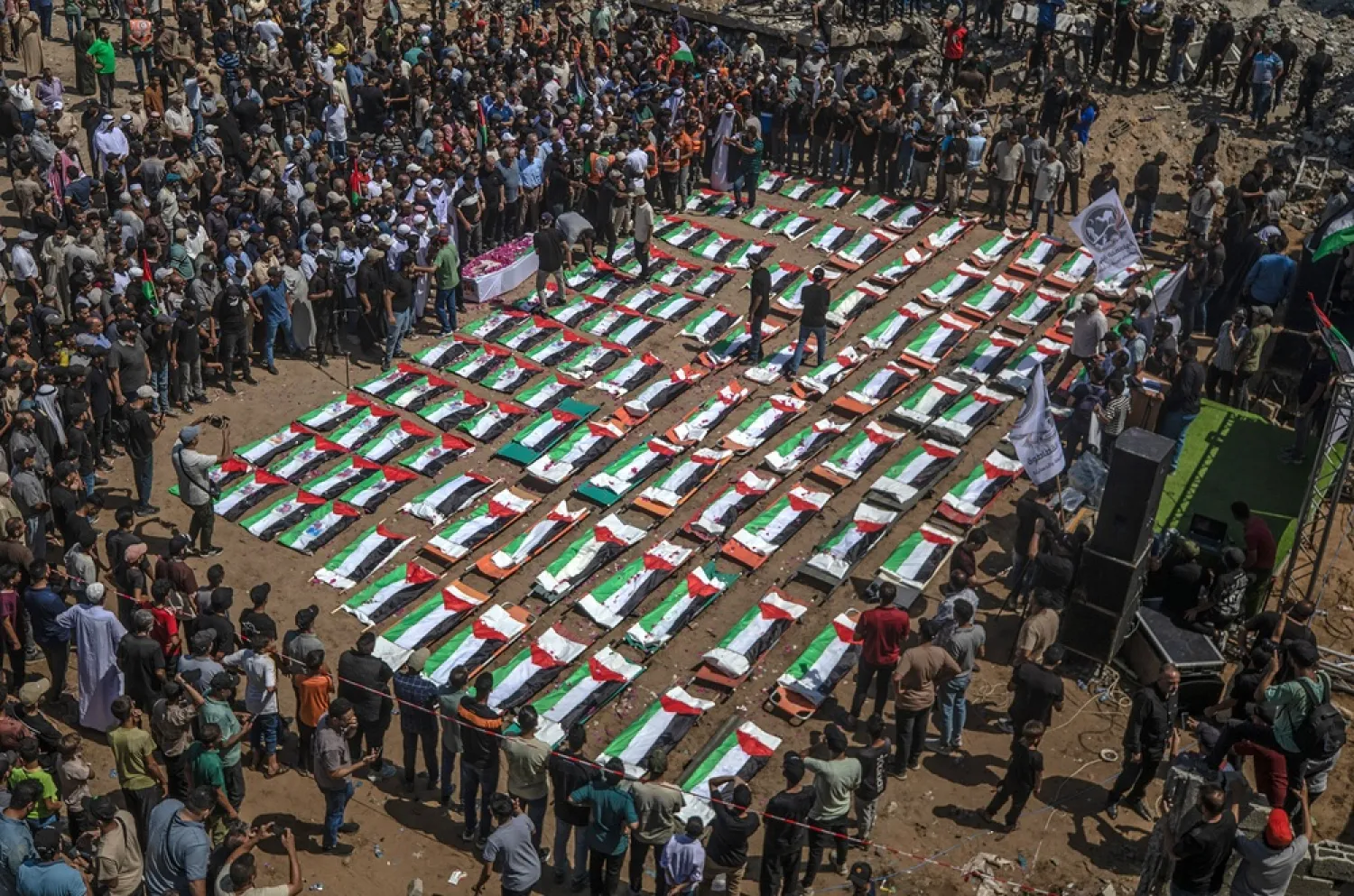
Palestinians gather during a mass funeral for 112 members of the Abu Sharia and Al-Hassayna families in the eastern Gaza City, 04 August 2026. (EPA)
TT

Gazans Bury Nearly a Whole Clan Found in Rubble in Mass Funeral for 112

Palestinians gather during a mass funeral for 112 members of the Abu Sharia and Al-Hassayna families in the eastern Gaza City, 04 August 2026. (EPA)

The decomposed remains of 112 bodies lay on stretchers shrouded ‌in flags in the sun's heat: all that could be found of the Al-Hassaynas of Sabra, a Palestinian clan of proud Bedouin stock all but wiped out by Israel nearly three years ago. 

According to Palestinian authorities, 308 members of the extended Al-Hassayna family, also known as the Abu Sharia, were killed on November 22, 2023, when Israeli airstrikes brought down a cluster of apartment buildings as residents slept in Sabra, one of the old neighborhoods of Gaza City. 

Around half of the dead were previously recovered and buried, but 153 bodies had remained under the rubble until now. 

Nearly three years later, a recovery team of 40 workers spent 17 days painstakingly combing the wreckage, and brought out remains identified as belonging to 112 of those missing victims. 

A cluster of neighbors and surviving members of the clan gathered on Tuesday on a flattened lot of demolished ruins, where the remains were laid out for what Palestinian authorities described as the largest mass funeral of the Gaza war. 

Men lifted the stretchers and carried them through the streets. A sign was adorned with portraits of the dead — men, women and children. 

"This day is mixed with grief, and it has reopened our wounds three years after this massacre," said ‌Taysir Al-Hassayna, a surviving member ‌of the clan. 

"It has brought sorrow back to our children and women. But our consolation is ‌that ⁠we believe they ⁠are martyrs with God." 

Reuters was unable to locate an Israeli military statement from November 2023 giving Israel's account of the strike, which took place in the early weeks of the war launched after Hamas-led fighters stormed out of Gaza killing 1,200 Israelis. The military did not immediately respond to a request for comment on its account of the incident. 

According to Palestinian health authorities, more than 73,000 Palestinians are confirmed to have died in the Israeli war in Gaza. Most of the deaths were documented when bodies were brought to morgues and buried, but around 8,000 more are believed to lie beneath the rubble. 

'THEY ARE PIECES OF ME' 

Omar Al-Hassayna, 65, a survivor of the Sabra bombing who escaped Gaza for Egypt days after the strike, wept as he watched footage from Tuesday's ⁠funeral of his kin on satellite TV in Cairo. 

His wife was killed in the bombing, along with ‌four of his adult sons, Abdallah, Abdel-Rahman, Ahmed and Osama. So were his four grandchildren: two ‌little boys and two little girls, the oldest just 4, the youngest only a few months old. 

"They are pieces of me. I have thought about ‌them every single day. I have seen them in my thoughts and in my dreams," he said. 

"The funeral today is the least that ‌could be done for those martyrs. It is time for those bodies, those little bodies, to rest in peace, and for their souls to hover in the skies around us." 

Most of the population of Gaza are descendants of refugees who arrived from territory now located in Israel, so it was common for entire extended families to settle together in clusters of residential buildings. But this meant that one Israeli airstrike could effectively wipe out an entire clan. 

The Hassaynas, who lived in the Sabra ‌neighborhood for decades, were a branch of a prominent clan known throughout the enclave for their generosity and humility. 

Omar said the Israeli strikes hit three residential buildings where members of the extended family had ⁠gathered for shelter, seeking safety in ⁠one place as the early days of the war unfolded. 

Two of the buildings were completely destroyed, killing almost everyone inside. He was in the third, which was only partially destroyed, and survived with minor injuries from flying debris. Two daughters and a son of his also survived. 

RECOVERY ONLY POSSIBLE OUTSIDE ISRAELI CONTROL 

An October ceasefire that ended major fighting left Israeli forces in control of over half of Gaza, since expanded to around two-thirds. There, they have bulldozed remaining buildings and ordered people out. 

The recovery of bodies can only take place in the remaining third of the territory, where nearly all of Gaza's more than two million people now live, mostly displaced in makeshift tents or shelters in the damaged buildings. 

Mahmoud Basal, spokesperson for Gaza's Civil Defense, said identifying the remains of the Al-Hassaynas required a mixture of forensic evidence and memories gathered from survivors. 

"The bodies were decomposed. Relatives identified some through their clothes, injuries and distinguishing marks. Some victims had bone fixation plates on some organs, while some women were identified through jewellery they had on or necklaces bearing their names," Basal said. 

With this recovery operation now over, the team would move on to other accessible areas of Gaza. 

"If we had at least 10 excavators, bulldozers, excavators, and cranes needed for the work, the job could be completed in three months," he told Reuters. 

When Tuesday's funeral procession reached a vast graveyard amid the ruins of Gaza, men passed the small shrouded bodies over their shoulders and laid the Hassayna clan to rest in fresh graves. 


New Battlefronts in Yemen Leave Houthis in Disarray

Armed forces celebrate their advances in al-Jawf. (X)
TT

New Battlefronts in Yemen Leave Houthis in Disarray

Armed forces celebrate their advances in al-Jawf. (X)

The Yemeni army and the National Resistance made progress on the ground on Monday across fronts in the Taiz, al-Bayda, and al-Jawf governorates, amid successive collapses and retreats among the Houthis. Al-Jawf is witnessing tribal mobilization in support of government forces following their field advances.

Yemeni army media announced that government forces secured a tactical breakthrough on the al-Bayda front, successfully liberating the Hayd al-Khazzan and al-Falhan areas up to the al-Nasifa region. The development allows the forces an advantage to sever Houthi supply lines between the central and southern governorates.

The advance coincided with the establishment of control over all hills and plateaus overlooking the al-Zaher district.

The director of media for the al-Bayda governorate, Aref Al-Amari, confirmed that the armed forces have tightened their control over the strategic highlands overlooking al-Zaher.

He noted that forces are currently combing al-Nasifa in preparation for an advance toward the Dhi Naem area, a development that strengthens the position of government forces in the governorate.

Spokesman for the Yemeni armed forces Colonel Maeen al-Nuzaili said the forces are achieving progress and victories on the al-Jawf and al-Bayda fronts as part of operations "aimed at restoring state institutions and ending the Houthi coup."

He called on the group's operatives to abandon their positions with their light weapons to save their lives.

On the western front, the Joint Forces managed to secure a vital artery in al-Kadha connecting Taiz city to the western coast, following the defeat of Houthis stationed in the controlling highlands.

Government forces targeted massive Houthi military reinforcements west of Taiz city, leaving heavy losses in lives and equipment.

Comprising more than 21 military vehicles, they were heading to support the al-Barh and Maqbanah fronts.

Meanwhile, tribes were mobilizing in al-Jawf to support the armed forces against the Houthis. According to local sources, the tribes moved toward the al-Yatma district.


Assad-era Syrian Reactor was Configured for Nuclear Weapons, IAEA Chief Says

The logo of the International Atomic Energy Agency (IAEA) at the organization's headquarters in Vienna, Austria, March 6, 2023 (Reuters)
TT

Assad-era Syrian Reactor was Configured for Nuclear Weapons, IAEA Chief Says

The logo of the International Atomic Energy Agency (IAEA) at the organization's headquarters in Vienna, Austria, March 6, 2023 (Reuters)

The Assad-era government in Syria was constructing a nuclear reactor that was configured to produce fissile material for possible use in nuclear weapons, the head of the International Atomic Energy Agency said on Monday.

The “configuration” and the “technical features” of the nuclear reactor under construction in Syria during the leadership of ousted former President Bashar Assad were “very efficient in the production of fissile material that could be directly used for the fabrication of nuclear weapons,” IAEA director general Rafael Grossi said.

“Of course, that was never declared, that was always denied, so, and again, intentions cannot be judged, but that was a very serious proliferation concern that we had, and this has been difficult work,” he told reporters on the first day of a regular meeting of the IAEA Board of Governors, in Vienna.

Syria was believed to have operated an extensive undeclared nuclear program under Assad that included a nuclear reactor built by North Korea in eastern Deir Ezzor province.

Following Assad’s ouster, the new government agreed to give IAEA inspectors access to suspected former nuclear sites.

During a visit to Syria in August, IAEA inspectors confirmed that “the cooling infrastructure which has now been uncovered is consistent with that of a nuclear reactor.” Grossi and a team of senior inspectors also visited a previously undeclared site in the country.

Syria notified the agency of the site’s existence in a July 17 letter and invited the IAEA “to cooperate with the Syrian authorities in the inspection and verification of the site and of any nuclear material to be potentially found.”

The IAEA said in its confidential report circulated to member states last Tuesday and seen by The Associated Press that this new site contained “natural uranium metal in the form of fuel rods with cladding.” The agency verified the material and confirmed “the presence of around 73 tonnes of natural uranium metal.”

Grossi said when the inspectors visited the site in August they had to “tear down walls” and go through “very difficult and narrow passages” to reach the nuclear material that had been hidden. The site had “boxes scattered all over the place,” he said.

Grossi said that “the important thing is that this material now is under safeguards” of the IAEA, adding that agency inspectors had managed to install cameras at the location, The AP reported.

Asked if the nuclear material will remain in Syria or be removed, Grossi said that this is “a matter that the Syrian government will have to decide.” He added: “We are not requesting them to do this or to do that. For us what’s important is that we know all the time where this (material) is until the last gram.”

Logan Mintz, a director for nuclear materials security at the Washington-based Nuclear Threat Initiative, said that natural uranium metal is not directly usable for a nuclear weapon but it could be “diverted to a covert weapons program that further processes it into plutonium for a nuclear weapon.”

She said that once deemed safe to move, the material could be “transported in certified containers” to a third country that can “safely and securely disposition it into a more chemically stable and more widely used form” for possible use in nuclear power plants.

“As with any transport of nuclear material, this movement would require robust security from theft or sabotage,” she said.


Syria Arrests Assad-era General Accused of Deadly Repression

A large Syrian flag flutters above Tishreen Park in Damascus, June 4, 2025. (AFP)
TT

Syria Arrests Assad-era General Accused of Deadly Repression

A large Syrian flag flutters above Tishreen Park in Damascus, June 4, 2025. (AFP)

Syrian authorities on Monday said they had arrested a former general accused of involvement in the bloody repression of protests in 2011 that sparked the country's civil war and the 1982 Hama massacre.

In a statement, security forces said they "arrested former Major General Mohammed Ali Durgham, a prominent officer in the military establishment during the era of the former regime" of Bashar al-Assad, who was ousted in 2024.

They accused him of "issuing direct orders to his units to fire on unarmed demonstrators in the Damascus countryside" after anti-Assad protests had erupted in 2011.

Durgham was a field commander in the army's feared Fourth Division, commanded by Assad's brother Maher al-Assad, between 2009 and 2013.

Human Rights Watch in 2011 quoted a Syrian army defector who said that Durgham was one of the generals who "ordered the troops to shoot at protesters when his unit was deployed to areas in and just outside of Damascus".

He has been under European Union sanctions since 2012.

Bashar al-Assad's crackdown turned the nationwide movement into a 13-year-long civil war that killed more than half a million people.

Authorities said Durgham had started "as a squad commander in the Defense Brigades during the events in Hama Governorate in 1982".

On February 2, 1982, amid an information blackout, Assad's father and then-Syrian president Hafez al-Assad launched a brutal crackdown in the central Syrian city of Hama against an armed Muslim Brotherhood revolt.

Survivors who witnessed extrajudicial executions told AFP that the authorities spared no one, with government forces killing men, women and children.

The death toll of the 27 days of violence has never been formally established, though estimates usually range from 10,000 to 40,000, with some going higher still.

Since Bashar al-Assad's overthrow in December 2024, Syria's new authorities have arrested dozens of former security officials, and trials began in April.

In August, Syria sentenced Bashar al-Assad, his brother Maher al-Assad and five other security officials to death in absentia for atrocities committed during the civil war, the first such ruling under the new authorities.

The former president fled Syria as his government was falling and is believed to be living in Russia.