


Rights Group Warns Israel's Policies are Pushing the West Bank Healthcare System to Collapse

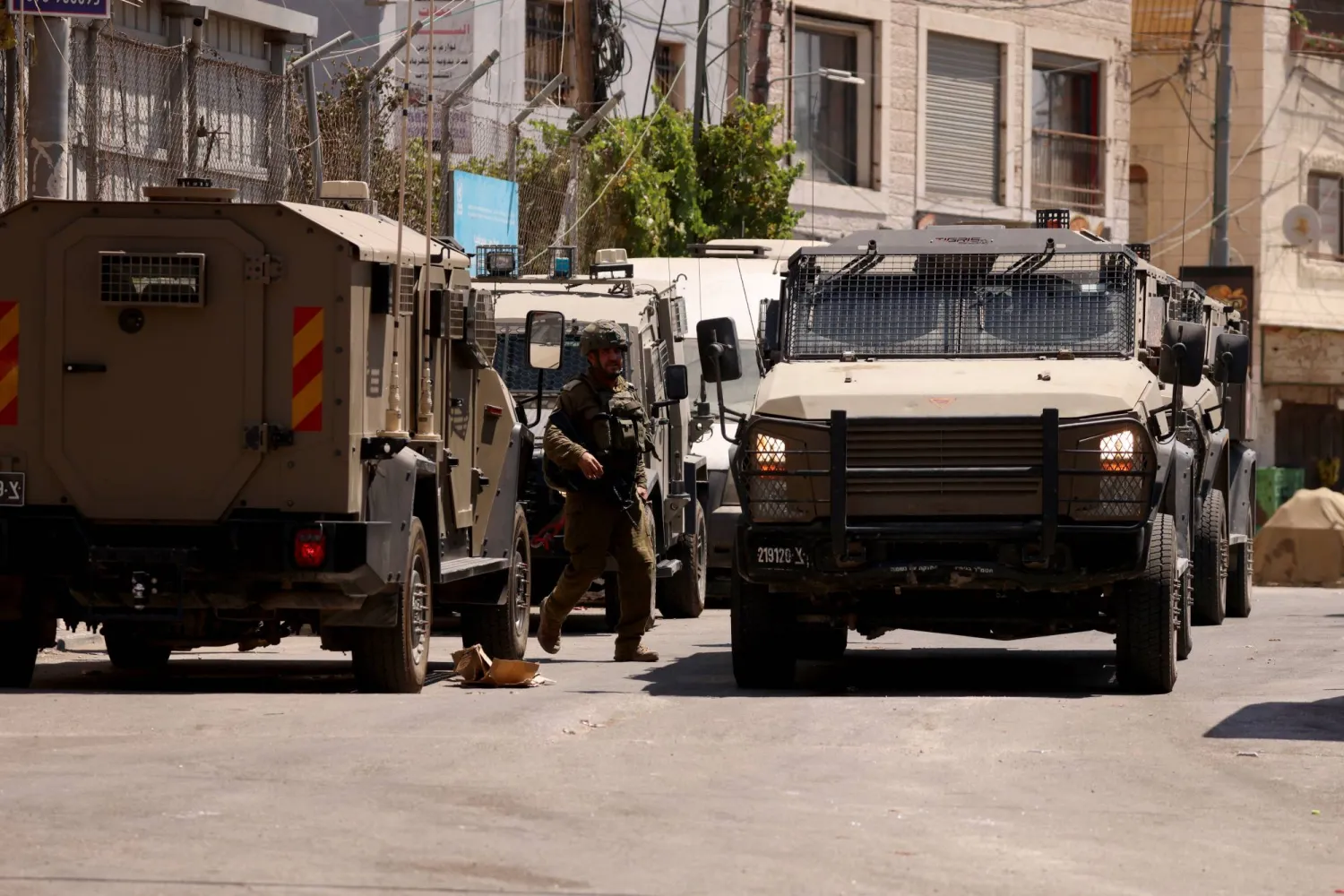
Israeli security forces patrol a street during a military operation in the Qalandia refugee camp, south of the West Bank city of Ramallah, 06 August 2026. EPA/ALAA BADARNEH
TT

Rights Group Warns Israel's Policies are Pushing the West Bank Healthcare System to Collapse

Israeli security forces patrol a street during a military operation in the Qalandia refugee camp, south of the West Bank city of Ramallah, 06 August 2026. EPA/ALAA BADARNEH

For six months, 70-year-old Bassam Musleh searched desperately for a pharmacy or clinic that could fill his prescription for blood pressure and other heart medications. Public dispensaries were out of stock, he said, and he couldn't afford the private ones.

But when he arrived Tuesday at a mobile clinic in the West Bank village of Iktaba, pulling the tattered prescription from his pocket, a local aid group finally gave him the medication he needs, The Associated Press said.

Musleh, who has a pacemaker, is one of hundreds of thousands of Palestinians struggling to get healthcare in the West Bank, where a report released Thursday by Physicians for Human Rights Israel warns that Israeli policies have pushed the territory's health system to the brink of collapse.

Since the war between Israel and Hamas in Gaza began nearly three years ago, Israel has withheld billions of dollars of tax and customs revenues collected on behalf of the Palestinian Authority, the government body that administers parts of the Israeli-occupied West Bank. Without those funds, the PA has struggled to pay health workers, buy medications and support public hospitals, pharmacies and clinics, 75% of which have reduced operations and are functioning just once or twice a week.

At the same time, Israeli military raids and a surge in new checkpoints are also impeding the ability of Palestinians to get adequate medical care, with life-threatening consequences.

“If this continues, it is patients — not institutions — who will pay the price,” said Milena Ansari, PHRI's director of the Occupied Palestinian Territory Department, who wrote the report.

Israel has withheld at least $2.5 billion in revenues from the West Bank

Because Palestinians don't control their own borders, the PA relies on Israel to collect taxes on goods that enter the West Bank through Israeli ports. But rights groups for decades have accused Israel of weaponizing the funds as a means of political pressure.

Israeli Finance Minister Bezalel Smotrich stopped sending monthly clearance revenues to the PA last year and, as of June, Israel had cumulatively withheld at least $2.5 billion from the PA since 2023, according to the International Crisis Group.

Smotrich's office and the office of Israeli Prime Minister Benjamin Netanyahu did not respond to repeated requests for comment from The Associated Press.

In an interview with the AP, Palestinian Health Minister Majed Abu Ramadan said that unpaid staff aren't showing up to work, creating a backlog of cases and delaying routine surgeries. Earlier this year, Palestinian doctors went on strike and some primary healthcare centers closed.

Some of the most impacted are those with cancer, kidney and heart problems, older people and those who have been displaced, health officials said.

At PHRI's mobile clinic in Iktaba, hundreds of people streamed in seeking treatment.

Mohammed Sarris said it's been weeks since he's been able to get the eye drops he needs for irritation caused by his diabetes.

The 64-year-old has been relying on the mobile clinic since he was forced from his home last year in the Nur Shams refugee camp, where he had easier access to healthcare provided by UNRWA, the UN Relief and Works Agency for Palestinian refugees.

A retired government worker, he earns a meager pension, often rationing medicine so he can afford food.

"It's degrading. ... All of this has affected us a lot,” he said.

The UN and other aid agencies say more patients are coming to their clinics

Physicians for Human Rights Israel said the number of patients at its mobile clinics has doubled in the last two years, from about 250 a day to around 500.

Roland Friedrich, UNRWA's West Bank director, said there's been a marked increase in patients at its health centers across the territory. The agency is trying to bridge the gap, but lacks funds to scale up health services and faces Israeli restrictions on imports of medications, he said.

Earlier this year, Israel revoked the licenses of more than three dozen humanitarian organizations, among them Doctors Without Borders, known by its French acronym MSF.

Last year, MSF had 12 mobile clinics operating in the South Hebron Hills. But because they could no longer coordinate their movements with the Israeli military, the group reduced the number of clinics it runs by half, impacting more than 40,000 people, said Joan Tubau, head of mission for Doctors Without Borders in Gaza and the occupied West Bank.

More Israeli checkpoints and roadblocks prevent Palestinians from accessing care

The lack of medicine, staff shortages and reduced services are being compounded by harsher Israeli restrictions on freedom of movement in the West Bank.

In recent years, the military has erected new barriers, checkpoints and roadblocks, closing off towns and cities, sometimes with little warning.

In July, at least two women gave birth in ambulances because checkpoints were closed, said Aseel Baidoun, deputy director of advocacy and campaigns for Medical Aid for Palestinians, or MAP, an international organization. One of the babies was stillborn.

She said three others also died trying to get to hospitals this year, including two more infants and a 30-year-old woman who died of a heart attack after an ambulance was stopped at a checkpoint near Sinjil, outside Ramallah.

The Israeli military has denied that it prevents medical treatment for civilians and said there is no intention to delay treatment or medical evacuations.

In response to questions about the stillborn infant, who was delivered in an ambulance near Nablus, the army said the emergency vehicle hadn’t completed “required coordination” prior to arriving at the checkpoint. It said the military conducted a security check, which only lasted a few minutes.

Dr. Leen Ibrahim, who works with MAP, said one of the consequences of this crisis is the impact on mental health.

“People here feel suffocated by everything they’re going through," she said.

At the clinic Tuesday, some Palestinians broke down waiting for hours to be seen.

“The line is so long,” said Asala Wawi, 65, wiping tears from her face as she got her eyes checked. “I'm tired."



New Battlefronts in Yemen Leave Houthis in Disarray

Armed forces celebrate their advances in al-Jawf. (X)
TT

New Battlefronts in Yemen Leave Houthis in Disarray

Armed forces celebrate their advances in al-Jawf. (X)

The Yemeni army and the National Resistance made progress on the ground on Monday across fronts in the Taiz, al-Bayda, and al-Jawf governorates, amid successive collapses and retreats among the Houthis. Al-Jawf is witnessing tribal mobilization in support of government forces following their field advances.

Yemeni army media announced that government forces secured a tactical breakthrough on the al-Bayda front, successfully liberating the Hayd al-Khazzan and al-Falhan areas up to the al-Nasifa region. The development allows the forces an advantage to sever Houthi supply lines between the central and southern governorates.

The advance coincided with the establishment of control over all hills and plateaus overlooking the al-Zaher district.

The director of media for the al-Bayda governorate, Aref Al-Amari, confirmed that the armed forces have tightened their control over the strategic highlands overlooking al-Zaher.

He noted that forces are currently combing al-Nasifa in preparation for an advance toward the Dhi Naem area, a development that strengthens the position of government forces in the governorate.

Spokesman for the Yemeni armed forces Colonel Maeen al-Nuzaili said the forces are achieving progress and victories on the al-Jawf and al-Bayda fronts as part of operations "aimed at restoring state institutions and ending the Houthi coup."

He called on the group's operatives to abandon their positions with their light weapons to save their lives.

On the western front, the Joint Forces managed to secure a vital artery in al-Kadha connecting Taiz city to the western coast, following the defeat of Houthis stationed in the controlling highlands.

Government forces targeted massive Houthi military reinforcements west of Taiz city, leaving heavy losses in lives and equipment.

Comprising more than 21 military vehicles, they were heading to support the al-Barh and Maqbanah fronts.

Meanwhile, tribes were mobilizing in al-Jawf to support the armed forces against the Houthis. According to local sources, the tribes moved toward the al-Yatma district.


Assad-era Syrian Reactor was Configured for Nuclear Weapons, IAEA Chief Says

The logo of the International Atomic Energy Agency (IAEA) at the organization's headquarters in Vienna, Austria, March 6, 2023 (Reuters)
TT

Assad-era Syrian Reactor was Configured for Nuclear Weapons, IAEA Chief Says

The logo of the International Atomic Energy Agency (IAEA) at the organization's headquarters in Vienna, Austria, March 6, 2023 (Reuters)

The Assad-era government in Syria was constructing a nuclear reactor that was configured to produce fissile material for possible use in nuclear weapons, the head of the International Atomic Energy Agency said on Monday.

The “configuration” and the “technical features” of the nuclear reactor under construction in Syria during the leadership of ousted former President Bashar Assad were “very efficient in the production of fissile material that could be directly used for the fabrication of nuclear weapons,” IAEA director general Rafael Grossi said.

“Of course, that was never declared, that was always denied, so, and again, intentions cannot be judged, but that was a very serious proliferation concern that we had, and this has been difficult work,” he told reporters on the first day of a regular meeting of the IAEA Board of Governors, in Vienna.

Syria was believed to have operated an extensive undeclared nuclear program under Assad that included a nuclear reactor built by North Korea in eastern Deir Ezzor province.

Following Assad’s ouster, the new government agreed to give IAEA inspectors access to suspected former nuclear sites.

During a visit to Syria in August, IAEA inspectors confirmed that “the cooling infrastructure which has now been uncovered is consistent with that of a nuclear reactor.” Grossi and a team of senior inspectors also visited a previously undeclared site in the country.

Syria notified the agency of the site’s existence in a July 17 letter and invited the IAEA “to cooperate with the Syrian authorities in the inspection and verification of the site and of any nuclear material to be potentially found.”

The IAEA said in its confidential report circulated to member states last Tuesday and seen by The Associated Press that this new site contained “natural uranium metal in the form of fuel rods with cladding.” The agency verified the material and confirmed “the presence of around 73 tonnes of natural uranium metal.”

Grossi said when the inspectors visited the site in August they had to “tear down walls” and go through “very difficult and narrow passages” to reach the nuclear material that had been hidden. The site had “boxes scattered all over the place,” he said.

Grossi said that “the important thing is that this material now is under safeguards” of the IAEA, adding that agency inspectors had managed to install cameras at the location, The AP reported.

Asked if the nuclear material will remain in Syria or be removed, Grossi said that this is “a matter that the Syrian government will have to decide.” He added: “We are not requesting them to do this or to do that. For us what’s important is that we know all the time where this (material) is until the last gram.”

Logan Mintz, a director for nuclear materials security at the Washington-based Nuclear Threat Initiative, said that natural uranium metal is not directly usable for a nuclear weapon but it could be “diverted to a covert weapons program that further processes it into plutonium for a nuclear weapon.”

She said that once deemed safe to move, the material could be “transported in certified containers” to a third country that can “safely and securely disposition it into a more chemically stable and more widely used form” for possible use in nuclear power plants.

“As with any transport of nuclear material, this movement would require robust security from theft or sabotage,” she said.


Syria Arrests Assad-era General Accused of Deadly Repression

A large Syrian flag flutters above Tishreen Park in Damascus, June 4, 2025. (AFP)
TT

Syria Arrests Assad-era General Accused of Deadly Repression

A large Syrian flag flutters above Tishreen Park in Damascus, June 4, 2025. (AFP)

Syrian authorities on Monday said they had arrested a former general accused of involvement in the bloody repression of protests in 2011 that sparked the country's civil war and the 1982 Hama massacre.

In a statement, security forces said they "arrested former Major General Mohammed Ali Durgham, a prominent officer in the military establishment during the era of the former regime" of Bashar al-Assad, who was ousted in 2024.

They accused him of "issuing direct orders to his units to fire on unarmed demonstrators in the Damascus countryside" after anti-Assad protests had erupted in 2011.

Durgham was a field commander in the army's feared Fourth Division, commanded by Assad's brother Maher al-Assad, between 2009 and 2013.

Human Rights Watch in 2011 quoted a Syrian army defector who said that Durgham was one of the generals who "ordered the troops to shoot at protesters when his unit was deployed to areas in and just outside of Damascus".

He has been under European Union sanctions since 2012.

Bashar al-Assad's crackdown turned the nationwide movement into a 13-year-long civil war that killed more than half a million people.

Authorities said Durgham had started "as a squad commander in the Defense Brigades during the events in Hama Governorate in 1982".

On February 2, 1982, amid an information blackout, Assad's father and then-Syrian president Hafez al-Assad launched a brutal crackdown in the central Syrian city of Hama against an armed Muslim Brotherhood revolt.

Survivors who witnessed extrajudicial executions told AFP that the authorities spared no one, with government forces killing men, women and children.

The death toll of the 27 days of violence has never been formally established, though estimates usually range from 10,000 to 40,000, with some going higher still.

Since Bashar al-Assad's overthrow in December 2024, Syria's new authorities have arrested dozens of former security officials, and trials began in April.

In August, Syria sentenced Bashar al-Assad, his brother Maher al-Assad and five other security officials to death in absentia for atrocities committed during the civil war, the first such ruling under the new authorities.

The former president fled Syria as his government was falling and is believed to be living in Russia.