
Israel’s Ben-Gvir Advocates Killing ‘30 to 40’ People in Gaza Nightly While Speaking to Ex-Hostage

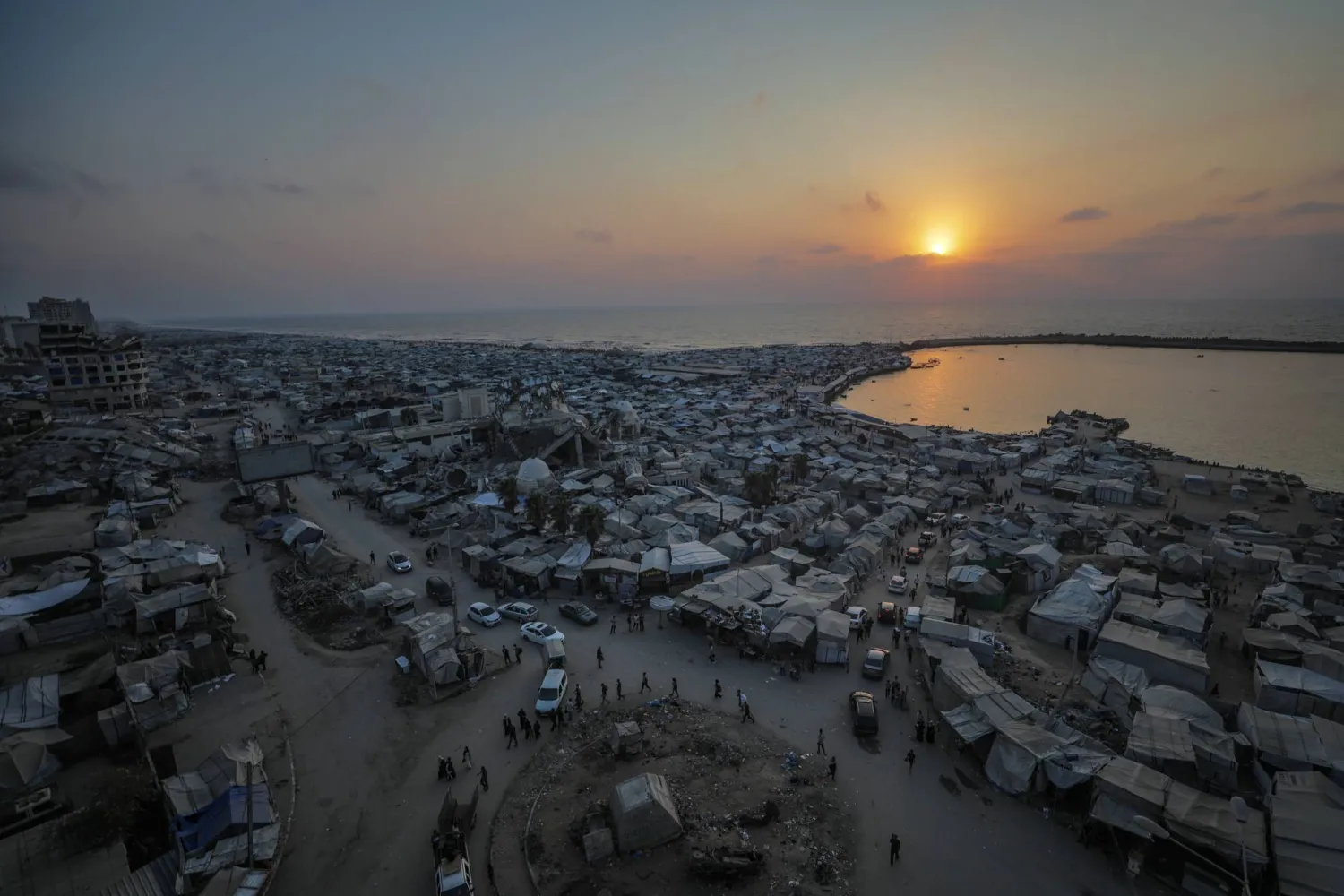
Thousands of makeshift tents of displaced Palestinian families are put up on the beach in western Gaza City, Gaza Strip, 14 August 2026. (EPA)
TT

Israel’s Ben-Gvir Advocates Killing ‘30 to 40’ People in Gaza Nightly While Speaking to Ex-Hostage

Thousands of makeshift tents of displaced Palestinian families are put up on the beach in western Gaza City, Gaza Strip, 14 August 2026. (EPA)

An extremist Israeli lawmaker in Prime Minister Benjamin Netanyahu's coalition publicly advocated for killing “30 to 40” people in Gaza each night, comments that surfaced Sunday and were quickly shared by Palestinian media.

Minister of National Security Itamar Ben-Gvir made the statement while speaking to a former Gaza-held hostage, Rom Braslavski, on Braslavski's podcast. The two were discussing Israel's recovery from the Hamas attack of Oct. 7, 2023, when Ben-Gvir criticized Israel's recent drawdown of strikes in Gaza.

“It’s no secret, I disagree with the prime minister,” he said. “I think targeted assassinations should be carried out in Gaza, taking down 30 to 40 every night. Not just those who pose an immediate threat — there are people there who are not worthy of life. They shouldn’t live. They’re not even people.”

In the past, similar statements by Ben-Gvir and other Israeli officials were widely condemned. Many have been presented to the UN’s world court as evidence of genocidal intent. Israel denies it has committed genocide in Gaza.

Israel’s domestic media has made scarce mention of the statement, highlighting how once-fringe ideologies like Ben-Gvir’s are surging in the leadup to Israeli elections Oct. 27.

Figures like Ben-Gvir have become more popular among Israelis since Hamas’ brutal attack in 2023, when the fighters killed about 1,200 people and took 251 hostage. Many hostages have recounted long-term starvation, physical and psychological abuse and, in some cases, sexual abuse.

Ben-Gvir does not have power over the country’s military and cannot order strikes on Gaza. But, after operating for decades within Israel's far-right fringe, he is now one of the most influential people in the country.

He has substantial control over key parts of Israel’s security apparatus, running the country’s prisons — where thousands of Palestinians from Gaza and the West Bank are incarcerated — as well as the national police force.

He has previously boasted of lessening food rations for Palestinian prisoners. Israel’s top court ruled in 2025 that the prison service under Ben-Gvir was depriving Palestinians of a minimum subsistence diet.

Ben-Gvir criticizes drawdown of Israeli strikes in Gaza

Until recently, Israel was striking Gaza nearly every day, attacks that have killed over 1,250 people since an October truce deal came into effect, according to Gaza’s Health Ministry.

Israel's military, which says the strikes have targeted Hamas fighters, appeared to ease off on the attacks in a quiet concession to US President Donald Trump after Netanyahu rejected the president’s latest attempt to move the truce forward.

Israeli media last week reported that the authority for carrying out strikes has now been limited to the army’s chief of staff, raising the ire of right-wing lawmakers such as Ben-Gvir.

Ben-Gvir advocates mass emigration, expulsion of Palestinians from Gaza

In the same taped appearance, the lawmaker advocated for mass emigration of Palestinians from Gaza — a proposal that international lawyers say could amount to ethnic cleansing — and resettlement of Gaza by Israel.

Twenty years ago, Israel withdrew from the Gaza Strip, dismantling a block of 21 Jewish settlements known as “Gush Katif” and pulling out its forces.

“I see all of Gaza as ours,” said Ben-Gvir in the interview. “Settlements not just in Gush Katif but throughout Gaza, encouraging as much emigration as possible, sending them to their countries, and for the terrorists, no emigration, nothing, just to kill them one by one.”

Trump’s latest proposal involves Hamas gradually giving up its weapons while Israeli forces halt their attacks and begin withdrawing from Gaza. Hamas accepted the deal, although the group linked the surrender of its heaviest weapons to the creation of a Palestinian state, something Israel’s current government and most of its political class adamantly reject.

Netanyahu says Israel will not retreat from any of its positions in Gaza until Hamas has been completely disarmed. The stance leaves other elements of the ceasefire, including the deployment of international forces and any reconstruction of the devastated territory, on hold.


Mansouri Destruction Tests Limits of Southern Lebanon’s ‘Yellow Line’

Smoke rises from the site of an Israeli strike on the southern Lebanese village of Mansouri on Sept. 9, 2026 (AFP)
TT

Mansouri Destruction Tests Limits of Southern Lebanon’s ‘Yellow Line’

Smoke rises from the site of an Israeli strike on the southern Lebanese village of Mansouri on Sept. 9, 2026 (AFP)

Israel has stepped up demolitions, explosions and bulldozing in the coastal town of Mansouri, south of Tyre, making it one of the hardest-hit areas in southern Lebanon in recent days.

The intensity of the destruction has raised questions over why Israel is focusing on the town — and whether it is targeting specific military installations or pursuing a broader aim:

reshaping the terrain to control Mansouri by fire without fully occupying it.

A documented tally of Israeli attacks over the past seven days shows a sharp surge in explosions inside the town. More than 75 were recorded between Sept. 3 and midday Thursday, alongside airstrikes and repeated artillery shelling.

The campaign peaked on Wednesday, with dozens of explosions in a single day. Another 12 were recorded on Thursday morning. The figures are a minimum estimate, with further explosions reported but not precisely counted.

According to available information, Israeli forces have recently adopted a method of demolishing homes and residential neighborhoods remotely. Drones drop barrels packed with powerful explosives onto rooftops before detonating them.

A similar tactic was recorded in Bani Hayyan, where a drone dropped explosives onto homes before they were blown up.

Mansouri is strategically important because it lies along the coastal route and close to several positions occupied by Israeli forces. The mounting destruction suggests Israel’s actions go beyond daily military operations, raising questions about the military reality it is seeking to impose in the town and its surroundings.

Reshaping the terrain

Retired Brig. Gen. Hassan Jouni links Israel’s focus on Mansouri to the area’s geography. But he says the presence of Hezbollah infrastructure alone does not explain the scale of the destruction.

“This is linked to Mansouri’s geography and its geographical extent,” Jouni told Asharq Al-Awsat. “The area forms a corridor that Hezbollah historically used extensively in its operations.

My assessment is that infrastructure exists there.”

“The terrain, dense woodland and a long corridor stretching from north of Tyre to the border made the area particularly useful to Hezbollah,” he said.

“It is likely to contain extensive and varied infrastructure, especially given its proximity to the border. During the fighting, reports spoke of drones and rockets being launched from this area.”

But Jouni stressed that this “does not mean every explosion carried out by Israel is targeting such infrastructure.”

“Israel is reshaping the geography and altering the terrain to create a military landscape better suited to its army,” he said.

“The natural geography is being changed to make surveillance, observation and monitoring easier for the Israeli army. What we are seeing is more an effort to reshape the geography than simply to target infrastructure in Mansouri.”

Jouni said the same logic applied to the destruction of buildings.

“Some homes stand at commanding, elevated locations that overlook the surrounding area,” he said.

“They are being destroyed because of the importance of their position — not necessarily because they contain infrastructure or ammunition, or because they belong to Hezbollah or its members. Some are destroyed solely because of where they stand.”

Jouni described Mansouri as a “pivotal target” for Israel because it “lies between Israeli army positions in the western sector and the city of Tyre.”

A shifting operational zone

Jouni said the “yellow line” should not be understood as a fixed boundary on the ground.

“The yellow line being discussed cannot be drawn as a line on the ground,” he said. “It is a series of operational zones extending in the west from the vicinity of Mansouri and Majdal Zoun, moving north toward Haddatha and then east to the vicinity of Ali al-Taher.”

“There is no yellow line like the one in Gaza, marked by signs or concrete blocks,” he added.

“Here, we are talking about a fluid, dynamic operational zone. It has been called the yellow line, but in practice, it is not fixed.”

Jouni said the limits of the Israeli army’s presence in southern Lebanon were defined not by a fixed line, but by shifting operations.

In Israeli calculations, he said, Mansouri is “a vital central target separating the city of Tyre from Israeli army positions along the southern border or in the buffer zones.”

“Israel views Mansouri strategically,” he said. “It is treating the town as a barrier village — and seeking to remove that barrier.”

Control by fire

Retired Brig. Gen. Saeed Qazah said Israel appeared to be trying to strip Mansouri of cover and control it from surrounding positions, rather than occupy it and station troops inside.

“Mansouri appears to contain many Hezbollah installations and infrastructure sites,” Qazah told Asharq Al-Awsat. “I do not know whether Hezbollah members are still able to infiltrate or move through them, but that may be one reason the Israelis are targeting the town so heavily.”

“They appear to be trying to destroy Mansouri — its infrastructure and its buildings — to leave it exposed without having to occupy it physically,” he said.

“They can control it by fire from Majdal Zoun, Bayyada and Shamaa. Once the buildings are destroyed and the area is exposed, they can detect any movement inside and respond.”

Qazah said the scale of destruction did not necessarily mean Israel was preparing to occupy the town.

“Mansouri lies on the edge of what has been declared the yellow line,” he said. “It is close to Majdal Zoun, Bayyada and Shamaa, while Majdal Zoun stands on higher ground overlooking it.”

“The Israelis enter, plant explosives and destroy infrastructure and homes to turn the area into exposed, scorched ground.”

Qazah said Israel appeared to want Mansouri cleared and exposed, allowing it to monitor the town from surrounding hills and positions.

“They would then be able to use firepower against any armed movement inside without having to station forces in the heart of the town, as long as they can control it by fire,” he said.

Qazah said Majdal Zoun lies southeast of Mansouri, while Bayyada and Shamaa lie to the south, alongside the Buyout al-Sayyad area. Their terrain and elevation, he said, allow Israel to monitor the town and its surroundings.

“Mansouri is tied to this coastal route,” Qazah said.

“It appears to contain many installations that are being entered and destroyed, while homes are also being demolished to leave the area devastated and completely exposed, allowing any potential movement inside it to be detected.

“This is particularly important because any movement from Mansouri could head toward Majdal Zoun or areas where Israeli forces are deployed.”


Algeria Severs Diplomatic Ties with the UAE

Algerian President Abdelmadjid Tebboune (Photo: The Presidency)
TT

Algeria Severs Diplomatic Ties with the UAE

Algerian President Abdelmadjid Tebboune (Photo: The Presidency)

Algeria announced Thursday that it's severing diplomatic ties with the United Arab Emirates, in a Foreign Ministry statement reported by state media.

“Having exhausted all the ways for preserving the bilateral relations, the Algerian government has decided, today, to sever diplomatic relations with the United Arab Emirates,” the statement said, according to the official APS news agency.

The ministry statement was also read out on public television.


Yemeni Army Makes Battlefield Gains in Al-Jawf, Marib

Yemeni army forces advance in Al-Jawf governorate (government media)
TT

Yemeni Army Makes Battlefield Gains in Al-Jawf, Marib

Yemeni army forces advance in Al-Jawf governorate (government media)

Yemeni government forces expanded military operations against the Houthis on several fronts Wednesday, making battlefield gains east of Al-Hazm in Al-Jawf province and cutting Houthi supply lines toward the eastern fronts.

The advances coincided with the launch of a major operation south of Marib, intensified fighting in southern Taiz and along the western coast, and the thwarting of a Houthi boat attack in the Red Sea.

A military source told the Yemeni Armed Forces Media Center that government forces continued advancing east of Al-Hazm to the outskirts of Bir al-Maraziq and cut Houthi supply lines on the city’s eastern fronts.

Operations were continuing amid what the source described as heavy Houthi personnel and material losses. Several Houthi fighters were detained or neutralized and others wounded in the clashes, the source added.

The advance followed several days of government military moves in Al-Jawf, as forces sought to consolidate gains and pressure Houthi supply lines rather than merely retake frontline positions.

Marib and Taiz Developments

In Marib, the Yemeni army’s Third Military Region launched a major operation on the province’s southern fronts targeting Houthi positions and concentrations. Government forces said the operation aimed to secure Marib’s southern belt and push the group away from its defensive lines.

According to a statement from the Third Military Region, the operation, which began early Wednesday and was still underway, killed, wounded and captured a number of Houthis and destroyed vehicles and combat equipment. Army and Popular Resistance forces also seized several positions and brought Houthi supply lines under fire.

The operation coincided with military activity in Marib in recent days and fighting across the province’s northern, western and southern axes, as government forces sought to capitalize on battlefield pressure to prevent the Houthis from regrouping or sending reinforcements to other fronts.

In Taiz, clashes continued on southeastern fronts, alongside artillery fire and airstrikes targeting Houthi positions and concentrations in Al-Mamshat, Al-Ahkum, Ayrim, Al-Qubaytah, Al-Rahidah and Karsh.

A military source said the Houthis had sent reinforcements to several positions, including Al-Akboush School, Al-Zubayrah market, the Al-Ahkum junction, Hawd Hill, Al-Khazjah, Al-Aabous and Al-Manzarah Hill.

On the western coast, the National Resistance’s military media said its forces shot down a Houthi suicide drone over Al-Barh and reported the killing and capture of several commanders linked to a Houthi plan to attack toward Bab al-Mandab.

Among those reportedly captured by the Giants Brigades was Murtada al-Nuami, known as “Abdul Samad,” identified as head of the medical division of the Houthi reserve and rapid intervention forces.

Naval forces separately said they thwarted a Houthi boat attack in the Red Sea after detecting the vessels and engaging them, forcing them to retreat north toward Hodeidah port.

In Al-Dhale, Yemeni Defense Minister Lt. Gen. Taher al-Aqili inspected front lines to assess operations, readiness and deployments, urging troops to remain vigilant and prepared to counter any Houthi attempt to target government positions.