
Erdogan Plans Syria Visit, Reaffirms Türkiye’s Support for Stability

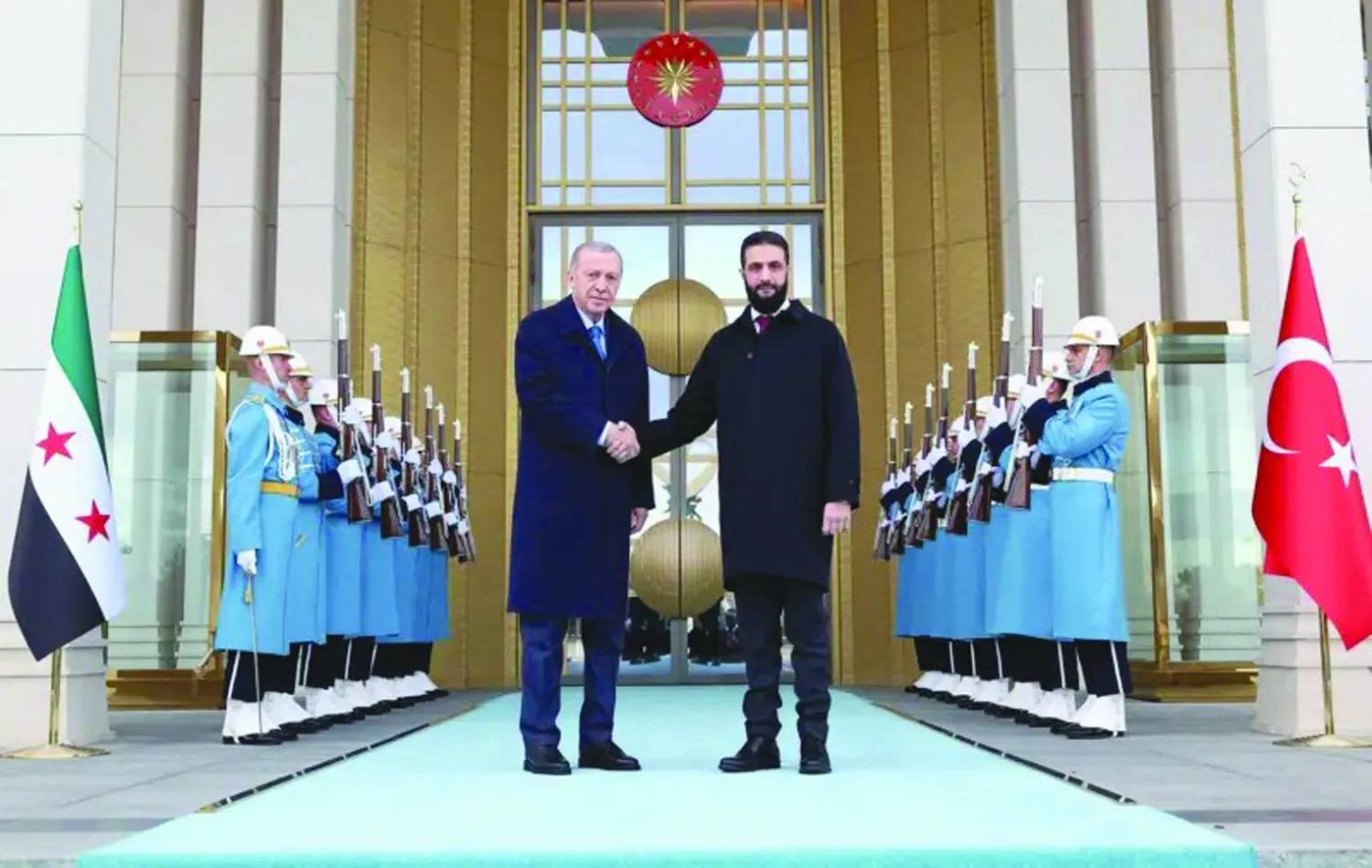
Turkish President Recep Tayyip Erdogan receives Syrian President Ahmed al-Sharaa during his first visit to Türkiye in February 2025. (Turkish Presidency)
TT

Erdogan Plans Syria Visit, Reaffirms Türkiye’s Support for Stability

Turkish President Recep Tayyip Erdogan receives Syrian President Ahmed al-Sharaa during his first visit to Türkiye in February 2025. (Turkish Presidency)

Turkish President Recep Tayyip Erdogan plans to visit Syria soon, reviving a trip initially scheduled for April but postponed after the outbreak of the Iran war in February.

Erdogan pledged that Türkiye would do everything possible to bolster stability in its neighbor, stressing that Syria “will not be alone,” according to excerpts from a television interview carried by Turkish media on Sunday.

He predicted that Syrian Kurds would play a role in peace and stability and pledged to strengthen Türkiye’s ties with Kurdish communities across the region.

Erdogan also cited parliament’s approval of legislation on “Strengthening National Solidarity and Social Integration,” known as the “framework law,” allowing members of the Kurdistan Workers’ Party (PKK) to return and reintegrate into Turkish society as part of the “Terror-Free Türkiye” process.

The Kurdish side calls the initiative the “Peace and Democratic Society Process,” centered on the PKK’s dissolution and disarmament, along with affiliated groups.

SDF integration

Erdogan’s remarks coincided with comments attributed by the pro-government Türkiye newspaper to Mahmoud Berkhedan, a Syrian Democratic Forces (SDF) commander in Ain al-Arab, or Kobani.

Berkhedan praised Erdogan and his ally, Nationalist Movement Party (MHP) leader Devlet Bahceli, for their role in Türkiye’s new peace process.

According to Berkhedan, 99% of outstanding issues over military integration with Damascus have been resolved, with some 10,000 to 12,000 members of the Kurdish People’s Protection Units (YPG), the main component of the SDF, integrated into the Syrian army.

He added that the YPG would be dissolved within days and the Autonomous Administration structure in northern and northeastern Syria would disappear.

“We have buried our weapons and are not demanding an independent state,” Berkhedan declared. “There is no turning back. We will participate side by side in building a new Syria within one army, one state, one flag and a shared homeland.”

Military integration is nearly complete, he added, though the status of the Women’s Protection Units (YPJ) and Turkish nationals serving in the Kurdish forces remains unresolved.

Syria trip

Turkish Ambassador to Damascus Nuh Yilmaz revealed Friday that Erdogan had been considering a visit around April 21, but the Iran war and closure of airspace prevented it.

The date had not been finalized before regional developments intervened, Yilmaz explained, but the trip remains planned and will be announced by the Turkish presidency once arrangements are complete.

He expects Erdogan to visit before the end of the year.

Erdogan last traveled to Damascus in January 2011, when he was Türkiye’s prime minister, about two months before the Syrian uprising and the subsequent rupture in diplomatic relations over Ankara’s opposition to the Assad government’s crackdown on protests.

Syrian President Ahmed al-Sharaa has made four visits to Türkiye since the fall of the Assad regime in December 2024, while exchanges between senior officials have increased and political, economic, security and defense ties have deepened.

Yilmaz noted that four strategic security threats along Türkiye’s border — human smuggling, drug trafficking, irregular migration and terrorism — had disappeared since the collapse of the regime.

Trade between the two countries has also risen 40% to $3.75 billion, with a medium-term target of $10 billion. Talks are continuing on a free-trade agreement, joint industrial zones and opening all crossings along the more than 900-kilometer border.

Türkiye’s foreign and interior ministries are also working on new visa arrangements to make it easier for Syrians who have returned home to visit Türkiye, according to Yilmaz.


Houthi Casualties Strain Sanaa Hospitals’ Capacity

Houthis use images of their dead to recruit more fighters (X)
TT

Houthi Casualties Strain Sanaa Hospitals’ Capacity

Houthis use images of their dead to recruit more fighters (X)

The fallout from the Houthis’ military escalation in Yemen is straining hospitals and endangering civilians in areas under the group’s control, while fueling rare criticism from within its own ranks.

Activists and former fighters accuse the group of exploiting poverty to recruit young men, trading on fighters’ blood and diverting resources to the war effort at the expense of civilian needs.

Medical sources in the Houthi-held capital Sanaa told Asharq Al-Awsat that the group’s Health Ministry had recently ordered several government hospitals to limit admissions of critically ill patients.

Intensive care units, emergency departments and other wards have instead been reserved for wounded Houthi fighters arriving from the front lines.

The measures cover Al-Thawra, Al-Jumhouri, Police, Military, Al-Quds, 48 and Kuwait hospitals — among the capital’s leading medical facilities. Their capacity to treat civilians has consequently shrunk, particularly for patients needing urgent care or intensive treatment.

The restrictions coincided with the arrival in Sanaa of large numbers of dead and wounded Houthi fighters following battles on several fronts across Yemen.

Health workers said hospitals were taking in growing numbers of casualties and setting aside beds, equipment and wards for those arriving from combat zones, including fighters requiring surgery or intensive care.

Hospitals under strain

The Houthis have tightened security around several medical facilities, barred media access and withheld information about the identities and conditions of casualties arriving from the front lines.

Health workers said the influx of wounded fighters had pushed hospitals closer to capacity, leaving less room for civilian patients.

Ahmed, whose relative needed treatment in Sanaa, said his family struggled to obtain the necessary care at Al-Jumhouri Hospital and was forced to look elsewhere because the facility lacked the resources to treat the patient.

He accused the Houthis of channeling available medical resources into the war effort, warning that civilians — particularly children, older people, chronically ill patients and emergency cases — faced growing risks.

The measures come as the health system in Houthi-held areas reels from years of war, dwindling funding and severe shortages of medicine, supplies and medical staff. Health facilities have also been damaged, forcing some to close.

The strain extends beyond Sanaa. The capital’s main hospitals routinely receive referrals from other provinces and regions, meaning their reduced capacity affects a far wider population under Houthi control.

Dissent from within

As the escalation weighs on the health sector, criticism is also mounting among figures and activists aligned with the Houthis.

Their complaints center on the war’s human cost, the treatment of fighters and the families of those killed or wounded, and recruitment practices that prey on economic hardship.

In the latest rebuke, activist and former Houthi fighter Abdullah Sharaf al-Mahdi attacked the group’s leaders and supervisors, accusing them of trading on fighters’ blood and sidelining bereaved and wounded families for personal gain.

Fighters and their families bear the cost of the war, al-Mahdi said, while officials and supervisors receive privileges including property and financial allocations. The conflict, he added, had become a vehicle for advancing the interests of factions within the group.

Al-Mahdi said he regretted the years he had spent fighting for the Houthis and would not support them again. His comments reflect a shift among some critics from opposing the group’s policies to questioning its motives for prolonging the war.

Criticism has also emerged from within Houthi-controlled institutions.

Abdu Bishr, a member of the Houthi-controlled parliament in Sanaa, accused the group of ignoring Yemenis’ suffering and pursuing what he called “futile” wars. He urged it to keep economic and humanitarian issues out of the conflict.

Bishr called for salaries to be paid, detainees released and airports reopened. He warned that what he described as “taking pleasure in bloodshed” would deepen the humanitarian catastrophe and urged the group to ease people’s suffering or “leave the scene.”

Houthi activist and writer Zaid al-Kibsi also criticized the group’s recruitment of young people and adolescents, saying it exploited poverty and worsening economic conditions to push more of them toward the front lines.

He accused the Houthis of using religious and sectarian rhetoric, along with slogans of “jihad and martyrdom,” to recruit young people as many families struggle to meet their basic needs.

Some recruits depend on the group’s modest payments to support their families while risking death or injury in combat, al-Kibsi said.

Many are young men who have had no chance to build their lives or start families, leaving their relatives to bear the consequences when they are killed or wounded.


Israeli Support for Ethiopia’s Maritime Access Bid Fuels Tensions With Egypt

Ethiopian Prime Minister Abiy Ahmed holds earlier talks with the Israeli president in Addis Ababa (Ethiopian News Agency)
TT

Israeli Support for Ethiopia’s Maritime Access Bid Fuels Tensions With Egypt

Ethiopian Prime Minister Abiy Ahmed holds earlier talks with the Israeli president in Addis Ababa (Ethiopian News Agency)

Israeli support for landlocked Ethiopia’s bid for access to the Red Sea is fueling tensions with Egypt, which has repeatedly opposed Addis Ababa’s moves amid a separate dispute over the Grand Ethiopian Renaissance Dam and its impact on Cairo’s Nile water share.

The Israeli backing raises friction with Egypt and gives Tel Aviv another way to pressure Cairo over its positions, despite the legitimacy of Egypt’s stance under international law, experts told Asharq Al-Awsat. They said the international community would ultimately determine the outcome.

Ethiopia has been landlocked since 1993, when Eritrea gained independence after a three-decade war. It relies on neighboring countries’ ports, particularly Djibouti’s.

The Ethiopian News Agency said Israel had announced diplomatic support for Ethiopia’s efforts to secure access to the sea. It quoted Israeli Ambassador to Ethiopia Avraham Neguise as saying that his country firmly backed the East African nation’s push for a Red Sea outlet.

Empowering and strengthening Ethiopia and stabilizing the Red Sea are in everyone’s interest, not Ethiopia’s alone, and Israel stands with Ethiopia in this effort, Neguise told the agency on Thursday evening.

It was not Neguise’s first intervention on an issue dividing Egypt and Ethiopia. In August, he told reporters that Israel would “continue to strengthen its support for Ethiopia, with the aim of helping it become a leading economic power on the African continent.”

Threat to Egyptian interests

African affairs expert Asmaa al-Husseini said the Israeli statements “increase tensions with Egypt” and point to “a covert Israeli role in Ethiopia’s Red Sea moves aimed at harming Egyptian interests.”

The issue may not trigger a direct crisis between Cairo and Tel Aviv, she told Asharq Al-Awsat, but Egypt would closely monitor it. Cairo’s response would depend on the level of escalation and Ethiopia’s actions on the ground.

“Egypt has the right to defend its national security,” Husseini said. “If any military arrangements targeting it are pursued in the Red Sea, Egypt will take measures to prevent them. Ethiopia and Israel understand this, but they are trying by every means to impose a fait accompli. Egypt will never accept that.”

Neguise’s latest remarks coincided with renewed Egyptian opposition to Ethiopian access to the Red Sea.

“There are sovereign states with ports on the Red Sea, and no one has the right to grant any country military maritime access. Otherwise, there would be chaos, particularly as many African countries are landlocked,” Egyptian Foreign Minister Badr Abdelatty told a news conference on Thursday evening.

“There is no problem with commercial access,” he added.

Ramadan Qarny, an expert on African affairs, said Egypt’s opposition rested on several established principles.

“The first is legal: respect for international law, which affirms the exclusive right of littoral states to maintain a presence on the Red Sea coast,” Qarny told Asharq Al-Awsat.

“The second is respect for African Union principles, which uphold the sanctity of borders inherited from the colonial era. Raising this issue could therefore open the door to widespread unrest across African countries.”

The third principle, Qarny said, was that “Egypt’s actions and position align with the principles of the African and Arab states bordering the Red Sea.”

Qarny said Israel was seeking Ethiopian backing on a similar issue: Israel’s presence in, or recognition of, the breakaway Somaliland region, which took place in December 2025.

“There is a political quid pro quo,” he said. “Israel supports Ethiopia in obtaining access to the Red Sea coast in exchange for Ethiopian support for Israel’s recognition of the breakaway Somaliland region.”

Cairo’s position

Cairo has not officially responded to Israel’s continued moves on Ethiopia.

Former Egyptian Foreign Minister Mohamed El-Orabi, a member of the Senate Foreign Relations Committee and the chairman of the Egyptian Council for Foreign Affairs, has downplayed their impact.

In earlier remarks to Asharq Al-Awsat, he said they would “neither undermine nor change” Egypt’s positions.

Qarny said Israeli support was unlikely to significantly alter the dynamics of the Egyptian-Ethiopian disputes.

“Tensions already exist and are likely to increase,” he said, adding that Ethiopian media had in recent months waged what he described as “a coordinated and organized campaign,” led by the Ethiopian News Agency, against Egypt’s positions.

The campaign, he said, had targeted Cairo’s stance on the Grand Ethiopian Renaissance Dam, the Nile Basin countries’ Cooperative Framework Agreement and Ethiopia’s bid for maritime access.


Iraqi Factions Demand Law Bringing All Weapons Under State Control

Officials from the Kurdistan Region’s Peshmerga Ministry attend a security coordination meeting in Baghdad (government media)
TT

Iraqi Factions Demand Law Bringing All Weapons Under State Control

Officials from the Kurdistan Region’s Peshmerga Ministry attend a security coordination meeting in Baghdad (government media)

Iraqi factions have renewed their demand that the Kurdistan Region’s Peshmerga forces be included in a plan to bring weapons under state control through a new law.

Qais al-Khazali, a senior figure in Asaib Ahl al-Haq, which announced last month that it had handed over its weapons, said the Kurdish forces were “constitutional and recognized by law.”

Iran-aligned Iraqi groups have repeatedly set conditions for accepting the plan. Observers believe the groups are trying to buy time as they await the outcome of the Iran-US conflict in the region.

Al-Khazali, a leader in the Coordination Framework alliance, said in televised remarks on Thursday night that “the Peshmerga is a constitutional institution and is not subject to the criteria for bringing weapons under state control.”

“These forces are recognized under the law,” he added.

Al-Khazali said bringing weapons under state control was “a legitimate aspiration for the stability of state institutions.” He added that “Shiite politicians are more concerned with this project than others.”

He said weapons had been transferred to state institutions “genuinely, rather than merely symbolically,” adding that Asaib Ahl al-Haq’s weapons had been placed under the authority of the Popular Mobilization Forces.

Al-Khazali’s position on the Peshmerga reflects sharp divisions among Shiite forces, including armed factions that have demanded the disarmament of Kurdish formations.

Al-Zaidi had made bringing weapons under state control a central part of his government program. Asaib Ahl al-Haq and other factions joined the settlement in the hope of easing international pressure and clearing the way for their participation in political and executive roles.

Sabah al-Numan, spokesperson for the commander-in-chief of the armed forces, said on Thursday that talks with armed factions were underway at the highest levels to resolve the weapons issue.

He said, however, that implementation would begin after the international coalition’s mission ends on Sept. 30.

A law applying to everyone

Al-Khazali’s remarks followed local reports citing sources familiar with the talks with the factions.

The sources said the factions had demanded a new law requiring everyone, including the Peshmerga, to disarm.

Several faction officials told figures in the Coordination Framework that restrictions on weapons should apply to all parties, the sources said.

They said the proposal aimed to control, regulate, and manage weapons nationwide under a unified legal framework. This would prevent measures from being applied selectively to one party but not another.

The sources said a committee would be formed in the next phase to draft a law governing the control, regulation, and management of weapons.

The draft would undergo legal review before being referred to parliament for a vote, with political forces participating in the process.

Kifah Mahmoud, media adviser to the president of the Kurdistan Democratic Party, told Asharq Al-Awsat that “the Iraqi constitution recognizes the legitimacy of the Peshmerga’s weapons.”

He described al-Khazali’s remarks as “a belated acknowledgment.”

Mahmoud said the federal government was fully informed about the Peshmerga’s weapons, equipment and military divisions. He added that the Peshmerga was an essential part of Iraq’s official military establishment.

He said bringing the Peshmerga into the debate over weapons control in Baghdad reflected deep divisions within the governing alliance and an attempt to divert attention from the heart of the crisis.

A political source familiar with the matter told Asharq Al-Awsat that the government’s plan was being obstructed by disagreements within the governing alliance itself.

The source said some figures opposed disarmament because they believed these groups should not be stripped of their power and influence.